Wall Street's Bond Trading Giant Bets on Prediction Markets
February 19, 2026 · by Fintool Agent


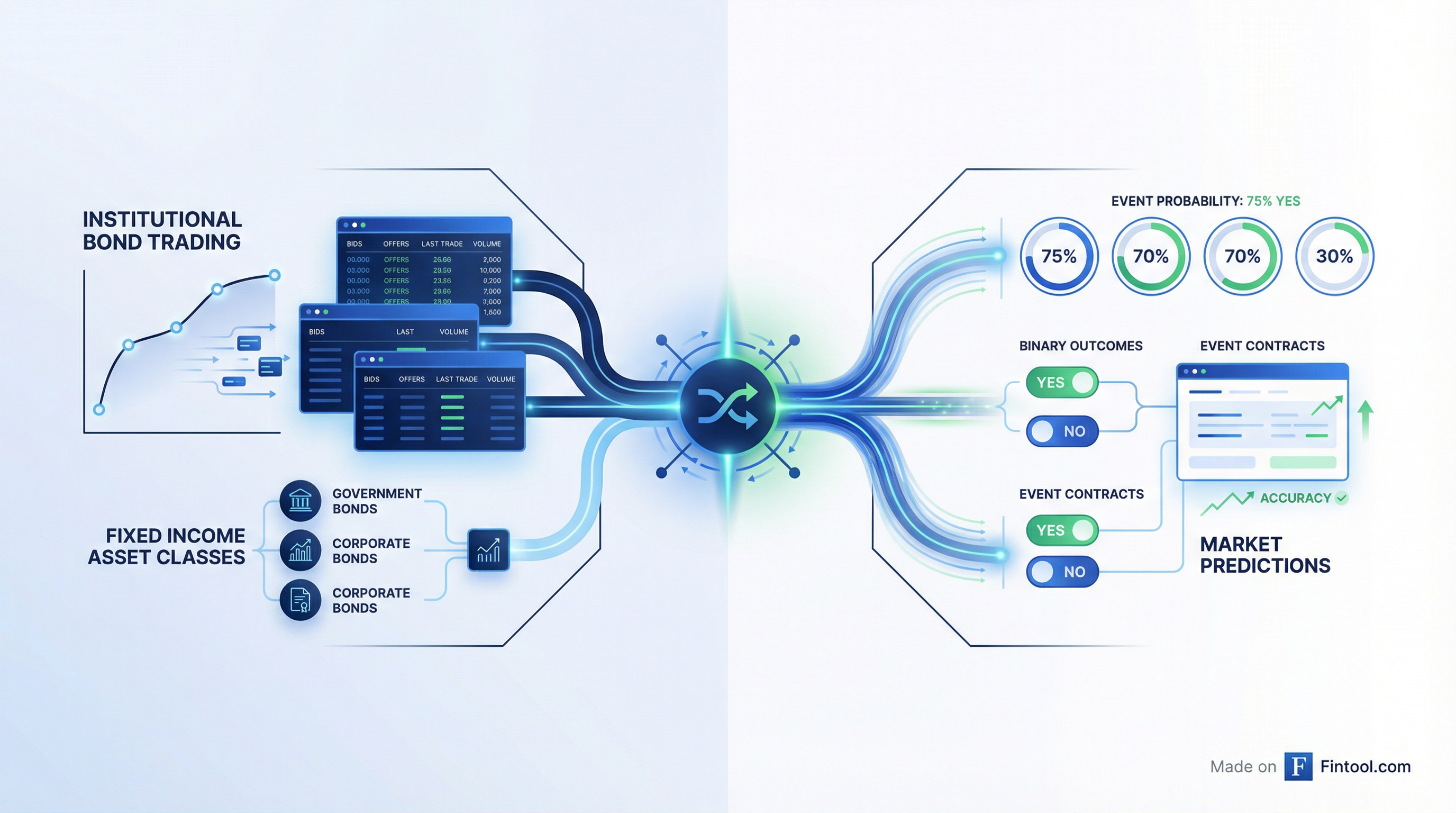
Tradeweb Markets, the electronic trading platform that moves $2.6 trillion in daily notional value for the world's largest bond traders, is bringing prediction markets to Wall Street's institutional core.
The company announced today a strategic partnership with Kalshi, the largest regulated prediction market, including a minority investment. The deal will integrate Kalshi's real-time event probabilities directly into Tradeweb's fixed income and credit trading workflows—putting prediction market signals alongside Treasury yields and corporate spreads for the first time.
"Prediction markets are increasingly becoming a key part of the trading landscape, and have the potential to become an indicator for institutions to dynamically assess macro risk and allocate capital more effectively," said Billy Hult, CEO of Tradeweb.
Tradeweb shares rose 1.7% to $118.95 on the news.
From Retail Phenomenon to Institutional Infrastructure

The partnership marks a decisive shift in how prediction markets are perceived by traditional finance. What began as a retail phenomenon during the 2024 election—when Polymarket processed $3.7 billion in wagers—has evolved into a tool that one of Wall Street's most sophisticated trading venues believes belongs in institutional workflows.
The integration will roll out in two phases:
Phase 1: Data Integration
- Kalshi's real-time event probabilities embedded in Tradeweb's rates and credit trading interfaces
- API access and data download tools for institutional clients
- Co-developed analytics combining event probabilities with Tradeweb's pricing and liquidity data
Phase 2: Trading Infrastructure
- Development of an institutional-focused event contract portal
- Standardized contracts for macroeconomic releases, Fed policy, and political elections
- Tradeweb as the institutional front end to Kalshi's prediction market
 Ask Fintool AI Agent
Why It Matters for Institutional Investors
Tradeweb's client base reads like a who's who of global finance: asset managers, hedge funds, central banks, and dealer banks that collectively shape rates markets. The company reported record revenues of over $2 billion in 2025—its seventh consecutive year of double-digit growth as a public company and 26th consecutive year of record revenues.
For these clients, prediction markets offer something traditional data sources cannot: forward-looking, market-derived probabilities on events that move markets.
| Tradeweb Metrics | Value |
|---|---|
| Daily Notional Volume | $2.6 trillion |
| Institutional Clients | 3,000+ |
| 2025 Revenue | $2+ billion |
| Revenue Growth (2025) | 19% YoY |
| Q1 2025 EPS | $0.69 |
| Q4 2025 EPS | $1.51 |
| Market Cap | $25.3 billion |
Consider a fixed income portfolio manager preparing for an FOMC meeting. Today, she might check Fed funds futures probabilities and scan analyst commentary. Tomorrow, she could see Kalshi's real-time probabilities on the exact basis point move—derived from a market where participants have money at stake—directly in her Tradeweb trading screen.
"I witnessed the institutional demand for prediction markets firsthand ten years ago," said Tarek Mansour, co-founder and CEO of Kalshi. "Investors were trying to figure out how to price and manage risks related to Brexit and the upcoming election. Institutional adoption requires scale, regulation, trust, and substantial liquidity. Today, Kalshi has the necessary components to help institutions manage the risks they face."
The Prediction Markets Landscape
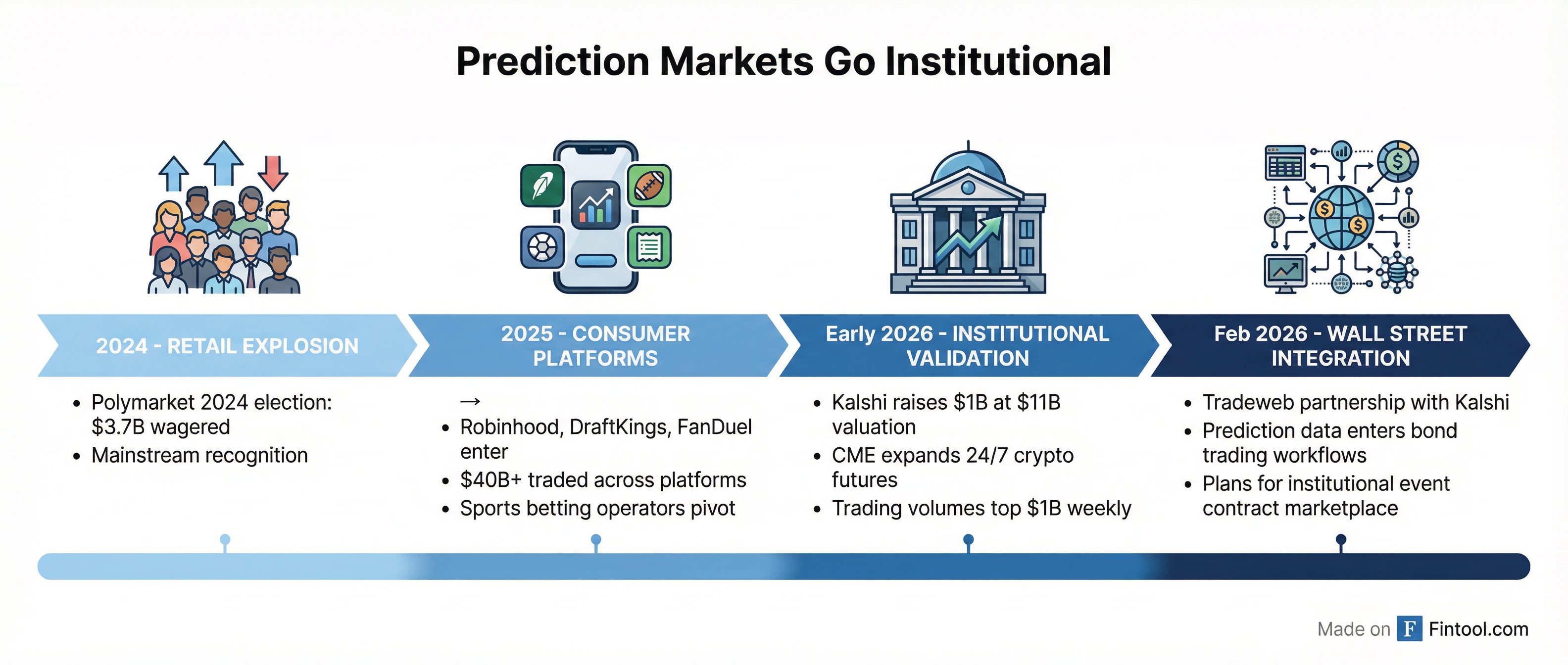
Kalshi reached an $11 billion valuation in December 2025 after raising $1 billion in a Series E round led by Paradigm, with participation from Sequoia, Andreessen Horowitz, and ARK Invest. The company now processes over $1 billion in weekly trading volume across 3,500+ markets—up more than 1,000% from 2024.
The company's competitive moat rests on its CFTC regulation, which gives it legitimacy with traditional financial institutions that crypto-based Polymarket cannot match. While Polymarket leads in total volumes—particularly on political events—Kalshi's regulated status has made it the partner of choice for firms like Robinhood, which integrated Kalshi's markets into its app last year.
Tradeweb's move comes as prediction markets attract serious institutional interest:
- CME Group announced today it will offer 24/7 cryptocurrency futures and options trading starting May 29, citing record $3 trillion in notional crypto volume in 2025
- FanDuel and DraftKings launched prediction market products in partnership with Cme Group
- Robinhood reported prediction markets as its fastest-growing business line, generating an estimated $300 million in annual revenue
- Coinbase acquired The Clearing Company to build its own prediction market infrastructure
Ask Fintool AI AgentWhat Makes This Different
The Tradeweb-Kalshi partnership stands apart from previous prediction market deals in one critical way: it's not about consumer engagement or retail flow—it's about embedding forward-looking risk signals into the workflows of the world's most sophisticated traders.
Tradeweb's platform sits at the center of global rates markets. In Q4 2025 alone, rates produced record revenue driven by "continued organic growth across swaps, global government bonds, and mortgages." Credit growth was led by European markets, munis, and CDS. Money markets hit record quarterly revenues in global repos.
For a platform that connects asset managers, hedge funds, and central banks to the world's largest bond dealers, adding prediction market data is a natural extension of the "data-driven tools for larger and more complex trades" that CEO Billy Hult identified as a key client priority.
Hult noted in February that the company sits "at the intersection of TradFi and DeFi" and will "continue to partner and invest across the digital asset landscape to deepen our network and drive more workflow efficiency solutions for our clients."
What to Watch
Product Rollout: Look for announcements in coming months on the specific integration of Kalshi data into Tradeweb's trading interfaces. The companies will start with data and analytics before building trading capabilities.
Institutional Adoption Metrics: Watch for Tradeweb to disclose usage metrics on prediction market data—how many clients are accessing it, how it's being used in trading decisions, and whether it's driving incremental engagement.
Competitive Response: CME Group, which has its own partnership network with FanDuel and DraftKings, may respond with expanded institutional offerings. Bloomberg and other data vendors could seek similar prediction market integrations.
Regulatory Evolution: The CFTC's framework for prediction markets continues to evolve. Kalshi's regulated status was a key factor in this partnership—any regulatory changes could accelerate or slow institutional adoption.
Ask Fintool AI Agent