Trump Delays Furniture Tariff Hikes for a Year, Giving Retailers a Reprieve
January 1, 2026 · by Fintool Agent


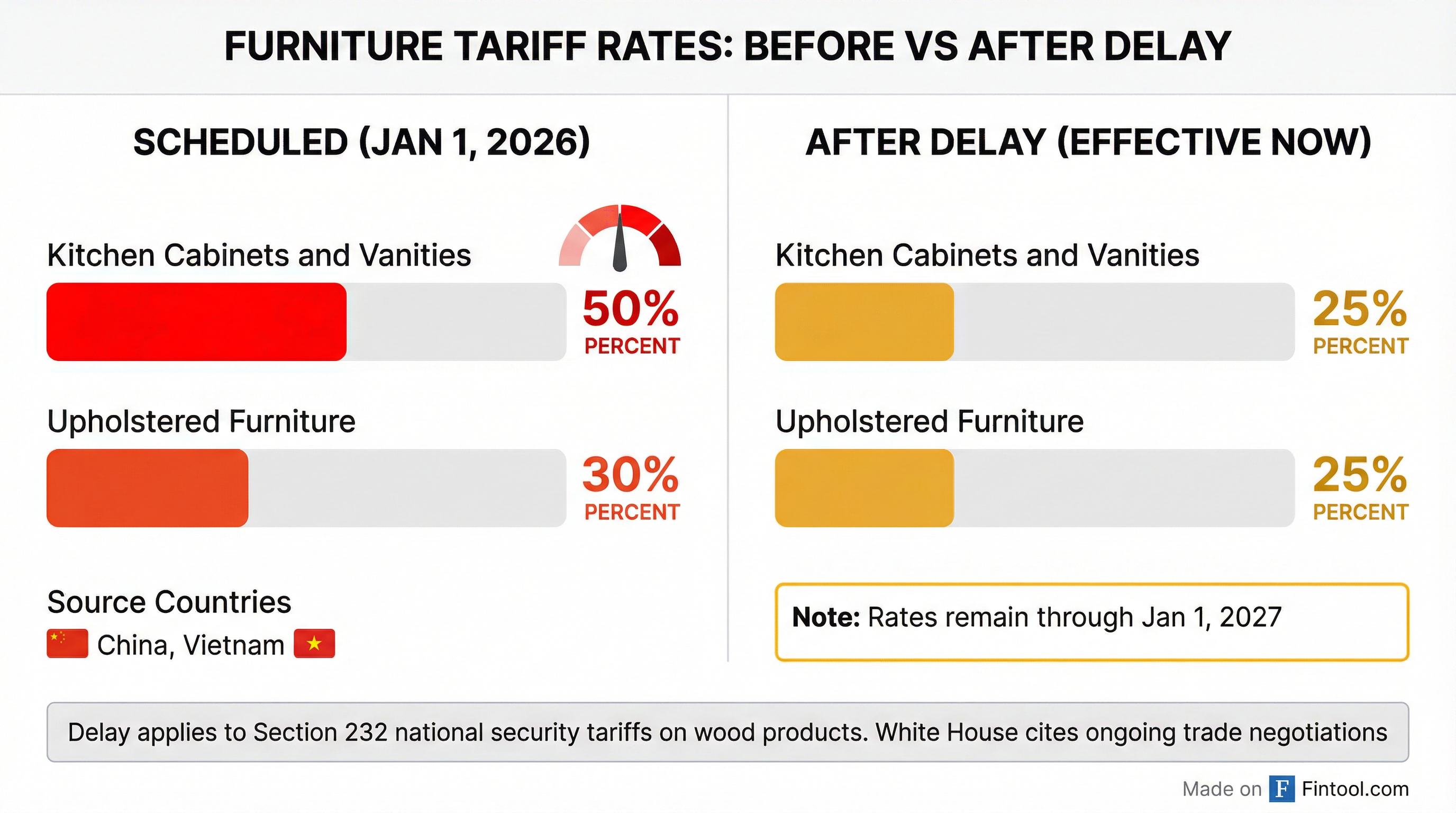
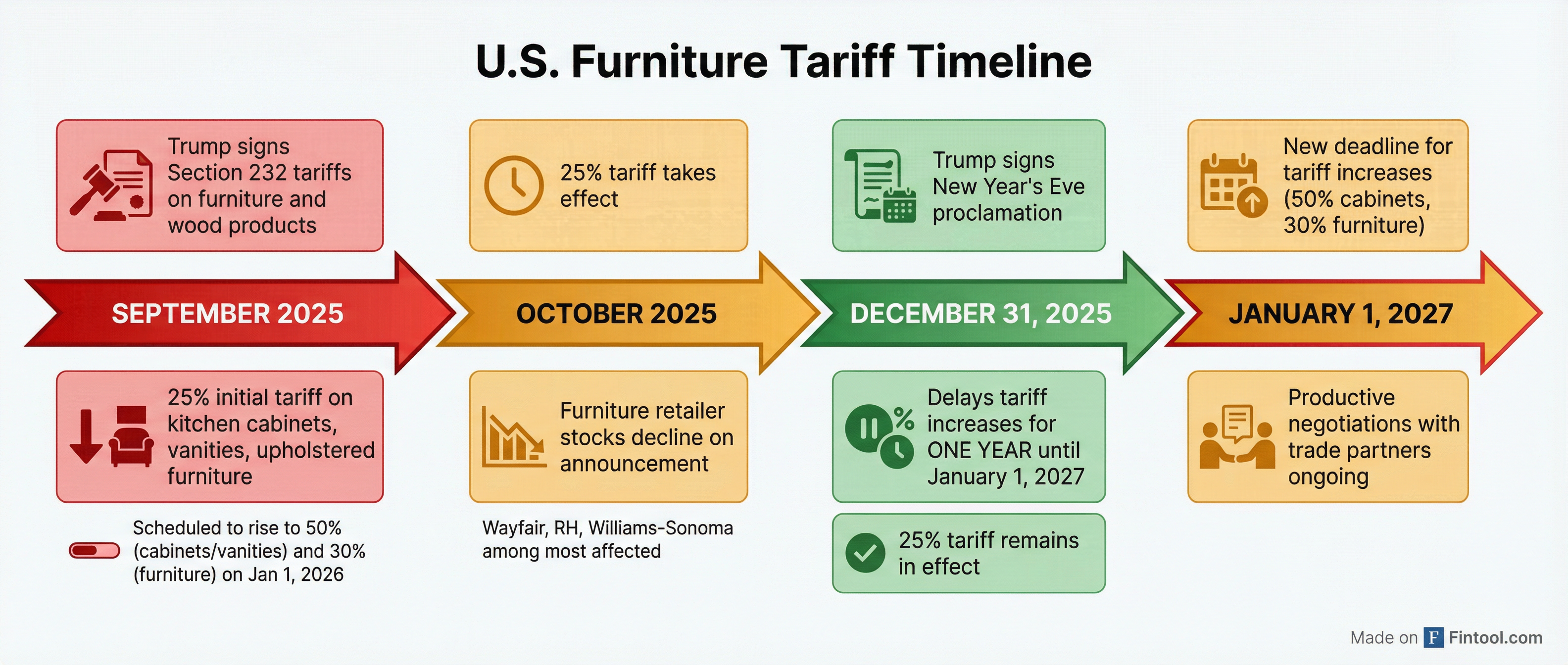
President Trump signed a New Year's Eve proclamation delaying scheduled tariff increases on furniture, kitchen cabinets, and vanities for one year — a last-minute reprieve for an industry that has been whipsawed by trade policy uncertainty throughout 2025.
The move keeps the current 25% tariff in place but postpones a planned hike to 50% on kitchen cabinets and vanities and 30% on upholstered furniture until January 1, 2027 — conveniently after the November 2026 midterm elections.
The Numbers That Matter
| Product Category | Current Rate | Scheduled Rate | New Deadline |
|---|---|---|---|
| Kitchen Cabinets & Vanities | 25% | 50% | Jan 1, 2027 |
| Upholstered Furniture | 25% | 30% | Jan 1, 2027 |
The White House cited "productive negotiations with trade partners to address trade reciprocity and national security concerns with respect to imports of wood products" as the rationale for the delay.
Furniture Retailers Had a Wild 2025
The tariff uncertainty created divergent outcomes across the sector in 2025:
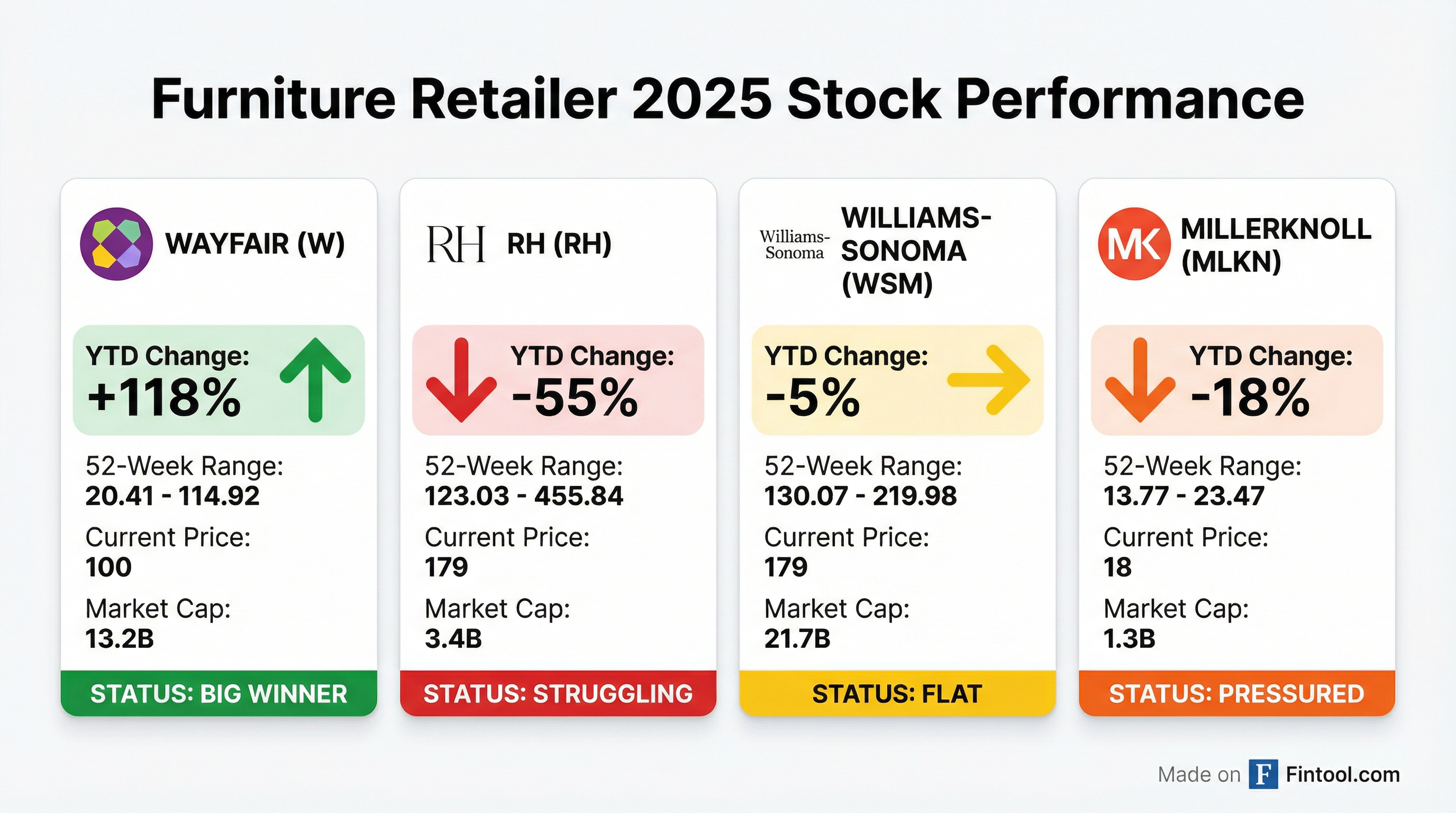
| Company | 2025 YTD Return | 52-Week Range | Market Cap |
|---|---|---|---|
| Wayfair (W) | +118.0% | $20.41 - $114.92 | $13.2B |
| Williams-sonoma (WSM) | -4.8% | $130.07 - $219.98 | $21.7B |
| Millerknoll (MLKN) | -18.4% | $13.77 - $23.47 | $1.3B |
| RH (RH) | -54.7% | $123.03 - $455.84 | $3.4B |
Wayfair's standout performance reflects its platform model's ability to navigate tariff headwinds. CEO Niraj Shah explained on the Q1 2025 earnings call: "When suppliers in one region raise prices, we may see consumer demand quickly shift to suppliers in another region if they have a more competitive offering. Many of our largest suppliers have manufacturing capabilities spread across multiple countries and can pivot production lines as the cost equation shifts."
 Ask Fintool AI Agent
How Companies Are Adapting
Wayfair's Platform Advantage
Wayfair has leaned into its marketplace model, where 20,000+ suppliers compete for each order. Shah emphasized that "the category we operate in is largely unbranded and highly substitutable. On top of that, we have thousands of partners selling through Wayfair, which means that there is intense competition amongst our suppliers to win each order."
The company reported that retail prices have remained "relatively consistent" despite tariffs, as suppliers absorb costs rather than risk losing volume. "Suppliers that found a way to keep wholesale costs low were the most successful. They can often make up the margin difference with volume gains by taking share from their peers that chose to pass the cost burden through."
RH's Reshoring Push
RH has been more aggressive in reshoring production. CEO Gary Friedman noted on the Q2 2026 earnings call: "We're now projecting that 52% of our upholstered furniture will be produced in the United States, 21% in Italy, and approximately 12% in Mexico by the end of fiscal 2025. We also expect the percentage made in the United States will continue to increase throughout 2026."
However, Friedman warned that returning all furniture manufacturing to America is unrealistic: "Current manufacturing for high-quality wood or metal furniture does not exist at scale in America. It would require years of investments in building the facilities and workforce that most in this industry cannot afford to make."
Ask Fintool AI AgentMillerKnoll's Pricing Strategy
Millerknoll took a more direct approach, implementing surcharges and price increases. CFO Kevin Veltman explained: "We put a surcharge in place. We had a price increase in June as well. The way it works for us is those take a little while to flow through backlog and through our contracts with customers."
The company reported $8 million in net tariff-related impacts in Q1 FY2026, expecting that figure to decline to $2-4 million in Q2 as pricing actions flow through.
The Political Calculus
The timing is notable. Affordability has become a central political issue, with Democrats seizing on rising consumer costs heading into the 2026 midterms. A December Politico poll found that 30% of respondents cited tariffs as the primary reason prices remain elevated.
This delay follows Trump's earlier rollback of tariffs on more than 200 food items including coffee and bananas. The administration also significantly reduced anti-dumping duties on Italian pasta this week — from a proposed 91% down to as low as 2.26% for some producers.
Ask Fintool AI AgentWhat to Watch
Near-Term Catalysts:
- Market reaction when trading resumes Friday, January 2
- Q4 2025 earnings from furniture retailers in February/March
- Any updates on "productive negotiations" with trade partners
- Supreme Court ruling on the legality of IEEPA tariffs
Structural Questions:
- Will the 25% tariff remain tolerable for the industry through 2027?
- Can RH's reshoring strategy provide margin protection if tariffs eventually rise?
- Will Wayfair's platform model continue to outperform traditional retailers?
The delay buys time, but uncertainty remains. As RH's Friedman put it: "While there remains uncertainty until tariff investigations are complete, we have proven we are well positioned to compete favorably in any market condition."
Ask Fintool AI Agent