UAE 'Spy Sheikh' Secretly Bought 49% of Trump's Crypto Company Before Inauguration
February 1, 2026 · by Fintool Agent
Four days before Donald Trump took the oath of office for his second term, his family's cryptocurrency company received a $500 million lifeline from one of the world's most powerful intelligence figures—a transaction that was never disclosed and has now emerged as the most significant foreign investment in a sitting president's business in American history.
Sheikh Tahnoon bin Zayed Al Nahyan, the UAE's national security adviser and brother to the country's president, acquired a 49% stake in World Liberty Financial through his Abu Dhabi investment vehicle Aryam Investment 1, according to a Wall Street Journal investigation published Saturday. The deal made Tahnoon's entity the largest shareholder in the Trump family's crypto venture—and set the stage for a series of policy decisions that would benefit the UAE within months.
 Ask Fintool AI Agent
The Deal Structure
The transaction, which World Liberty spokesperson David Wachsman confirmed to the New York Times on Sunday, reveals an intricate web of payments flowing to Trump insiders at a pivotal moment in American political history.
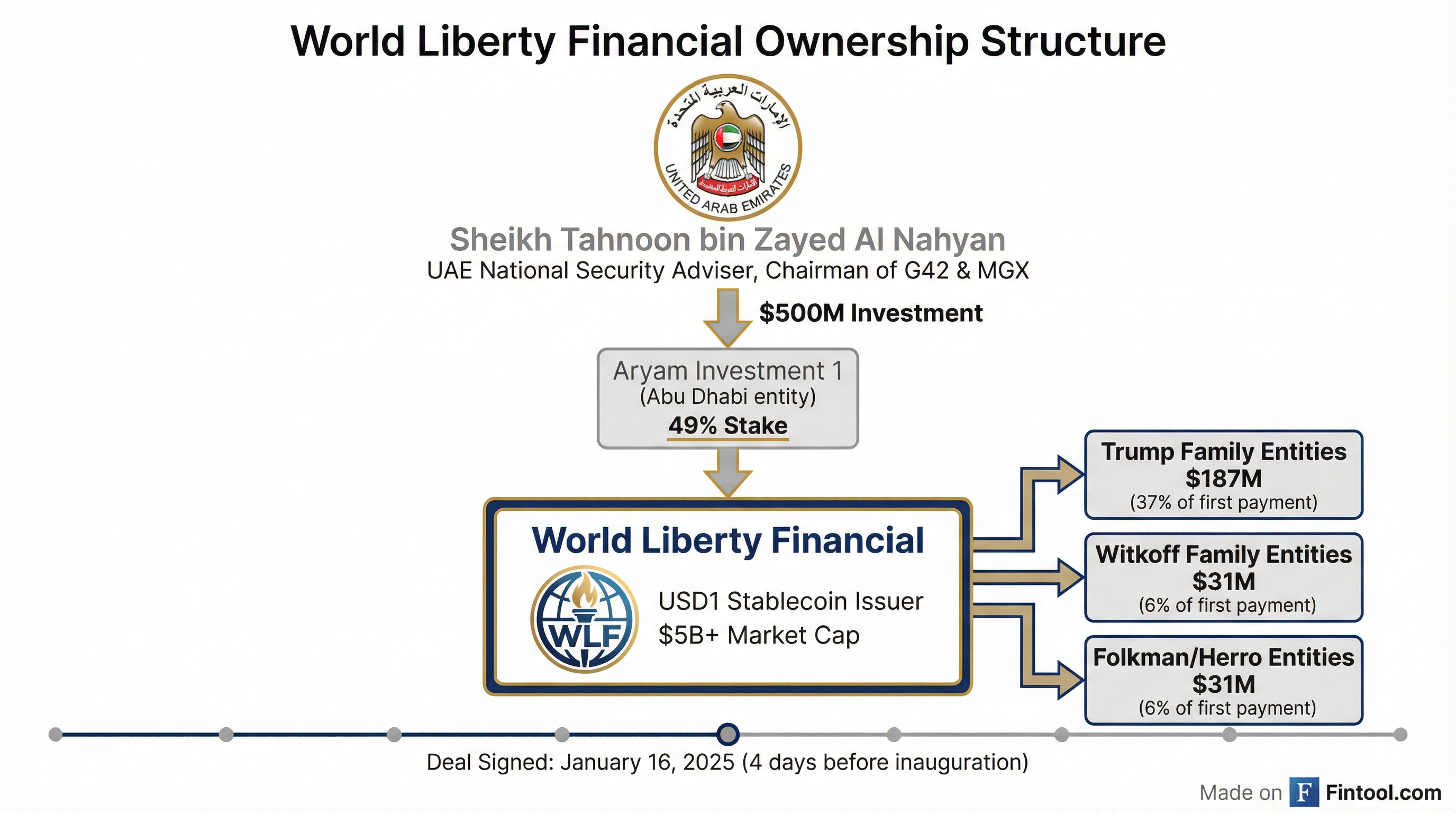
Of the $500 million total, half was paid upfront:
| Recipient | Amount | Share of Payment |
|---|---|---|
| Trump Family Entities | $187 million | 37.4% |
| Witkoff Family Entities | $31 million | 6.2% |
| Folkman/Herro Entities | $31 million | 6.2% |
| Other/Escrow | $1 million | 0.2% |
| Total First Installment | $250 million | 50% |
Eric Trump, the president's middle son, signed the agreement on behalf of World Liberty Financial. Steve Witkoff, a co-founder of World Liberty and Trump's special envoy to the Middle East, had entities receiving payments from the deal while simultaneously conducting diplomacy with the UAE on behalf of the United States.
From Crypto Investment to AI Chips
What makes the transaction particularly consequential is what happened in the months that followed.
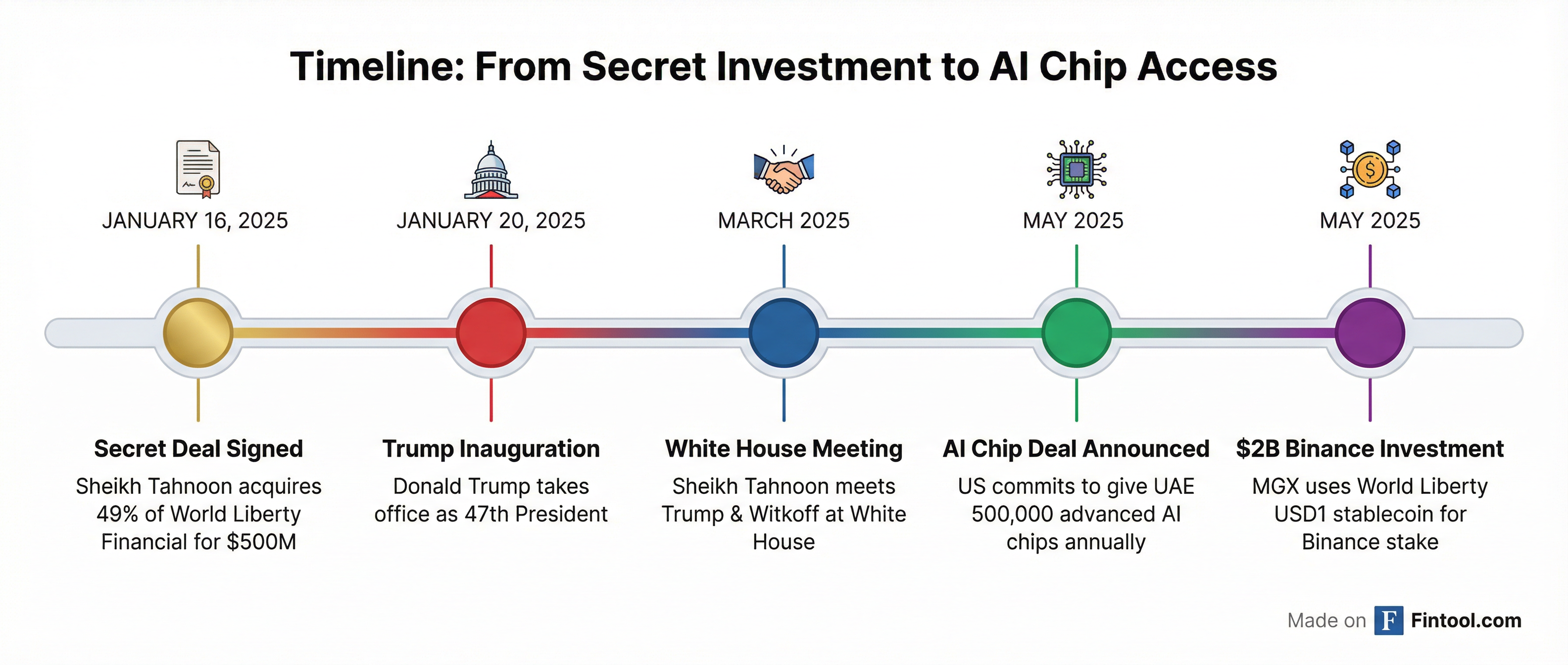
In March 2025, just weeks after taking office, Sheikh Tahnoon visited the White House for meetings with President Trump and Steve Witkoff. Within two months, the Trump administration announced a landmark agreement: the US would commit to providing the UAE with access to 500,000 of America's most advanced AI chips annually—enough to build one of the world's largest AI data center clusters.
The Biden administration had explicitly blocked such access, citing concerns that the technology could be diverted to China through UAE intermediaries.
Sheikh Tahnoon, known in intelligence circles as the "Spy Sheikh," chairs both G42 and MGX—the UAE's sovereign AI and investment vehicles that would be primary beneficiaries of the chip access. Microsoft has since announced a $15.2 billion investment in UAE AI infrastructure through G42, enabled by the new chip export approvals.
Ask Fintool AI AgentThe Binance Connection
The intertwining of Trump family crypto interests and UAE policy decisions deepened further in May 2025, when MGX—Sheikh Tahnoon's investment arm—announced a $2 billion investment in cryptocurrency exchange Binance.
The transaction was settled using World Liberty Financial's USD1 stablecoin, providing massive transaction volume and credibility to the Trump family's crypto product. At the time, there was no disclosure that MGX affiliates owned nearly half of World Liberty itself.
In October 2025, President Trump issued a pardon to Binance founder Changpeng Zhao, who had pleaded guilty to violating anti-money-laundering rules and was banned from operating in the US. Zhao, who obtained UAE citizenship and is close to Sheikh Tahnoon and the Abu Dhabi royal family, was subsequently able to resume activities in the American market.
World Liberty's Rise
The UAE investment came at a critical moment for World Liberty Financial, which had launched its WLFI token sale in late 2024 but had no functioning products when the deal was signed.
Since then, the company's USD1 stablecoin has grown dramatically:
| Metric | Current Status |
|---|---|
| USD1 Market Cap | $5+ billion |
| Stablecoin Ranking | 5th largest globally |
| Launch Date | March 2025 |
| Reserves Custodian | BitGo Trust |
The stablecoin, backed by US Treasury bills and dollar deposits, has become one of the most successful crypto launches in history—though critics note that much of its growth has come through offshore programs and the UAE connection.
World Liberty is now seeking a US banking charter that would allow it to issue and safeguard USD1 directly, potentially making the Trump family's crypto interests a permanent fixture in American financial infrastructure.
Ask Fintool AI AgentEthics Concerns Mount
Legal experts say the transaction raises profound questions about foreign influence on American policy.
"This looks like a bribe," Kathleen Clark, a law professor and former ethics lawyer for Washington DC, told the Wall Street Journal. "This should be a five-alarm fire about the federal government being for sale."
Even former Trump administration officials expressed concern. "It's like complaining about kayaks when B52s are flying overhead," said Ty Cobb, who served as a top White House lawyer in Trump's first term. "My advice as an ethics lawyer would have been clear: You don't do business deals with the families of the leaders of foreign countries. It taints American foreign policy."
A White House spokesperson told the Journal that Trump's assets are in a trust managed by his children and that "there are no conflicts of interest."
World Liberty spokesperson David Wachsman maintained that "neither President Trump nor Steve Witkoff had any involvement whatsoever in this transaction and have had no involvement in World Liberty Financial since taking office."
What to Watch
The revelation comes at a critical moment for crypto legislation in Washington. The GENIUS Act, which established a federal regulatory framework for stablecoins, passed in 2025 and has enabled the industry's explosive growth.
Democrats are now pushing for ethics clauses in pending crypto market infrastructure legislation that would restrict sitting officials from holding financial interests in regulated crypto entities. The UAE revelation will likely intensify those efforts.
For investors, the key questions are:
- Regulatory risk: Will Congress impose restrictions on crypto ventures with political ties?
- USD1 stability: Does the foreign ownership structure create risks for the stablecoin's dollar peg?
- AI policy: Will scrutiny of the UAE-Trump connection affect chip export approvals for Gulf states?
- Banking charter: Will World Liberty's banking charter application face enhanced scrutiny?
The story also raises broader questions about the intersection of cryptocurrency, foreign capital, and American political power—questions that will likely dominate Washington's crypto policy debates for months to come.
Related Company Profiles:
- Microsoft-0.74% - $15.2B UAE AI investment through G42
- Nvidia-0.72% - Supplies advanced AI chips to UAE data centers