Uber Ordered to Pay $8.5 Million in First Federal Sexual Assault Bellwether Trial
February 5, 2026 · by Fintool Agent


A federal jury in Phoenix ordered Uber to pay $8.5 million to a woman who alleged she was raped by her driver, the first verdict in a federal bellwether trial that could reshape the trajectory of more than 3,000 similar lawsuits against the ride-hailing giant.
The verdict carries outsized significance for Uber investors: bellwether trials are designed to test legal theories and establish benchmarks for potential mass settlement negotiations. With nearly 3,700 plaintiffs across 30 states joined in the federal multidistrict litigation, the $8.5 million award—while far below the $140 million sought by plaintiff's attorneys—provides the first federal data point for valuing thousands of pending claims.
Uber shares fell 0.5% in after-hours trading following the verdict, with the stock closing at $75.21 on the regular session. Rival LYFT, which faces its own slate of sexual assault lawsuits though not in coordinated federal litigation, dropped 2% on the day to $15.84.
The Verdict: Agency, Not Negligence
The nine-person jury reached a nuanced verdict that both sides claimed as partial victory:
What the jury found:
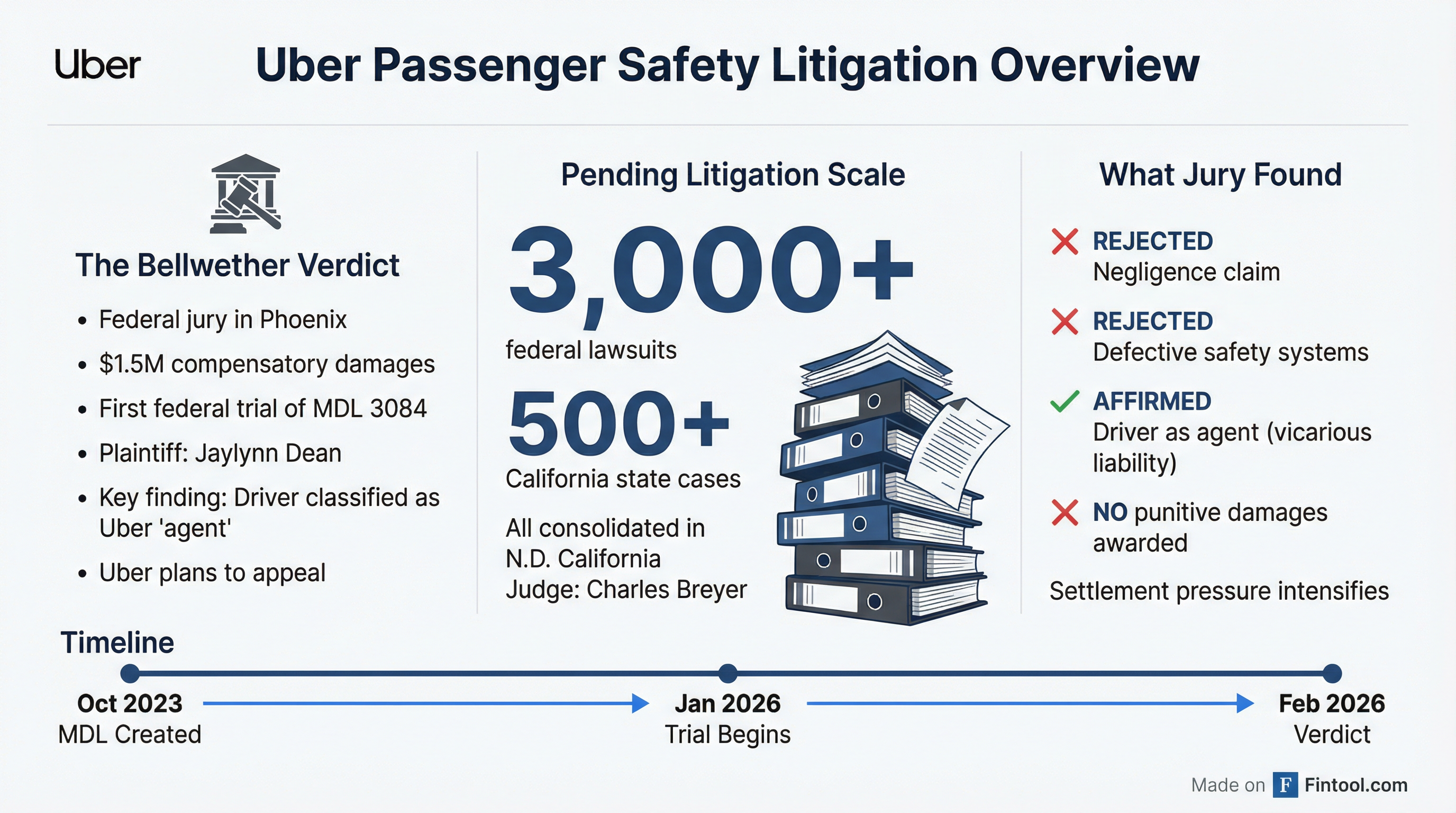
- The driver was an "agent" of Uber, making the company vicariously liable for his actions
- $8.5 million in compensatory damages awarded
What the jury rejected:
- Uber was negligent in rider safety
- Uber's safety systems were defective
- Punitive damages
The agency finding is legally significant. Uber has long argued that drivers are independent contractors—not employees or agents—shielding the company from direct liability for driver misconduct. This verdict undercuts that defense in the federal MDL context.
"This verdict validates the thousands of survivors who have come forward at great personal risk to demand accountability against Uber for its focus on profit over passenger safety," said Sarah London, an attorney for plaintiff Jaylynn Dean.
Uber emphasized the jury's rejection of negligence claims: "This verdict affirms that Uber acted responsibly and has invested meaningfully in rider safety," a company spokesperson said, adding that Uber plans to appeal.
The Case: Jaylynn Dean v. Uber
The plaintiff, an Oklahoma resident, alleged she was intoxicated when she hired an Uber driver to take her from her boyfriend's home to her hotel in Arizona in November 2023. The driver asked harassing questions during the ride before stopping the car and raping her, according to the lawsuit.
During closing arguments, plaintiff's attorney Alexandra Walsh argued that Uber had marketed itself as a safe option for women traveling at night—particularly if they had been drinking—despite internal data allegedly showing that demographic faced elevated assault risk.
"Women know it's a dangerous world. We know about the risk of sexual assault," Walsh told the jury. "They made us believe that this was a place that was safe from that."
 Ask Fintool AI Agent
Litigation Scale: 3,000+ Cases Pending
The Dean case serves as the first bellwether in a federal multidistrict litigation (MDL No. 3084) that consolidates thousands of sexual assault claims against Uber:
| Litigation | Cases | Status |
|---|---|---|
| Federal MDL (N.D. Cal.) | 3,000+ | Bellwether complete |
| California State Court | 500+ | One trial in Sep 2025 (Uber won) |
| Total Plaintiffs | 3,700 | Across 30 states |
The cases are consolidated before U.S. District Judge Charles Breyer in San Francisco, who oversaw the Phoenix trial. Bellwether trials help gauge claim values and drive settlement discussions—or, if no global resolution is reached, cases are remanded to home-state courts for individual trials.
Uber had previously won the only California state case to go to trial in September 2025. That jury found Uber had been negligent with safety measures but that the negligence was not a "substantial factor" in causing the plaintiff's harm. The mixed results across venues will complicate settlement calculations.
What Uber Has Disclosed
Uber has consistently flagged driver misconduct and sexual assault allegations as material risks in SEC filings. From the company's most recent 10-K:
"There have been numerous incidents and allegations worldwide of Drivers, or individuals impersonating Drivers, sexually assaulting, abusing, kidnapping and/or fatally injuring consumers, or otherwise engaging in criminal activity while using our platform or claiming to use our platform."
The company acknowledges that while it administers background checks through third-party providers, these "may not expose all potentially relevant information" and are "limited in certain jurisdictions according to national and local laws."
Uber has also warned investors that "public reporting or disclosure of reported safety information... may adversely impact our business and financial results."
Financial Context
Uber enters this litigation from a position of financial strength:
| Metric | FY 2023 | FY 2024 | FY 2025 |
|---|---|---|---|
| Revenue | $37.3B | $44.0B | $52.0B |
| Net Income | $1.9B | $9.9B | $10.1B |
| EBITDA | $1.9B | $3.5B | $6.3B |
| Cash Position | $4.7B | $5.9B | $7.1B |
With $7.1 billion in cash and FY 2025 net income of $10 billion, Uber has the balance sheet capacity to absorb significant litigation costs. A hypothetical $8.5 million average across 3,000 cases would imply roughly $25.5 billion in potential liability—though actual settlements typically resolve below bellwether verdicts, and the jury's rejection of punitive damages and negligence claims provides Uber significant negotiating leverage.
Ask Fintool AI AgentImplications for Lyft
LYFT faces similar sexual assault lawsuits in both state and federal court, though there is no coordinated federal litigation for those claims. The Uber verdict could influence settlement expectations for Lyft plaintiffs as well.
Lyft shares fell 2% on Thursday, closing at $15.84, and dropped an additional 1% in after-hours trading following the verdict. The smaller rideshare company trades at a $6.3 billion market cap versus Uber's $156 billion—meaning equivalent per-claim exposure would represent a proportionally larger financial burden for Lyft.
What to Watch
Near-term catalysts:
- Uber's appeal — The company plans to challenge the verdict, which could take 12-18 months to resolve
- Additional bellwether trials — More test cases are likely before any global settlement discussions
- Settlement negotiations — The mixed verdict (agency liability but no negligence) creates leverage for both sides
Longer-term questions:
- Will this verdict accelerate mandatory in-car cameras or fingerprint background checks?
- Does Congress take action on rideshare safety regulations?
- How do insurance markets respond to explicit vicarious liability exposure?
The gig economy's liability architecture has long rested on the independent contractor classification. This verdict suggests federal juries may look past that structure to find agency relationships—a precedent that could extend beyond Uber to the broader platform economy.
Ask Fintool AI Agent