Versant Media Tumbles 15% in Debut as Comcast Sheds Declining Cable Empire
January 5, 2026 · by Fintool Agent


Versant Media Group crashed as much as 15% on its first day of trading, a brutal welcome for the newly independent cable television company spun off from Comcast. Shares that had traded on a "when-issued" basis at $55 in December plunged to $40.78 by mid-morning Monday, giving the media spinoff a market value of just $5.94 billion—a harsh verdict from investors skeptical that legacy cable networks can survive the streaming era.
The separation marks the end of an era. Comcast is officially exiting the cable network business it helped build, retaining only the Bravo channel while sending iconic brands including CNBC, MS NOW (formerly MSNBC), USA Network, and SYFY into independent life. The strategic logic is clear: as streaming reshapes entertainment, Comcast wants to focus on its growth engines—Peacock streaming, Universal Studios, theme parks, and connectivity services—rather than defend declining linear TV.
The Deal Structure
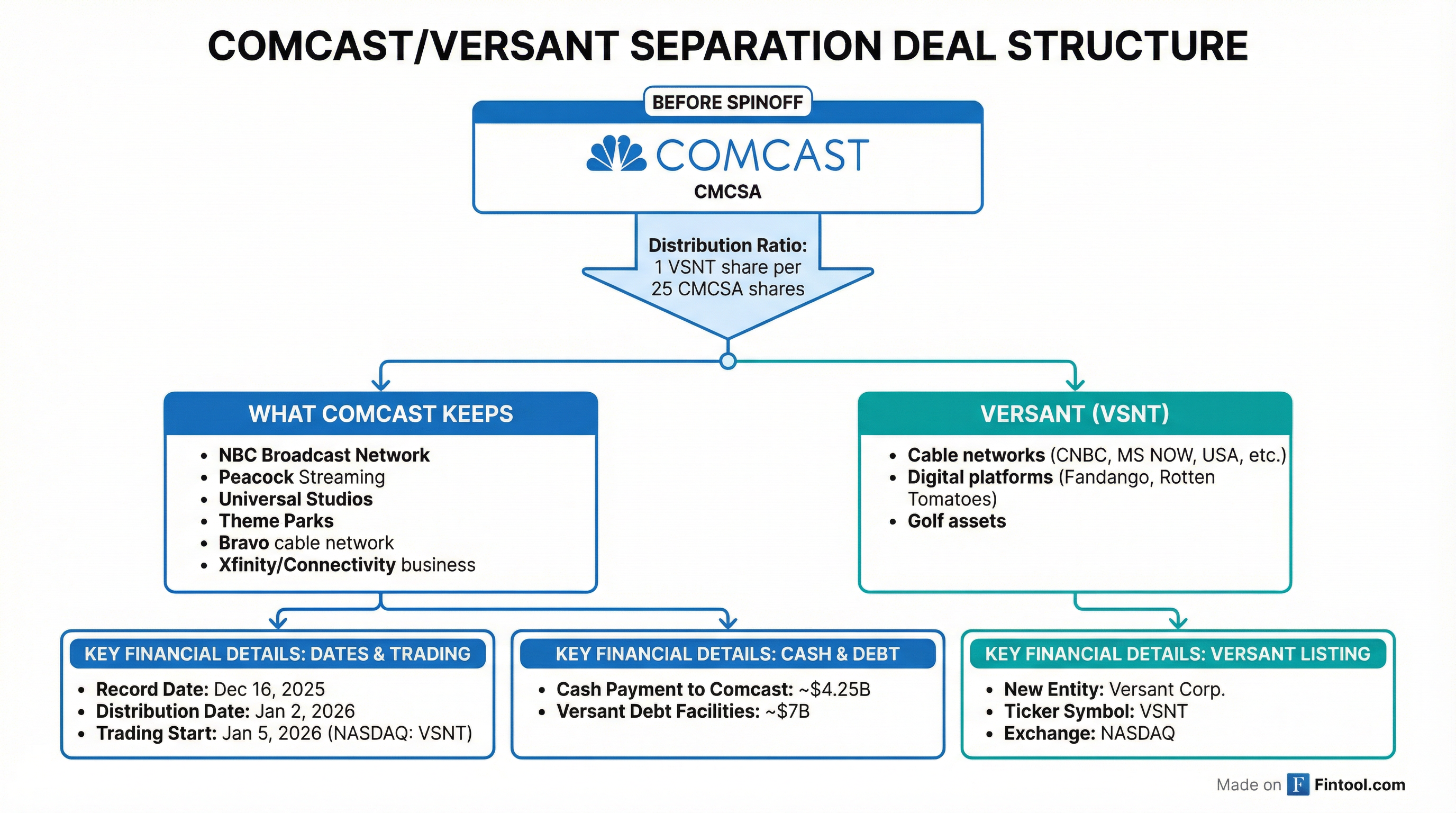
Comcast completed the tax-free spinoff effective 11:59 p.m. Eastern Time on January 2, 2026, distributing shares to its stockholders the following day.
Distribution mechanics:
- Comcast shareholders received one Versant share for every 25 Comcast shares held as of the December 16, 2025 record date
- Fractional shares were aggregated and sold in the open market, with proceeds distributed to holders
- Versant trades on Nasdaq under ticker VSNT
- Goldman Sachs, Morgan Stanley, and PJT Partners advised Comcast; Davis Polk provided legal counsel
Versant's capital structure:
- $1.0 billion Term A loan facility due January 2031
- $1.0 billion Term B loan facility due January 2031
- $750 million revolving credit facility (undrawn at separation)
- $1.0 billion in 7.25% senior secured notes due January 2031
- ~$2.25 billion cash payment made to Comcast at separation
 Ask Fintool AI Agent
What Versant Owns
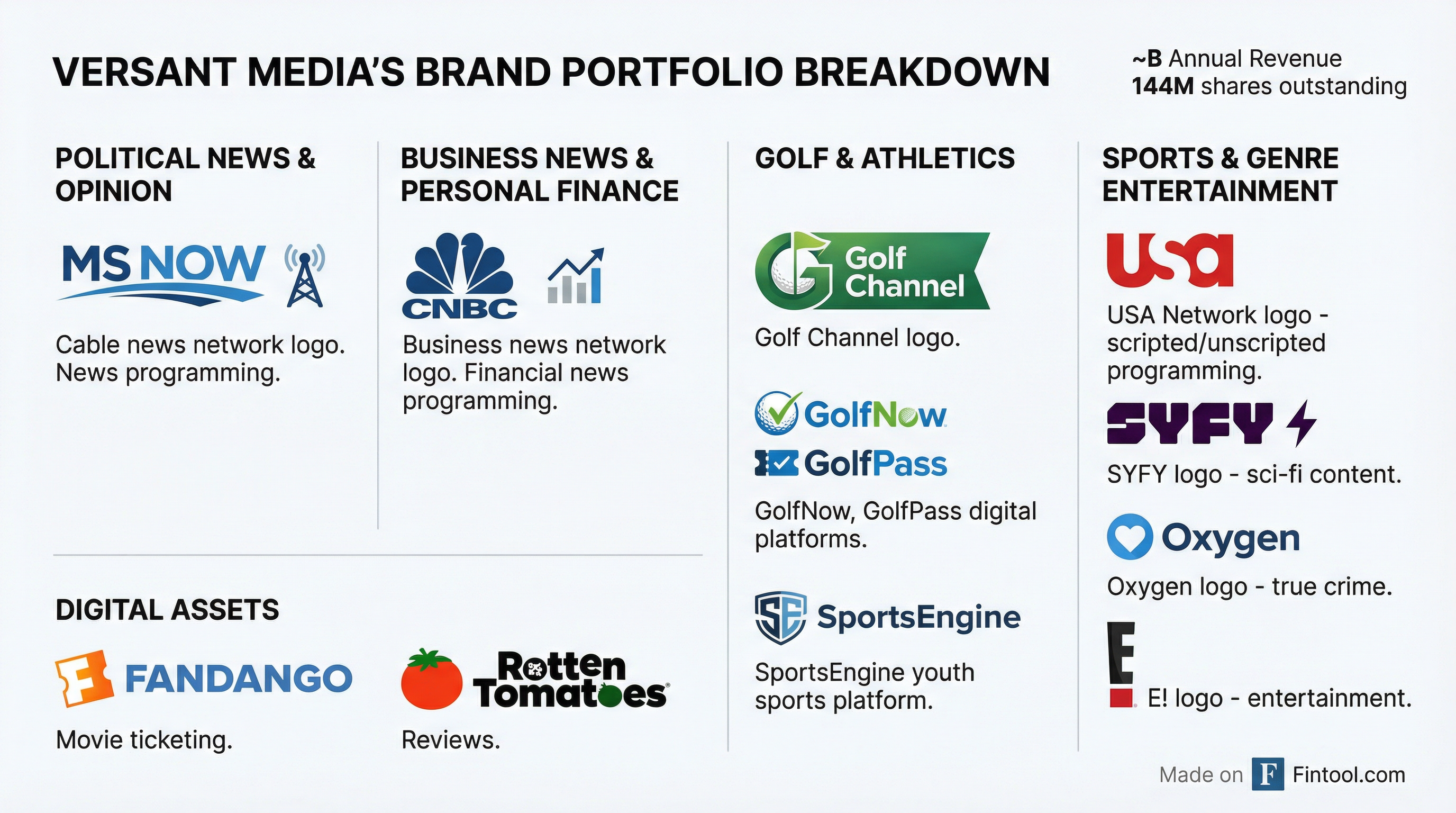
Versant emerges as a diversified media company operating across four distinct markets—but every one of them faces structural headwinds.
| Segment | Key Brands | Description |
|---|---|---|
| Political News & Opinion | MS NOW (formerly MSNBC) | Cable news programming |
| Business News & Finance | CNBC | Financial news and markets coverage |
| Golf & Athletics | Golf Channel, GolfNow, GolfPass, SportsEngine | Golf broadcasting and digital platforms |
| Sports & Genre Entertainment | USA Network, SYFY, Oxygen, E! | Scripted/unscripted programming |
| Digital Assets | Fandango, Rotten Tomatoes | Movie ticketing and reviews |
The portfolio generates approximately $7 billion in annual revenue—but that figure has been declining. According to SEC filings, Versant's assets generated over $7 billion in 2024, down from previous years.
Leadership and Strategy
Mark Lazarus, a veteran NBCUniversal executive, takes the helm as CEO. Anand Kini serves as operating and finance chief.
"With a strong balance sheet, substantial cash flow, and clear capital allocation framework, we are well positioned to execute with discipline to drive long-term value." — Anand Kini, Operating and Finance Chief
"Today marks a defining moment as VERSANT becomes an independent, publicly traded media company. As a standalone company, we enter the market with the scale, strategy and leadership to grow and evolve our business model." — Mark Lazarus, CEO
Management is pitching transformation—evolving a portfolio built for the cable bundle era into something sustainable for the streaming age. The question investors answered with a 15% selloff: Can they actually do it?
Ask Fintool AI AgentThe Cable TV Reckoning
The market's skepticism reflects the brutal reality facing linear television. Versant inherits an industry in the ninth consecutive year of subscription decline.
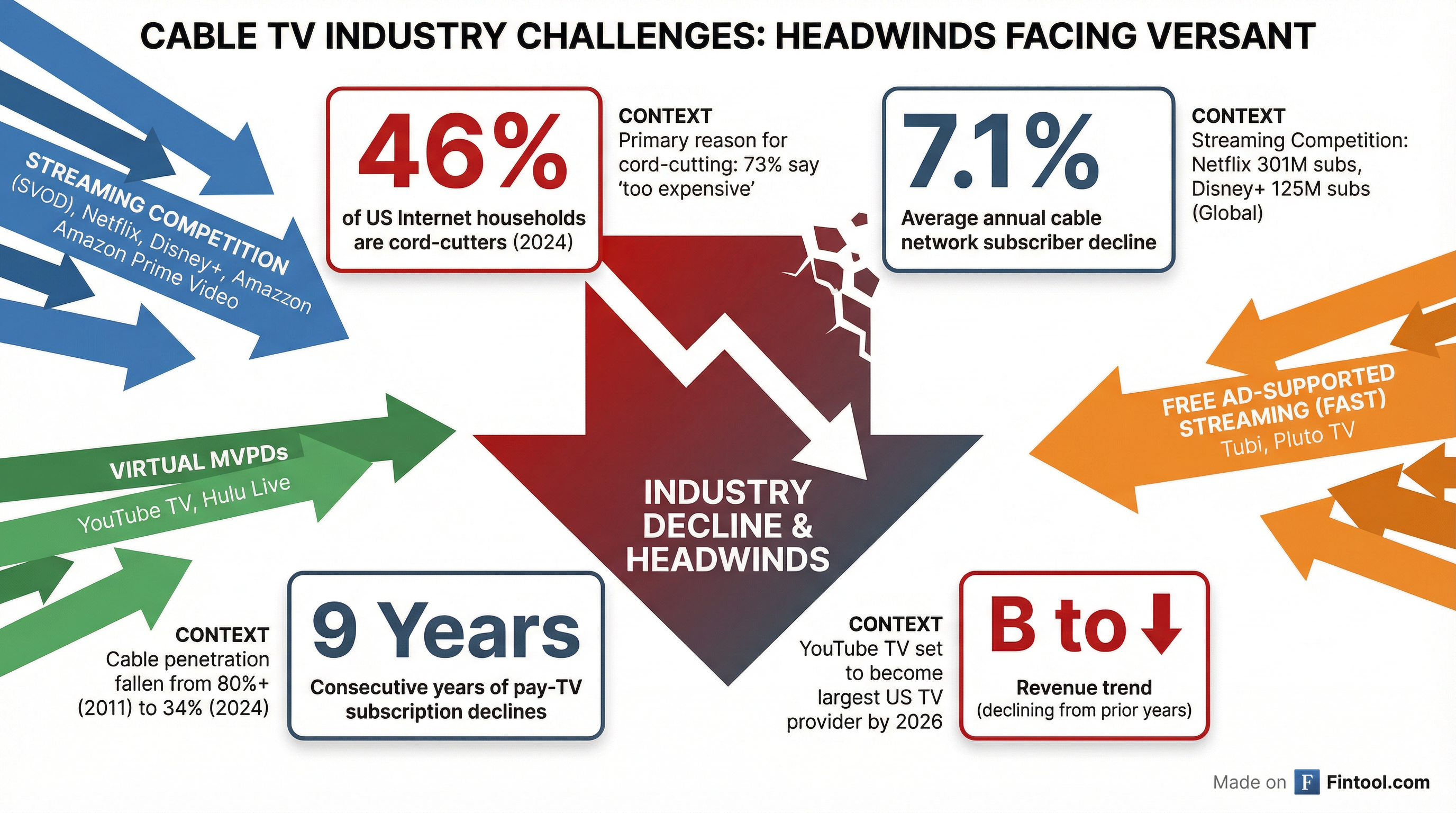
The numbers paint a stark picture:
| Metric | Value | Trend |
|---|---|---|
| US Cord-Cutting Households | 56 million (46% of internet households) | Rising |
| Average Cable Network Subscriber Decline | 7.1% annually | Accelerating |
| Pay-TV Penetration | Down from 80%+ (2011) to 34.4% (2024) | Collapsing |
| Cable Ad Revenue (2024) | $20.2 billion | Lowest since 2007 |
S&P Global declared in late 2025 that cable television has officially entered the "decline stage"—though analysts emphasized this forecasts a "long, slow bleedout rather than a precipitous fall."
The economics are punishing. Among the 190 cable networks S&P analyzed, only 36 retain over 60 million subscribers, while 49 have fallen below 10 million—a distribution that suggests many networks face relegation to expensive tiers or outright closure.
Ask Fintool AI AgentWhy Comcast Let Go
For Comcast, the spinoff is strategic housekeeping. Management has been explicit: the company wants to focus capital and attention on growth businesses.
"As you fast forward a couple of years, between continued investment in sustaining strong growth in these businesses and actions we are taking on other areas, including our announced spin off of our linear cable networks into Versant... our exposure to these growth areas will be closer to 70% of our total revenue, which is fundamental to our path to reaccelerating total company revenue growth." — Jason Armstrong, CFO, Q2 2025 Earnings Call
Comcast's core growth drivers now include:
- Broadband: Despite competitive pressure from fiber and fixed wireless, remains the cash engine
- Wireless: Xfinity Mobile hit 8.5 million lines with 14% broadband customer penetration
- Peacock Streaming: Kept under the NBC umbrella along with broadcast network and Bravo
- Theme Parks: Universal Destinations continues expansion
- Studios: Universal film and TV production
| Comcast Metric | Q4 2024 | Q1 2025 | Q2 2025 | Q3 2025 |
|---|---|---|---|---|
| Revenue ($B) | $31.9 | $29.9 | $30.3 | $31.2 |
| EBITDA Margin % | 27.7% | 31.9% | 33.5% | 30.6% |
| Net Income ($B) | $4.8 | $3.4 | $11.1* | $3.3 |
*Q2 2025 net income includes one-time gains
Ask Fintool AI AgentWhat to Watch
Near-term catalysts:
- Q4 2025 / Q1 2026 earnings: First glimpse of Versant as a standalone entity
- Strategic announcements: Will Versant pursue M&A, partnerships, or cost restructuring?
- Affiliate negotiations: How much leverage do these cable networks have with distributors?
- Digital transformation: Can Fandango and Rotten Tomatoes become bigger businesses?
Key risks:
- Accelerating cord-cutting: Every cable bundle cancellation hits multiple Versant networks
- Advertising pressure: Linear TV ad dollars continue migrating to streaming and digital
- Carriage disputes: Distributors are increasingly willing to drop channels
- Sports rights: Live sports remain cable's lifeline—but costs keep rising
The next two years will be telling. The 2026 Winter Olympics and FIFA World Cup provide temporary tailwinds for cable viewership. But after the events conclude, Versant must demonstrate it can do more than ride legacy distribution deals into decline.
Ask Fintool AI AgentThe Bottom Line
Versant Media's rough debut crystallizes a hard truth: investors see cable television as a melting ice cube. The 15% first-day drop values the company at roughly 0.85x revenue—a discount valuation that reflects deep skepticism about the business model's staying power.
For Comcast shareholders who now hold Versant stock, the question is whether to sell immediately or bet on management's ability to transform a legacy portfolio. For market observers, the spinoff is the latest evidence that major media conglomerates are willing to "abandon cable networks in favor of streaming services."
What made cable networks extraordinarily valuable—captive audiences, guaranteed carriage fees, bundled distribution—is precisely what's disappearing. Versant has the brands, the cash flow, and the leadership. What it lacks is a clear path to growth in a world that's choosing Netflix over Nightly News.
Related: