Zebra CFO at Citi Conference: Memory Headwinds Won't Derail AI and RFID Push
February 17, 2026 · by Fintool Agent

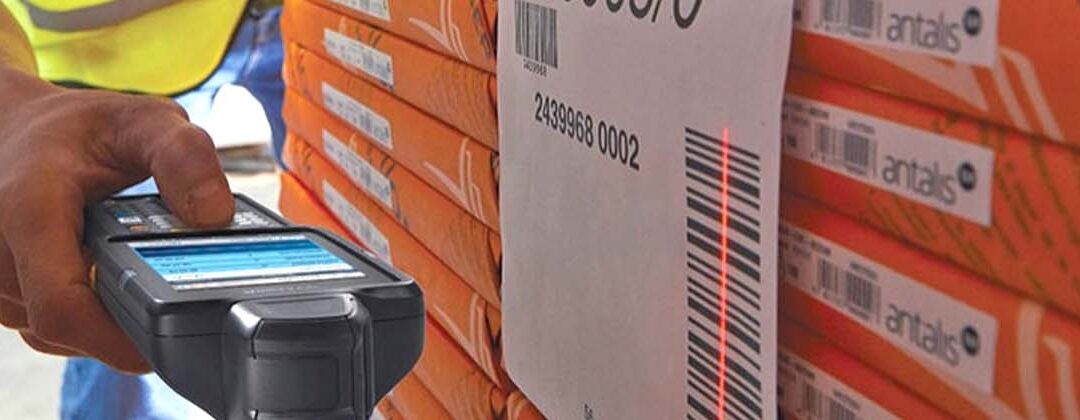
Zebra Technologies CFO Nathan Winters took the stage at Citi's 2026 Global Industrial Tech and Mobility Conference this morning, laying out a detailed playbook for navigating industry-wide memory cost increases while accelerating investments in AI, RFID, and machine vision—the three growth vectors the company is betting on after exiting its money-losing robotics business.
The stock closed at $264.62, down 3.5% on the day, continuing to give back gains from a 15% post-earnings surge last week.
Memory Pricing: A 2-Point Headwind, But "We've Done This Before"
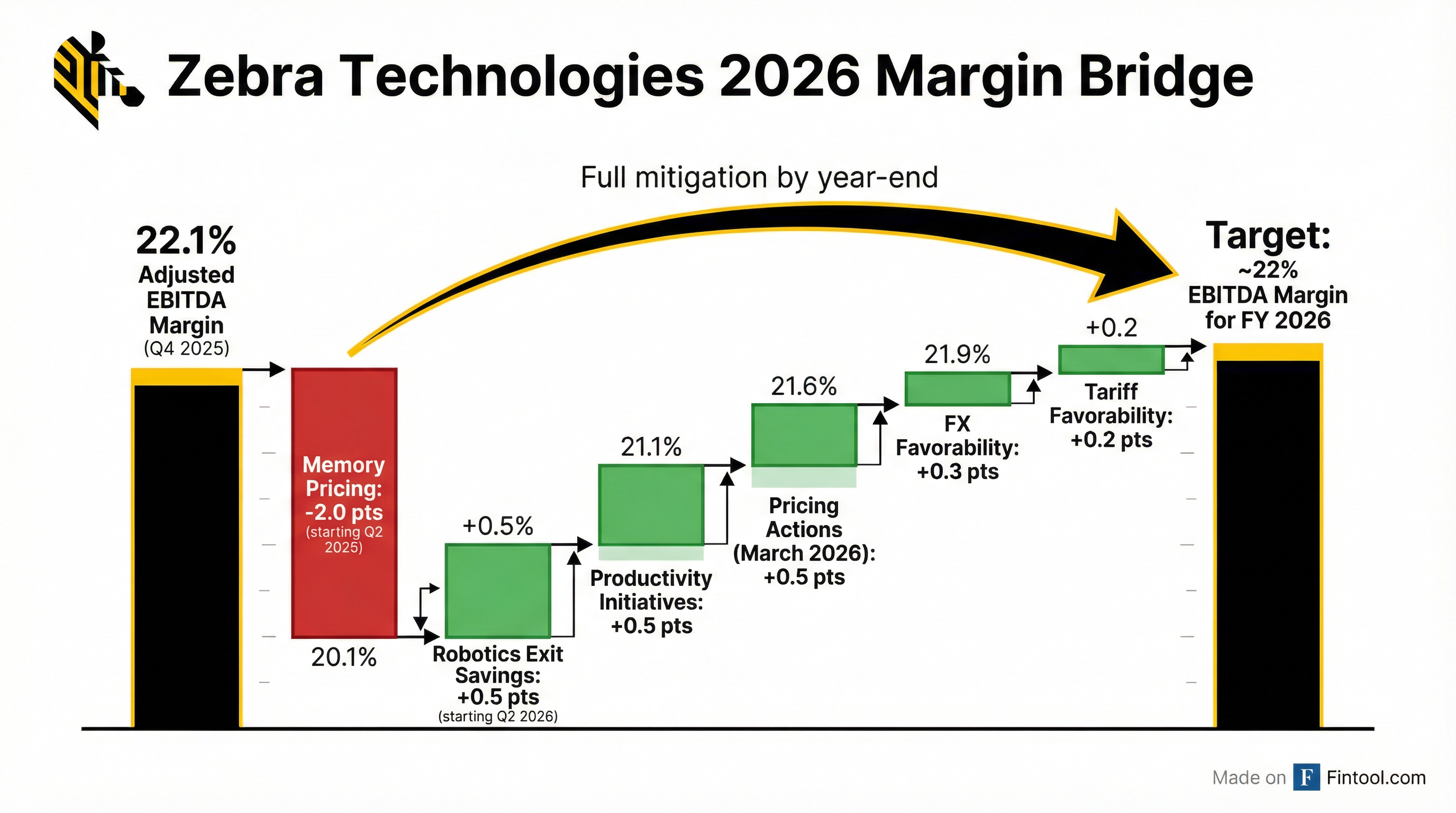
The headline concern for investors heading into 2026 is memory pricing. Winters confirmed that industry-wide cost increases beginning in Q2 will create approximately a 2-percentage-point headwind to gross margins—but expressed confidence in full mitigation by year-end.
"Everyone's facing the same headwinds," Winters told Citi analyst Piyush Awasthi. "We're seeing similar actions by our competitors. To date, we haven't really seen any noticeable change in pipeline or someone saying, 'Hey, we're just going to wait.'"
The mitigation strategy relies on multiple levers:
- Price increases announced "just over a couple weeks ago"—not embedded in guidance as management wanted to see market reception first
- Robotics exit savings of $20M annually, flowing directly to R&D reduction
- FX and tariff favorability from lower rates out of China
- Supply chain actions including working with multiple memory suppliers on allocation and pivoting to different memory types later in the year
Crucially, Zebra's supply chain team is going "one layer deeper" with customers to understand exact memory specifications needed for their pipeline projects—critical when allocation is tight.
 Ask Fintool AI Agent
Robotics Exit: "Focus Our Energy and Effort"
The robotics exit announced in Q4 looms large over the conversation. Winters was candid: "The market never really evolved as we anticipated when we did the acquisition back in 2021."
The unit economics on deployments proved challenging, and management concluded it was better to "shut it down, sell some of the assets, give that money back to shareholders in terms of improved profitability, and then really focus our efforts around where we think there's big automation plays that we have a right to play."
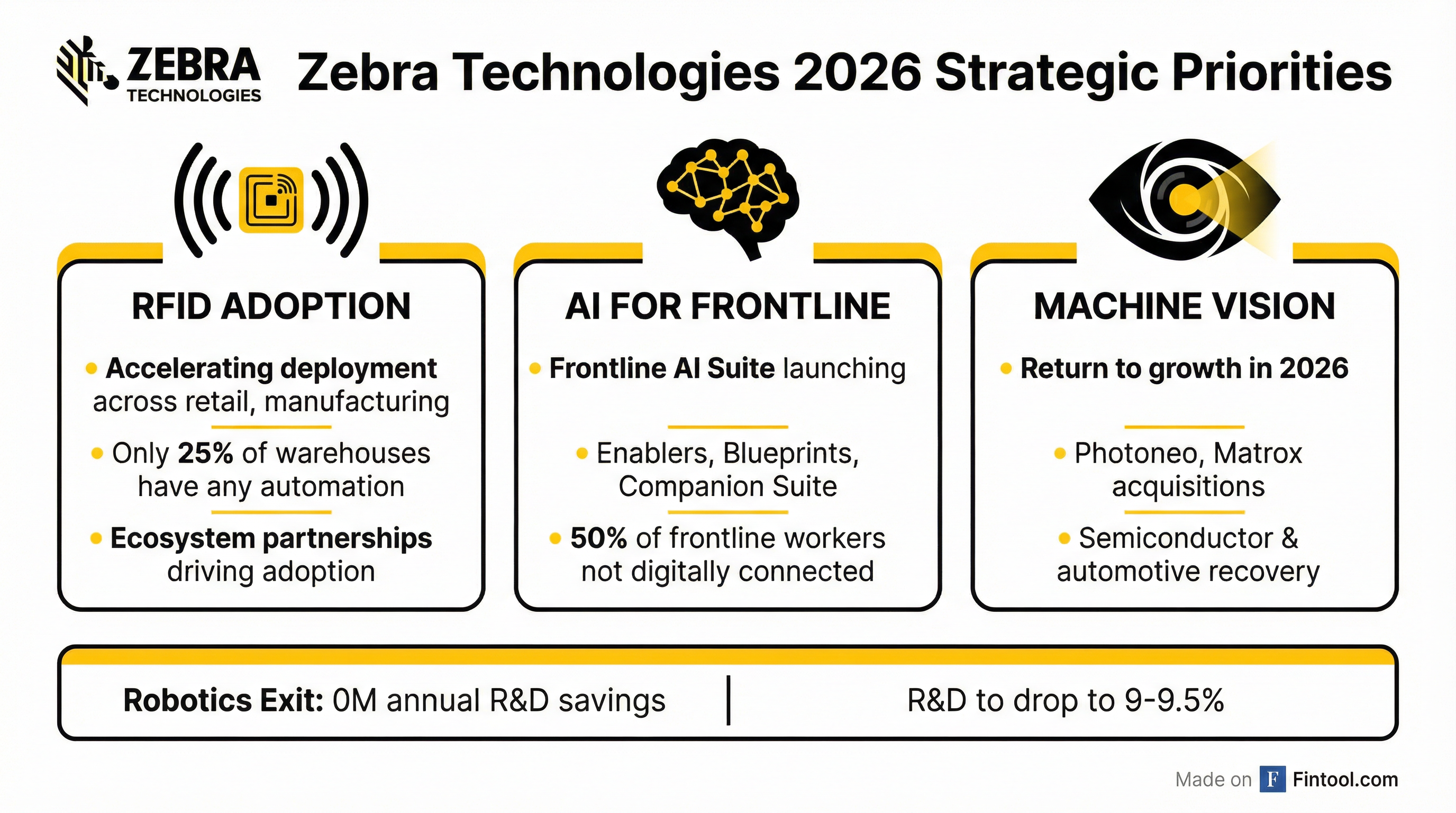
The financial impact is tangible: R&D as a percentage of revenue—which had been running around 10%—is expected to drop to 9%-9.5% as the company exits the year.
Importantly, Zebra isn't abandoning the robotics ecosystem entirely. Its Photoneo 3D cameras remain the "eyes" for many robotics automation systems, and the company maintains venture investments in several robotics companies.
AI Strategy: "Uniquely Positioned" for Frontline Workers
Winters outlined Zebra's three-tier AI offering, all currently in pilot phase but expected to scale:
1. Enablers – Tools and APIs allowing customers to develop AI applications for their frontline workers on Zebra devices. "If you do that, you need a higher-end mobile computer, which will drive the need for a refresh and upgrade of your existing devices."
2. Blueprints – Pre-built templates combining multiple enablers for specific use cases. The proof-of-delivery automation for transportation and logistics is the lead example: "If they drop the package off at your door, there's a couple steps they need to follow in terms of clicking buttons, and if you can automate that with AI, that saves seconds. You multiply that times thousands of transactions and package deliveries, it's millions of dollars."
3. Companion Suite – Full AI agents for sales enablement, operating procedures, and product knowledge. The wine retailer example: a store associate can instantly access customized recommendations based on actual inventory and current promotions—"not just broader knowledge that you get from AI, but also custom-built around their application."
On competitive moats, Winters was direct: "Because of that position—our install base, the market share we have, the relationships we have with the top retail, e-commerce, TNL providers—we're in a great position to help our customers disrupt versus someone else coming in and doing that for them."
Ask Fintool AI AgentRFID: The Adoption Tipping Point
RFID remains Zebra's clearest growth driver. Winters noted the technology has "hit the tipping point over the last couple of years as the cost of the chip made it economically viable."
The proliferation effect is real: "If you're a garment provider tagging everything going to multiple different stores, you may look around your environment at a store who doesn't have RFID readers and go, 'You know what? 40%-50% of the articles I have in my store are already tagged. Now, all I need is a reader to take advantage of the productivity I can get.'"
Fresh food tracking is a new frontier—using RFID to track produce age and reduce waste. "If that loaf of bread—how old is it really? And the only way to know that is with RFID. By having that information, there's a lot they can do around shaping demand."
Machine Vision: "Earning the Right to Invest More"
Machine vision has been the laggard in Zebra's portfolio, hurt by semiconductor and automotive market weakness. But Winters signaled a turn: "Now we're starting to see finally all that pay off. The work around—you're seeing some traction in automotive again. The semiconductor customers are starting to recover."
Investment philosophy here is disciplined: "It's not really net incremental investment in the short term. It's focus, it's executing and delivering on the growth opportunities we see ahead and getting that business back to the growth profile that we expect—and then earning the right to continue to invest more."
Capital Allocation: Buybacks Over Debt Paydown
With leverage at 2x and a new $1 billion share repurchase authorization, Zebra is leaning into buybacks. The plan: return 50% of free cash flow through buybacks primarily in H1, which equates to roughly 100% of H1 free cash flow given timing.
"That still puts us in a good position as we enter the second half of the year with another $450 million of free cash flow to generate, plenty of capacity for M&A opportunities that may arise," Winters said.
On the Elo Touch acquisition (closed five months ago), Zebra has already confirmed $10 million of the $25 million synergy target for year three. The combined incentive plan for sales teams is driving cross-selling opportunities, and supply chain teams are sharing intelligence on memory procurement.
The Big Picture: 75% of Warehouses Still Unautomated
Perhaps the most compelling long-term stat Winters shared: "Only 25% of worldwide warehouses have any form of automation."
And on the retail side: "50% of frontline workers still aren't digitally connected, even with the most basic communication forms of connectivity."
Management's thesis is straightforward: there's decades of runway for digitization and automation, AI is accelerating the upgrade cycle, and recent pullbacks from fully autonomous warehouse deployments by large customers actually benefit Zebra's modular, flexible solutions.
Stock Reaction and What to Watch
The stock's post-earnings surge has largely reversed, with shares down approximately 9% from the February 12 high of $291.60.
Key metrics from Q4 2025:
| Metric | Q4 2025 | Q4 2024 | Change |
|---|---|---|---|
| Revenue | $1.48B* | $1.33B* | +10.6% |
| Organic Growth | +2.5%* | — | — |
| Adjusted EBITDA Margin | 22.1%* | 22.1%* | Flat |
| Non-GAAP EPS | $4.33* | $4.00* | +8.3% |
| Free Cash Flow (FY) | $831M* | $954M* | -13% |
*Values retrieved from S&P Global
2026 Guidance:
| Metric | FY 2026 Guidance |
|---|---|
| Sales Growth | 9-13% (incl. 7 pts from acquisitions/FX)* |
| Adjusted EBITDA Margin | 22%* |
| Non-GAAP EPS | $17.70-$18.30* |
| Free Cash Flow | ≥$900M* |
*Values retrieved from S&P Global
Near-term catalysts to monitor:
- Q1 2026 results – Will the pricing actions announced in March stick without demand destruction?
- Memory cost trajectory – Management's mitigation timeline assumes specific cost curves; any acceleration would pressure margins
- AI pilot conversions – Moving from pilots to scaled deployments will be the proof point for 2026
Ask Fintool AI Agent