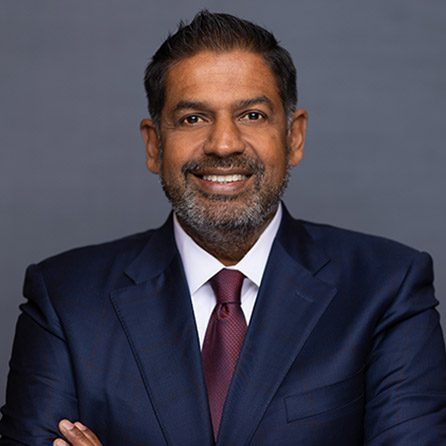
Chris Villavarayan
 Axalta Coating Systems
About Chris Villavarayan
Chief Executive Officer and President of Axalta since January 1, 2023; age 54 as of February 13, 2025; civil engineering degree from McMaster University and Wharton Executive Education Advanced Finance Program alumnus . Under his leadership, Axalta delivered record net sales and Adjusted EBITDA for the second consecutive year in 2024, with net income of $391 million (up from $269 million in 2023) and Adjusted EBITDA of $1.116 billion (up from $951 million in 2023) . Axalta’s 2024 Pay-versus-Performance table shows a company TSR “$100 value” of $112.57 versus peer group $161.74 in 2024, contextualizing shareholder return performance during his tenure . He has served as an Axalta director since January 2023 (employee director) and the Board maintains a separated leadership structure (non-executive Chair) to preserve independence .
Past Roles
| Organization | Role | Years | Strategic impact |
|---|---|---|---|
| Meritor, Inc. | Chief Executive Officer & President | 2021–Oct 2022 | Led global commercial vehicle supplier; guided company through sale to Cummins (Aug 2022) . |
| Meritor, Inc. | Executive Vice President & Chief Operating Officer | 2020–2021 | Oversaw global operations across Global Truck and Aftermarket & Industrial; board lead over four largest JVs . |
| Meritor, Inc. | SVP & President – Global Truck | 2018–2020 | Full P&L for global truck business . |
| Meritor, Inc. | President – Americas | 2014–2018 | Led North and South America businesses across portfolios . |
External Roles
| Organization | Role | Years |
|---|---|---|
| Franklin Electric Co., Inc. (NASDAQ: FELE) | Director | Current |
| Focus: HOPE (non-profit) | Director | Current |
Fixed Compensation
| Metric | 2023 | 2024 |
|---|---|---|
| Base Salary ($, paid) | 1,000,000 | 1,089,231 |
| Base Salary Rate (effective 3/11/24) | — | 1,100,000 |
| All Other Compensation ($) | 356,056 | 82,207 |
| Total Compensation ($) | 9,694,005 | 9,823,635 |
Additional details:
- 2024 target annual bonus (ABP) for CEO: $1,375,000 (plan-based target) .
- Director pay: As an employee director, he receives no additional compensation for Board service .
Perquisites (illustrative, modest): executive physical, umbrella liability insurance, supplemental long-term disability, global travel insurance, limited personal use of company-held event tickets .
Performance Compensation
Annual Bonus (ABP) – 2024 Results
| Item | Value |
|---|---|
| Financial performance payout | 144.2% |
| Individual performance modifier (CEO) | 100% (key achievements: launched 2026 “A Plan”; record net sales and Adjusted EBITDA; 2024 Transformation Initiative) |
| Actual ABP award (CEO) | $1,982,750 (144.2% of $1,375,000 target) |
Long-Term Incentives – Design and 2024 Grants
- LTI mix: 60% performance share units (PSUs), 40% time-based RSUs, aligning pay with multiyear value creation; PSUs tied to 3-year Adjusted EBITDA and relative TSR vs S&P 400 MidCap; minimum 12-month vesting; double-trigger vesting upon change-in-control; no options granted currently .
- 2024 CEO LTI awards (grant date 2/28/2024):
- RSUs: 73,893 units; grant-date fair value $2,400,045; vest one-third on each of the first three anniversaries of grant (i.e., 2/28/2025, 2/28/2026, 2/28/2027) .
- PSUs: Target 110,836 (threshold 55,418; max 221,672) units; grant-date fair value $4,269,403; 3-year performance period 2024–2026; payout 0–200% of target based on metrics .
| 2024 LTI Grant (2/28/2024) | Shares/Units | Grant-Date Fair Value ($) |
|---|---|---|
| RSU (time-based) | 73,893 | 2,400,045 |
| PSU (performance-based) – Target | 110,836 | 4,269,403 |
| PSU – Threshold / Maximum | 55,418 / 221,672 | — |
Performance realization to date:
- 2022–2024 PSU cycle vested at ~26% of target (Committee determination in March 2025), indicating challenging performance hurdles and risk-adjusted design .
- 2023–2025 and 2024–2026 PSU cycles reflected threshold (50%) as of 12/31/2024; actual vesting to be determined after cycle completion .
2024 equity vesting/realization:
| 2024 Vesting/Exercise | CEO Value |
|---|---|
| RSU/PSU shares vested (count) | 25,279 |
| Value realized on vesting ($) | 821,062 |
| Stock options exercised | None (no options outstanding awards for CEO) |
Equity Ownership & Alignment
| Item | Detail |
|---|---|
| Beneficial ownership | 109,753 shares; “less than 1%” of outstanding (218,560,711 shares outstanding as of 4/10/2025) |
| Stock ownership guidelines | CEO: 5x base salary; executives must retain 75% of net shares from RSU/PSU vesting until compliant |
| Compliance status | All NEOs met guidelines or were within grace period as of 12/31/2024 |
| Hedging/pledging | Prohibited (no pledging, margin, hedging, or short sales) |
Outstanding unvested and unearned equity (as of 12/31/2024):
| Award | Grant Date | Unvested/Unearned Units | Market/Payout Value Reference |
|---|---|---|---|
| RSU (time-based) | 2/28/2024 | 73,893 | $2,528,618 (at $34.22) |
| PSU (2024–2026 cycle) | 2/28/2024 | 55,418 (uneamed) | $1,896,404 (at $34.22) |
| RSU (time-based) | 2/28/2023 | 50,560 | $1,730,163 (at $34.22) |
| PSU (2023–2025 cycle) | 2/28/2023 | 56,879 (uneamed) | $1,946,399 (at $34.22) |
Notes:
- RSUs vest one-third annually on the first, second, and third anniversaries of grant; PSUs vest after the performance period subject to the Compensation Committee’s determination .
- The insider trading policy imposes pre-clearance and blackout periods and prohibits hedging/pledging, limiting opportunistic selling and alignment risks .
Employment Terms
| Term | Provision |
|---|---|
| Start date (CEO) | January 1, 2023 |
| Agreement | Executive Restrictive Covenant and Severance Agreement (Nov 15, 2022) |
| Clawback | SEC/NYSE-compliant clawback; additional internal recoupment policy for policy violations |
| Non-compete / Non-solicit | Restrictive covenants apply under severance arrangements; non-compete noted in separation disclosures for NEOs (policy framework) |
| Change-in-control (CIC) | Double-trigger vesting; PSU CIC treatment = greater of target or actual to date depending on metric/timing; RSUs 100% vest if terminated without cause/for good reason within 2 years post-CIC |
Estimated CEO severance economics (as of 12/31/2024):
| Scenario | Salary Severance ($) | Bonus Severance ($) | Equity Vesting ($) | Other ($) | Total ($) |
|---|---|---|---|---|---|
| Death/Disability | — | — | 11,944,388 | — | 11,944,388 |
| Termination without Cause or Resignation for Good Reason (non‑CIC) | 2,200,000 | 3,880,000 | — | 27,445 | 6,107,445 |
| Termination without Cause or Resignation for Good Reason (following CIC) | 3,300,000 | 4,125,000 | 13,010,408 | 41,167 | 20,476,575 |
Deferred compensation (NDCP – 2024):
| Item | Amount ($) |
|---|---|
| Executive contributions | 11,000 |
| Company contributions | 51,234 |
| Aggregate balance at FYE | 62,389 |
Governance and Say‑on‑Pay signals:
- 2025 Say‑on‑Pay approved (Votes For 189,602,022; Against 1,689,413; Abstentions 163,026; Broker non‑votes 10,051,959) .
- Compensation Committee fully independent; uses independent consultant (Pearl Meyer) with no conflicts; peer group overseen annually .
- “What we do / don’t do” governance includes no single‑trigger vesting, no options repricing, no tax gross‑ups, and double‑trigger CIC vesting .
Board Governance
- Role: Employee director since January 2023; not independent (CEO) .
- Board structure: Independent, non‑executive Chair (Rakesh Sachdev); all standing committee members independent; independent director executive sessions held regularly .
- Committee roles: As CEO, he is not listed as a member of standing committees .
- Director compensation: Employee directors receive no director fees/equity; program (cash $75k; equity $200k; additional chair fees) applies to non‑employee directors only .
Compensation Structure Analysis
- High at‑risk mix: 87% of CEO target pay at risk in 2024 (ABP + LTI); LTI 60% PSUs tied to multi‑year Adjusted EBITDA and relative TSR promotes durability of results .
- Strong performance linkage: 2022–2024 PSU cycle paid ~26%, demonstrating downside sensitivity; 2023/2024 cycles at threshold to date (50%) .
- Governance features reduce risk: Double‑trigger CIC; no tax gross‑ups; hedging/pledging prohibited; minimum vesting periods; independent consultant .
- Peer benchmarking: Peer set spans chemicals and coatings; Axalta positioned ~45th percentile by revenue and ~55th percentile by market cap at selection time; base salary moved toward CEO peer median in 2024 .
Equity Ownership & Vesting Schedules (Trading Pressure Indicators)
- Upcoming vesting from time‑based RSUs (2/28/2023 and 2/28/2024 grants) each vest one‑third annually over three years, creating predictable taxable events and potential sell‑to‑cover pressure at each anniversary; PSUs cliff‑vest post‑measurement, concentrating potential supply at determination dates (2026, 2027) .
- 2024 realized vesting: 25,279 shares vested for CEO, $821,062 value, a datapoint for annual sell‑to‑cover supply sizing .
- Prohibitions on hedging/pledging and pre‑clearance/blackouts reduce opportunistic selling and misalignment risk .
Performance & Track Record
- 2024 achievements underpinning incentives: 2026 “A Plan” rollout; record net sales and Adjusted EBITDA for a second year; execution of 2024 Transformation Initiative .
- Capital allocation: $700 million repurchase authorization; $100 million repurchased in 2024; net leverage reduced to 2.5x, lowest year‑end level in company history .
Compensation Committee Analysis
- Composition: Independent directors; Chair William M. Cook; Audit Chair Jan A. Bertsch; Nominating & Governance Chair Deborah J. Kissire (committee independence maintained) .
- Consultant: Pearl Meyer; no conflicts; roles include peer benchmarking, plan design, target setting, and risk assessment .
Investment Implications
- Alignment: High at‑risk pay with rigorous multi‑year PSU metrics (Adj. EBITDA and relative TSR) and a low 26% payout on 2022–2024 PSUs signal a performance‑sensitive program; prohibition on pledging/hedging and robust ownership guidelines (CEO 5x salary) support alignment .
- Retention: Meaningful unvested RSUs and multi‑year PSUs (2023–2025, 2024–2026) create retention hooks; double‑trigger CIC protects against windfalls yet provides security, reducing flight risk .
- Trading signals: Annual RSU vesting dates (late February) and PSU cliff determinations (2026/2027) are the primary supply events; 2024 vesting realization ($821k) is a guidepost for potential sell‑to‑cover flows .
- Governance risk: Separation of Chair/CEO, independent committees, no single‑trigger or tax gross‑ups, and strong Say‑on‑Pay support (approved at 2025 AGM) suggest low governance overhang and manageable compensation risk .