Earnings summaries and quarterly performance for Bunge Global.
Executive leadership at Bunge Global.

Board of directors at Bunge Global.
Adrian Isman
Director
Anne Jensen
Director
Carol Browner
Director
Christopher Mahoney
Director
Eliane Aleixo Lustosa de Andrade
Director
Jay Winship
Director
Kenneth Simril
Director
Linda Jojo
Director
Mark Zenuk
Chair of the Board
Markus Walt
Director
Monica McGurk
Director
Research analysts who have asked questions during Bunge Global earnings calls.
Heather Jones
Heather Jones Research
8 questions for BG
Manav Gupta
UBS Group
8 questions for BG

Salvator Tiano
Bank of America
8 questions for BG
Steven Haynes
Morgan Stanley
8 questions for BG

Andrew Strelzik
BMO Capital Markets
7 questions for BG
Derrick Whitfield
Texas Capital
7 questions for BG
Pooran Sharma
Stephens Inc.
5 questions for BG
Thomas Palmer
Citigroup Inc.
5 questions for BG
Benjamin Theurer
Barclays Corporate & Investment Bank
3 questions for BG
Ben Theurer
Barclays
2 questions for BG
Ben Toyrer
Barclays
2 questions for BG

Matthew Blair
Tudor, Pickering, Holt & Co.
2 questions for BG

Puran Sharma
Stevens Inc.
2 questions for BG
Tom Palmer
JPMorgan Chase & Co.
2 questions for BG
Andrew Stravik
BMO Capital Markets
1 question for BG
Rahi Parikh
Barclays
1 question for BG
Tami Zakaria
JPMorgan Chase & Co.
1 question for BG
Recent press releases and 8-K filings for BG.
- Bunge has transformed since 2019 into an integrated global agribusiness, exiting non-core assets and unlocking $4 billion in portfolio proceeds to strengthen cash flow and returns.
- The July 2025 acquisition of Viterra accelerates growth with cost synergies ahead of plan, commercial and network synergies, and $250 million of targeted annual operational savings.
- Bunge updates its mid-cycle EPS baseline to over $15 by 2030, driven by project completions, Viterra synergies, and disciplined capital deployment.
- The company targets returning 50% of discretionary cash flow to shareholders via dividends and share repurchases and maintaining net leverage at 2x–2.5x.
- Bunge advances its digital agenda, deploying the Bunge Data Platform and AI tools to optimize supply-chain, processing, and risk decisions, delivering measurable improvements in throughput, yield, and planning efficiency.
- Bunge aims to lift its mid-cycle EPS baseline to $15+ by 2030, driven by inflight capex projects (adding $1.30 EPS) and Viterra synergies (adding $1.50 EPS) by 2030.
- Committed to returning at least 50% of discretionary cash flow to shareholders through dividends and share buybacks, supported by a strong investment-grade credit profile with an adjusted leverage ratio of 1.9x at year-end 2025.
- Integration of Viterra has unified Bunge’s seaborne flows under one team and system, doubling volumes to ~120 MMT and unlocking network efficiencies.
- Growth capex of $300–400 M/year is targeted toward productivity and expansion, while the dividend has risen from $2.00 in 2024 to $2.05 in 2025.
- Strong cash generation underpins the plan, with a mid-cycle run rate adjusted FFO baseline of ~$3.5 B, sustaining capital of ~$0.8 B, and discretionary cash flow of ~$2.7 B.
- Bunge raised its mid-cycle EPS baseline to over $15 by 2030, up from $8.50 in 2022, driven by Viterra synergies and large multi-year CapEx projects nearing completion.
- The Viterra integration is ahead of plan on cost synergies and has uncovered additional network and commercial synergies; major CapEx projects are slated to complete by H2 2026–H1 2027.
- CFO expects a $13 mid-cycle EPS run-rate with $3.5 bn of adjusted funds from operations, targeting $15 by 2030 through margin improvements, integration benefits, and disciplined capital deployment.
- Capital allocation will direct 50% of discretionary cash flow to dividends and share repurchases (~$700 M annually), maintain a 2–2.5× leverage target, and invest $300–400 M/year in growth and productivity CapEx.
- Bunge closed its Viterra acquisition in July 2025, creating an unmatched global footprint across origination, processing and distribution, and is already realizing cost and commercial synergies to enhance supply-chain optionality.
- Management raised its mid-cycle EPS baseline to over $15 by 2030 (up from $8.50 in 2022), driven by Viterra synergies, maturing CapEx projects and an improving structural market environment.
- CFO guidance projects $3.5 billion in annual adjusted funds from operations at the new baseline; 50% of discretionary cash flow (about $700 million/year) will be allocated to dividends and share buybacks, while maintaining a target 2x–2.5x net leverage ratio.
- The company’s value-chain operating model integrates four core segments—soy and softseed processing, tropical oils & specialty ingredients, and grain merchandising—underpinned by a centralized risk-management function to optimize flows and reduce costs.
- Bunge Global hosted its 2026 Investor Day in New York, outlining strategic priorities including Viterra integration, portfolio optimization, and capital allocation goals.
- Updated EPS mid-cycle baseline to ~$13 and introduced a growth framework targeting at least $15 by end of 2030.
- Authorized a $3 billion share repurchase program and committed to returning a minimum of 50% of discretionary cash flow to shareholders across the cycle.
- Bunge completed acquisition of IFF’s soy protein concentrate, lecithin, and soy crush businesses, including the Response®, Alpha®, Procon®, and Solec™ brands (NYSE: BG).
- The deal expands Bunge’s ingredients portfolio with textured, functional, and powdered soy protein concentrates for bakery, snacks, meats, and alternative proteins.
- It enhances Bunge’s lecithin offerings to a comprehensive range of liquid, powdered, and fractionated soy, sunflower, and rapeseed lecithins for confectionery, bakery, and other products.
- The transaction reinforces Bunge’s strategy to be a partner of choice, delivering diverse, reliable ingredient solutions and bolstering supply chain resilience.
- Glencore reported full-year adjusted EBITDA of $13.51 billion (down 6%) and adjusted EBIT of $6 billion (down 14%), while revenue rose 7% to $247.5 billion.
- The company will return $2 billion to shareholders through an aggregate 17 cents per share distribution, paid in two instalments in June and September.
- Second-half 2025 copper output reached 500 kt, about 50% above H1, reinforcing its copper-led growth strategy toward over 1 Mt annualised by 2028.
- Finalised a KCC land access package with Gécamines, unlocking life-of-mine extension and targeting 300 kt per annum of copper production.
- Completed Viterra combination, realizing > $70 million in run‐rate synergies by end-2025 and targeting $190 million of synergies in 2026 (run rate $220 million by year-end).
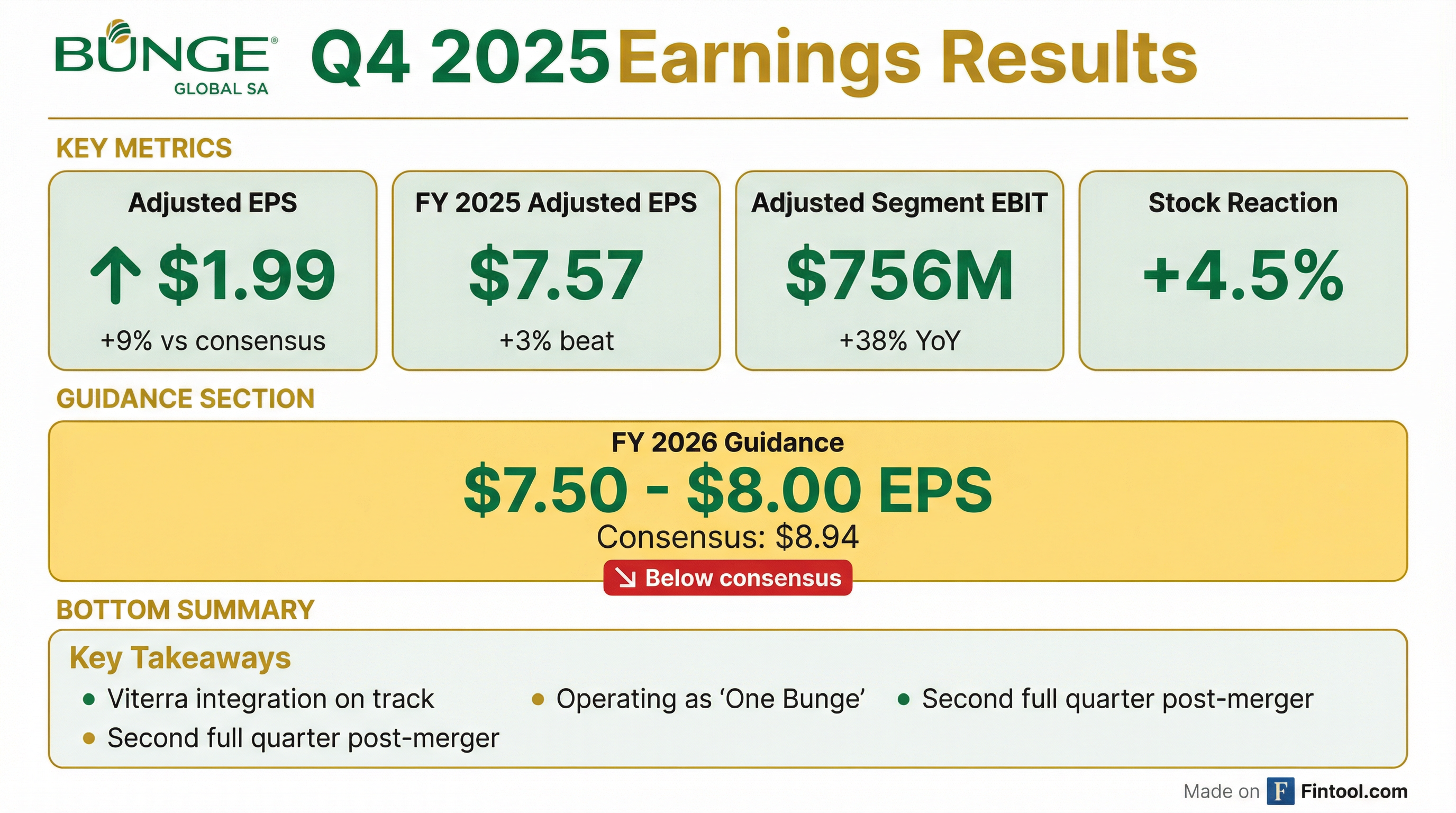
- Q4 2025: reported EPS $0.49 vs. $4.36 LY; adjusted EPS $1.99 vs. $2.13 LY; adjusted EBIT $756 million vs. $546 million LY; results included mark-to-market timing and integration costs.
- 2026 guidance: adjusted EPS $7.50–$8.00, annual tax rate 23–27%, net interest expense $575–$625 million, CapEx $1.5–$1.7 billion, D&A ~$975 million.
- FY 2025 cash flow and leverage: adjusted FFO $1.7 billion, discretionary cash flow $1.25 billion, year-end net debt $700 million (ex-RMI), and adjusted leverage 1.9×.
- Q4 adjusted EPS was $1.99 (vs. $2.13 in Q4 2024) and Q4 adjusted Total EBIT reached $622 M (vs. $445 M).
- FY 2025 adjusted EPS declined to $7.57 (from $9.19 in FY 2024) while FY 2025 adjusted Total EBIT was $2.034 B (vs. $2.017 B).
- The company generated FY 2025 discretionary cash flow of $1.248 B, allocating $459 M to dividends, $1.173 B to growth capex and $551 M to share buybacks.
- For FY 2026, Bunge guides adjusted EPS of $7.50–$8.00, with net interest expense of $575 M–$625 M and capex of $1.5 B–$1.7 B.
- Q4 reported EPS of $0.49 was weighed down by a $0.55 mark-to-market timing charge and $0.95 of notable items; adjusted EPS was $1.99 vs $2.13 in Q4 2024, and adjusted EBIT rose to $756 million from $546 million year-over-year.
- Integration of Viterra completed in 2025, with $70 million of synergies realized; management now targets $190 million of synergy capture in 2026 and a year-end run rate of $220 million.
- For 2026, Bunge forecasts adjusted EPS of $7.50–$8.00, an effective tax rate of 23–27%, net interest expense of $575–$625 million, capital expenditures of $1.5–$1.7 billion, and depreciation & amortization of ~$975 million.
- At year-end, net debt (ex-RMI) stood at $700 million with an adjusted leverage ratio of 1.9×, and liquidity remained strong with $9 billion of undrawn committed credit facilities.
Quarterly earnings call transcripts for Bunge Global.

Ask Fintool AI Agent
Get instant answers from SEC filings, earnings calls & more