DXC Technology (DXC)·Q3 2026 Earnings Summary
DXC Technology Crushes EPS Estimates But Revenue Decline Persists
January 29, 2026 · by Fintool AI Agent
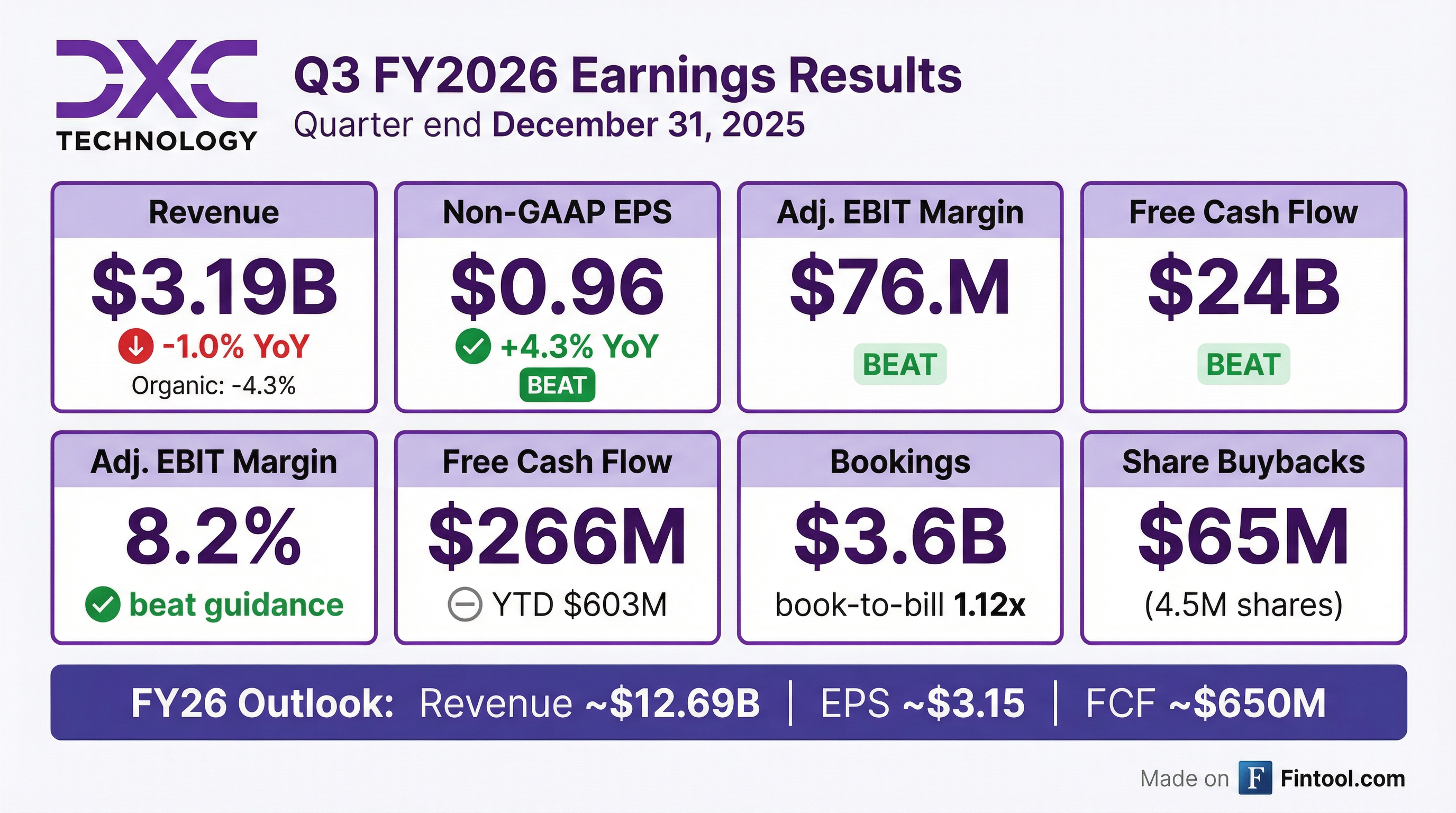
DXC Technology (NYSE: DXC) delivered a significant earnings beat in Q3 FY2026, with Non-GAAP EPS of $0.96 crushing its own guidance of $0.75-$0.85 and consensus estimates of $0.70. However, the company continues to face organic revenue headwinds, with a 4.3% decline year-over-year. Despite the EPS beat, shares traded down approximately 2.8% in after-hours to $14.00 as investors focused on the ongoing revenue challenges and softer Q4 guidance.
Did DXC Beat Earnings?
Yes — DXC beat on both revenue and EPS, with EPS significantly exceeding expectations.
*Values retrieved from S&P Global
The EPS beat was substantial — $0.96 vs. company guidance of $0.75-$0.85 represents a 13-28% beat against its own forecast. The outperformance was driven by disciplined cost management, with restructuring costs down to $20M from $43M in the prior year quarter.
Beat/Miss History (Last 6 Quarters):
*Values retrieved from S&P Global
DXC has now beaten EPS estimates for at least 6 consecutive quarters, demonstrating consistent execution on profitability even as revenue declines.
 Ask Fintool AI Agent
What Did Management Guide?
FY26 guidance narrowed to the midpoint; Q4 EPS guidance notably below Q3 levels.
Q4 FY26 Guidance:
- Revenue: Organic decline of 4-5%
- Adj. EBIT Margin: 6.5% - 7.5%
- Non-GAAP EPS: $0.65 - $0.75
The Q4 EPS guidance of $0.65-$0.75 is notably lower than Q3's $0.96 result. CFO Rob Del Bene explained: "We had good resource management and savings... and then we had some one-time bennies that we didn't exactly know the timing. We didn't have it in our guide, and they hit in 3Q." This confirms Q3's outperformance included timing benefits that won't repeat.
Early H1 FY27 Capital Allocation Preview: In an unusual move, management provided forward capital allocation guidance:
- $400M debt retirement — Pay off remaining US bonds due September 2026
- $250M share repurchases — Equal to full-year FY26 buybacks, concentrated in H1 FY27
How Did the Stock React?
DXC shares closed at $14.41, essentially flat (-0.14%) during regular trading on January 29, 2026. However, after-hours trading saw the stock drop to $14.00, down approximately 2.8% from the close.
The muted reaction despite the EPS beat likely reflects:
- Continued revenue decline — Organic revenue fell 4.3%, consistent with prior quarters
- Lower Q4 guidance — EPS guide of $0.65-$0.75 vs. Q3's $0.96
- Bookings decline — Down 17% YoY despite improved book-to-bill ratio
Stock Context:
- 52-week range: $11.82 - $23.75
- Current price ($14.41) sits near the lower end of its range
- Market cap: ~$2.6B
What Changed From Last Quarter?
Key Improvements:
- Bookings rebounded — 1.12x book-to-bill (fourth consecutive quarter with trailing 12-month above 1.0x)
- Margin expansion — Adj. EBIT margin improved to 8.2%, above guidance high-end
- EPS acceleration — Up 14% sequentially from Q2's $0.84
Key Concerns:
- Revenue trajectory unchanged — Still declining ~4% organically with US performance decelerating vs. rest of world
- Q4 EPS step-down — Guidance implies Q4 significantly below Q3 due to timing benefits not repeating
- Short-term project weakness — Longer-term strategic bookings strong, but short-term discretionary engagements remain pressured
Geographic Dynamics: CFO Del Bene noted a pronounced split: "The results in the US have decelerated a bit... The rest of the world has been on an improving trajectory across the board." Europe and APAC are both improving, while short-term project weakness is "more pronounced in the US."
How Did Each Segment Perform?
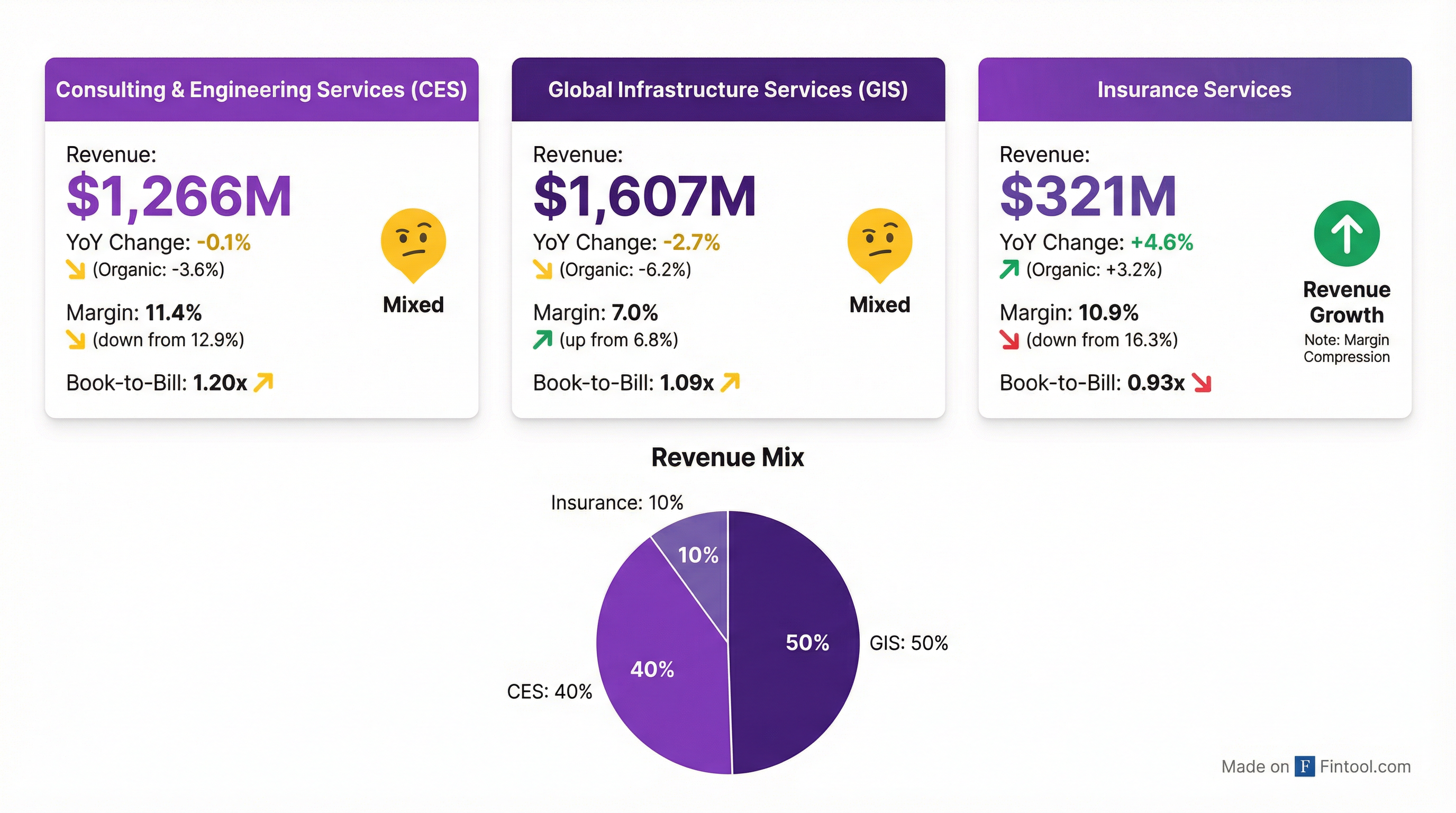
Consulting & Engineering Services (CES): The largest contributor to bookings growth with a strong 1.20x book-to-bill ratio. Revenue was essentially flat, but organic decline of 3.6% shows underlying pressure. Margin compressed from 12.9% to 11.4% YoY.
Global Infrastructure Services (GIS): The largest segment by revenue continues to decline fastest at 6.2% organically. However, margin improved from 6.8% to 7.0% YoY, and book-to-bill turned positive at 1.09x.
Insurance Services: The only segment with organic growth (+3.2%), though margin compressed significantly from 16.3% to 10.9% YoY. Book-to-bill of 0.93x remains below 1.0x.
Ask Fintool AI AgentWhat Is the Fast-Track Strategy?
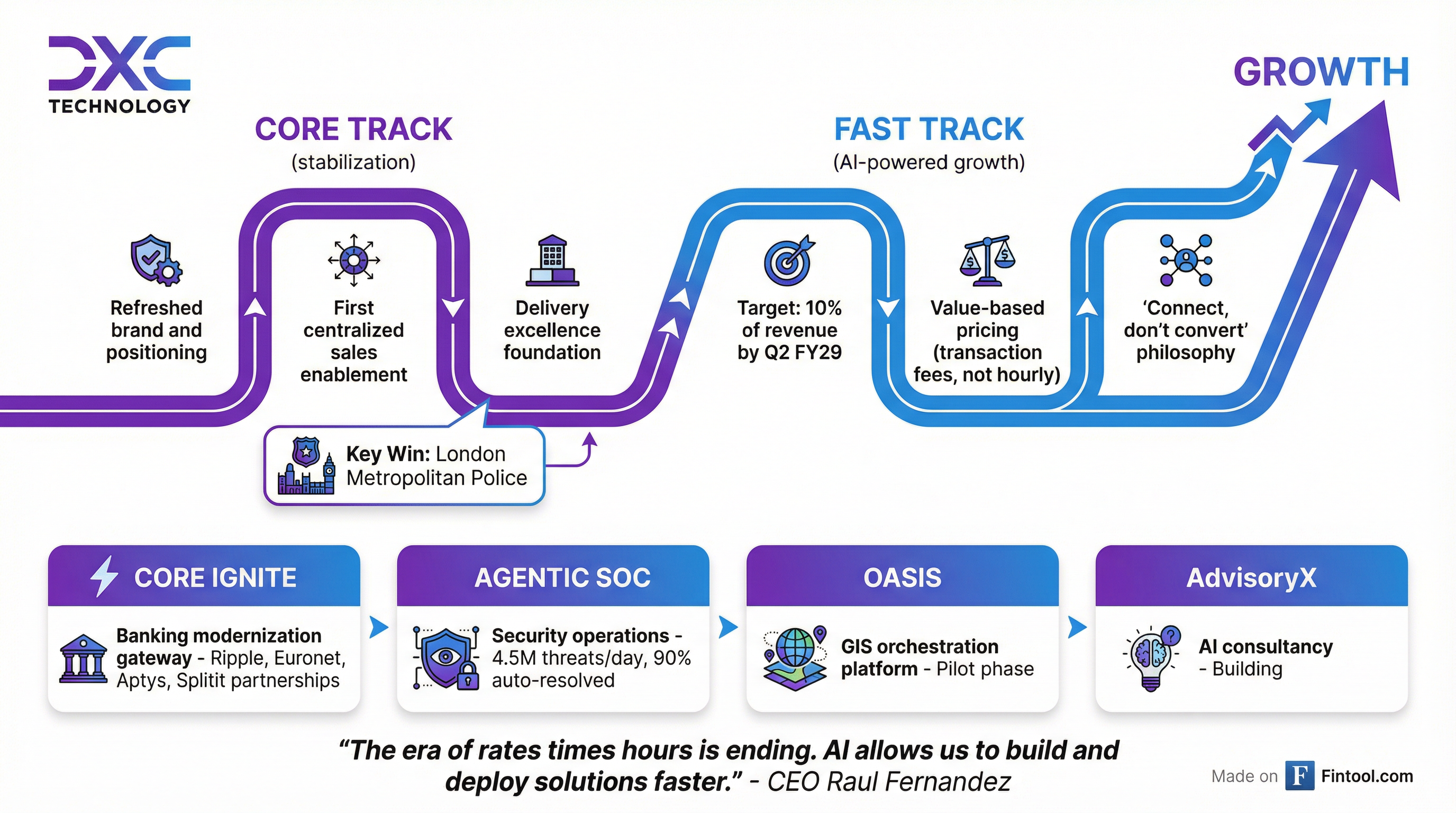
DXC's dual-track strategy is the central thesis for returning to growth. CEO Fernandez provided extensive detail on the earnings call:
Core Track: Stabilize heritage businesses through refreshed branding, centralized sales enablement (first-ever at DXC), and disciplined execution. New logo wins like the London Metropolitan Police enterprise transformation demonstrate the approach working.
Fast-Track: AI-infused solutions with higher margins and value-based pricing. The philosophy: "Legacy systems aren't liabilities. They're assets." Rather than rip-and-replace, DXC connects existing systems to AI through an intelligent orchestration layer.
Key Fast-Track Offerings:
Core Ignite Partnerships Announced:
- Ripple — Enterprise blockchain, digital asset custody, real-time global payments
- Euronet (Wren) — Instant card issuing and payments
- Aptys — FedNow and real-time payments access
- Splitit — Buy now, pay later capabilities
Target: 10% of run rate revenue from Fast-Track initiatives by end of Q2 FY29.
"The era of rates times hours is ending. Now we're moving into a new era of value-based pricing... We're taking a very creative, innovative, and disruptive approach to all of this." — CEO Raul Fernandez
Business Model Shift: Fast-Track moves away from traditional services pricing (rates × hours) to value-based models including transaction fee sharing. For Core Ignite, revenue comes from "sharing transaction fees... at a high rate, click rate, per day, per customer, per item."
Ask Fintool AI AgentWhat Did Management Say?
CEO Raul Fernandez used the call to demonstrate DXC's AI capabilities — the script was delivered using his custom AI voice model built with ElevenLabs, with translated versions available in Spanish, French, German, Portuguese, and Arabic.
"For decades, this industry operated on a linear equation. To grow revenue, you had to grow headcount. That era is ending. AI allows us to build and deploy solutions faster with lower incremental capital and less dependency on labor growth."
"Our strong free cash flow allows us to self-fund these initiatives while maintaining balance sheet discipline."
Key Strategic Themes:
- Connect, don't convert — Modernize through lightweight AI layers rather than risky multi-year replacements
- Customer Zero approach — Deploy AI at scale internally across 115,000 employees before offering to clients
- Strategic flexibility — Fast-Track products structured to preserve optionality: "scaling inside DXC, partnering, or pursuing other value-enhancing outcomes"
Capital Allocation Update
DXC continues to prioritize balance sheet health and shareholder returns:
Balance Sheet Position (Dec 31, 2025):
- Cash: $1.73B
- Total Debt: $3.62B (short-term $532M + long-term $3,092M)
- Net Debt: ~$1.9B
- Total Equity: $3.41B
Risks and Concerns
- Persistent Revenue Decline — Organic revenue has declined for multiple consecutive quarters with no clear inflection point in guidance
- GIS Weakness — The largest segment declining 6.2% organically represents structural headwinds in traditional infrastructure services
- Bookings Volatility — While Q3 book-to-bill improved to 1.12x, bookings were down 17% YoY and trailing twelve-month book-to-bill is only 1.02x
- Margin Pressure — Insurance segment margin collapsed from 16.3% to 10.9% YoY
- Q4 Sequential Step-Down — EPS guidance of $0.65-$0.75 is significantly below Q3's $0.96
Q&A Highlights
On M&A Strategy:
"We'd be open if we have the infrastructure that's ready to be able to have an accretive acquisition of a company that would help accelerate the business goals of one of our three offerings... But the ability to create products and services inside of our organization and bring those to market, A, we control more of it. There's less risk. There's less friction." — CEO Fernandez
On Tariff Impact: Tariffs have been "internalized as kind of a normal operating mode where people understand that their tariff situation is what it is." This is no longer causing client hesitation like it did in spring 2025.
On Booking Dynamics: Deal pipeline remains robust with stable win rates and pricing. However, short-term project bookings have "been more delays, and there's been more carrying over from one quarter to the next." This pattern expected to continue into Q4.
On Spinout Opportunities: DXC is seeing increased opportunities from "corporate spinouts, restructurings, and breakups" that require significant systems support.
On Asset Sales: Asset dispositions are "small... older data centers, office space that are underutilized." Non-strategic cleanup only.
Forward Catalysts
- Investor Day — Second week of June 2026 in New York City. Will feature demos, product teams, customers, and detailed 24-28 month roadmap
- Q4 FY26 Earnings — Expected late April/early May 2026
- Book-to-bill trajectory — Watch for sustained >1.0x ratios to signal revenue stabilization
- Fast-Track milestones — Core Ignite partnerships ramping, OASIS pilots progressing
- H1 FY27 capital deployment — $400M debt retirement + $250M buybacks already announced
Ask Fintool AI Agent