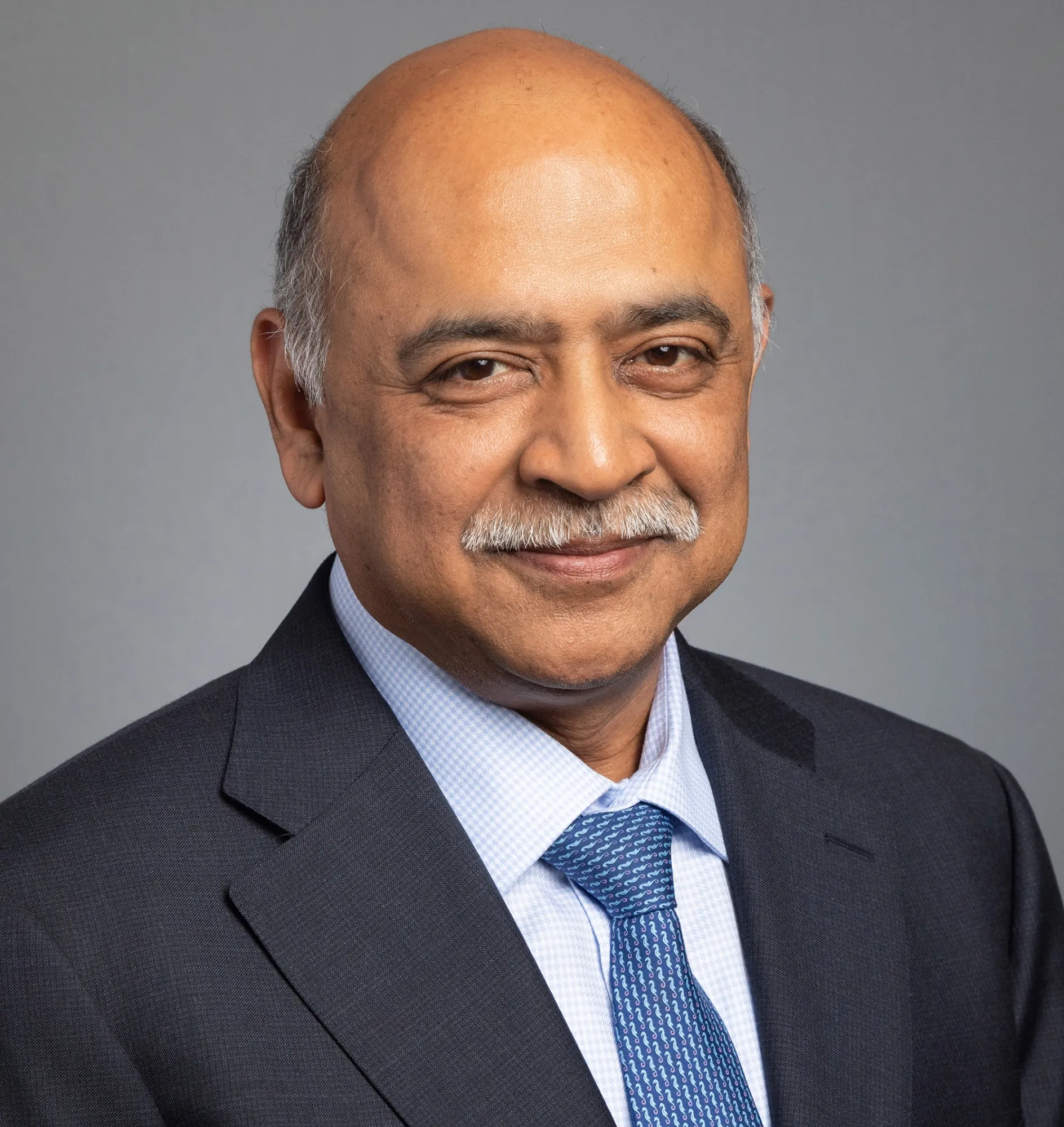
Arvind Krishna
 INTERNATIONAL BUSINESS MACHINES
About Arvind Krishna
Arvind Krishna, 62, is IBM’s Chairman, President and CEO; he became CEO in April 2020 and was elected Chairman in December 2020. He joined IBM in 1990, previously led IBM Research (2015–2020) and the Cloud & Cognitive Software unit (2017–April 2020), and was a principal architect of the Red Hat acquisition; he holds an undergraduate degree from IIT Kanpur and a PhD in electrical engineering from the University of Illinois at Urbana-Champaign . Under his leadership, IBM reported 2024 revenue of $62.8B and free cash flow of $12.7B, with total shareholder return of ~40% in 2024 versus the S&P 500 at +25%; operating margins and gross margins expanded year-over-year, reflecting portfolio optimization and productivity initiatives .
Past Roles
| Organization | Role | Years | Strategic Impact |
|---|---|---|---|
| IBM | Chairman of the Board | Dec 2020–present | Unified leadership and oversight; board chair role with independent Lead Director structure to balance governance . |
| IBM | President and CEO | Apr 2020–present | Execution of hybrid cloud and AI strategy; 2024 TSR ~40% and improved margins and FCF . |
| IBM | SVP, IBM Cloud & Cognitive Software | 2017–Apr 2020 | Led cloud and AI portfolio; principal architect of Red Hat acquisition (largest in IBM history) . |
| IBM | Director, IBM Research | 2015–2020 | Advanced AI and quantum initiatives; research-to-product pipeline . |
| IBM | GM, Systems & Technology Group; various data businesses | Prior to 2015 | Built and led IBM’s data-related businesses; systems development and manufacturing . |
External Roles
| Organization | Role | Years | Strategic Impact |
|---|---|---|---|
| Federal Reserve Bank of New York | Director | 2022–present | Monetary policy/regulatory perspectives; macro risk oversight . |
| Northrop Grumman Corporation | Director | 2022–present | Defense technology governance; cross-industry insights . |
| U.S.-India Strategic Partnership Forum | Director | Ongoing | Geopolitical and market access engagement . |
| The Economic Club of New York | Vice Chair | Ongoing | Business community leadership; investor and policy network . |
Fixed Compensation
| Metric | FY 2022 | FY 2023 | FY 2024 |
|---|---|---|---|
| Base Salary ($) | $1,500,000 | $1,500,000 | $1,500,000 |
| Actual AIP (Annual Bonus) ($) | $3,480,000 | $3,510,000 | $3,850,000 |
| Target Bonus % of Salary | Not disclosed | Not disclosed | 233% of salary |
2025 decisions: Base salary unchanged; target annual incentive $3.5M; long-term incentive grant valued at $25M with mix 60% PSUs, 20% RSUs, 20% stock options; 78% of total target comp at risk .
Performance Compensation
Annual Incentive Program (AIP) – 2024
| Metric | Weighting | Attainment | Payout Mechanics | Pool Funding | Individual Payout |
|---|---|---|---|---|---|
| Revenue | Not disclosed | 97% leveraged score | Threshold 80%→50% payout; Target 100%→100%; Max 110%→200% | AIP pool score: 110 | Krishna: $3,850,000 (110% of target) |
| Operating Cash Flow (non-GAAP) | Not disclosed | 104% leveraged score | Threshold 70%→70% payout; Target 100%→100%; Max 120%→200% | AIP pool score: 110 | Krishna: $3,850,000 (110% of target) |
| AIP Modifier (DEI & inclusion) | n/a | No impact in 2024 | ±5 points potential | Included in process | n/a |
AIP qualitative adjustment: +10 points approved by the Compensation Committee reflecting execution progress in hybrid cloud/AI, innovation, and value creation .
Performance Share Units (PSUs) – 2022–2024 cycle
| Component | Weighting | Threshold / Target / Max Attainment & Payout | ROIC Modifier | Final PSU Score |
|---|---|---|---|---|
| Revenue (currency-adjusted) | 40% | 70%/25%, 100%/100%, 120%/150% | Relative ROIC vs S&P 500 & IT indices; 0 modifier for 2022–2024 | 93 |
| Operating EPS (non-GAAP) | 30% | 70%/25%, 100%/100%, 120%/150% | See above | See above |
| Free Cash Flow (non-GAAP) | 30% | 70%/25%, 100%/100%, 120%/150% | See above | See above |
2024 grants to Krishna: PSU target 67,362 units (Grant 2/21/2024); RSUs 22,454; stock options 112,269 (exercise price $180.87, 10-year term); AIP target $3.5M . RSUs and stock options vest 25% per year over four years; PSUs vest based on 3-year performance with payout in the following February .
Equity Ownership & Alignment
| Item | Value | Notes |
|---|---|---|
| Common Stock owned | 396,341 shares | Includes 288,955 shares with shared voting/investment power . |
| Stock-based holdings (incl. RSUs, plan deferrals) | 475,310 | As defined in proxy . |
| Acquirable within 60 days | 117,831 shares | Options/RSUs vesting within 60 days . |
| Value of Common Stock + DCEAP (FY-end) | $87,127,611 (at $219.83 close) . | |
| Ownership guidelines | CEO must hold 10x salary . | |
| Compliance status | Krishna holds >42x his base salary . | |
| Hedging/Pledging | Prohibited for directors/executives; no IBM securities may be hedged or pledged, including margin accounts . | |
| Pledged shares | None pledged for named persons; standard brokerage set-off provisions may apply . |
Outstanding Equity Awards at FY 2024 Year-End (positioned vs potential insider selling pressure)
| Award Type | Grant Date | Exercisable | Unexercisable | Exercise Price | Expiration |
|---|---|---|---|---|---|
| Stock Options | 02/21/2022 | 72,268 | 72,269 | $124.51 | 02/20/2032 |
| Stock Options | 02/21/2023 | 36,730 | 110,193 | $133.00 | 02/20/2033 |
| Stock Options | 02/21/2024 | 0 | 112,269 | $180.87 | 02/20/2034 |
| RSUs (unvested) | Multiple (see notes) | — | 59,758 units (6/8/21: 8,606; 6/21/22: 10,329; 2/21/23: 18,369; 2/21/24: 22,454) | — | — |
| PSUs (target unearned) | 02/21/2023 | — | 73,476 target | — | — |
| PSUs (target unearned) | 02/21/2024 | — | 67,362 target | — | — |
Notes: RSUs and options vest 25% annually; PSUs vest based on 3-year performance; market value at FY-end computed by IBM in table using $219.83 close (RSUs ~$13.1M; PSUs target ~$31.0M) . Section 16(a) filings were timely in 2024, indicating routine compliance; we did not retrieve Form 4 transaction details in this analysis .
Employment Terms
| Term | Detail |
|---|---|
| Employment start at IBM | 1990 . |
| CEO since | April 2020 . |
| Chairman since | December 2020 . |
| Contract/Severance | No individual severance or change-in-control agreements; no excise tax gross-ups; no accelerated vesting of equity awards for executive officers . |
| Non-compete / Non-solicit | ~1,600 key executives (incl. NEOs) subject to noncompetition and nonsolicitation; 12-month non-compete post-employment . |
| Clawbacks | SEC/NYSE-compliant clawback for restatements; equity plan clawbacks for detrimental conduct; Excess Savings Plan clawback provisions . |
| Hedging/Pledging | Prohibited for board members and corporate leadership teams; no margin pledging . |
| Potential Payments Upon Termination (FY-end illustrative) | Under “Termination” (resignation/retirement/involuntary): AIP $3,850,000; Stock Options $26,534,591; Stock Awards $20,868,462; Excess Savings Basic Account $10,062,428; “For Cause”: AIP/Options/Stock Awards $0; Basic Account $9,822,860 . |
Compensation Structure Analysis
| Component | FY 2022 | FY 2023 | FY 2024 | Observation |
|---|---|---|---|---|
| Stock Awards ($) | 8,927,701 | 11,483,809 | 14,827,724 | Rising equity grants support retention and long-term alignment . |
| Option Awards ($) | 2,033,636 | 3,339,560 | 4,499,742 | Increased use of stock options (still at-market strike, no repricing) . |
| Non-Equity Incentive ($) | 3,480,000 | 3,510,000 | 3,850,000 | AIP reflects revenue and cash flow attainment and qualitative adjustment . |
| Total ($) | 16,580,075 | 20,398,426 | 25,143,682 | Total comp moved higher alongside business execution and TSR . |
Design guardrails: No guaranteed incentive payouts; pay heavily at risk; robust clawbacks; removal of share repurchase effects from incentives; prohibition on hedging/pledging; no excise tax gross-ups; no option repricing; benchmarking generally at median with technology peer alignment for CEO .
Board Governance
- Dual role implications: Krishna serves as Chairman and CEO; IBM mitigates independence concerns via a strong, independent Lead Director (Alex Gorsky) with clearly defined responsibilities, including presiding over executive sessions at each Board meeting, agenda oversight, liaison duties, and annual board evaluation leadership .
- Committees: Krishna chairs the Executive Committee; Audit, Directors & Corporate Governance, and Executive Compensation & Management Resources Committees are composed of independent directors; Executive Committee met 0 times in 2024; Audit 10; Directors & Corporate Governance 4; Executive Compensation 5 .
- Attendance: In 2024, overall Board and committee attendance exceeded 97%, with each director at least 75%; Board held 7 meetings, committees 19; executive sessions of independent directors held at every Board meeting .
Director Compensation (context for dual-role)
- Non-management directors receive cash retainers and may defer fees into equity (DCEAP); additional annual retainers for committee chairs and Lead Director ($50,000); Krishna, as management, is compensated through the executive program, not director retainers .
- Director stock ownership guidelines require 8x the equity portion of annual retainer within five years; robust deferred equity framework; Semler Brossy advises on director compensation; no conflicts .
Compensation Peer Group & Say-on-Pay
- Benchmarking: Technology companies >$10B revenue plus large-cap cross-industry companies; for 2025, VMware and GE removed, Broadcom and Elevance Health added; IBM generally targets the 50th percentile for cash and total comp, with CEO target compensation above median of general industry peers and at median of technology peers .
- Say-on-Pay: 2024 approval 92.2%, reflecting investor support for pay practices and engagement .
Performance & Track Record
| Metric/Outcome | Detail |
|---|---|
| Revenue & mix | 2024 revenue $62.8B; ~76% from higher-growth Software and Consulting . |
| Margin expansion | 2024 gross margin 57% (+120 bps YoY); operating PTI margin 18% (+120 bps YoY) . |
| Free Cash Flow | $12.7B in 2024, +$1.5B YoY . |
| TSR | ~40% in 2024 vs S&P +25% . |
| Innovation | Granite models, InstructLab, quantum systems (>75 deployed), strengthened AI governance and open innovation via AI Alliance . |
| Capital allocation | ~$3B across 11 acquisitions; ~$7.5B R&D; $6.1B in dividends . |
Risk Indicators & Red Flags
- No hedging/pledging; strong clawbacks across incentive and savings plans; non-compete applies; no excise tax gross-ups; no option repricing; no accelerated vesting for executive officers; Section 16(a) timely filings in 2024 .
- Related-party transactions overseen with strict policy and independent director review; none disclosed requiring escalation beyond policy .
Employment Terms Summary
| Provision | IBM Policy/Status |
|---|---|
| Severance/CoC | No individual severance or change-in-control agreements; payments upon termination follow plan terms; illustrative FY-end values shown above . |
| Vesting post-termination | RSUs/options generally require minimum service (e.g., ≥1 year from grant for 2024 awards); PSUs release based on completed performance cycle and policy . |
| Non-compete | 12 months for key executives . |
| Clawbacks | SEC/NYSE-compliant plus equity/detrimental conduct clawbacks . |
| Deferred comp | Excess Savings Basic Account balances apply; Krishna $10,062,428 in illustrative termination scenario . |
Investment Implications
- Alignment is strong: Ownership well above guideline (>42x salary), prohibitions on hedging/pledging, and substantial pay-at-risk (78% for 2025) tie outcomes to long-term performance and stock price .
- Incentive calibration favors durable value: AIP tied to revenue and operating cash flow, plus qualitative innovation and client outcomes; PSUs weight revenue/EPS/FCF with ROIC modifier; 2022–2024 PSU score of 93 indicates disciplined targets .
- Selling pressure watchpoints: Four-year ratable vesting for large 2024 RSU and option grants and multi-year PSU payouts create predictable Form 4 activity; however, hedging/pledging bans and strong insider policies mitigate risk; recent Section 16(a) compliance was timely .
- Governance mitigates dual-role risk: Independent Lead Director with robust authorities, executive sessions each Board meeting, and high attendance underpin oversight of a Chairman/CEO structure .
- Execution track record supportive of valuation: 2024 TSR ~40%, margin expansion, FCF growth, and portfolio mix shift to higher-growth segments; sustained R&D and strategic M&A suggest continued focus on AI/hybrid cloud levers .


