Lou Gerstner, Who Saved IBM From Collapse With Greatest Corporate Turnaround in History, Dies at 83
December 28, 2025 · by Fintool Agent


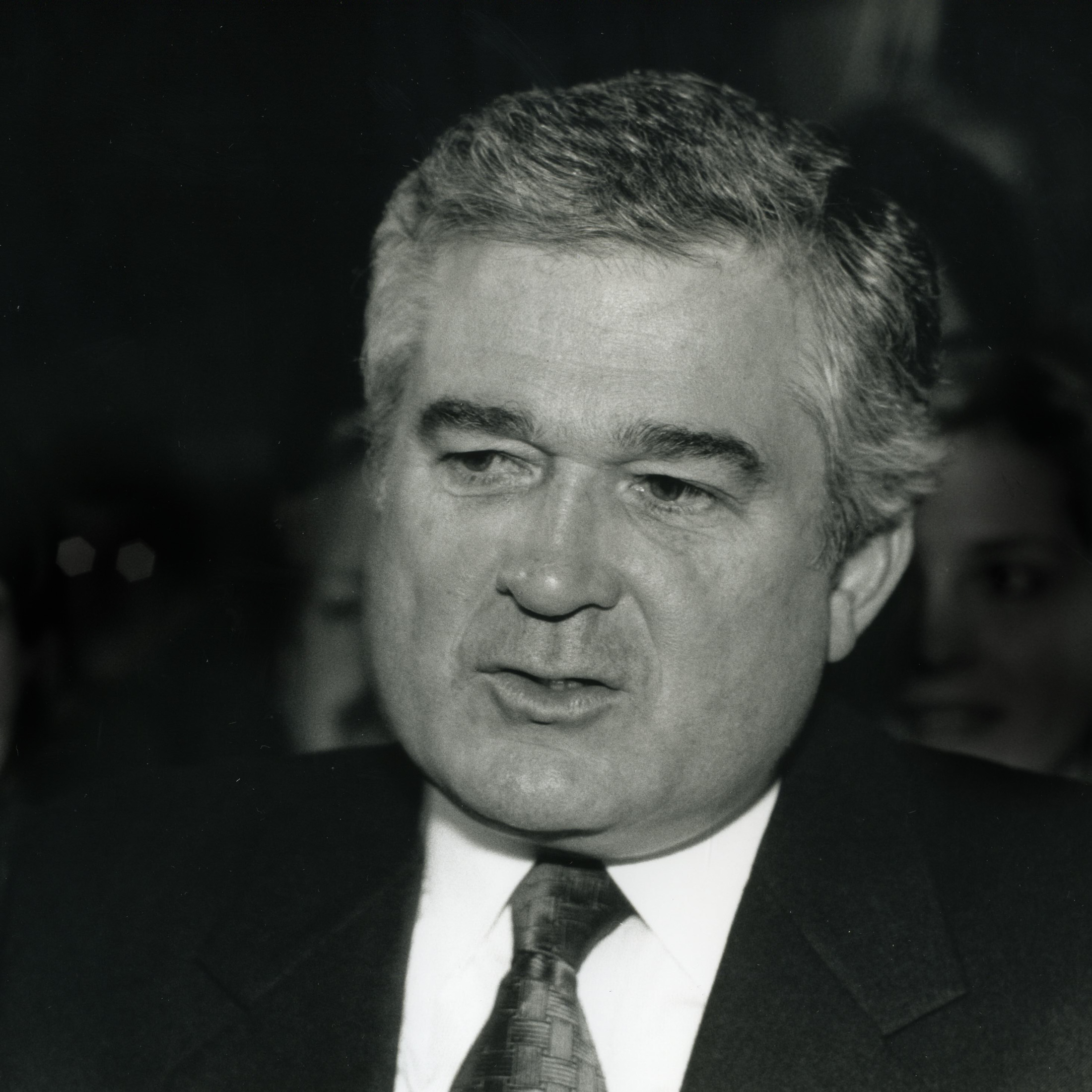
Louis V. Gerstner Jr., the outsider CEO who arrived at Ibm in 1993 when it was hemorrhaging more money than any company in American history and transformed it into a services powerhouse, died Saturday at 83. IBM Chairman and CEO Arvind Krishna announced his death in an email to employees Sunday.
The timing is poignant: Gerstner passes as IBM's market cap stands at $285 billion—nearly ten times the $29 billion valuation when he took over a company that many expected to disintegrate. The strategic foundation he built—the pivot from hardware to services, the decision to keep IBM unified, the relentless focus on enterprise clients—remains the blueprint IBM follows today.
The Crisis That Demanded an Outsider
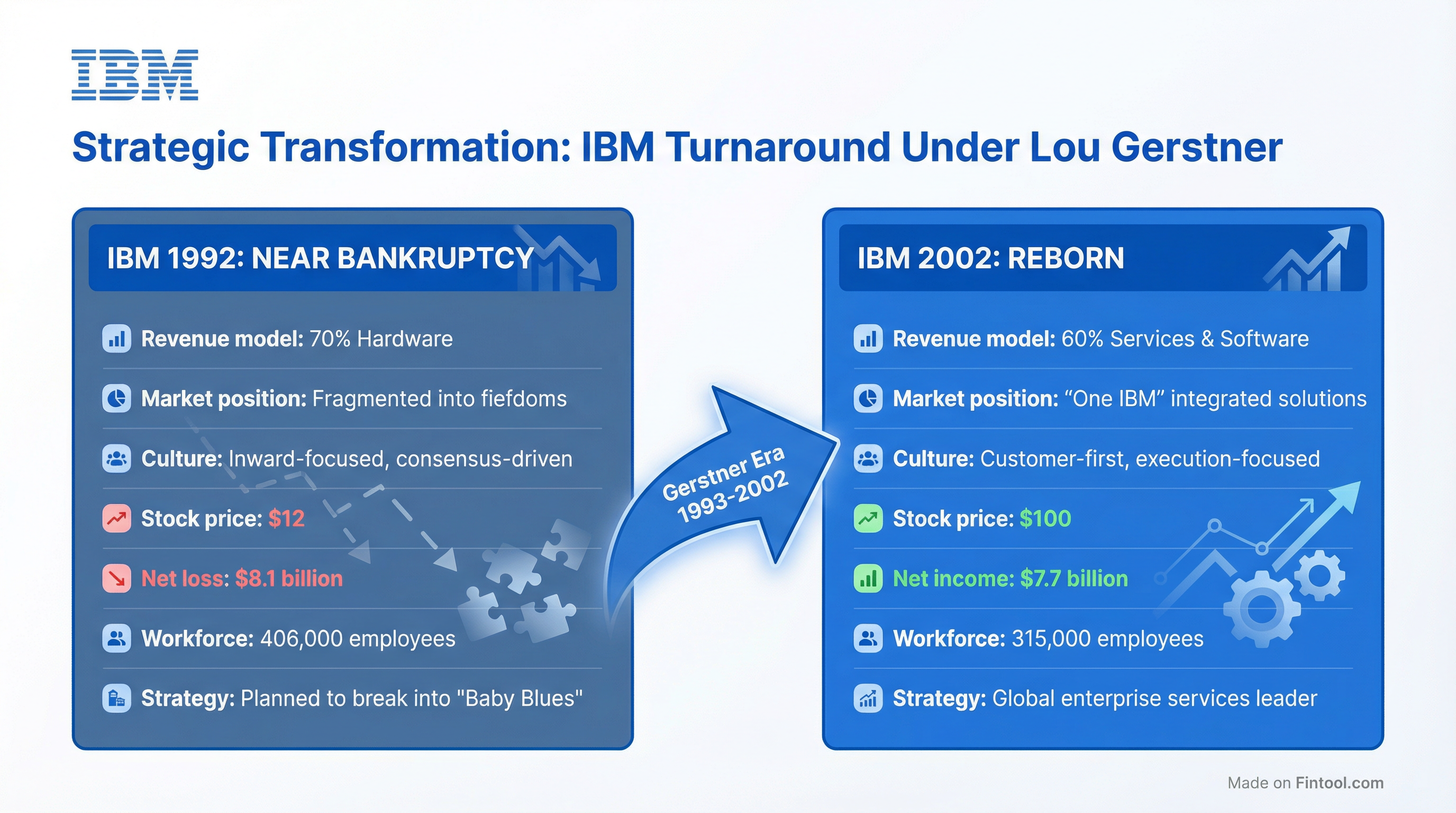
When Gerstner arrived on April 1, 1993—a date he later called fitting for "a fool's errand"—IBM had just reported an $8.1 billion loss for 1992, the largest annual loss in U.S. corporate history. The company that had dominated computing for decades had missed the PC revolution it helped create, watching as Microsoft and Intel captured the industry's profit pools while IBM's stock collapsed from $43 in 1987 to $12.
Bill Gates predicted IBM would fold within seven years. Wall Street analysts wrote the company off. The board, having exhausted internal candidates, turned to a 51-year-old executive with no technology experience: a McKinsey-trained strategist who had run American Express's card business and RJR Nabisco.
"Lou arrived at IBM at a moment when the company's future was genuinely uncertain," Krishna wrote in his tribute. "The industry was changing rapidly, our business was under pressure, and there was serious debate about whether IBM should even remain whole."
 Ask Fintool AI Agent
The Decision That Defined a Career
When Gerstner arrived, a plan was already well underway to break IBM into a collection of independent "Baby Blues"—separate companies for mainframes, software, services, and semiconductors. The logic seemed sound: smaller, nimbler competitors were eating IBM's lunch, so IBM should become smaller and nimbler too.
Gerstner killed the breakup plan. It was, he later wrote, "the most important decision I ever made—not just at IBM, but in my entire business career."
His insight, born from years watching enterprise clients at American Express and McKinsey, was counterintuitive: customers didn't want IBM to become another disk-drive company or another operating system company. They wanted someone to stand between them and the overwhelming complexity of enterprise computing. They wanted integrated solutions. They wanted One IBM.
Operation Bear Hug
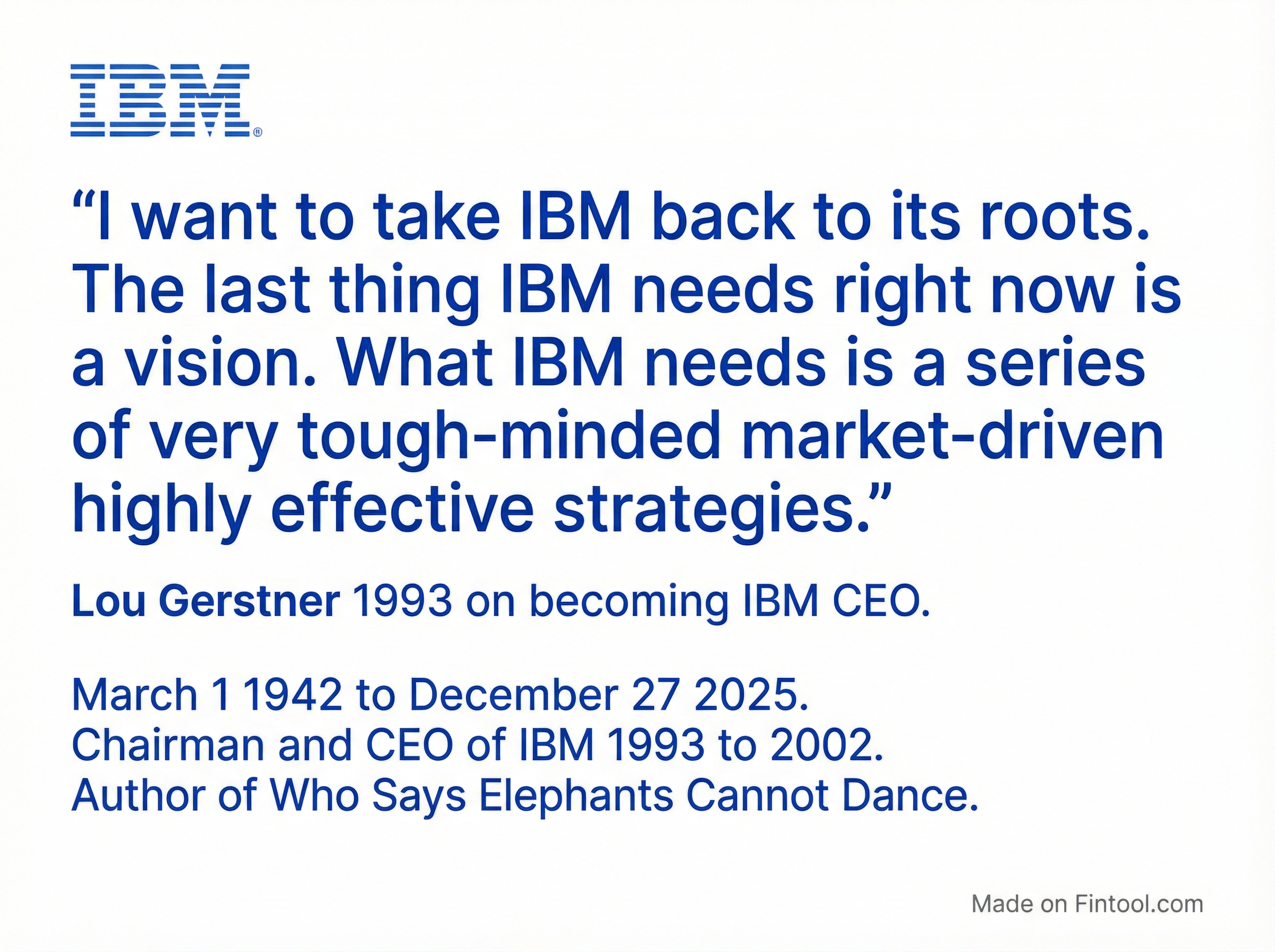
Within weeks of arriving, Gerstner launched "Operation Bear Hug," requiring every senior executive to visit customers directly and report what they learned. The message was clear: IBM had become a company optimized around its own processes rather than client outcomes.
"One of Lou's earliest signals as CEO has become part of IBM lore," Krishna recalled. "Early on, he stopped a long internal presentation and said, simply, 'Let's just talk.' The message was clear: less inward focus, more real discussion, and much closer attention to customers."
Bear Hug revealed what Gerstner suspected: clients felt IBM's products were too expensive and its organization impossible to navigate. Different IBM divisions competed against each other. Compensation tied to divisional performance encouraged turf protection over collaboration.
Gerstner's response was systematic:
| Reform | Impact |
|---|---|
| Unified compensation | Tied pay to IBM's total performance, not divisional results |
| Single ad agency | Consolidated dozens of agencies to Ogilvy & Mather for "One IBM" messaging |
| Price reductions | Cut mainframe prices rather than milk dying products |
| 35,000 layoffs | Reduced workforce from 406,000 to rebuild cost structure |
| $8.9B write-off | One of the largest in corporate history to clear restructuring costs |
Ask Fintool AI AgentThe Services Revolution
Gerstner's most lasting contribution was recognizing that IBM's future lay not in boxes but in services. In 1995, he launched IBM Global Services, betting that enterprises would pay premium prices for help navigating their increasingly complex technology environments.
The bet paid off spectacularly. By the time Gerstner retired in 2002, services and software represented over 60% of IBM's revenue, up from roughly 30% when he arrived. IBM Global Services alone generated over $30 billion annually, making it the largest IT services business in the world.
The implications rippled across the industry. Gerstner's IBM proved that technology companies could make enormous profits helping enterprises implement and manage technology, not just selling them hardware. Today's consulting giants—Accenture, Deloitte's tech practice, even parts of Microsoft and Oracle—owe their business models in part to the path Gerstner blazed.
IBM's current strategic focus—hybrid cloud and AI through its Software and Consulting segments—traces directly to the services-first foundation Gerstner established. "Over the past 5 years, IBM has shifted to higher growth areas, with approximately 75 percent of our business mix in Software and Consulting," the company notes in its latest annual report.
The Numbers Tell the Story
The transformation Gerstner engineered remains one of the most dramatic in corporate history:
| Metric | 1993 (Arrival) | 2002 (Retirement) | Change |
|---|---|---|---|
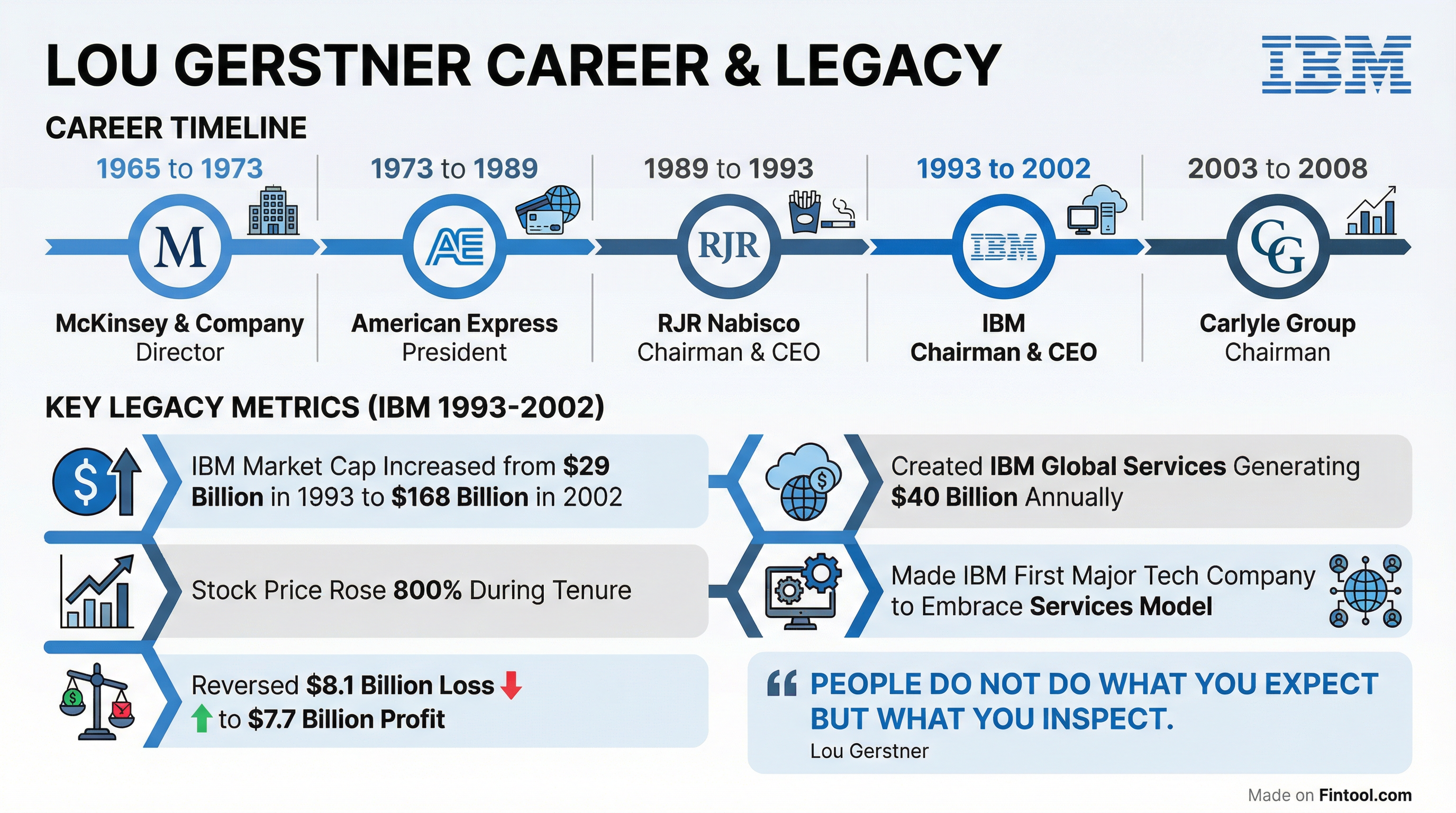
| Stock Price | $12 | $100 | +733% |
| Market Cap | $29B | $168B | +480% |
| Net Income | -$8.1B (1992) | +$7.7B | Turnaround |
| Revenue Mix | 70% Hardware | 60% Services/Software | Strategic pivot |
| Workforce | 406,000 | 315,000 | -22% |
Today, IBM trades at $305 per share with a market capitalization of $285 billion. The company generated $62 billion in revenue in FY 2024 , with net income of $6 billion and operating cash flow of $13.4 billion .
Ask Fintool AI Agent"Who Says Elephants Can't Dance?"
In 2002, Gerstner published Who Says Elephants Can't Dance?, a first-person account of the IBM turnaround that became a bestseller and business school staple. The title captured his central thesis: large enterprises could move as decisively as startups if leadership aligned culture, strategy, and incentives.
The book revealed Gerstner's disdain for what he found at IBM—"an extraordinary inward focus" and "fiefdoms" that prioritized internal competition over client outcomes. He compiled a list of IBM-specific vocabulary that baffled him, signaling how disconnected the company had become from the broader business world.
"Lou believed lasting change required a shift in culture—in how people behave when no one is watching," Krishna noted. "What mattered was what IBMers valued, how honestly they confronted reality, and how willing they were to challenge themselves and each other."
Beyond IBM
Gerstner's career arc traced the evolution of American business leadership. At McKinsey (1965-1973), he became one of the youngest partners in firm history. At American Express (1973-1989), he built the card business into a powerhouse. At RJR Nabisco (1989-1993), he tackled the debt mountain left by the leveraged buyout that inspired Barbarians at the Gate, paring $25 billion in obligations down to $14 billion.
After IBM, he chaired private equity giant The Carlyle Group from 2003 to 2008. He devoted substantial time to education philanthropy, co-authoring Reinventing Education and establishing programs at IBM to integrate technology into public schools. Queen Elizabeth II made him an honorary Knight Commander of the Order of the British Empire in 2001 for his contributions to education.
"Lou was direct. He expected preparation. He challenged assumptions," Krishna reflected. "But he was deeply committed to building a company that could adapt—culturally as much as strategically—without losing its core values."
Ask Fintool AI AgentThe Legacy in Today's IBM
Gerstner's strategic DNA runs through IBM's current positioning. The company's focus on hybrid cloud and AI—helping enterprises navigate complex multi-cloud environments and integrate artificial intelligence into business workflows—is a direct descendant of his services-first vision.
"Our strategy aligns with the needs of our clients," IBM's 2024 annual report states. "Companies are increasingly deploying technology workloads across environments where the business runs... IBM is strategically positioned to help clients unlock their next chapter of technology-led business growth."
IBM Consulting, the successor to IBM Global Services, now boasts the world's largest Red Hat practice and strategic partnerships with Amazon Web Services, Microsoft, Oracle, and Sap—the "coopetition" model Gerstner pioneered.
Even IBM's recent acquisition strategy—the $6.4 billion HashiCorp deal for infrastructure automation, the $2.3 billion Software AG assets purchase—reflects Gerstner's playbook of bolstering capabilities through strategic M&A rather than organic development alone.
Personal Life and Family
A native of Mineola, New York, Gerstner earned his engineering degree from Dartmouth College (1963) and an MBA from Harvard Business School (1965). He was devoted to his family throughout his life—his wife Robin, daughter Elizabeth, and grandchildren. He was preceded in death by his son Louis Gerstner III.
IBM plans a celebration in the new year to reflect on Gerstner's legacy and what his leadership enabled.
Ask Fintool AI AgentWhat to Watch
Near-term: Markets will watch how IBM commemorates Gerstner's legacy and whether leadership reinforces commitment to his strategic vision during any tributes.
Medium-term: The HashiCorp acquisition, expected to close in 2025, represents IBM's latest bet on the Gerstner playbook—strategic acquisitions that strengthen enterprise services capabilities.
Long-term: As AI reshapes enterprise computing, IBM's ability to remain the trusted integrator for complex technology environments will determine whether Gerstner's transformation endures or becomes another chapter of corporate history.
Related
- International Business Machines Corporation — The company Gerstner saved
- Microsoft Corporation — Competitor that defined the PC era IBM missed
- Accenture PLC — Services giant that followed IBM's lead
- Oracle Corporation — Enterprise software competitor and IBM partner