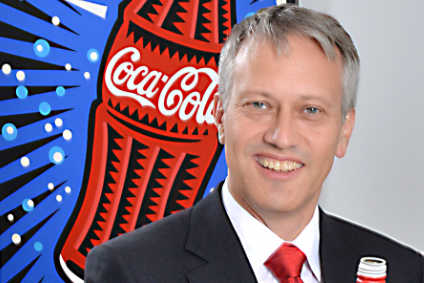
James Quincey
 COCA COLA
About James Quincey
James Quincey is Chairman and Chief Executive Officer of The Coca‑Cola Company (CEO since May 2017; Chairman since April 2019), age 60, with 25+ years of Coca‑Cola system experience across Latin America and Europe . KO’s 2024 performance underpinning his incentive framework included organic revenue growth of 12%, comparable currency-neutral operating income growth of 16%, and comparable EPS growth of 7% . The CEO’s annual incentive metrics used net operating revenue growth and operating income growth, each paying at 200% of target in 2024 (combined with inclusion goals), driving a 190% Business Performance Factor . Over the 2022–2024 PSU period, financial measures exceeded maximum targets, yielding a 190% payout (with sustainability and TSR modifiers applied) .
Past Roles
| Organization | Role | Years | Strategic Impact |
|---|---|---|---|
| The Coca‑Cola Company | Chief Executive Officer | May 2017–present | Led “all‑weather” growth strategy and marketing/digital transformation; integrated generative AI into marketing and operations . |
| The Coca‑Cola Company | Chairman of the Board | Apr 2019–present | Combined Chair/CEO structure; chairs Executive Committee; works closely with global bottlers and senior leadership . |
| The Coca‑Cola Company | President & COO | Aug 2015–Apr 2017 | Responsible for all operating units worldwide; strengthened system alignment and execution . |
| The Coca‑Cola Company | President, Europe Group | Jan 2013–Aug 2015 | Drove portfolio/pack/price/channel strategies; innovated brand portfolio in Europe . |
| The Coca‑Cola Company | President, Northwest Europe & Nordics | Oct 2008–Jan 2013 | Led acquisition of innocent juice; improved execution . |
| The Coca‑Cola Company | President, Mexico Division | Dec 2005–Oct 2008 | Built successful brand/pack/price/channel strategy replicated globally . |
| The Coca‑Cola Company | President, South Latin Division | Dec 2003–Dec 2005 | Operational leadership across Latin America . |
| The Coca‑Cola Company | Director, Learning Strategy (LATAM) and other operational roles | Since 1996 | Early roles in Latin America; foundation for global operational leadership . |
External Roles
| Organization | Role | Years | Strategic Impact |
|---|---|---|---|
| Pfizer Inc. | Director | 2020–present | Public company board; cross‑industry perspective in healthcare . |
| Special Olympics; US‑China Business Council; Consumer Goods Forum | Board/Member | Various | Engagement with global NGOs and industry bodies; policy and stakeholder relations . |
Fixed Compensation
| Metric | FY 2022 | FY 2023 | FY 2024 |
|---|---|---|---|
| Base Salary ($) | $1,600,000 | $1,600,000 | $1,656,250 |
| Target Annual Incentive ($) | Not disclosed in table | Not disclosed in table | $3,350,000 (200% of base salary) |
| Non‑Equity Incentive Paid ($) | $6,080,000 | $6,080,000 | $6,365,000 |
| All Other Compensation ($) | $519,145 | $625,056 | $847,056 |
Performance Compensation
| Component | Metric | Weight | Target | Actual | Payout / Result | Vesting |
|---|---|---|---|---|---|---|
| 2024 Annual Incentive | Net Operating Revenue Growth (organic, non‑GAAP) | 45% (CEO) | 7.5% | 12.0% | 200% | Annual (cash) |
| 2024 Annual Incentive | Operating Income Growth (comparable currency‑neutral, adjusted) | 45% (CEO) | 10.0% | 18.0% | 200% | Annual (cash) |
| 2024 Annual Incentive | Inclusion Components | 10% | Progress | Achieved (60% qualitative/40% quantitative) | 100% | Annual (cash) |
| 2022–2024 PSU Program | Net Operating Revenue CAGR | 30% | 5.0% | Above max | Max (within a 190% overall) | 3‑year |
| 2022–2024 PSU Program | EPS CAGR | 30% | 8.0% | Above max | Max | 3‑year |
| 2022–2024 PSU Program | Cumulative Free Cash Flow ($B) | 30% | $30.6 | Above max | Max | 3‑year |
| 2022–2024 PSU Program | Packaging: Global rPET Usage Rate | 5% | 25.0% | Below threshold | Below | 3‑year |
| 2022–2024 PSU Program | Water Replenishment Rate | 5% | 70.0% | Above max | Max | 3‑year |
| PSU Payout Modifier | Relative TSR | Modifier | 25th–75th percentile band | Within band | No up/down trigger | — |
Additional 2024 grants: PSUs 167,087 and options 835,436 for Quincey (exercise/base price $60.28/$60.40) ; Business Performance Factor for CEO was 190% .
Equity Ownership & Alignment
- Beneficial ownership: 4,099,518 shares (includes 3,704,229 options exercisable by/ before May 2, 2025; 200 restricted stock; 8,065 shares in 401(k)), plus family member holdings; excludes 30,582 supplemental 401(k) share units (cash‑settled) .
- Outstanding shares were 4,301,000,395 as of Feb 18, 2025 ; James Quincey’s direct beneficial ownership is therefore under 0.1% of outstanding shares (calculation based on cited figures) .
- Unvested/uneared equity at FY‑end 2024: 259,310 RSUs/units not vested (MV $16,144,641) and 627,548 unearned PSU shares not vested (MV $39,071,138) .
- 2024 vesting/exercises: 443,544 PSU shares released ($26,297,724 value realized); 144,930 options exercised ($4,077,817 value realized) .
- Policies: KO prohibits hedging, short selling, and pledging of company stock by Directors and Section 16 officers; requires pre‑clearance and trading windows; supports 10b5‑1 plan usage .
- Stock ownership guidelines: all NEOs compliant; stock options do not count; PSUs count only after performance met; enforcement includes potential withholding of up to 50% of annual incentive and mandating retention of 100% of net shares until compliant .
Employment Terms
- Severance plan: maximum cash severance benefit equals two years of base pay (lump sum); for Quincey, involuntary termination severance shown as $3,350,000 (reflecting his $1,675,000 base salary) .
- Change‑in‑control: no individual CIC agreements or tax gross‑ups; equity uses “double‑trigger” provisions (requires CIC plus qualifying termination) . For Quincey, illustrative CIC + termination benefits totaled $39,982,642, comprised of accelerated equity (options and PSUs) and guaranteed target annual incentive; severance under the plan not assumed in CIC column .
- Clawback: NYSE/SEC‑aligned accounting restatement clawback plus broader recoupment for policy violations, reputational harm, confidentiality breaches, competitive employment, and solicitation, during employment and up to the later of one year post‑separation or payment .
- Director compensation: as an employee, Quincey does not receive payment under the Directors’ Plan .
Board Governance
- Roles: Combined Chairman & CEO; chairs Executive Committee; not independent under NYSE rules .
- Safeguards: Robust Lead Independent Director role (David B. Weinberg), with authority over agendas, information flow, executive sessions, CEO evaluation, shareholder communications, and succession planning .
- Committees: Independent Audit, Talent & Compensation, Corporate Governance & Sustainability, and Finance Committees; overall meeting attendance ~98% in 2024 .
Director Compensation (for directors; CEO excluded)
- Non‑employee directors receive $90,000 cash retainer and $200,000 equity retainer in deferred share units; additional fees for certain chair roles and Lead Independent Director; no meeting fees; deferred units paid in cash post‑service; CEO receives none .
Performance & Track Record
- KO’s 2024 highlights include organic revenue +12%, comparable currency‑neutral operating income +16%, comparable EPS +7%, and $10.8B free cash flow excluding an IRS deposit; $8.4B returned to shareholders .
- Pay‑versus‑performance: 2024 PEO (CEO) “compensation actually paid” $40.6M vs SCT total $28.0M; TSR value of initial fixed $100 was 131 for KO vs 121 for peer group; organic revenue growth 12.0% .
Compensation Structure Analysis
- Mix and pay‑for‑performance: In 2024, ~94% of CEO total direct compensation was performance‑based; annual metrics were set above long‑term plan midpoints due to inflationary backdrop, and paid at maximum on financial measures, with inclusion goals achieved .
- Equity design: PSU program balances growth (revenue, EPS, FCF) with sustainability (rPET, water) and TSR modifier; 2022–2024 payout was 190% as a function of overachievement on core financials .
- Risk controls: Award caps, multiple measures, clawbacks, ownership/retention guidelines, and prohibition of hedging/pledging mitigate risk; no option repricing; equity burn rate maintained at ≤0.4% .
Investment Implications
- Alignment: Strong linkage of pay to growth and returns (annual and PSU metrics), high performance payout in 2024, and strict ownership/retention plus anti‑pledging policies support long‑term alignment .
- Supply overhang considerations: Significant PSU releases (443,544 shares) and option exercises in 2024 could contribute to periodic supply; KO’s trading window and 10b5‑1 framework can moderate market impact .
- Governance: Combined Chair/CEO structure introduces oversight scrutiny; KO’s empowered Lead Independent Director and independent committees provide counterbalances .
- Downside protection: Double‑trigger CIC and standardized severance (2x base) avoid single‑trigger windfalls; comprehensive clawback extends beyond financial restatements .


