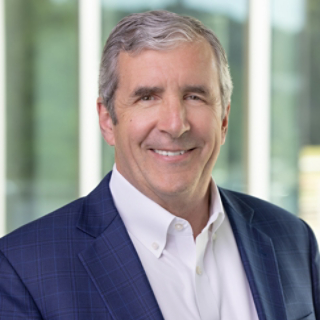
David Regnery
 Trane Technologies
About David Regnery
Chair and CEO of Trane Technologies since July 1, 2021 (Chair since Jan 1, 2022), David S. Regnery, 62, has spent his entire career at the company, previously serving as President and COO with global responsibility for regional segments and mission-critical operations (supply chain, engineering, IT) . Under his leadership, 2024 revenue grew 12% to $19.8B, adjusted EBITDA rose 21% to $3.8B, and free cash flow increased ~30% to $2.8B; three-year CROIC reached 32.3% (78th percentile) and three-year TSR 101.96% (84th percentile) versus S&P 500 Industrials, driving a 200% PSU payout for 2022–2024 . The board combines the Chair/CEO role with a strong Lead Independent Director structure to address independence and oversight .
Past Roles
| Organization | Role | Years | Strategic Impact |
|---|---|---|---|
| Trane Technologies | Chair of the Board | 2022–present | Combined Chair/CEO leadership; chairs Executive Committee |
| Trane Technologies | Chief Executive Officer | 2021–present | Led global portfolio through strong commercial HVAC outgrowth and elevated backlog; drove performance-based pay outcomes |
| Trane Technologies | President & Chief Operating Officer | 2020–July 2021 | Direct responsibility for regional segments and core operations (supply chain, engineering, IT) |
| Trane Technologies | Leadership roles across businesses (Commercial HVAC, Transport Refrigeration) | Prior years | Led majority of businesses globally |
External Roles
| Organization | Role | Years | Notes |
|---|---|---|---|
| L3Harris Technologies (NYSE: LHX) | Director | Current | Public company board service |
| World Economic Forum | Alliance of CEO Climate Leaders member | Current | External leadership network |
Fixed Compensation
| Metric | 2022 | 2023 | 2024 |
|---|---|---|---|
| Base Salary ($) | 1,237,500 | 1,362,500 | 1,456,250 |
| Base Salary Rate ($, year-end) | — | — | 1,475,000 (effective Apr 1, 2024) |
Performance Compensation
2024 Annual Incentive (AIM) – Design and Outcomes (Enterprise)
| Item | Detail |
|---|---|
| Structure | Equal weighting: 1/3 Revenue, 1/3 Adjusted EBITDA, 1/3 Cash Flow; payout 30% at threshold, 100% at target, 200% at max; sustainability modifier +/-20% |
| 2024 Targets vs Actuals (Enterprise) | Revenue: Threshold $18,438.5M; Target $19,008.8M; Max $19,579.0M; Actual $19,904.1M (above max) . Adjusted EBITDA: Threshold $3,201.1M; Target $3,556.7M; Max $3,912.4M; Actual $3,837.9M (between target and max) . Cash Flow: Threshold $1,851.8M; Target $2,314.7M; Max $2,777.7M; Actual $2,791.2M (above max) . |
| Financial Score | 193.02% (Enterprise-aligned NEOs) |
| Sustainability Modifier | 0% (no positive or negative adjustment) |
| CEO AIM Target ($) | $2,433,750 |
| CEO AIM Payout for 2024 ($ and %) | $4,867,500 at 200% of target |
Long-Term Incentives (LTI) – Structure and 2024 Grants
- Mix: 50% PSUs (PSP), 25% Stock Options, 25% RSUs; options/RSUs vest ratably over 3 years; options expire at 10 years .
- PSU metrics: 3-year relative CROIC and relative TSR vs S&P 500 Industrials, equal weight; 200% payout at >75th percentile, 100% at 50th .
- 2022–2024 PSU payout: 200% (CROIC 32.3% at 78th percentile; TSR 101.96% at 84th) .
| 2024 LTI Award Component | Grant Date | Shares/Units | Terms |
|---|---|---|---|
| PSUs (2024–2026) Target | 2/6/2024 | 23,684 | Earned 0–200% based on relative CROIC/TSR; 3-year performance period |
| RSUs | 2/6/2024 | 11,842 | Vests 1/3 per year over 3 years |
| Stock Options | 2/6/2024 | 41,711 at $270.23 | Vests 1/3 per year over 3 years; 10-year term |
Special Outperformance Incentive Program (2024–2026)
| Feature | CEO Terms |
|---|---|
| Purpose | Additional cash incentive for outsized 3-year revenue growth beyond AIM’s maximum, subject to 25%+ enterprise organic leverage and 3-year attainment |
| Payout Range | Threshold $750,000; Target $3,000,000; Max $6,000,000 |
| 2024 Run-rate | Based solely on year 1, 2024 results equated to a potential average payout of 166% of target at period end if sustained; no vesting until end of 3 years |
Equity Ownership & Alignment
Ownership Guidelines and Policies
- Executive stock ownership: CEO requirement 6x base salary; NEO actual average multiple 27.4x (all NEOs employed met requirements as of record date) .
- Anti-hedging/pledging: Prohibited; no margin accounts or pledging of company securities .
- Clawback: SEC/NYSE-compliant policy covering excess incentive-based compensation and reputational harm, administered by HRCC .
Beneficial Ownership and Outstanding Equity (as of 12/31/2024)
| Holding | Amount |
|---|---|
| Ordinary Shares Owned | 106,022 |
| Notional Shares (deferred) | 475 |
| Options Exercisable Within 60 Days | 308,705 |
Unvested/Unearned Awards at 12/31/2024:
- RSUs unvested and market value per grant:
- 2022 Grant: 3,988 RSUs ($1,472,968)
- 2023 Grant: 10,622 RSUs ($3,923,236)
- 2024 Grant: 11,842 RSUs ($4,373,843)
- PSUs (target) unearned and payout value per grant:
- 2022 Grant: 23,927 target PSUs ($17,674,875)
- 2023 Grant: 31,865 target PSUs ($23,538,676)
- 2024 Grant: 23,684 target PSUs ($13,121,528)
Options Outstanding (selected):
- Unexercised (Exercisable): series including 22,497 @ $62.53; 43,778 @ $70.22; 48,091 @ $78.97; 38,946 @ $105.28; 26,316 @ $148.98; 19,434 @ $186.20 .
- Unexercisable: 18,576 @ $167.18 (2022 grant); 40,014 @ $180.45 (2023); 41,711 @ $270.23 (2024); market price at 12/31/24 was $369.35 .
2024 Realizations:
| 2024 Equity Activity | Quantity | Value Realized ($) |
|---|---|---|
| Options Exercised | 29,450 | 8,312,480 |
| Shares Vested (RSUs/PSUs) | 48,048 | 13,547,365 |
Employment Terms
Severance and Change-in-Control (CIC) Economics
| Provision | Key Terms |
|---|---|
| Severance (without cause) | Employment agreement provides 2x base salary plus pro‑rated AIM earned for the year, payable at year-end per AIM rules; equity generally prorated and continues vesting per award terms (e.g., 12 months acceleration for non-retirement eligible) . |
| CIC protection | Double-trigger: payouts only if terminated without cause or for good reason within 2 years post-CIC; CEO receives 3x (base salary + target AIM or 3-year average AIM if higher); equity vesting per 2018 Plan (time-based vests if not assumed or upon qualifying termination; PSUs vest at target pro-rated or actual performance per HRCC); welfare benefits continuation and up to $100,000 outplacement . |
| Major Restructuring Severance Plan | If termination linked to a Major Restructuring (non-CIC), CEO receives 2.5x (current base salary + target AIM); pro‑rated AIM payout based on actuals; equity vests/accelerates per award rules; illustrative unvested equity values disclosed (see below) . |
| Clawback | Recovery of excess incentive comp following restatement; HRCC discretion for broader recoupment in misconduct or reputational harm . |
Potential Payments as of 12/31/2024 (CEO)
| Scenario | Severance ($) | Earned but Unpaid AIM ($) | PSU Payout ($) | Value of Unvested Equity ($) | Enhanced Retirement Benefits ($) | Health Benefits ($) | Outplacement ($) | Total ($) |
|---|---|---|---|---|---|---|---|---|
| Voluntary Resignation/Retirement | — | 4,867,500 | 25,435,288 | 25,218,595 | — | — | — | 55,521,383 |
| Involuntary Without Cause | 2,950,000 | 9,735,000 | 25,435,288 | 25,218,595 | — | — | 11,400 | 63,350,283 |
| Change in Control (double-trigger) | 16,381,026 | 4,059,149 | 25,431,594 | 25,218,595 | 6,356,754 | 81,069 | 100,000 | 77,628,187 |
| Death/Disability | — | 4,867,500 | 25,435,288 | 25,218,595 | — | — | — | 55,521,383 |
Notes: CIC is double-trigger; CEO severance multiple under CIC is 3x salary+bonus; no single-trigger vesting; no tax gross-ups for CIC severance (company practice) .
Board Governance
- Board structure: 11 of 12 director nominees are independent; Regnery is the sole non-independent (employee director) .
- Combined Chair/CEO with Lead Independent Director; duties include setting agendas with CEO, leading executive sessions, succession oversight, and shareholder liaison; John P. Surma to serve as Lead Independent Director effective AGM (subject to re‑election) .
- Committees: Regnery chairs the Executive Committee; all other committees comprise independent directors only .
- Attendance: All incumbent directors at year-end 2024 attended ≥75% of Board meetings; independent directors held five executive sessions in FY2024 .
- Director pay: Employee directors receive no additional director compensation (non‑employee directors only) .
Compensation Committee Analysis and Pay Governance
- HRCC members (all independent): Chair Kirk E. Arnold; members Ana P. Assis, April Miller Boise, John A. Hayes, Linda P. Hudson .
- Independent advisor: Meridian Compensation Partners; HRCC determined independence and no conflicts .
- Pay program features: >91% of CEO TDC performance‑based in 2024; diversified metrics (AIM: revenue/EBITDA/cash flow; PSUs: relative CROIC/TSR); robust clawback; strong ownership guidelines; no single‑trigger CIC vesting; no tax gross‑ups; no option repricing .
- Say‑on‑Pay: 87% shareholder support in 2024; annual vote frequency maintained through 2029 .
- Compensation peer group (used for benchmarking): Carrier, Cummins, Danaher, Dover, Eaton, Emerson, Fortive, Honeywell, Illinois Tool Works, Johnson Controls, Lennox, Otis, Parker-Hannifin, Rockwell Automation, TE Connectivity .
Performance & Track Record
- 2024 enterprise performance: Revenue $19.8B (+12% YoY), adjusted EBITDA $3.8B (+21%), free cash flow $2.8B (+29.7%); modifier-aligned sustainability achievements disclosed .
- 2022–2024 value creation: CROIC 32.3% (78th percentile) and TSR 101.96% (84th percentile) vs S&P 500 Industrials, resulting in 200% PSU payout .
- 2025 trajectory: Q3 2025 set record bookings ($6B), strong applied solutions order growth (>100%), and elevated commercial HVAC backlog; reaffirmed focus on services growth and balanced capital deployment .
- Shareholder engagement: Met ~300 unique investors in 2024, covering ~80% of active outstanding shares .
Vesting Schedules and Potential Selling Pressure
- Standard vesting: RSUs and stock options vest 1/3 annually over three years; options 10-year term .
- 2024–2026 PSUs: Payout 0–200% based on relative CROIC/TSR; vest at cycle end .
- 2024 realizations indicate liquidity events: 29,450 options exercised ($8.31M realized); 48,048 shares vested ($13.55M realized) in 2024; future scheduled vesting (RSUs/options) and PSU cycle outcomes may create additional trading windows, subject to insider trading policy and blackout periods .
Equity Ownership & Alignment Controls
- Ownership compliance: CEO ownership multiple (6x salary) policy; NEO average 27.4x; mandatory hold-until-compliant rules .
- No hedging/pledging: Directors and executive officers are prohibited from hedging or pledging company stock, and from margin accounts .
- No dividends on unvested awards: No dividends on unvested restricted stock or equivalents until vesting (consistent with plan design) .
Say‑on‑Pay & Shareholder Feedback
- 2024 Say‑on‑Pay support: 87%; HRCC maintained core program and added outperformance incentive based on investor feedback and market analysis .
- Ongoing investor outreach: Robust year‑round engagement; board and management input integrated into program design .
Related-Party Transactions and Red Flags
- Related-party: None requiring disclosure in FY2024 .
- Perquisites: CEO required to use company aircraft for business and personal travel for security and availability; personal use capped at $150,000; 2024 “All Other Compensation” included aircraft usage and tax equalization related to director role’s Irish taxes .
- No CIC gross-ups; no single-trigger vesting; no option repricing .
Compensation Structure Summary (Pay-for-Performance)
| Component | Design & Alignment |
|---|---|
| Base Salary | Competitive, with 2024 rate at $1.475M effective Apr 1, 2024 . |
| Annual Incentive (AIM) | Balanced growth/profit/cash metrics, +/- sustainability modifier; 200% cap; CEO 200% payout in 2024 . |
| LTI | 50% PSUs (relative CROIC/TSR), 25% options, 25% RSUs; three-year PSU cycle; strong historical PSU outcomes (200% for 2022–2024) . |
| Special Outperformance Plan | 2024–2026 cash plan for outsized revenue growth with profitability guardrails; CEO max $6M; self-funding design . |
Investment Implications
- Strong alignment: High proportion of at‑risk pay (AIM + PSUs), rigorous relative CROIC/TSR, and strict ownership/anti‑hedging policies align CEO incentives with long‑term TSR and cash returns .
- Execution momentum: Above‑target 2024 performance, 200% PSU payout (2022–2024), record bookings/backlog in 2025, and durable services growth support medium‑term earnings power and cash conversion .
- Watch items: Combined Chair/CEO structure partially mitigated by a robust Lead Independent Director role; significant scheduled vesting and in‑the‑money options (vs $369.35 at 12/31/24) may create periodic selling windows, though subject to policy constraints .
- Downside protections: No single‑trigger CIC vesting and no gross‑ups; double‑trigger CIC policy is shareholder‑friendly, though total CIC exposure is sizable given accrued pension (KMP present value $22.68M) and equity position .
