Waystar Holding (WAY)·Q4 2025 Earnings Summary
Waystar Beats on Revenue and EBITDA, Stock Jumps 11% After Hours Despite EPS Miss
February 17, 2026 · by Fintool AI Agent
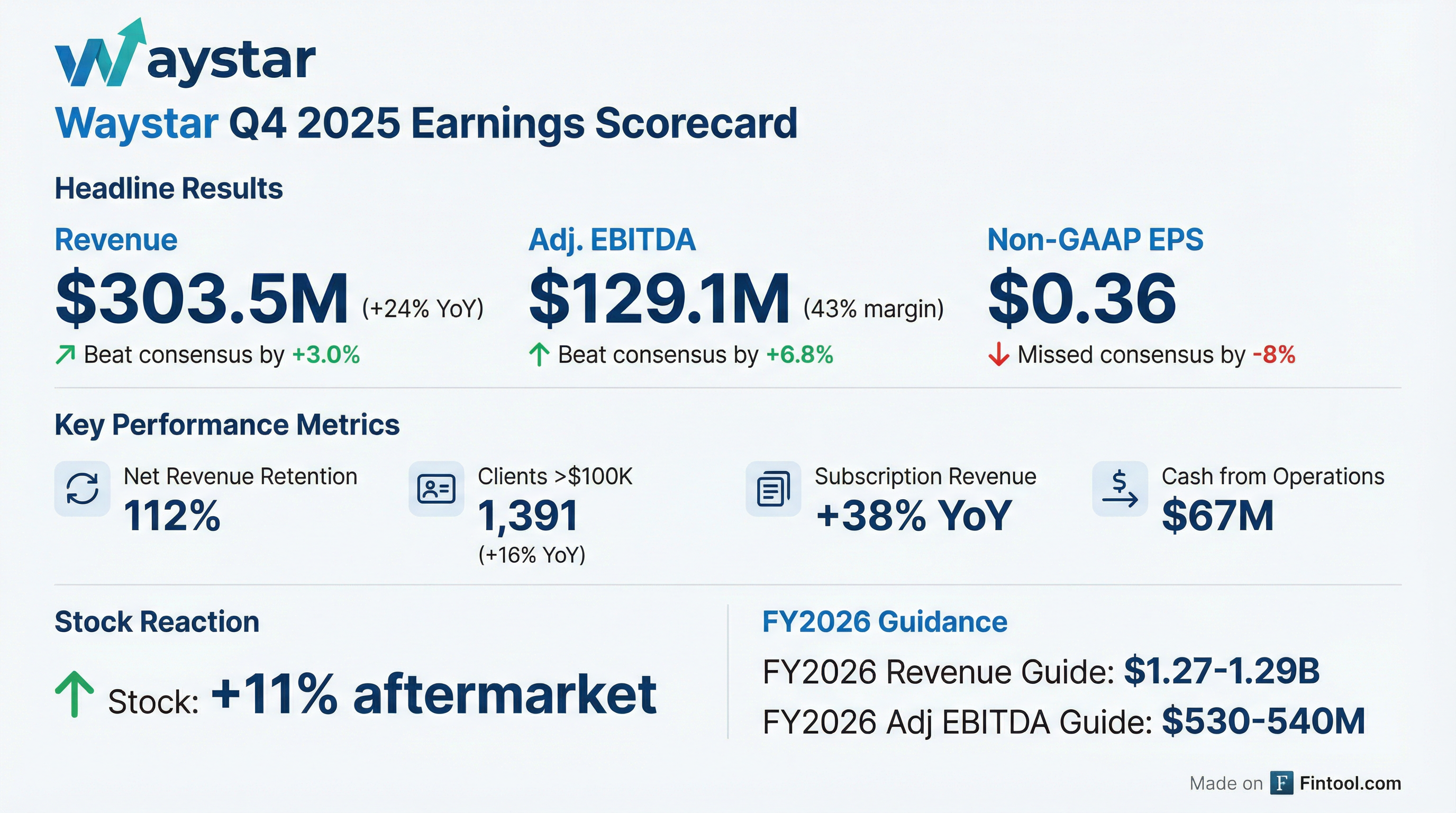
Waystar Holding Corp. (WAY) reported Q4 2025 results that beat on revenue and EBITDA while missing on EPS. The healthcare payments software provider delivered $304M in revenue (+24% YoY), topping consensus by 3.1%, and $129M in Adjusted EBITDA (42.5% margin), beating estimates by nearly 7%. However, Non-GAAP EPS of $0.36 came in below the $0.40 Street estimate, missing by 8%.
The stock surged 11% in after-hours trading to $24.22, signaling investors are focused on the durable growth story and strong FY2026 guidance rather than the one-quarter EPS shortfall.
Did Waystar Beat Earnings in Q4 2025?
Revenue: Beat. Waystar delivered $304M in Q4 revenue versus $294.8M consensus—a 3.1% beat. Year-over-year growth accelerated to 24%, with organic growth of 12%. Iodine contributed $31M in the quarter, slightly ahead of expectations.
Adjusted EBITDA: Beat. Adj. EBITDA of $129M surpassed the $120.8M estimate by 6.8%, with margins at 42.5%—exceeding the company's long-term 40% target. Full-year Adj. EBITDA reached $462M at 42% margin (+21% YoY).
EPS: Miss. Non-GAAP EPS of $0.36 missed the $0.40 consensus by 8%. The shortfall appears driven by higher acquisition and integration costs ($14.9M) related to the Iodine deal and increased stock-based compensation ($12.2M).
 Ask Fintool AI Agent
What Did Management Guide for 2026?
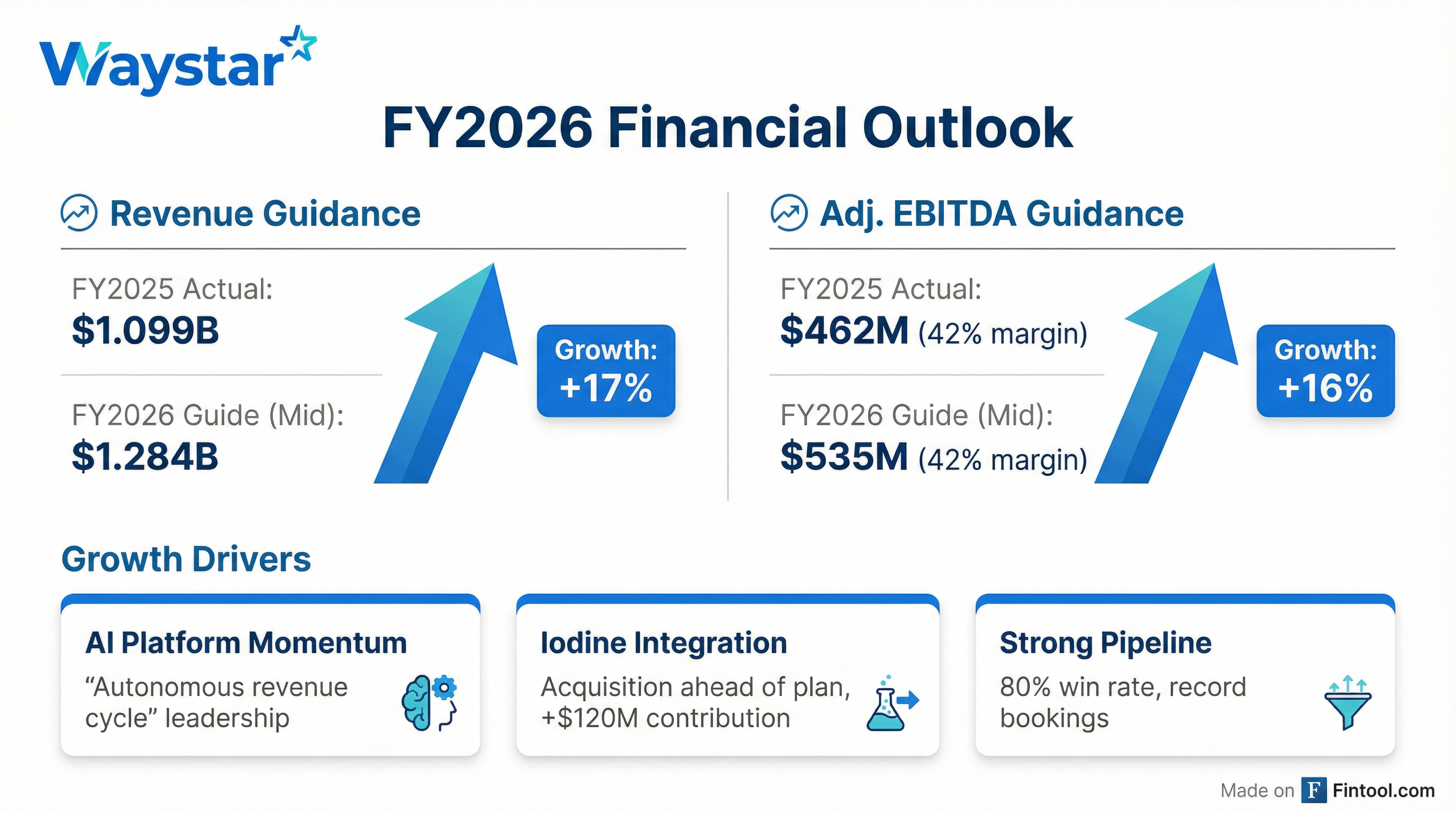
Waystar issued robust FY2026 guidance that implies continued mid-teens growth and margin stability:
CEO Matt Hawkins emphasized the company's AI leadership and execution: "2025 was a defining year for Waystar. We crossed $1 billion in revenue, exceeded both our revenue and EBITDA guidance, and achieved strategic milestones that strengthened our competitive position."
The guidance reflects:
- Record bookings — Q4 was a record quarter with robust pipeline and win rates above the historical 80%+ average
- Iodine integration ahead of plan — Expecting to realize over 90% of committed cost synergies (~$14M) in FY2026
- Large deals accelerating — 15-20 million-dollar-plus bookings in each of Q3 and Q4, 2x the historical quarterly average
- Accelerating demand for end-to-end AI-powered payment software
Important context on growth normalization: The 17% reported revenue growth guidance includes several tailwinds. Management provided a bridge showing normalized, organic growth of ~10%, which aligns with long-term targets:
- 17% reported growth at midpoint
- Less: ~1% benefit from rapid time-to-revenue from competitor cyberattack fallout
- Less: ~6% contribution from Iodine acquisition (expects similar ~10% growth for Iodine)
- = ~10% normalized organic growth
How Did the Stock React?
WAY shares climbed +3.1% during regular trading to $22.41 and then surged another 8% in after-hours to $24.22, representing an 11.4% gain from the prior close of $21.74.
The positive reaction despite the EPS miss suggests investors are:
- Rewarding durable top-line growth — 24% YoY revenue growth in a healthcare IT market with consolidation tailwinds
- Crediting strong guidance — FY2026 revenue guide midpoint of $1.28B implies continued momentum
- Discounting near-term integration costs — Iodine acquisition costs are transitory
The stock remains well below its 52-week high of $48.11, trading at roughly half that level. The strong Q4 results and guidance may catalyze a re-rating if the company continues executing.
What Changed From Last Quarter?
Several important developments emerged versus Q3 2025:
Revenue mix shifting toward subscriptions: Subscription revenue grew to $168M in Q4 (+38% YoY, +25% sequentially), representing 55% of total revenue. Full-year subscription revenue reached $558M (+22% YoY). Volume-based revenue of $134M grew 11% YoY but only 1% sequentially, as patient payment seasonality was offset by provider solution volumes.
Iodine contribution ramping: The October 2025 acquisition contributed $31M to Q4 revenue, slightly ahead of expectations, adding 1,000+ hospitals with only 35% customer overlap. Integration is ahead of plan with commercial teams already producing cross-sell results.
Client expansion continues: Clients contributing >$100K in LTM revenue reached 1,391, up 16% YoY. Net revenue retention held steady at 112% with 97% gross revenue retention. Roughly half of the Q4 client increase came from Iodine.
Margins stable despite deal costs: Waystar has delivered 40%+ Adj. EBITDA margins for 8 consecutive quarters, with FY2025 margin of 42.0% benefiting from favorable revenue mix and cost savings ahead of planned reinvestments. Q4'25 margins of 42.5% included ~$11M of Iodine EBITDA contribution plus ~$2M in realized synergies.
Ask Fintool AI AgentKey KPIs and Business Metrics
Waystar's operating metrics reinforce the durability of its business model:
The company prevented $15.5 billion in denied claims across its platform in 2025, highlighting the tangible ROI providers achieve from Waystar's AI-powered solutions.
AI Platform Penetration: Waystar's AI capabilities are now deeply embedded across the business:
- 50% of solutions leverage AI
- ~40% of revenue is driven by AI embedded in mission-critical reimbursement workflows
- ~30% of 2025 new bookings came from AI-powered capabilities
- ~99% clean claim rate achieved through AI-powered automation
- $15 billion in denials prevented by Waystar Altitude AI in 2025
- 90% reduction in appeal time — turning work that took days into minutes
Autonomous Revenue Cycle Vision: Management outlined their roadmap for building "a dynamic, end-to-end agentic network that acts continuously within workflows, learns from outcomes, and delivers meaningful financial results with minimal intervention." Waystar plans to launch several new AI agents in 2026.
Google Cloud Partnership: Waystar has a multi-year partnership with Google Cloud's Gemini LLM to accelerate innovation while retaining control of data, decisioning, and outcomes.
NRR Component Breakdown: Management provided transparency on what drives the 108-110% historical NRR range:
- ~97% gross retention (exceptional stickiness)
- +1-2% from higher utilization
- +3-4% from annual price lifts
- +6-8% from existing client cross-sell
- = 108-110% net revenue retention
Capital Allocation and Balance Sheet
Waystar ended Q4 with $61M in cash and $1.4B in total debt (net debt of $1.4B). The adjusted net leverage ratio of 3.0x TTM Adj. EBITDA is manageable for a software company with predictable recurring revenue.
Strong cash conversion: FY2025 unlevered free cash flow conversion reached 79%, well above the long-term target of 70%.
Deleveraging track record: Waystar has historically deleveraged ~1x annually. Net leverage spiked to 3.4x immediately after the Iodine close (Oct 1, 2025) but dropped 0.4x within Q4 to 3.0x.
Cash decreased YoY primarily due to the $630M Iodine acquisition (net of cash acquired), partially offset by $621M in stock issued.
Q&A Highlights: What Management Said
The earnings call Q&A revealed several important insights on AI strategy, competitive positioning, and growth outlook:
On AI Monetization Strategy:
CEO Matt Hawkins outlined three pathways for monetizing AI:
- Retention & elongation — AI capabilities drive stronger client retention (97% GRR)
- Annual price increases — When AI delivers automation that reduces client headcount, Waystar can price to value
- New SKUs — Launching new AI agents with distinct pricing tied to value delivered
"Some of that will be brand new, and it will be a new SKU with new price to value, reflective of the value that agent is delivering to our clients. Other AI capability will add on to existing software modules that will bring incremental automation."
On Large Deal Momentum:
CFO Steve Oreskovich provided color on enterprise traction: "The million-dollar-plus bookings count was in the 15-20 range for each of Q3 and Q4 — that's two times the amount we had typically seen on a quarterly basis for the past three years."
On Platform vs. Point Solutions:
Hawkins emphasized the platform approach is winning: "If you looked at our last two quarters of bookings in 2025, the number of million-dollar-plus bookings were more than 2x the quarterly average of the past 3 years. What this signals is that our platform approach is working. It is displacing, oftentimes, point solutions and multiple vendors."
On EHR Competition:
When asked about EHR vendors building RCM/AI capabilities, Hawkins was dismissive: "We have not seen a successful test or result of anybody creating an EHR system creating a clearinghouse. We've been building Waystar's cloud-native modern clearinghouse for over a decade... That's very different from developing an electronic health record solution."
On Healthcare Utilization:
CFO Oreskovich expects utilization on the "higher side of that 1%-2%" historically, with sequential revenue growth of 1%-3% throughout 2026, with Q3 at the low end due to patient payment seasonality.
On the AI Competitive Moat:
Hawkins articulated four pillars of Waystar's AI advantage:
- Mission-critical infrastructure — Embedded in the flow of dollars, decisions, and denials with 97% GRR
- Proprietary data advantage — 7B+ transactions annually, now paired with clinical data from ~1/3 of US hospital discharges via Iodine
- Deeply deployed network — 100,000+ live integrations, 1M+ providers connected to every major payer
- Scaled distribution + domain expertise — Top 10 clients are only ~11% of revenue, providing resilience
Ask Fintool AI AgentForward Catalysts and Risks to Monitor
Catalysts:
- AI product momentum — Waystar Altitude AI preventing $15B in denials and achieving 90% faster appeal generation
- Concrete ROI examples driving sales:
- Prior authorization: 90% touchless, replacing work of 12 employees at a mid-sized hospital
- Coverage detection: Discovering $20M+ in incremental insurance coverage per typical hospital
- Digital patient payments: 80% self-service automation lifting collections by 20% (~$8M annual impact)
- Phase 2 market share gains — Ongoing tailwind from competitors' challenges (cyber attack fallout) driving enterprise switches to Waystar
- Iodine synergies — Integration ahead of plan; pre-bill anomaly detection expected to recover $7M annually for mid-sized health systems (5x ROI over 3 years)
Risks:
- Healthcare utilization sensitivity — While the company models 1-2% annual utilization growth, macro weakness could pressure volume-based revenue
- Integration execution — $21M in acquisition costs in FY2025 pressured EPS; continued costs could weigh on near-term profitability
- Leverage — 3.0x net leverage leaves less flexibility for additional M&A without equity dilution
Ask Fintool AI AgentBottom Line
Waystar delivered another strong quarter of execution, extending its beat streak on revenue and EBITDA to seven consecutive quarters. The EPS miss—driven by one-time acquisition costs—did not deter investors, who pushed the stock up 11% after hours on robust FY2026 guidance and continued AI momentum.
The company's Rule of 50+ profile (17% organic revenue growth + 42% EBITDA margin = 59%), strong NRR of 112%, and leadership in healthcare AI position it well for sustained value creation. The key question is whether the elevated valuation multiple can hold as integration costs normalize and growth potentially moderates.
For more on Waystar, see the company profile or prior earnings reports.