Private Payrolls Add Just 22,000 Jobs in January, Missing Forecasts by Half
February 04, 2026 · by Fintool Agent


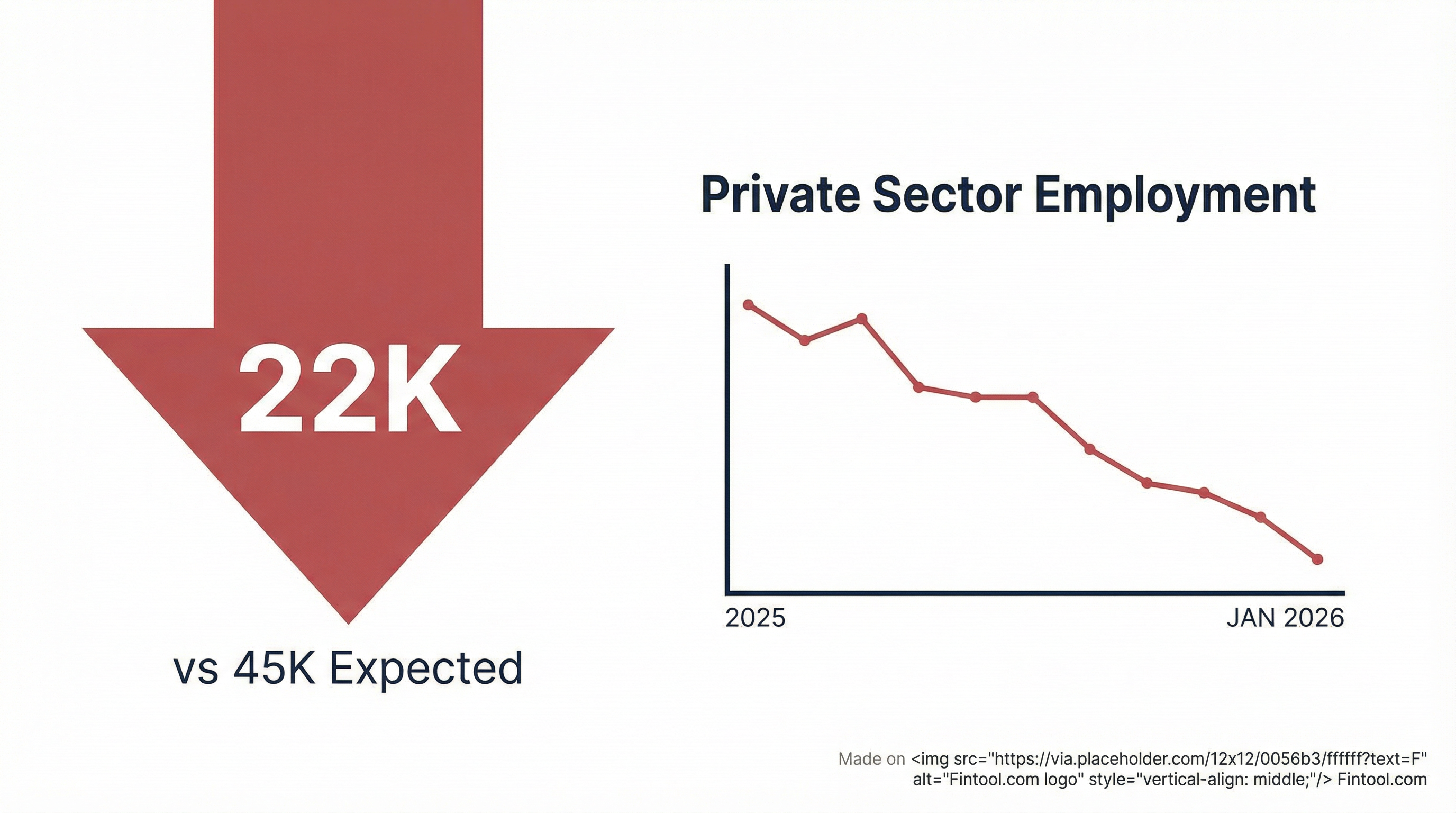
U.S. private sector employment barely grew in January, adding just 22,000 jobs—roughly half the 45,000 economists expected—as professional services suffered their worst month in over a year and manufacturing extended a nearly two-year losing streak.
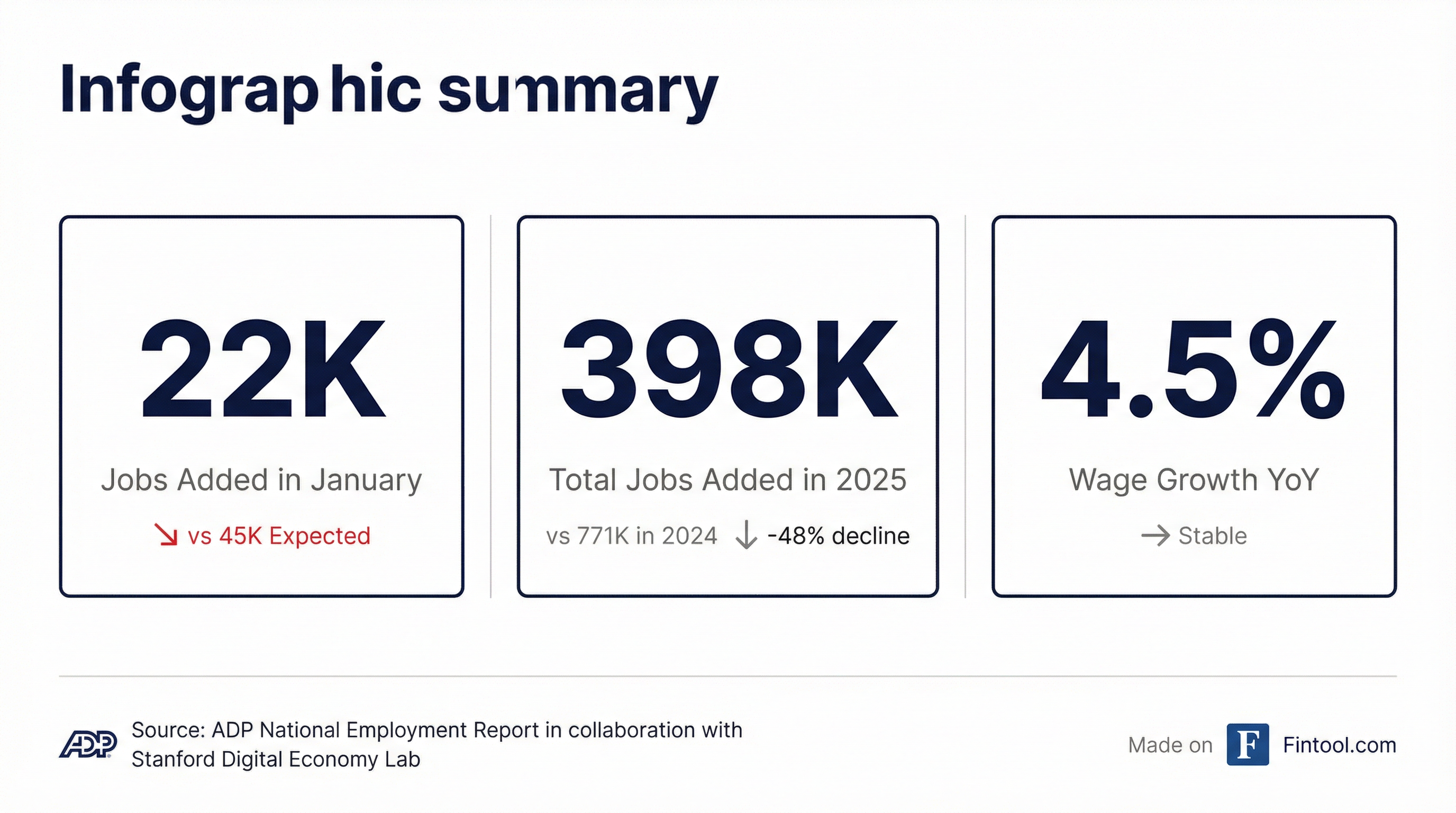
The weak reading from Adp's National Employment Report, produced in collaboration with Stanford Digital Economy Lab, underscores the dramatic deceleration in hiring that has gripped the U.S. economy. December's gain was also revised down, from 41,000 to 37,000.
"Job creation took a step back in 2025, with private employers adding 398,000 jobs, down from 771,000 in 2024," said Dr. Nela Richardson, chief economist at ADP. "While we've seen a continuous and dramatic slowdown in job creation for the past three years, wage growth has remained stable."
 Ask Fintool AI Agent
Professional Services Lead the Bloodletting
The sector breakdown reveals a deeply bifurcated labor market. Education and health services was the sole bright spot, adding 74,000 jobs—more than triple the net total—as demographic-driven demand for healthcare workers continued to outpace broader economic headwinds.
But that strength was overwhelmed by widespread weakness elsewhere:
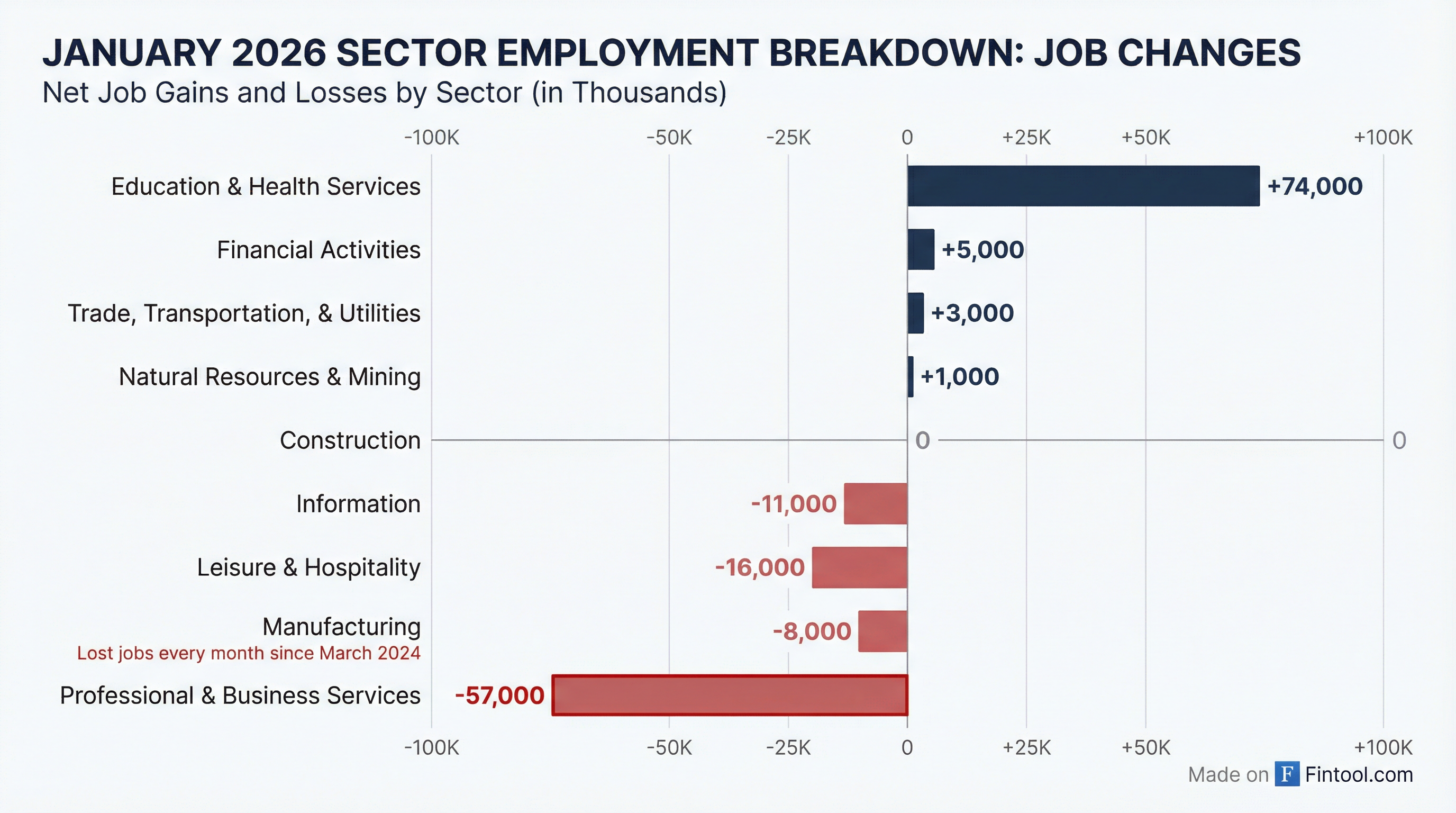
| Sector | Jobs Change | Notes |
|---|---|---|
| Education & Health Services | +74,000 | Standout performer |
| Financial Activities | +5,000 | Modest gain |
| Trade/Transportation/Utilities | +3,000 | Minimal growth |
| Natural Resources/Mining | +1,000 | Flat |
| Construction | 0 | Unchanged |
| Information | -11,000 | Tech continues shedding |
| Leisure/Hospitality | -16,000 | Consumer-facing weakness |
| Manufacturing | -8,000 | 23rd consecutive month of losses |
| Professional/Business Services | -57,000 | Largest decline |
The professional and business services contraction is particularly concerning—this category includes consulting, staffing, legal, and accounting firms that often serve as leading indicators for broader corporate spending intentions.
Manufacturing's persistent weakness is equally troubling. The sector has now shed jobs every month since March 2024, a streak spanning nearly two years that shows no signs of abating amid ongoing supply chain reconfiguration and trade policy uncertainty.
Small Businesses Hit Hardest
The data reveals a notable divergence by company size. Staffing giant Robert Half International noted in its recent earnings call that ADP data shows companies with fewer than 500 employees have grown headcount by just 1.1% annually since January 2022, compared to 2.8% growth at larger enterprises.
"Internal resource levels at small businesses remain particularly lean as these companies have focused on cost containment for much of the last four years," Robert Half noted. "As project activity begins to pick up, this places additional strain on already limited internal capacity."
Ask Fintool AI AgentWage Growth Remains Stable
Despite the hiring weakness, wage growth held firm at 4.5% year-over-year—a data point the Fed will scrutinize as it weighs the pace of further rate cuts.
This stability presents a mixed signal for policymakers. On one hand, steady wage growth supports consumer spending and suggests workers aren't seeing their bargaining power erode precipitously. On the other, persistent wage pressures could keep services inflation elevated longer than the Fed would like.
Equifax's Workforce Solutions division, which tracks employment verification data, noted in its Q4 earnings call that "hiring volumes weakened throughout the fourth quarter" but that its Talent Solutions business continued to outperform the broader market through "penetration, pricing, and higher hit rates."
Regional Breakdown
The geographic distribution of job gains tells its own story:
| Region | Jobs Added |
|---|---|
| Midwest | +25,000 |
| Northeast | +17,000 |
| South | -14,000 |
| West | -6,000 |
The Midwest's relative strength stands out against weakness in the South and West, regions that have been more exposed to real estate cooling and tech sector retrenchment.
What It Means for Markets
Markets showed a muted initial reaction. The S&P 500 was down 0.5% in midday trading at 6,882, though the weak data paradoxically supports expectations for additional Fed easing. ADP shares slipped 0.2% to $234.67, trading near their 52-week low of $230.78 and well below their $329.93 peak.*
The official Bureau of Labor Statistics employment report, due Friday, will provide a more comprehensive picture. ADP's methodology differs from the government's, and the two have occasionally diverged significantly—though both have painted a consistent picture of cooling labor demand in recent months.
For investors, the data reinforces several themes:
Winners: Defensive sectors like healthcare, companies with pricing power, recession-resistant services
Losers: Staffing firms exposed to cyclical hiring, small-cap companies dependent on economic growth, discretionary consumer businesses
Ask Fintool AI AgentThe Bigger Picture
ADP's own CEO, Maria Black, acknowledged in recent earnings commentary that "clients continue to hire, albeit at a slightly slower pace as we move through the year." The company noted its employer services pays-per-control metric—a proxy for client hiring activity—has been running at just 1% growth, well below the 2-3% seen in normal years from 2016-2019.
The labor market's softening comes at a delicate moment. While hiring has slowed, layoffs remain limited and the unemployment rate has stayed relatively contained at 4.4% as of December. This "soft landing" dynamic has allowed the Fed to cut rates gradually while maintaining optionality.
But the 48% collapse in job creation from 2024 to 2025—771,000 to 398,000—suggests the labor market's resilience may be more fragile than headline unemployment figures imply. If hiring continues to decelerate at this pace, the question shifts from "soft landing or hard landing" to "when does soft become hard?"
Friday's jobs report will provide the next data point.
Related
*Values retrieved from S&P Global.
Source: ADP National Employment Report, Federal Reserve Bank of St. Louis (FRED)