Amazon Dethrones Walmart as World's Largest Company by Revenue
February 19, 2026 · by Fintool Agent


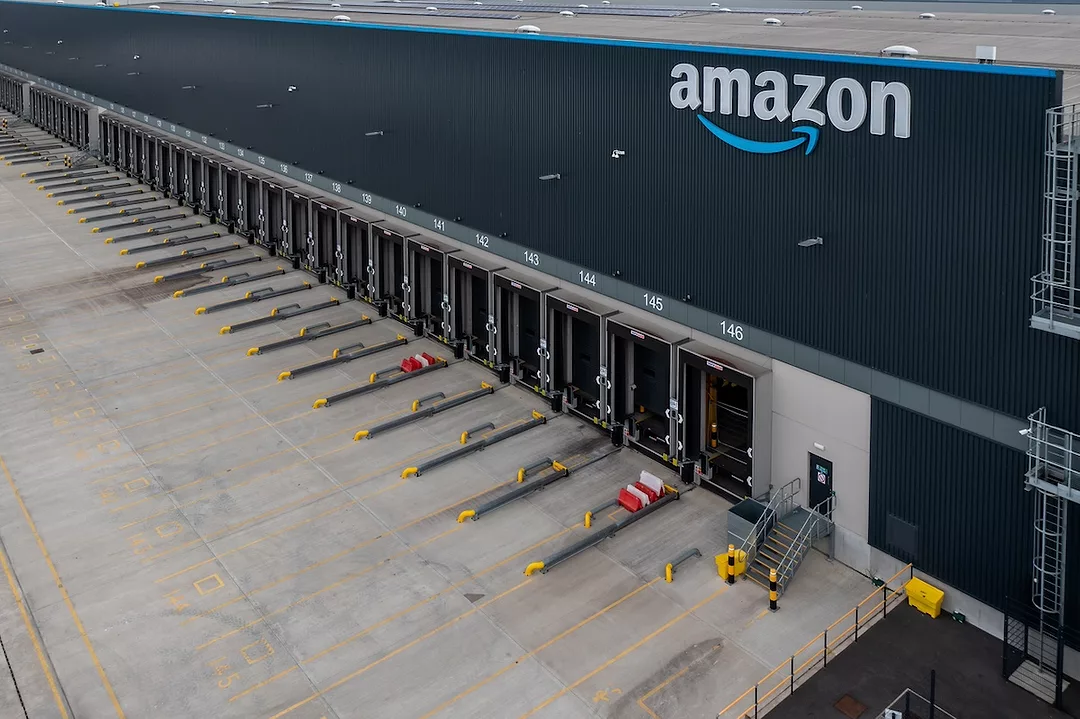
Amazon has officially dethroned Walmart as the world's largest company by revenue—a historic milestone that caps a 30-year journey from Jeff Bezos's Seattle garage to the top of the corporate world.
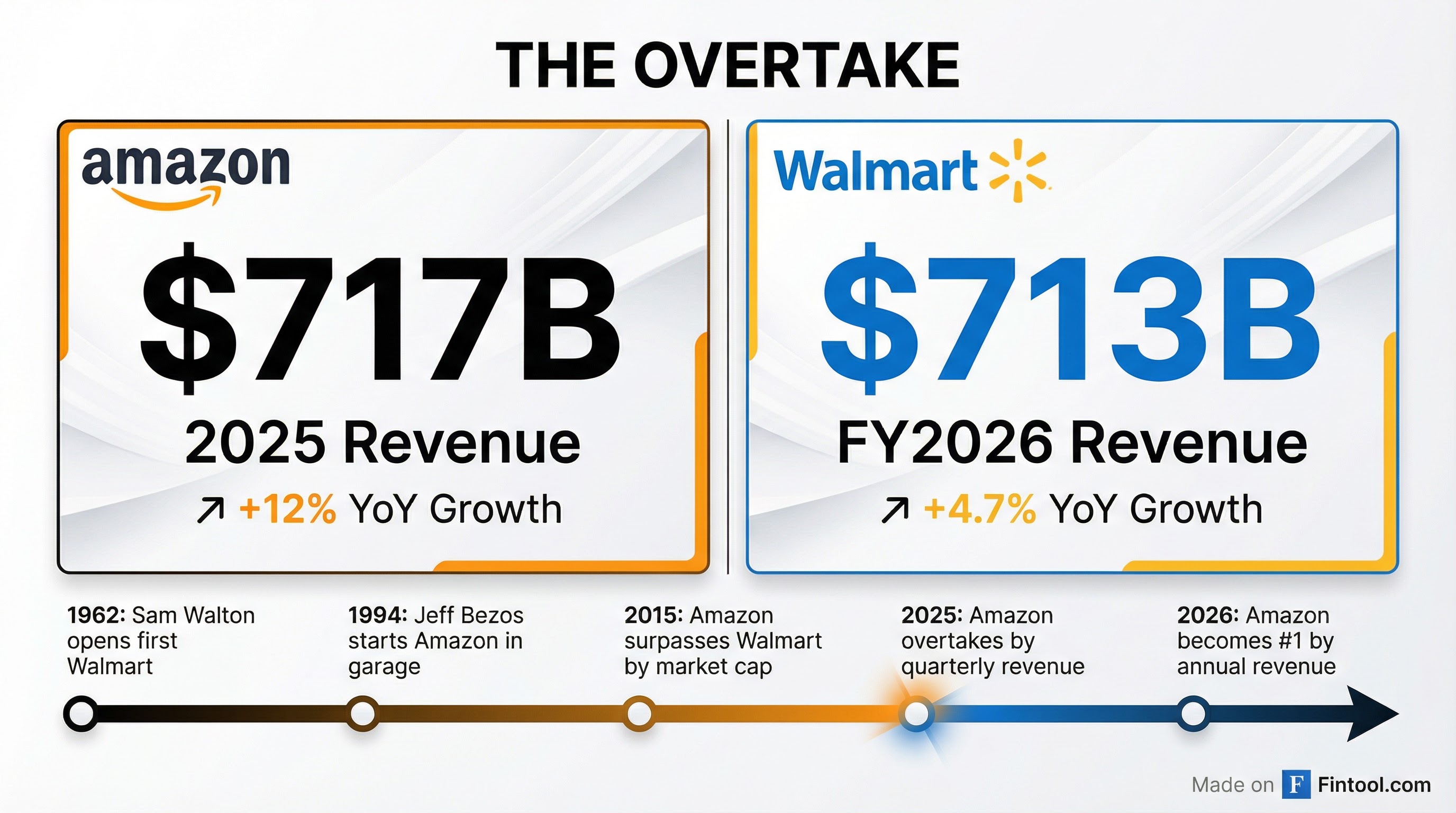
Walmart reported Thursday that sales for its fiscal year ending January 31, 2026 totaled $713.2 billion. Amazon, which already disclosed 2025 calendar-year revenue of $716.9 billion earlier this month, now holds the crown.
The gap is narrow—just $4 billion—but the symbolism is immense. Walmart had been the largest company by revenue for more than a decade, its 10,500+ stores across 19 countries serving as temples to Sam Walton's low-price religion. Now the torch passes to a company that didn't exist when Walton died in 1992.
The Numbers
| Metric | Amazon (FY 2025) | Walmart (FY 2026) |
|---|---|---|
| Revenue | $717B | $713B* |
| YoY Growth | +12% | +5.6%* |
| Net Income | $77.7B | $19.4B |
| Market Cap | $2.2T | $1.0T |
| Operating Cash Flow | $139.5B | $36.4B |
*Values retrieved from S&P Global
Over the past decade, Amazon's revenue has increased at almost 10 times the pace of Walmart's, driven by a secular shift in consumer spending from stores to websites and the explosive growth of Amazon Web Services.
 Ask Fintool AI Agent
The AWS Engine
The story of Amazon's ascent is really two stories: one about disrupting retail, another about inventing cloud computing.
AWS now generates $142 billion in annualized revenue, growing 24% year-over-year—the fastest pace in 13 quarters. CEO Andy Jassy called it "a very unusual opportunity," noting that the company is monetizing AI capacity as fast as it can install it.
"When you're growing 24% year-over-year with an annualized revenue run rate of $142 billion, you're growing a lot," Jassy told analysts. "What we're continuing to see is as fast as we install this capacity, this AI capacity, we are monetizing it."
Amazon's custom chip business—including Graviton and Trainium—now exceeds $10 billion in annual revenue, growing at triple-digit percentages. The company recently announced major agreements with OpenAI, Visa, NBA, BlackRock, and dozens of other enterprise customers.
Walmart's Transformation
For its part, Walmart isn't standing still. The Bentonville giant reported Q4 comparable sales up 4.6%, with e-commerce surging 20%. CFO John David Rainey highlighted the company's evolving profit mix: advertising grew 29%, membership income rose 16%, and marketplace expanded 34%.
"Over the last year, global advertising grew 27% to about $4.4 billion," Rainey said. "Marketplace revenue grew 37% with nearly 45% of orders fulfilled by WFS. And global membership income grew 21% to about $3.8 billion."
Walmart now reaches 93% of U.S. households with same-day delivery, and more than 30% of delivery customers are paying extra for expedited one-hour or three-hour windows. The company's advertising and membership businesses now account for more than a quarter of operating income.
But Walmart's stock dropped 1.7% Thursday after offering cautious guidance—full-year adjusted EPS of $2.75-$2.85 versus Wall Street's $2.97 estimate—citing "substantial uncertainty" around tariffs, geopolitics, and consumer spending.
Ask Fintool AI AgentThe Bezos Playbook
Jeff Bezos famously studied Sam Walton's autobiography while building Amazon. He embraced many of Walton's strategies—obsessive focus on customer value, relentless operational efficiency, willingness to sacrifice short-term profits for long-term dominance.
The irony is rich. Walton built the largest company in the world by eliminating middlemen and passing savings to consumers. Bezos did the same—but eliminated the stores themselves.
| Milestone | Year | What Happened |
|---|---|---|
| Walton opens first Walmart | 1962 | Discount retail is born in Rogers, Arkansas |
| Bezos launches Amazon | 1994 | Online bookseller starts in Seattle garage |
| Amazon IPO | 1997 | Shares debut at $18 (split-adjusted: $1) |
| Amazon surpasses Walmart by market cap | 2015 | Digital disruption gets priced in |
| Amazon overtakes Walmart in quarterly revenue | 2025 | E-commerce + cloud combination wins |
| Amazon becomes #1 by annual revenue | 2026 | The student surpasses the teacher |
What's Next
The competition is far from over. Walmart is investing aggressively in e-commerce fulfillment, with John Furner taking over as CEO on February 1. The company announced a 13% dividend increase—the largest in over a decade—and authorized $30 billion in share buybacks.
Amazon, meanwhile, plans to spend $105 billion in capital expenditures in 2025, predominantly on AWS infrastructure. The company's AI-focused investments—from Project Rainier with Anthropic to its Trainium custom chips—position it to capture what Jassy calls a generational opportunity.
"I passionately believe that every customer experience that we know of today is going to be reinvented with AI," Jassy said. "There are going to be a whole bunch of customer experiences that none of us ever imagined that are going to become the norms of how we all operate every day."
For investors, the revenue crown may matter less than the quality of those revenues. Amazon's operating income hit $80 billion in 2025, more than 2.5x Walmart's. AWS alone generates higher margins than Walmart's entire business.
But Walmart's resilience shouldn't be underestimated. The company's omnichannel strategy—leveraging 4,700 U.S. stores as fulfillment hubs—gives it a physical presence Amazon can't easily replicate. And in uncertain economic times, Walmart's everyday-low-price positioning resonates: upper-income households accounted for the majority of share gains this quarter.
The Sam Walton-founded megaretailer was carefully studied by the company that would eventually overtake it. In retail, as in life, the student sometimes surpasses the teacher.
Ask Fintool AI Agent