Anta Sports to Pay $1.8 Billion for 29% Puma Stake, Becoming Largest Shareholder
January 26, 2026 · by Fintool Agent


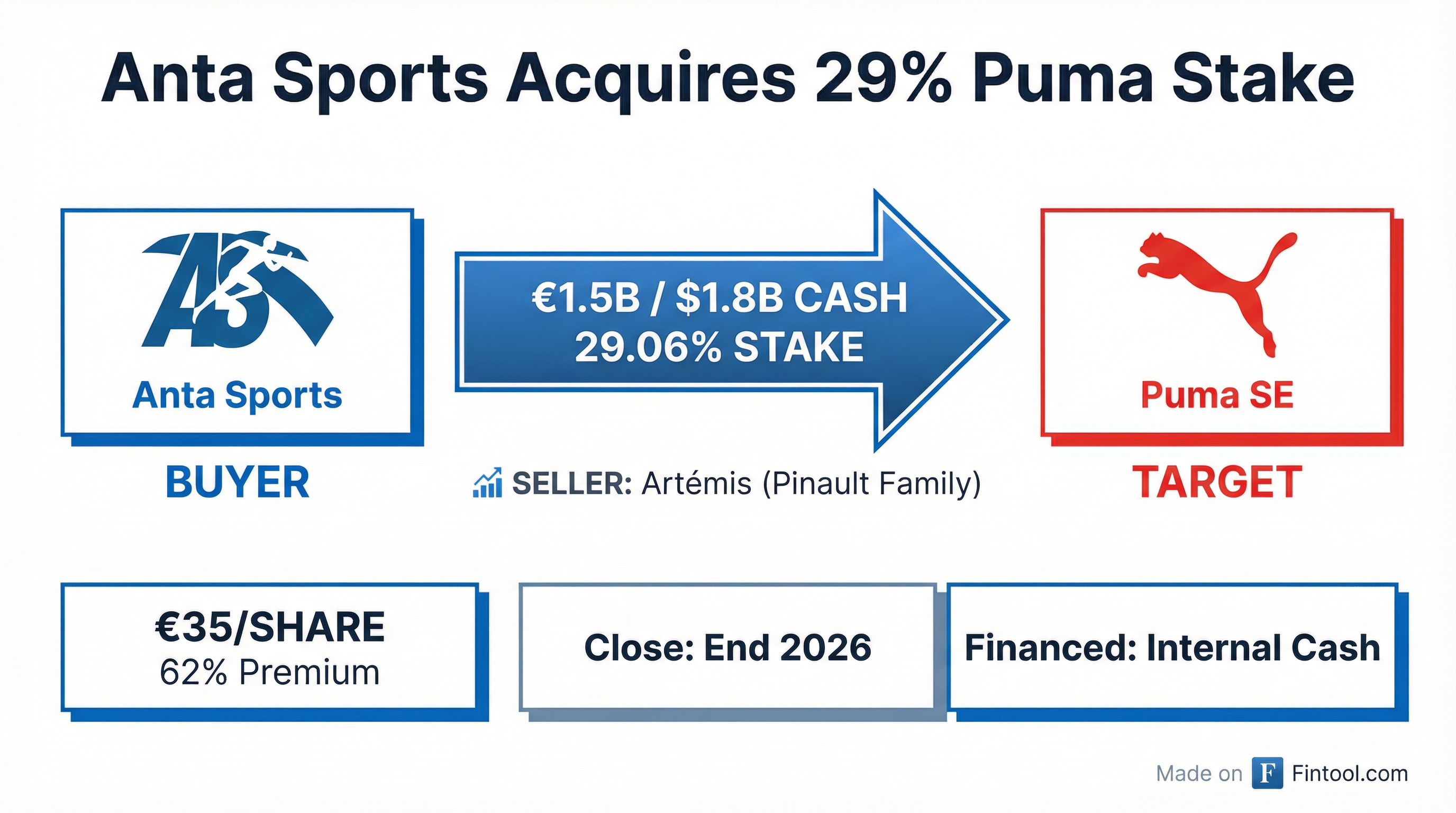
China's Anta Sports is acquiring a 29.06% stake in Puma SE from France's Pinault family for €1.5 billion ($1.8 billion), making the Chinese sportswear giant the largest shareholder in the struggling German brand . The all-cash deal values Puma shares at €35 each—a 62% premium to Monday's closing price of €21.63—and marks another milestone in Anta's aggressive global expansion strategy .
The transaction comes as Puma navigates a painful turnaround under new CEO Arthur Hoeld, with shares having fallen 32% over the past 12 months and the company expecting an EBIT loss for fiscal 2025.
Deal Structure and Financing
Anta will acquire approximately 43 million Puma shares from Groupe Artémis, the holding company of billionaire François-Henri Pinault, who chairs luxury conglomerate Kering . The Pinault family acquired the stake when Kering divested it in 2018 as part of a strategic shift toward pure luxury brands.
| Deal Metric | Details |
|---|---|
| Stake Size | 29.06% (43 million shares) |
| Price Per Share | €35 |
| Total Value | €1.5 billion ($1.8 billion) |
| Premium to Market | 62% (vs. €21.63 close) |
| Financing | Internal cash resources |
| Expected Close | End of 2026 |
Anta Chairman Ding Shizhong called the acquisition "a major step forward in our 'single-focus, multi-brand, globalization' strategy," adding that Puma's "global business footprint and focused positioning in sports categories are highly complementary to the group's existing multi-brand and specialized business" .
 Ask Fintool AI Agent
Why Anta, Why Now
Anta has built a track record of acquiring and revitalizing Western sports brands. The Hong Kong-listed company led a €4.6 billion consortium in 2019 to acquire Amer Sports, owner of premium outdoor brands Arc'teryx, Salomon, and tennis racquet maker Wilson . That bet has paid off spectacularly—Amer Sports saw revenue surge 23% in 2023 with 61% growth in Greater China, and the company completed an IPO on the New York Stock Exchange in 2024.
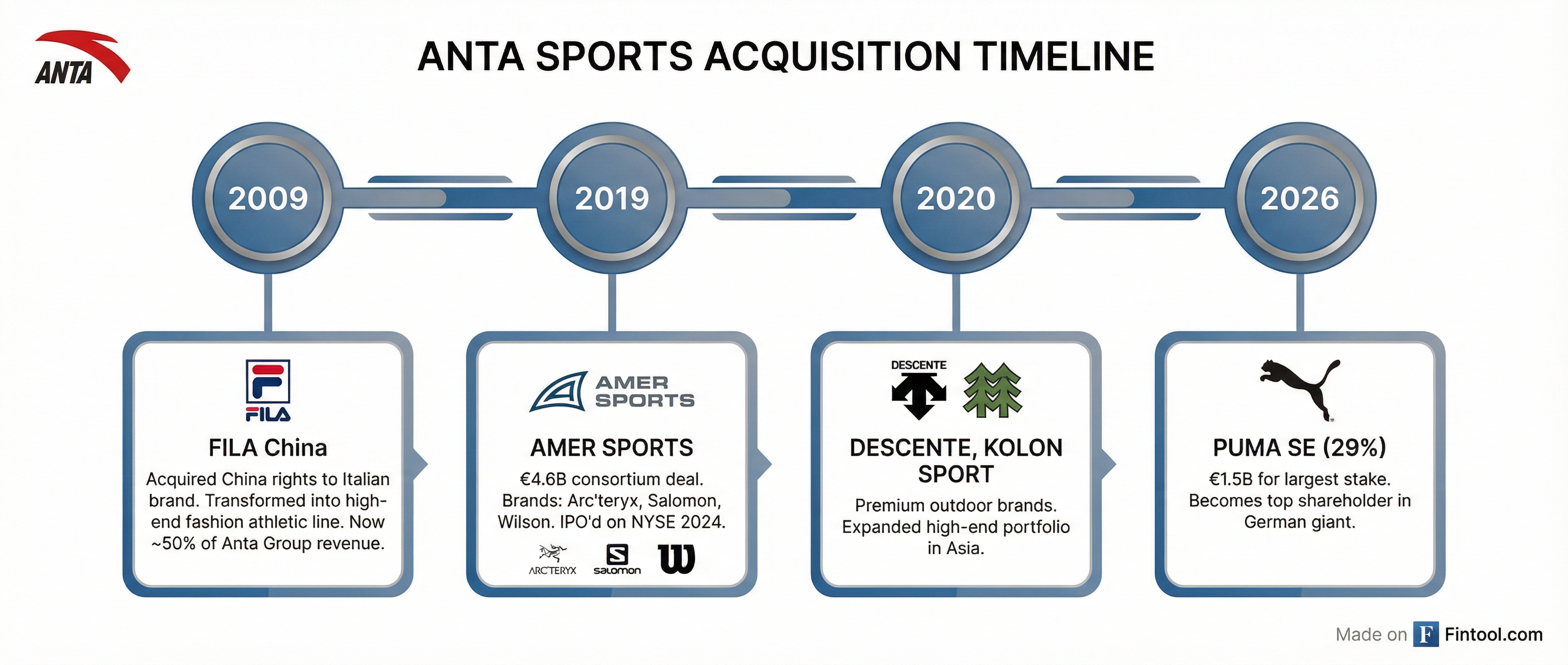
Anta's earlier acquisition of Fila's China rights in 2009 proved transformative. The Italian brand, repositioned as a premium fashion-athletic line, now generates roughly half of Anta Group's revenue and was key to the company surpassing both Adidas and Nike in Chinese market share by 2022.
The Puma stake represents a different approach—rather than full ownership, Anta is taking a minority position that will give it board seats and strategic influence over a struggling global brand while preserving management autonomy .
Puma's Painful Reset
The timing is notable. Puma has been in crisis mode since new CEO Arthur Hoeld took the helm in July 2025, inheriting a brand he described as having become "too commercial, overexposed in the wrong channels, with too many discounts" .
Hoeld—a 26-year Adidas veteran who formerly ran that company's global sales—has outlined an aggressive turnaround:
- 900 corporate job cuts (about 13% of workforce) by end of 2026
- Reduce wholesale exposure to discount retailers
- Cut product range and new releases
- Rebuild brand positioning around performance innovations
- Target return to growth in 2027
The financials tell the story of the challenge ahead. Third-quarter 2025 sales fell 15.3% to €1.96 billion on a currency-adjusted basis, with Puma's investor guidance confirming a "low double-digit" full-year sales decline and an EBIT loss for fiscal 2025 .
| Puma Metric | Q3 2025 | Outlook |
|---|---|---|
| Sales | €1.87B | Low double-digit FY decline |
| EBIT | Loss | FY 2025 EBIT loss expected |
| Net Debt | €1.2B | Elevated through H1 2026 |
| Job Cuts | 900 | Through end of 2026 |
Hoeld has framed 2025 as a "reset year" with 2026 continuing as a transition period before returning to above-industry growth and healthy profits by 2027 .
Ask Fintool AI AgentStrategic Rationale: Complementary Footprints
Anta sees geographic complementarity as a key driver. Puma has established strength in Europe, Latin America, Africa, and India, while Anta dominates China and has been expanding into Southeast Asia, the Middle East, and North America .
The global sportswear market remains dominated by Nike (roughly 20-25% market share) and Adidas (12-15%), with Puma sitting in the 4-5% range alongside Skechers and newer challengers like On Running and Hoka . Nike has been losing ground amid a lack of innovation, while Adidas has surged under CEO Bjorn Gulden—himself a former Puma chief executive.
For Anta, the investment provides:
- Access to Western markets where Puma has established distribution
- Premium brand portfolio diversification beyond its existing holdings
- Performance technology sharing across product categories
- Management expertise from Puma's European operations
Importantly, Anta has stated it has "no plans to make a takeover offer for Puma" and intends to preserve the German brand's identity and management team .
Market Reaction
Puma shares soared 17% in Monday trading to €21.63 before the official announcement, likely reflecting earlier Reuters reporting that the deal was imminent . The €35 per share price implies substantial upside from current levels, though the transaction is not a tender offer to other shareholders.
The Pinault family had previously signaled it would not sell at depressed prices. In September 2025, a source close to Artémis told Reuters the family would not exit "at the current market value" . The 62% premium appears to have changed that calculus.
Ask Fintool AI AgentWhat to Watch
Regulatory approvals: The transaction requires various regulatory clearances across jurisdictions. Given Anta's existing portfolio and the minority stake structure, significant antitrust concerns appear unlikely, but Chinese outbound investment deals can face heightened scrutiny.
Board representation: Anta will seek Supervisory Board seats once the deal closes. The composition and influence of these appointments will signal how actively Anta intends to shape Puma's strategic direction.
Turnaround execution: Puma's Q4 2025 results (due February 26, 2026) and Arthur Hoeld's strategic update expected in Q2 2026 will provide visibility into whether the reset is gaining traction.
Amer Sports comparison: Investors will watch whether Anta can replicate its Amer Sports playbook—supporting management while providing access to Chinese distribution and capital—without the full control that outright ownership provides.
The deal cements Anta's position as the most aggressive acquirer in global sportswear, adding another Western trophy brand to a portfolio that has transformed a Fujian-based manufacturer into a genuine multinational competitor to Nike and Adidas.
Related Companies: Nike (nke) · Amer Sports (as)