Anta Sports Makes Play for Puma, Offering to Buy Pinault Family's 29% Stake
January 9, 2026 · by Fintool Agent

China's largest sportswear company is making a bold move into European sports retail. Anta Sports+0.19% has offered to acquire the Pinault family's 29% stake in Germany's Puma, a deal that would make the Hong Kong-listed giant the largest shareholder in the world's third-biggest sportswear brand.
Puma shares jumped as much as 9% on the news, reaching €24.6—their highest level since May 2025—though talks have reportedly stalled as the Pinaults seek above €40 per share. At that price, the stake would be valued at approximately €960 million ($1.1 billion).
The Deal on the Table
According to Reuters, Anta made the offer several weeks ago and has already secured financing for the acquisition. But the transaction has hit a snag: Artemis, the Pinault family's investment vehicle, was expecting bids to exceed €40 per share—well above Puma's recent trading range in the low-to-mid €20s.
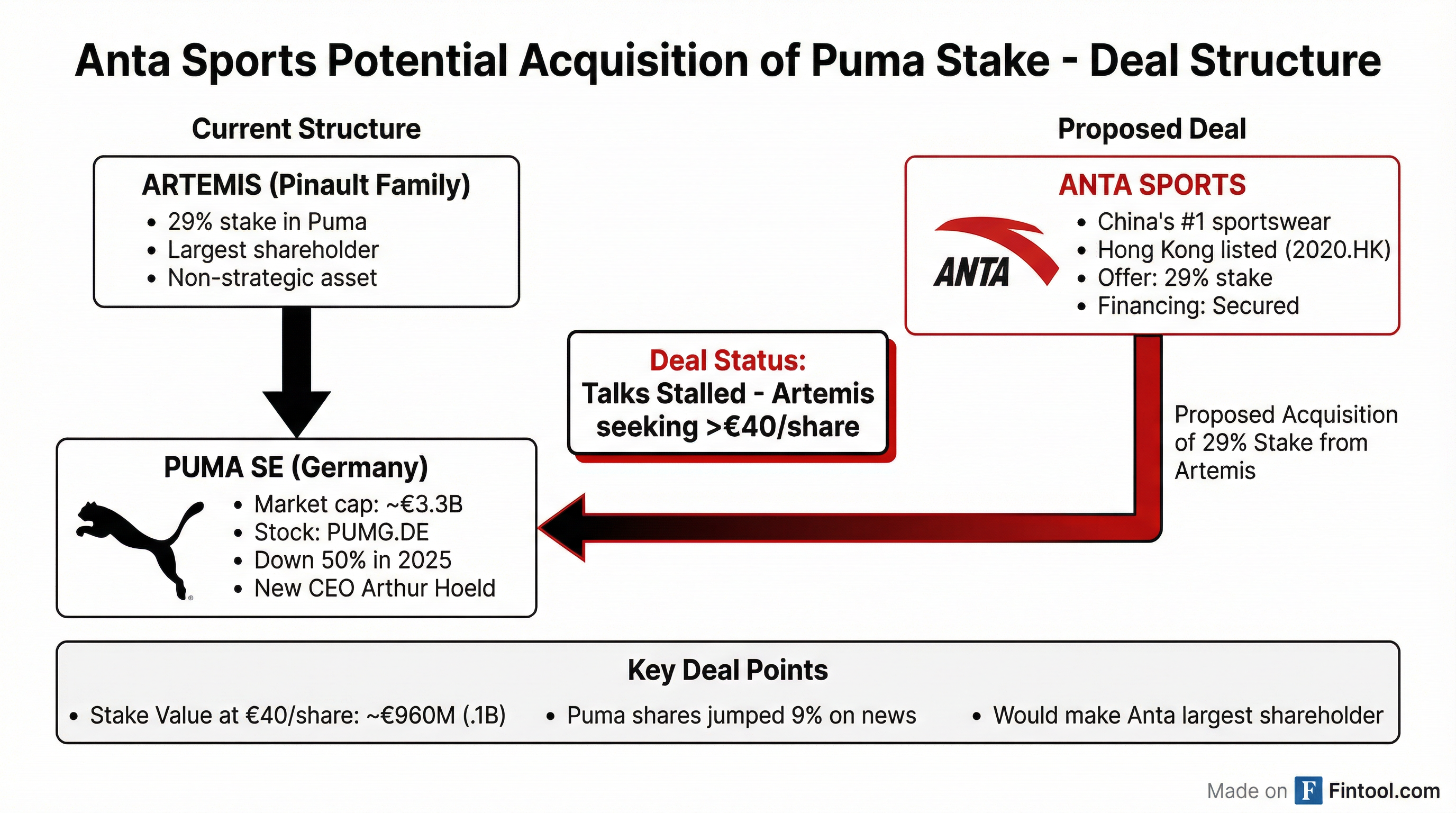
François-Henri Pinault, who chairs luxury conglomerate Kering+0.13% (owner of Gucci), acquired the Puma stake in 2018 when Kering transformed itself into a pure luxury player. A source close to Artemis told Reuters in September that the family viewed the stake as "non-strategic"—but wouldn't sell at then-current market valuations.
The valuation gap highlights Puma's dramatic decline: the company's market cap has been cut roughly in half over the past year, falling from approximately €6.6 billion to around €3.3 billion as the brand lost ground to rivals in an increasingly competitive sportswear market.
 Ask Fintool AI Agent
Anta's Western Brand Playbook
This isn't Anta's first foray into acquiring Western sports brands. In 2019, the company led a consortium that paid approximately $5.2 billion to acquire Finland's Amer Sports—the owner of Wilson tennis rackets, Salomon ski equipment, Arc'teryx outdoor gear, and Louisville Slugger baseball bats.
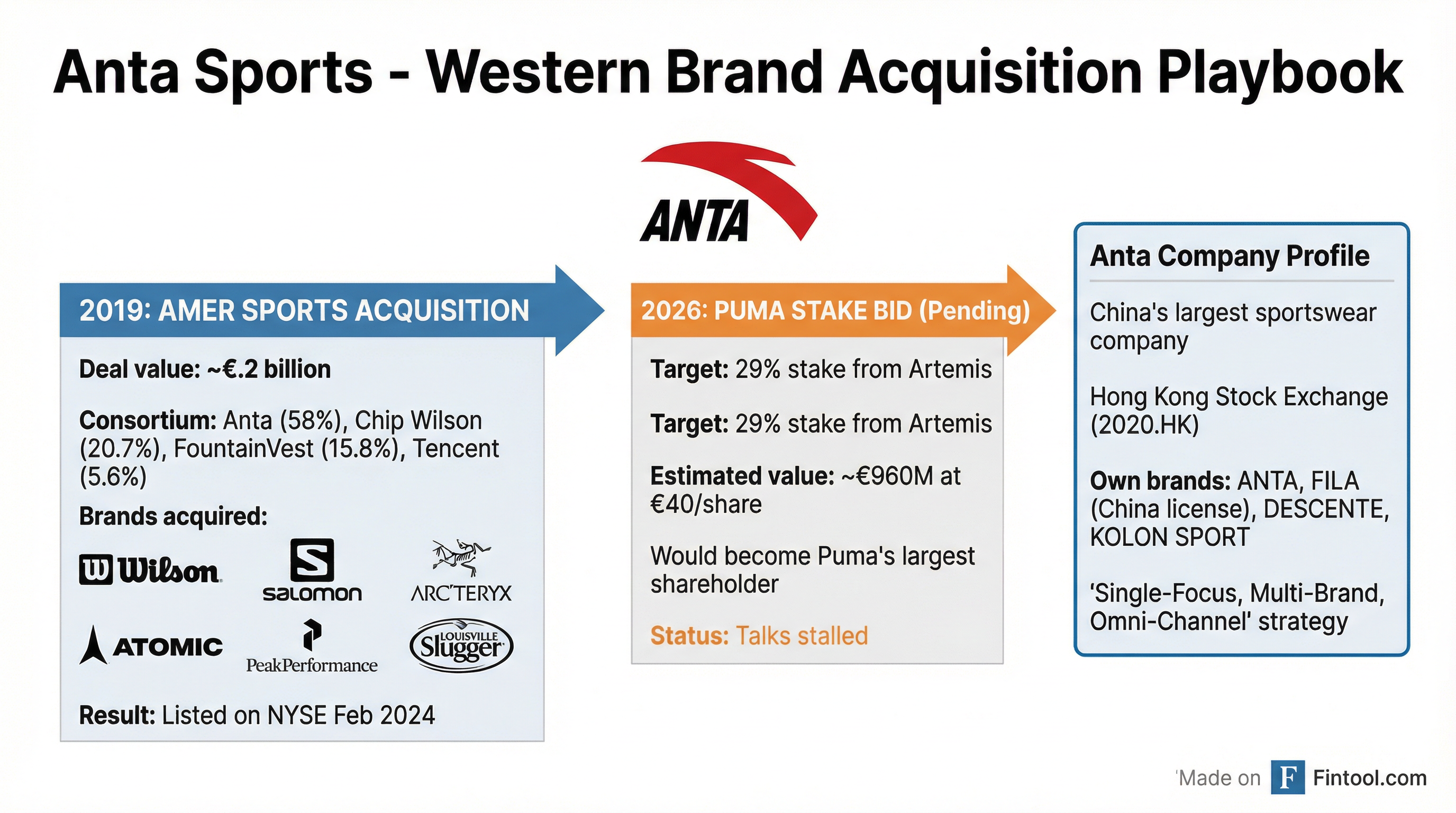
The consortium included notable partners: Tencent Holdings, private equity firm FountainVest Partners, and Canadian billionaire Chip Wilson—founder of Lululemon+1.62%. Anta holds approximately 58% of Amer Sports, which successfully listed on the NYSE in February 2024.
Anta's strategy centers on what it calls "Single-Focus, Multi-Brand, Omni-Channel"—acquiring established Western brands with strong heritage while leveraging its distribution network and manufacturing capabilities in China's fast-growing market. The company already operates brands including ANTA, FILA (China license), DESCENTE, and KOLON SPORT.
RBC analysts noted the potential transaction could benefit Puma: "We view the potential disposal of Artemis' 29% stake in PUMA as incrementally positive for the PUMA equity story, with potential new ownership that could support investments behind the brand, offer new perspectives and support the early stage turnaround strategy under new CEO Arthur Hoeld."
Why Now? Puma's Turnaround Moment
The timing of Anta's approach coincides with a critical inflection point for Puma. The German brand has struggled mightily in 2025, with sales falling 8.5% in the first nine months of the year and the company posting a net loss of €309 million—a stark reversal from the €257 million profit in the prior year period.
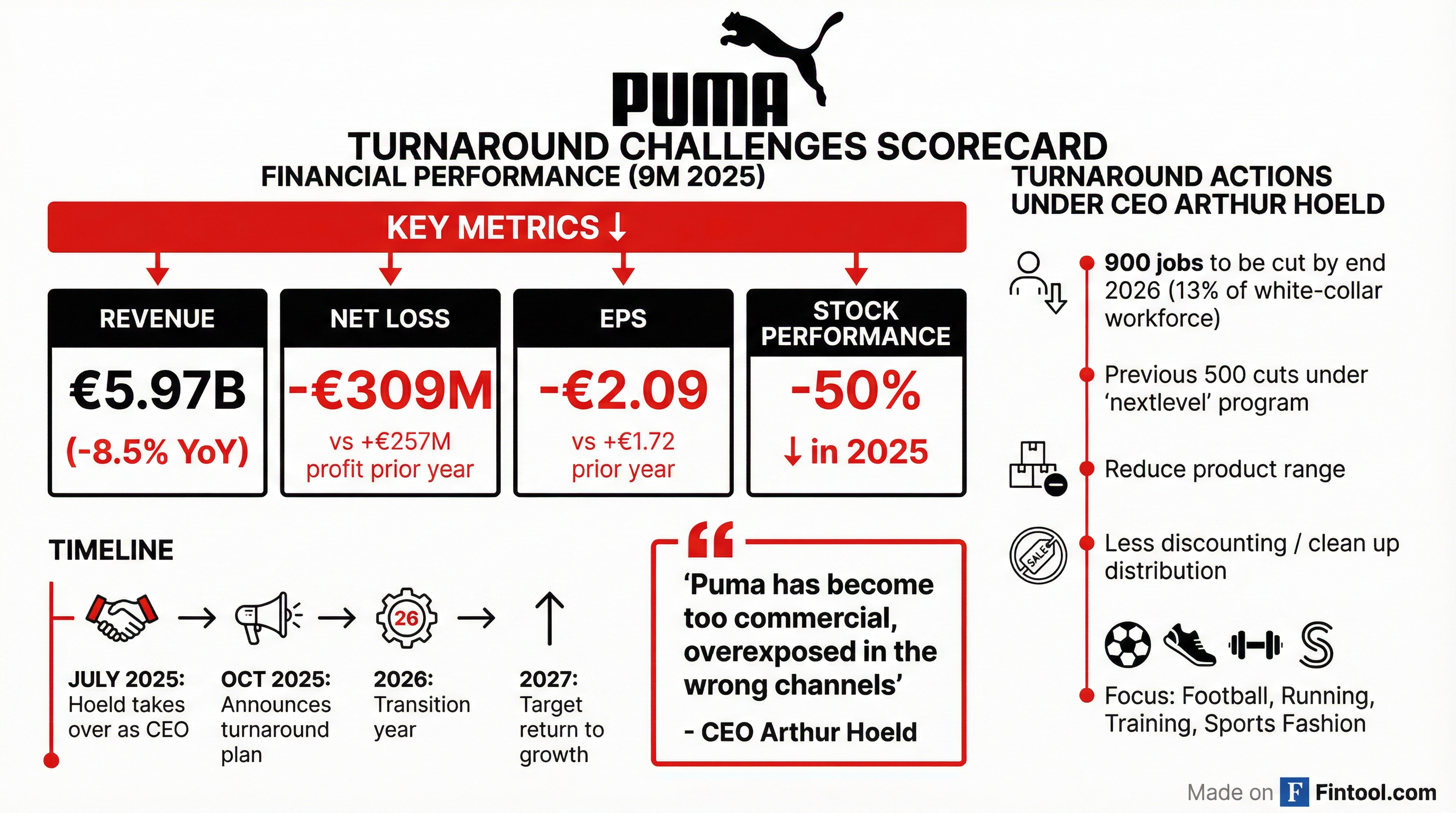
New CEO Arthur Hoeld—the former sales chief at arch-rival Adidas+1.73%—took the helm in July 2025 with a mandate to reset the brand. His diagnosis was blunt: "Puma has become too commercial, overexposed in the wrong channels, with too many discounts."
His turnaround plan includes:
- Job cuts: 900 white-collar positions by end of 2026, on top of 500 already eliminated
- Distribution cleanup: Reducing sales to cut-price retailers, expanding direct-to-consumer
- Product rationalization: Narrowing the product range, fewer new releases per season
- Brand rebuilding: Refocusing on football, running, training, and sports fashion
Hoeld has called 2026 a "transition year," with growth expected to return in 2027. But Puma's inventory remains elevated—up 17.3% to €2.12 billion—and won't normalize until late 2026.
Ask Fintool AI AgentThe Strategic Calculus
For Anta, a 29% stake in Puma would represent a meaningful position in a global brand with deep roots in football, motorsport, and lifestyle categories—all underpenetrated in China relative to competitors. The acquisition would also give Anta direct exposure to the European market.
For the Pinaults, a sale would allow Artemis to reduce its exposure to a non-core holding while crystallizing value amid the brand's challenges. The family's main focus remains Kering's luxury portfolio, which has faced its own headwinds as Gucci works through a creative transition.
However, several factors could complicate any deal:
- Valuation gap: With Artemis seeking €40+ and Puma trading in the mid-€20s, significant bridging is required
- Regulatory scrutiny: Chinese acquisition of German industrial assets has faced increased scrutiny in recent years
- Turnaround risk: Puma's recovery is far from certain, and any new shareholder would be buying into a multi-year restructuring
- Minority position: A 29% stake doesn't confer control—though it would make Anta the largest single shareholder
What to Watch
Investors should monitor several key developments:
- Renewed negotiations: Whether Anta revises its offer or Artemis lowers expectations
- Alternative bidders: Puma's depressed valuation could attract other strategic or financial buyers
- Q4 2025 results: Puma's upcoming earnings will provide color on early turnaround progress
- Regulatory signals: Any indications from German authorities on cross-border M&A appetite
For now, the talks have stalled—but in M&A, that's often where the real negotiation begins.
Ask Fintool AI AgentRelated Companies: