Anthropic's Legal AI Plugin Triggers $100 Billion Global Software Selloff
February 3, 2026 · by Fintool Agent



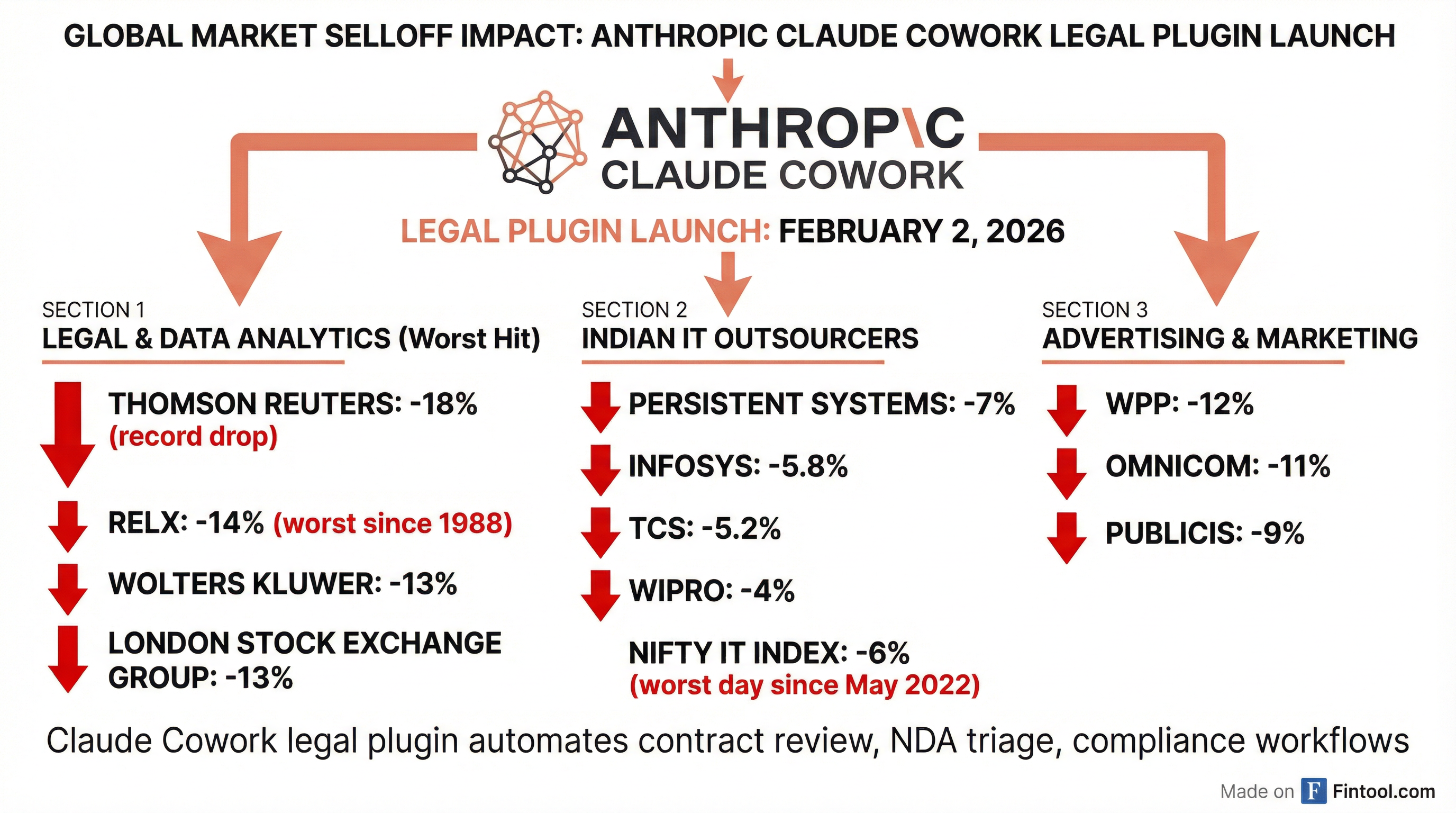
Thomson Reuters suffered its largest single-day loss in history—down 18% to its lowest close since June 2021—after Anthropic launched a legal plugin for its Claude Cowork AI agent that threatens to automate core functions of the legal data and analytics industry.
The carnage spread globally, erasing an estimated $100 billion in market value across legal software, IT outsourcing, and advertising stocks in what analysts are calling the most significant AI-driven market disruption event to date.
What Anthropic Launched
Anthropic released plug-ins for its Claude Cowork agentic desktop application on Friday, February 2, extending Claude's capabilities into specialized business functions across legal, sales, marketing, data analysis, and customer support.
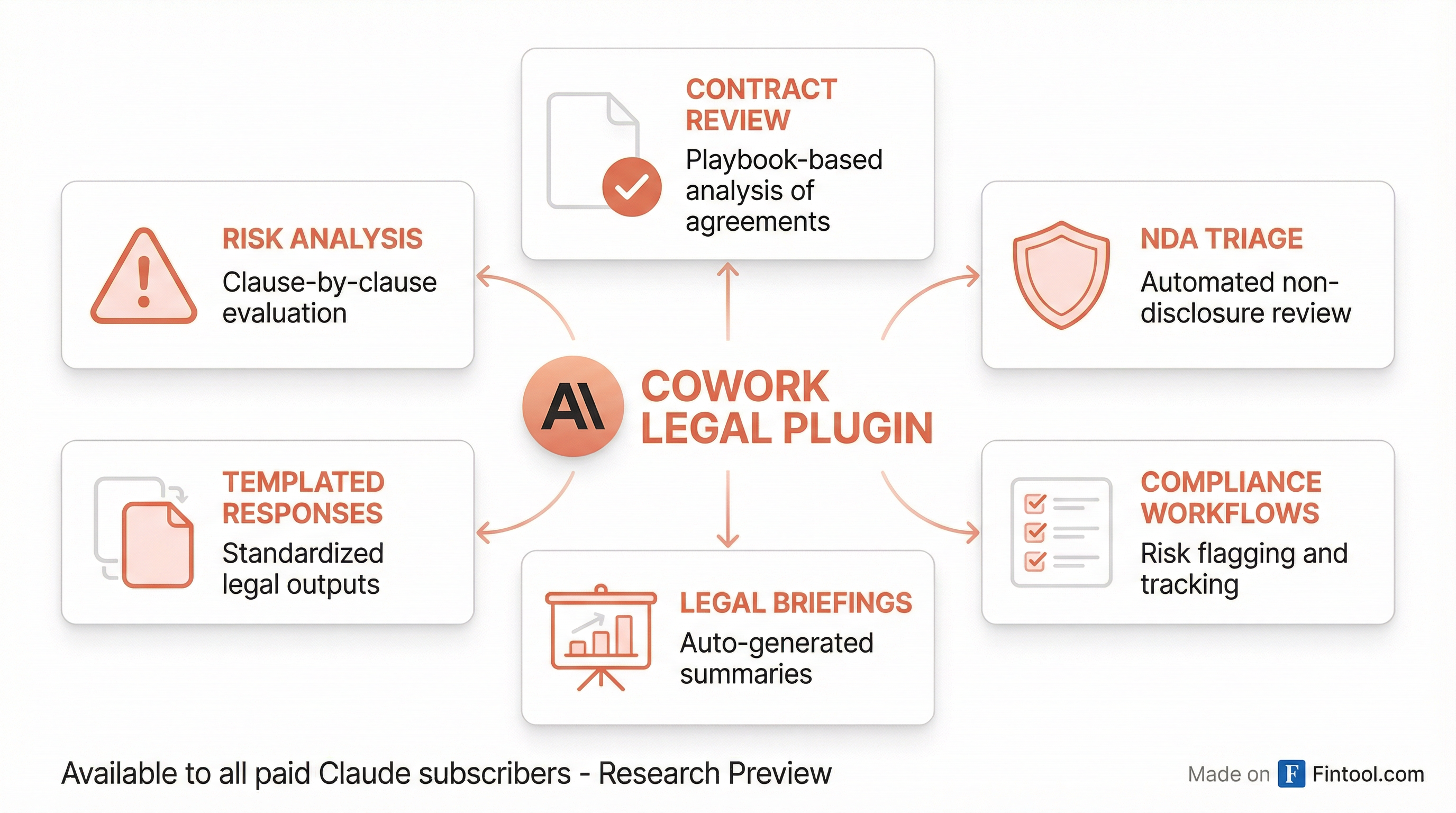
The legal plugin can:
- Review contracts using playbook-based analysis tailored to an organization's risk tolerances
- Triage NDAs with automated flagging and classification
- Track compliance workflows with risk monitoring
- Generate legal briefings and templated responses
- Analyze clauses on a granular, clause-by-clause basis
"Anthropic is shifting from model supplier to the application layer and workflow owner," observed Legal IT Insider, noting the move represents a direct challenge to established legal tech providers.
The plugin is available to all paid Claude subscribers in research preview, and Anthropic has published the full plugin code on GitHub as open source—meaning any organization can customize it for their needs.
 Ask Fintool AI Agent
Market Devastation: The Numbers
Legal Data & Analytics Stocks
| Company | Ticker | Drop | Context |
|---|---|---|---|
| Thomson Reuters | TRI | -18% | Record one-day loss, lowest since June 2021 |
| RELX | RELX | -14% | Worst single-day performance since 1988 |
| Wolters Kluwer | WTKWY | -13% | LexisNexis competitor |
| London Stock Exchange Group | LSEG | -13% | Worst day in five years |
| Pearson | PSO | -8% | Educational publishing exposure |
| Experian | EXPN | -7% | Data analytics concern |
| Sage | SAGE | -10% | Enterprise software selloff |
Thomson Reuters owns Westlaw, the dominant legal research platform, while RELX owns rival LexisNexis. Both generate substantial revenue from per-seat software licensing—precisely the business model threatened by AI that automates routine legal research and document review.
Morgan Stanley analysts wrote that Anthropic's move represents "a sign of intensifying competition, and thus a potential negative" for Thomson Reuters.
Indian IT Outsourcers
The Nifty IT Index plunged 6%—its worst session since May 2022—as Indian IT exporters bore the brunt of global software selling.
"The IT selloff in the US yesterday will drag the Indian IT index, too, constraining the rally in the Indian market. Since valuations continue to be high there is no fundamental support for a sustained rally," said VK Vijayakumar, Chief Investment Strategist at Geojit Investments.
Advertising & Marketing Agencies
Anthropic's marketing automation plugins also crushed advertising stocks:
| Company | Drop |
|---|---|
| WPP | -12% |
| Omnicom | -11% |
| Publicis | -9% |
Ask Fintool AI AgentWhy This Selloff Is Different
Previous AI announcements have sparked sector rotations, but the Anthropic Cowork selloff stands out for several reasons:
1. Direct revenue threat. Unlike general-purpose AI improvements, Anthropic's plugins target specific professional workflows—contract review, compliance tracking, NDA triage—that currently generate billions in software licensing and services revenue. Thomson Reuters' Westlaw and RELX's LexisNexis charge on a per-seat basis; AI that performs the same tasks threatens that entire pricing model.
2. Open source deployment. By publishing plugin code on GitHub, Anthropic enables any organization to deploy legal AI without paying incumbent vendors. This isn't a preview demo—it's production-ready code.
3. Cascading effects. The selloff spread beyond direct competitors to IT outsourcers, advertising agencies, and even private equity firms that have invested heavily in software:
| PE Firm | Drop |
|---|---|
| Ares Management | -10% |
| KKR | -10% |
| Apollo | -4.8% |
4. "Visibility premium" erosion. Schroders analyst Jonathan McMullan captured the fundamental shift: "Investors are aggressively repricing these areas as the historical 'visibility premium' erodes; the speed of AI advancement makes long-term valuations harder to defend, particularly as AI tools allow businesses to do more with fewer staff, threatening the traditional model of charging per software user."
Thomson Reuters: Facing Its ChatGPT Moment
The 18% single-day drop in Thomson Reuters is particularly notable given the company's $49 billion market cap and its aggressive push into AI with its own CoCounsel product built on large language models including custom OpenAI models.
| Metric | FY 2022 | FY 2023 | FY 2024 |
|---|---|---|---|
| Revenue ($B) | $6.6 | $6.8 | $7.3 |
| Net Income ($B) | $1.3 | $2.7 | $2.2 |
| EBITDA Margin | 29.6% | 30.7% | 28.1% |
| Gross Margin | 38.6% | 39.7% | 38.9% |
*Values retrieved from S&P Global
Thomson Reuters has been growing revenue steadily and enjoys healthy margins. But investors are questioning whether those margins can hold if competitors can offer "good enough" legal research for a fraction of the cost—or if clients simply use Claude directly.
"I think Anthropic came out with some plug-ins to tackle the legal space," said Mike Archibald, portfolio manager at AGF Investments in Toronto. "Obviously, that's where Thomson Reuters generates a good chunk of their revenues. Sometimes the market just shoots first and asks questions later."
Ask Fintool AI AgentThe Bigger Picture: AI Eating White-Collar Jobs
This selloff arrives amid growing evidence that AI is disrupting white-collar employment faster than expected:
-
Clifford Chance, one of the world's largest law firms, announced in November it was reducing business services staff in London by 10%, citing AI.
-
Morgan Stanley research found the UK is losing more jobs than it's creating as companies adopt AI tools—and is being hit harder than rival economies.
-
London Mayor Sadiq Khan warned last month that AI could "destroy swathes of jobs" in the capital because of its reliance on white-collar workers in finance, creative industries, and professional services.
The irony is stark: companies like Infosys, Accenture, and Gartner have been touting AI as a growth driver for their consulting practices—and now AI is threatening those same practices.
Apple's Xcode Announcement Adds to the Pressure
Also on Monday, Apple announced Xcode 26.3 with "agentic coding" support, integrating Anthropic's Claude Agent and OpenAI's Codex directly into its developer environment. Developers can now use AI agents to autonomously write code, build projects, run tests, and fix bugs with minimal human oversight.
The announcement underscores how quickly AI agents are moving from demos to production tools—and why investors are repricing any company whose business model depends on humans performing tasks that AI can automate.
What to Watch
1. Earnings reactions. Thomson Reuters reports Q4 results later this month. Watch for management commentary on competitive positioning and whether they address the Anthropic threat directly.
2. Customer adoption. How quickly do law firms and corporate legal departments adopt Claude Cowork vs. incumbent tools? Early adoption metrics will be crucial.
3. Defense strategies. Incumbents like Thomson Reuters and RELX have invested heavily in their own AI. Can they iterate fast enough to maintain pricing power?
4. Startup activity. Legal tech startups raised $3 billion in 2025. Some—like Harvey, which recently opened a Toronto office—may accelerate into the disruption. Others built on top of the same models may struggle.
5. Indian IT earnings. TCS, Infosys, and Wipro all report in the coming weeks. Listen for commentary on AI's impact on demand for traditional IT services.
Ask Fintool AI Agent