Apple Accelerates AI Wearables Push: Smart Glasses, Pendant, and Camera AirPods in Development
February 17, 2026 · by Fintool Agent


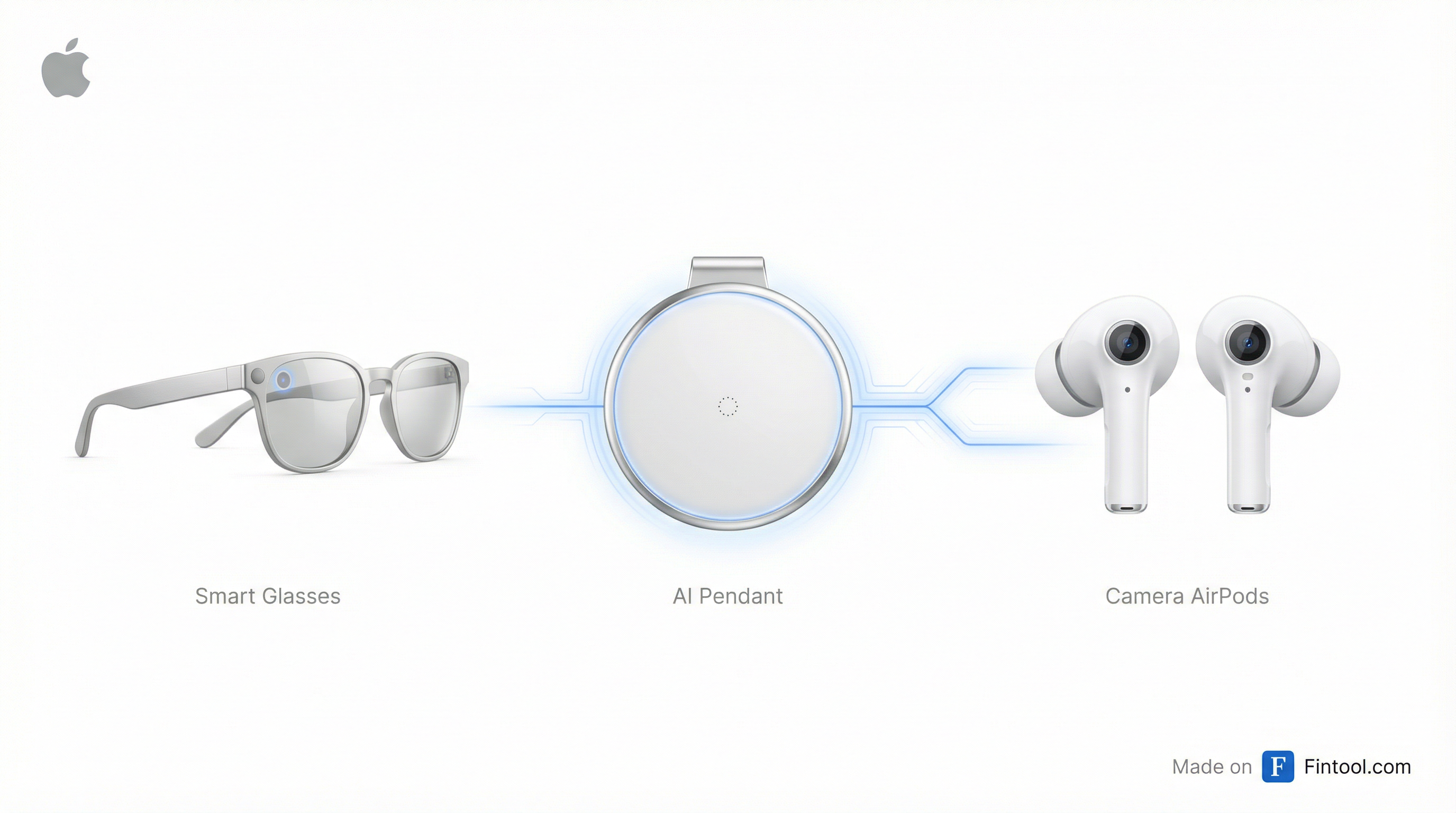
Apple is accelerating development of three AI-powered wearable devices—smart glasses, a pendant, and camera-equipped AirPods—as the company pivots toward artificial intelligence hardware to compete with Meta Platforms and OpenAI, according to a Bloomberg report published today.
Shares of Apple rose 3.6% to $265.06 on the news, adding approximately $130 billion in market value as investors welcomed signs of a concrete AI hardware roadmap from the world's most valuable company.
Three Devices, One Vision
All three products are being built around an enhanced Siri digital assistant that will use visual context to carry out actions, representing Apple's most significant wearables expansion since the Apple Watch debut in 2015.
Smart Glasses (Code name: N50)
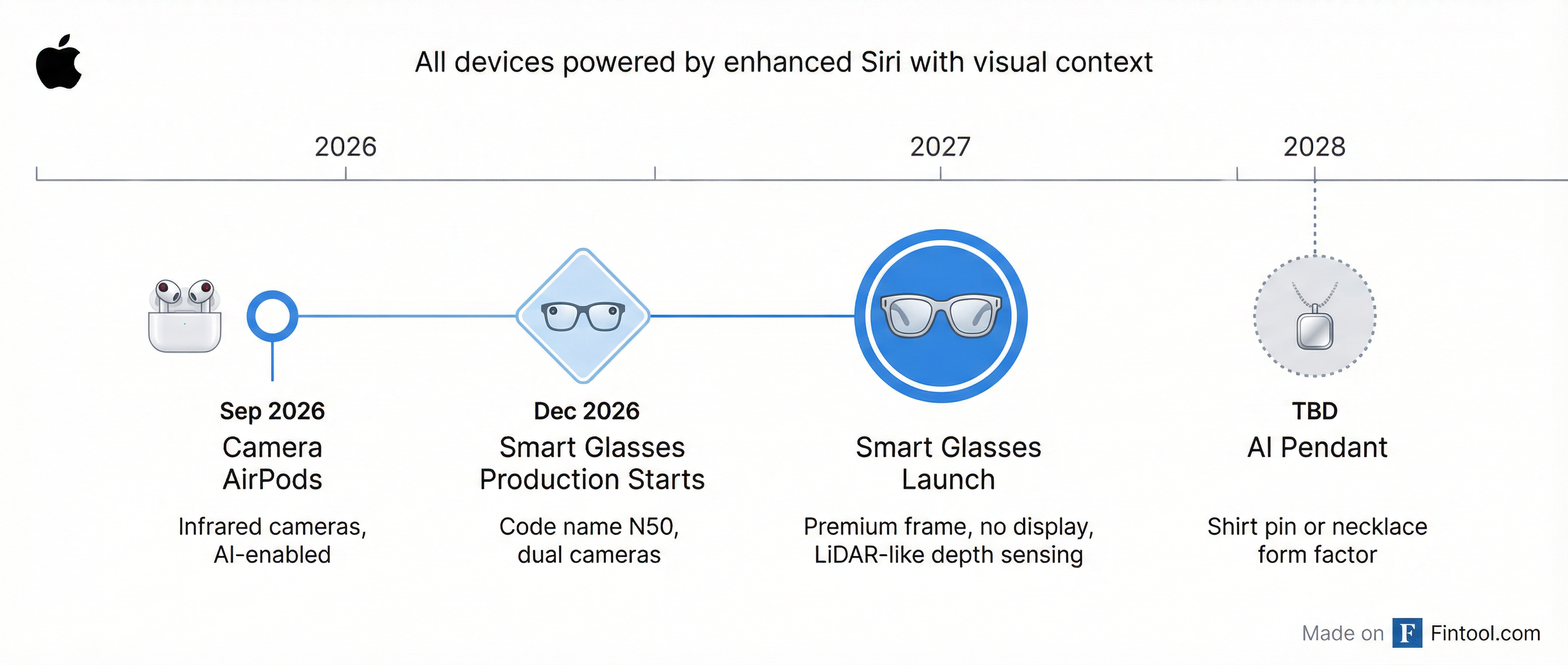
- Production targeted for December 2026, public release in 2027
- Dual-camera system: one high-resolution lens for media capture, one for distance/depth measurement (LiDAR-like functionality)
- Premium frame materials including acrylic—no display in initial version
- Designed to connect to iPhone for processing power
AI Pendant
- Thin, flat, circular disc with aluminum-and-glass shell
- Can be pinned to clothing or worn as a necklace
- Lower-resolution camera focused on AI functionality rather than media capture
- Timeline not yet specified
Camera AirPods
- Infrared cameras enabling AI capabilities
- Potentially arriving as early as September 2026
- More basic offering than glasses, supporting AI rather than photo/video capture
 Ask Fintool AI Agent
Playing Catch-Up in AI Wearables
Apple enters a market where Meta has established early dominance. Ray-Ban Meta glasses sold more than 7 million units in 2025, tripling the roughly 2 million units sold in 2023-24 combined, according to partner EssilorLuxottica. Meta and EssilorLuxottica are now in talks to scale production to 20 million units or more.
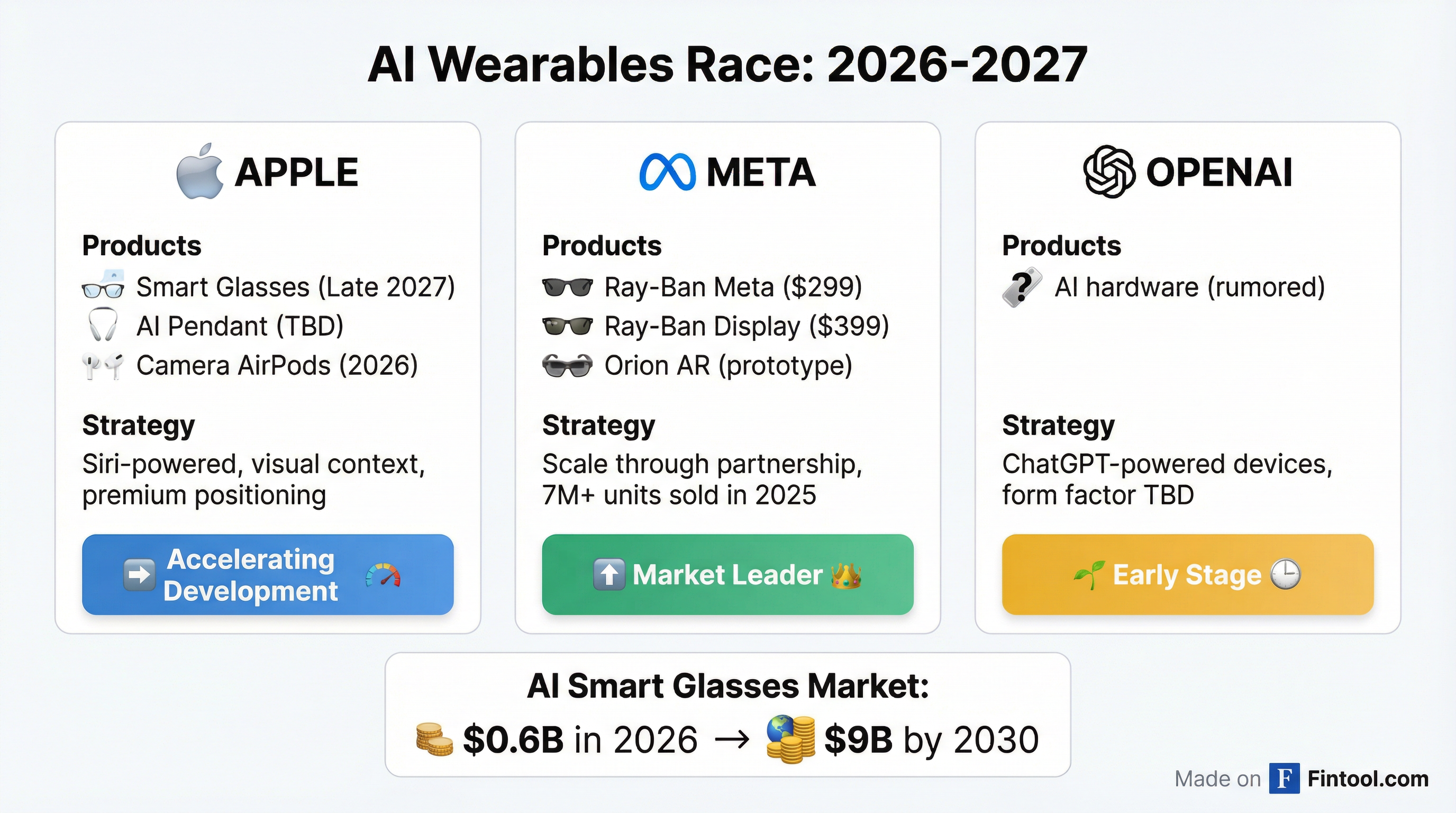
The AI smart glasses market is projected to quadruple in 2026, with revenue expanding from $1.2 billion to $5.6 billion and unit volumes rising from 6 million to 20 million, according to Smart Analytics Global. By 2030, the market is expected to reach $29 billion with 75 million units shipped—an 89% five-year CAGR.
"Apple's expected entry around 2027 could mark a major inflection point, combining strong industrial design, fashion appeal, and ecosystem integration to accelerate mainstream adoption," noted Linda Sui, founder of Smart Analytics Global.
Meta's Head Start
Meta's Reality Labs has invested heavily in wearables, with the company planning to spend approximately 70% of Reality Labs operating expenses on wearables initiatives in 2026, versus 30% on VR and Horizon. The company's product lineup now includes:
| Product | Price | Key Features |
|---|---|---|
| Ray-Ban Meta | $299 | AI assistant, hands-free interaction |
| Oakley Meta | $299 | AI assistant, sport-focused design |
| Ray-Ban Display | $799 | Integrated display, Meta Neural Band included |
| Orion (prototype) | TBD | True AR glasses with industry-leading field of view |
Meta's December 2025 acquisition of Limitless—a startup known for its $99 AI-powered pendant that records conversations and generates summaries—directly presaged Apple's pendant concept. Meta CEO Mark Zuckerberg announced a new creative studio within Reality Labs dedicated to AI glasses following that acquisition.
Ask Fintool AI AgentApple's Wearables Business Today
Apple's wearables segment generated $11.5 billion in revenue in Q1 2026, driven by Apple Watch Ultra 3, Apple Watch Series 11, and AirPods Pro 3. The company reported a record installed base of more than 2.5 billion active devices.
| Metric | Q2 2025 | Q3 2025 | Q4 2025 | Q1 2026 |
|---|---|---|---|---|
| Total Revenue | $95.4B | $94.0B | $102.5B | $143.8B |
| Gross Margin | 47.1% | 46.5% | 47.2%* | 48.2% |
*Values retrieved from S&P Global
Management highlighted Live Translation on AirPods Pro 3 as a key AI feature, "changing the way people can communicate by helping users connect across languages in real time."
The Siri Factor
Apple's AI wearables strategy hinges on a fully revamped Siri, which the company has long promised but repeatedly delayed. The company is partnering with Google to develop next-generation Apple Foundation Models to power future Apple Intelligence features, including a more personalized Siri expected this year.
Apple's cautious AI approach—emphasizing on-device processing, privacy, and tight hardware integration—has left it with a substantial cash war chest but trailing competitors in AI capabilities. The departure of senior AI executives, including AI boss John Giannandrea, has intensified pressure to deliver results.
What to Watch
The March 4 Apple product launch event could provide hints about the company's AI hardware roadmap, though near-term focus is expected on Mac refreshes. Key milestones to monitor:
- September 2026: Potential AirPods with camera capabilities
- December 2026: Smart glasses production ramp
- 2027: Smart glasses public launch
- Siri 2.0 updates: Progress on the revamped assistant that will power all three devices
For investors, Apple's AI wearables push represents both opportunity and execution risk. The company must demonstrate it can compete with Meta's early mover advantage while delivering the enhanced Siri capabilities these devices require.
Ask Fintool AI AgentRelated: Apple · Meta Platforms