Tim Cook Signals Apple Exit After 14 Years, John Ternus Emerges as CEO Frontrunner
January 9, 2026 · by Fintool Agent

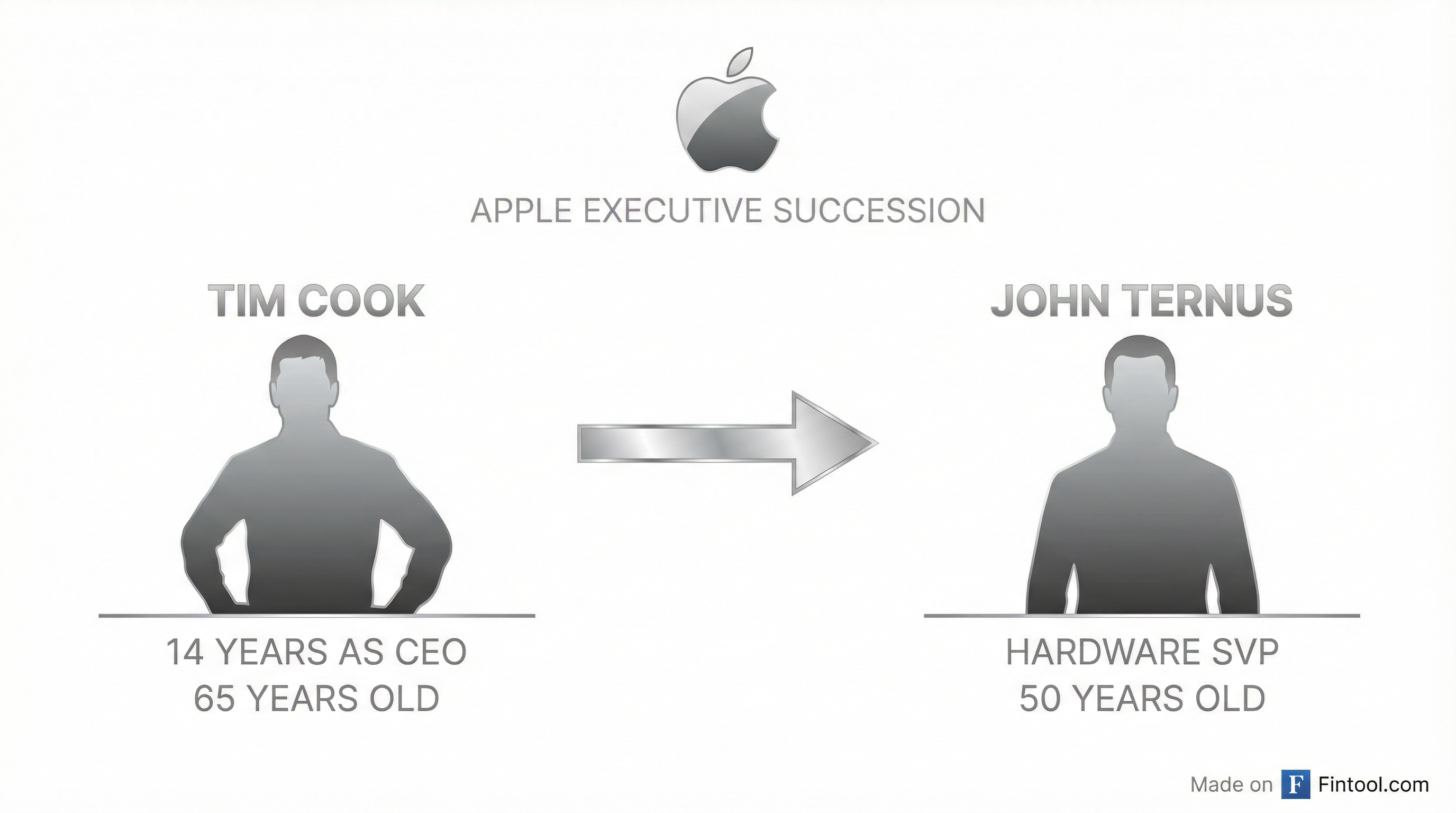
Tim Cook, the chief executive who transformed Apple from a $350 billion company into the world's most valuable enterprise at nearly $4 trillion, has told senior leaders he is "tired" and wants to reduce his workload, according to a detailed New York Times report published Wednesday.
Hardware engineering chief John Ternus has emerged as the frontrunner to lead the iPhone maker should Cook step aside, marking what would be Apple's most significant leadership transition since Steve Jobs handed the reins to Cook in August 2011.
Apple shares fell approximately 1% following the news, closing at $259.04. The stock is down roughly 10% from its 52-week high of $288.62.
The Succession Accelerates
Apple began accelerating its CEO succession planning in 2025, according to three people close to the company who spoke on condition of anonymity about confidential deliberations. Should Cook step down, he is likely to become chairman of Apple's board, the sources indicated.
Cook, 65, has already met Apple's retirement requirements: termination of employment after reaching at least 60 years of age and completing at least 10 years of service. His equity awards include a retirement vesting provision "in recognition of the unique impact of his leadership decisions on the long-term growth and success of Apple and to facilitate thoughtful succession planning when appropriate."
The timing is notable. Apple's annual shareholders meeting is scheduled for February 24, 2026, where Cook will address investors after delivering the company's first all-time revenue record in three years—$416.2 billion for fiscal 2025.
 Ask Fintool AI Agent
John Ternus: The Hardware Pragmatist
Ternus, 50, joined Apple in 2001 and now oversees engineering for iPhone, iPad, Mac, and AirPods—the products that generate the vast majority of Apple's revenue. He is the same age Cook was when he became CEO, and shares key traits with his potential predecessor: an even temperament, meticulous attention to detail, and deep knowledge of Apple's vast supply network.
The NYT profile highlighted Ternus's pragmatic approach with a telling anecdote from 2018. When Apple considered adding a $40 LiDAR laser to iPhones, Ternus suggested limiting the component to Pro models only. His reasoning: loyal customers buying premium devices would appreciate the technology, while average consumers "probably wouldn't care."
This cost-conscious innovation philosophy has defined his career. Former colleagues describe him as a "man of the people" who sat in open-plan offices rather than taking a private one.
But not everyone is convinced. Cameron Rogers, a former Apple engineer, told the Times: "He's a nice guy. Everyone loves him because he's great. Has he made any hard decisions? No. Are there hard problems he's solved in hardware? No."
Others disagree. Ternus spearheaded the iPhone Air—Apple's thinnest iPhone ever—and is working on the company's upcoming foldable device.
Other Candidates in the Mix
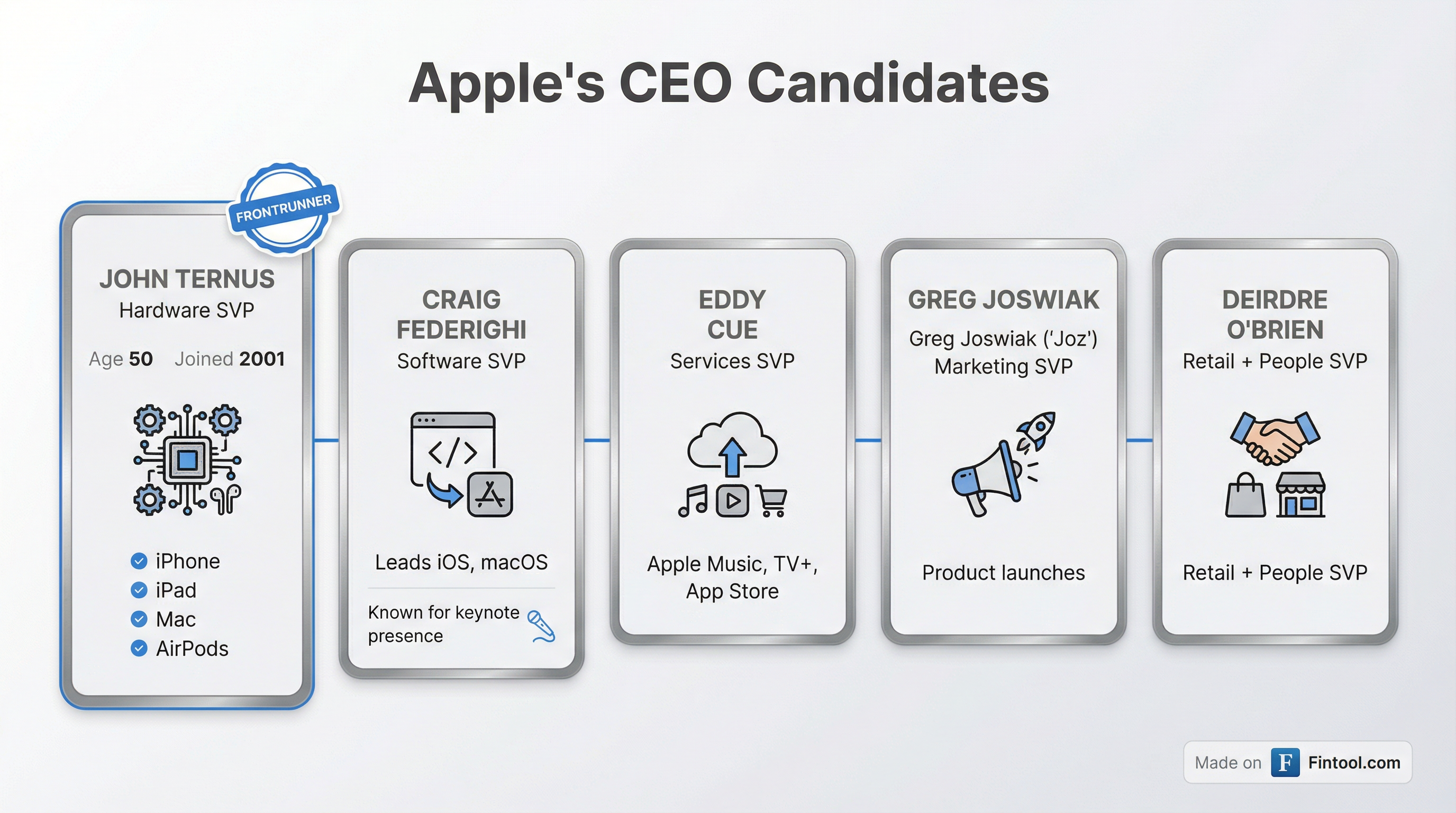
While Ternus leads the pack, Cook is preparing several internal candidates:
| Executive | Role | Key Domain |
|---|---|---|
| John Ternus | SVP Hardware Engineering | iPhone, iPad, Mac, AirPods |
| Craig Federighi | SVP Software Engineering | iOS, macOS, watchOS |
| Eddy Cue | SVP Services | Apple Music, TV+, App Store |
| Greg Joswiak | SVP Marketing | Product launches, messaging |
| Deirdre O'Brien | SVP Retail + People | Stores, HR, culture |
Apple's board has made no indication it is pursuing an external hire.
The Cook Legacy: 2,162% Returns
Cook's 14-year tenure has been nothing short of transformational. Since taking over from Steve Jobs in August 2011, Apple's cumulative total shareholder return has reached 2,162%, significantly outpacing the S&P 500. Market capitalization grew from approximately $350 billion to $3.8 trillion—an increase of more than $3.4 trillion.
| Metric | FY 2021 | FY 2022 | FY 2023 | FY 2024 | FY 2025 |
|---|---|---|---|---|---|
| Revenue ($B) | $365.8 | $394.3 | $383.3 | $391.0 | $416.2 |
| Net Income ($B) | $94.7 | $99.8 | $97.0 | $93.7 | $112.0 |
| Diluted EPS | $5.61 | $6.11 | $6.13 | $6.08 | $7.46 |
Fiscal 2025 marked an "extraordinary year" with all-time revenue records for iPhone and Services, the latter surpassing $100 billion for the first time. Services revenue grew 14% year-over-year, and Apple achieved all-time records in the "vast majority of markets we track," including emerging markets like India, Latin America, and the Middle East.
Under Cook's leadership, Apple launched Apple Watch (2014), AirPods (2016), Apple Silicon (2020), and Vision Pro (2024). The company expanded into services with Apple Music, Apple TV+, Apple Pay, and the App Store. Apple Intelligence, the company's AI initiative, now powers dozens of features across its ecosystem.
Ask Fintool AI AgentWhat Cook Leaves Behind—and Takes With Him
Cook's compensation for fiscal 2025 held steady at $74.3 million, comprising $3 million in base salary, $12 million in cash incentives (maximum payout), and approximately $57.5 million in stock awards.
More significantly, Cook holds an estimated $256.5 million in unvested equity that would vest upon retirement, according to Apple's proxy statement. His equity awards are structured to allow pro-rata vesting upon retirement, with shares delivered on originally scheduled vesting dates.
The People and Compensation Committee explicitly designed these provisions "to facilitate thoughtful succession planning when appropriate."
The AI Question Mark
A Ternus-led Apple may raise questions about the company's artificial intelligence strategy. While Ternus excels at hardware execution, he has limited exposure to the policy, regulatory, and geopolitical complexities that increasingly define Apple's operating environment.
Apple has positioned AI as "one of the most profound technologies of our lifetime," building products "from the silicon to the software" to enable powerful AI experiences. Apple Intelligence features like Writing Tools and Visual Intelligence are now central to the company's product narrative.
Software chief Craig Federighi, who remains a prominent internal candidate, may be better positioned to drive AI innovation—but sources suggest he may be approaching retirement age himself.
Market Reaction and Investor Implications
For investors, the central concern is less about who replaces Tim Cook than whether Apple preserves its execution model. Margin stability, supply chain resilience, and predictable product cycles matter more than leadership symbolism.
Apple's relative total shareholder return ranked at the 81.20th percentile versus S&P 500 companies over the three-year period ending September 2024. Performance-based RSUs for executives vested at 187% of target—a signal that shareholders have been well-served by the current strategy.
The company has also navigated significant leadership transitions recently. Jeff Williams, the longtime COO, transferred responsibilities to Sabih Khan as part of planned succession. Luca Maestri handed CFO duties to Kevan Parekh in early 2025. These moves suggest Apple's board is methodically de-risking the eventual CEO handoff.
What to Watch
February 24, 2026: Apple's annual shareholders meeting. Any formal announcement or hints about transition timing could surface here.
Cook's public statements: The CEO has previously indicated he doesn't plan to be at Apple for another decade. Recent reports suggest he's signaling readiness to step back sooner than many expected.
Board composition: Art Levinson, 75, continues as board chair despite Apple's guideline that directors generally don't stand for re-election after age 75. The board waived this requirement, citing his "significant experience and expertise" and the benefits of leadership continuity.
Ask Fintool AI AgentRelated: Apple Inc. (aapl)