Apple Reports Record Quarter: iPhone Sales Surge 23% to $85B as China Turnaround Stuns Wall Street
January 29, 2026 · by Fintool Agent


Apple reported the best quarter in company history on Thursday, with iPhone revenue surging 23% to an all-time record $85.3 billion as a stunning turnaround in China defied investor fears about the world's most competitive smartphone market. CEO Tim Cook called demand "simply staggering."
The results crushed Wall Street expectations across every major metric, delivering a stark contrast to Microsoft's 10% crash earlier in the same trading session. While Microsoft cratered despite beating estimates on AI spending concerns, Apple rose in extended trading on proof that hardware cycles still matter—and that its iPhone 17 lineup has reignited consumer demand globally.
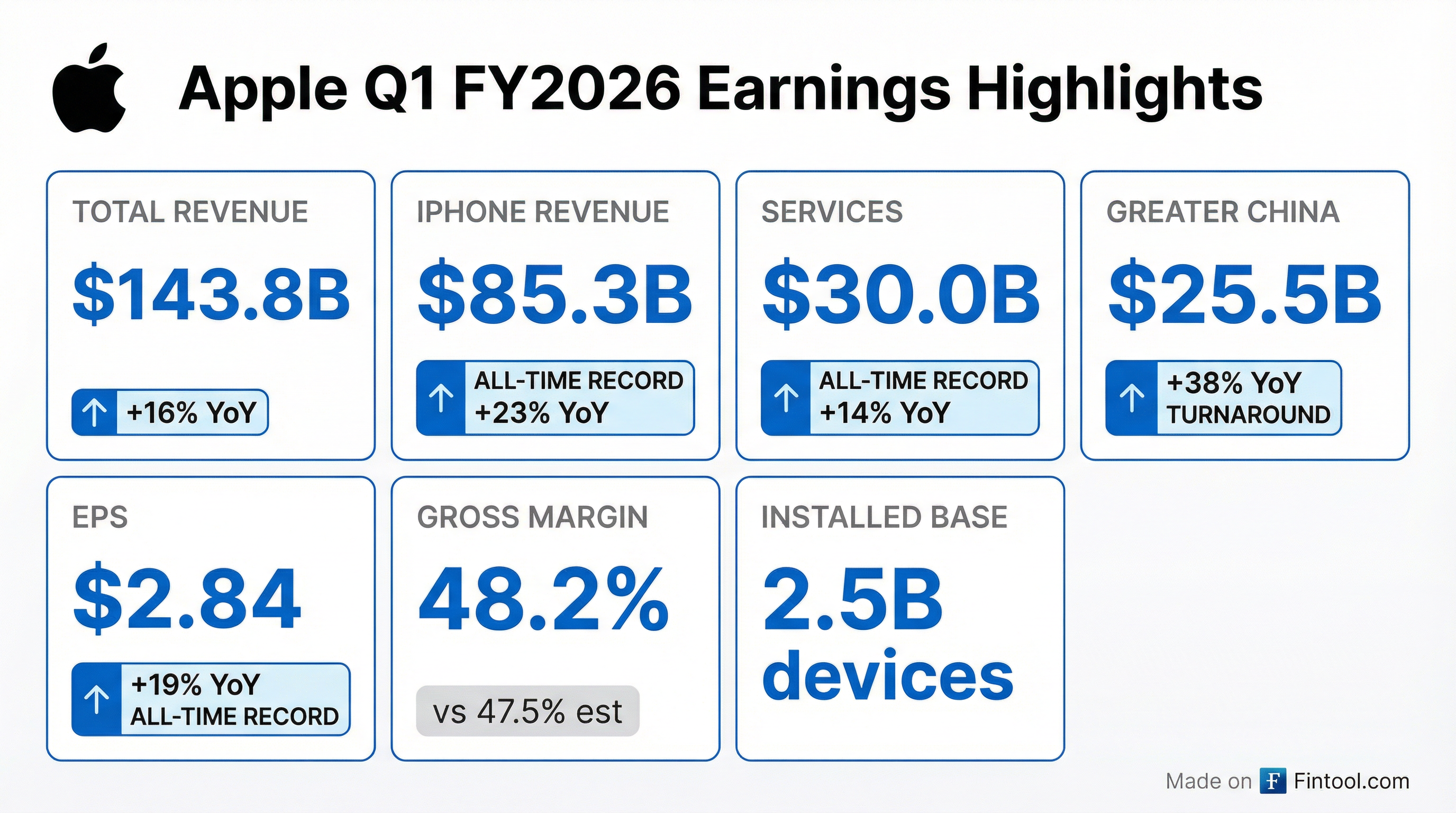
"Today, Apple is proud to report a remarkable, record-breaking quarter, with revenue of $143.8 billion, up 16 percent from a year ago and well above our expectations," Cook said. "iPhone had its best-ever quarter driven by unprecedented demand, with all-time records across every geographic segment."
The Numbers: Records Across the Board
Apple's Q1 FY2026 results exceeded expectations on virtually every line item:
| Metric | Q1 FY2026 | Q1 FY2025 | YoY Change | vs Consensus |
|---|---|---|---|---|
| Total Revenue | $143.8B | $124.3B | +16% | Beat by $5.3B |
| iPhone Revenue | $85.3B | $69.1B | +23% | Beat by $6.6B |
| Services Revenue | $30.0B | $26.3B | +14% | In line |
| Diluted EPS | $2.84 | $2.40 | +19% | Beat by $0.17 |
| Gross Margin | 48.2% | 46.9% | +130 bps | Beat 47.5% est |
The iPhone beat was particularly remarkable. Analysts had expected iPhone revenue of approximately $78.3-78.7 billion, already an optimistic forecast. Apple delivered $85.3 billion—a beat of nearly $7 billion, or about 8.5%.
CFO Kevan Parekh highlighted the cash generation: "These exceptionally strong results generated nearly $54 billion in operating cash flow, allowing us to return almost $32 billion to shareholders."
 Ask Fintool AI Agent
The China Turnaround: From Crisis to Record
Perhaps the most significant development was Greater China's 38% year-over-year surge to $25.5 billion—up from $18.5 billion in the year-ago quarter. This represents a dramatic reversal for a region that had been Apple's biggest headache.
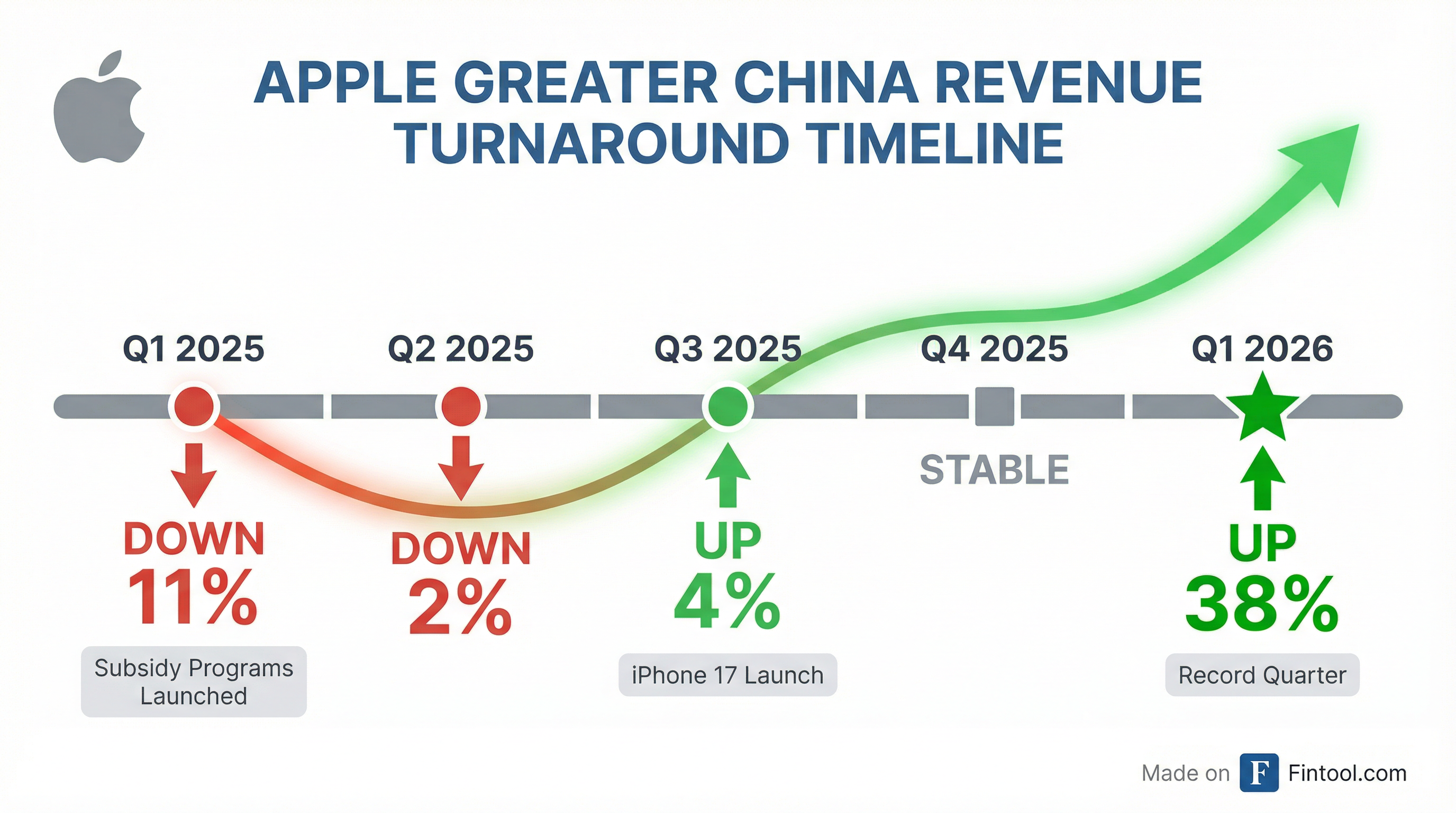
The trajectory tells the story:
| Quarter | Greater China Revenue | YoY Change | Context |
|---|---|---|---|
| Q1 FY2025 | $18.5B | -11% | Huawei resurgence, no Apple Intelligence |
| Q2 FY2025 | $16.4B | -2% | Subsidies begin, FX headwinds |
| Q3 FY2025 | $15.7B | +4% | First full quarter of subsidies |
| Q4 FY2025 | $15.0B | Flat | iPhone 17 launch |
| Q1 FY2026 | $25.5B | +38% | Record quarter |
Just one year ago, analysts were questioning whether Apple could compete in China against subsidized domestic champions like Huawei and Xiaomi. Cook had acknowledged China was "the most competitive market in the world" while facing questions about nationalist sentiment against Western brands.
The turnaround was driven by multiple factors:
- Government subsidies: China's national subsidy program launched in January 2025 covered smartphones, tablets, and PCs up to certain price points. Cook had previously said "I do believe that the subsidies played a favorable impact."
- iPhone 17 design refresh: The "liquid glass" design and upgraded camera features resonated with Chinese consumers
- Installed base momentum: Cook noted Apple's installed base hit "a record high in Greater China" with "an all-time record for the iPhone installed base"
Ask Fintool AI AgentRegional Performance: Records Everywhere
Every geographic segment grew, with most setting records:
| Region | Q1 FY2026 | Q1 FY2025 | YoY Change |
|---|---|---|---|
| Americas | $58.5B | $52.6B | +11% |
| Europe | $38.1B | $33.9B | +13% |
| Greater China | $25.5B | $18.5B | +38% |
| Japan | $9.4B | $9.0B | +5% |
| Rest of Asia Pacific | $12.1B | $10.3B | +18% |
Cook emphasized that "iPhone had its best-ever quarter driven by unprecedented demand, with all-time records across every geographic segment."
Product Mix: iPhone Dominates
While iPhone drove the outperformance, other categories showed mixed results:
| Category | Q1 FY2026 | Q1 FY2025 | YoY Change |
|---|---|---|---|
| iPhone | $85.3B | $69.1B | +23% |
| Services | $30.0B | $26.3B | +14% |
| Wearables, Home & Accessories | $11.5B | $11.7B | -2% |
| iPad | $8.6B | $8.1B | +6% |
| Mac | $8.4B | $9.0B | -7% |
Services continued its steady growth trajectory, reaching another all-time revenue record. The Services segment now generates $30 billion per quarter—more than many S&P 500 companies generate annually. Apple also announced that its installed base now exceeds 2.5 billion active devices.
The Mac decline (-7%) was the only notable weakness, likely reflecting the timing of product launches and a tough year-ago comparison when the M3 MacBook Pro had just launched.
The Tale of Two Tech Giants
The contrast with Microsoft couldn't be sharper. Both companies reported after the bell on Wednesday, but the market reactions diverged dramatically:
| Company | Revenue Beat | EPS Beat | Stock Reaction |
|---|---|---|---|
| Apple | +$5.3B (+3.8%) | +$0.17 (+6.4%) | +0.7% regular, +2.5% after-hours |
| Microsoft | +$1.0B (+1.2%) | +$0.17 (+4.3%) | -10% |
Microsoft's $357 billion market cap wipeout—its worst day since March 2020—came despite beating estimates, as investors questioned whether its massive AI infrastructure spending would deliver proportional returns. Azure growth decelerated to 39%, and margins compressed.
Apple's results suggest a different narrative: hardware innovation cycles still drive consumer spending, and the iPhone franchise retains remarkable pricing power and customer loyalty. While Microsoft's AI investments are being questioned, Apple's focus on product-driven growth appears validated.
"The demand for iPhone was simply staggering, with revenue growing 23 percent year over year to achieve its biggest quarter in history," Cook told Reuters.
Ask Fintool AI AgentThe AI Question
Apple's results come at an interesting moment for its AI strategy. Unlike Microsoft, Google, and Meta, Apple has taken a more measured approach to generative AI—focusing on on-device processing through Apple Silicon and privacy-preserving features through Apple Intelligence.
Earlier this month, Apple and Google announced a partnership to integrate Google's Gemini models into Apple Intelligence. Cook has promised a "more personalized Siri" with advanced capabilities, though that feature has been delayed until later in 2026.
The strong iPhone results may vindicate Apple's strategy of letting hardware drive the upgrade cycle rather than AI hype. Bernstein analyst Mark C. Newman noted that "strong iPhone sales continued into December with sell-through revenue up 12% year-over-year," driven by the iPhone 17 design refresh and customers upgrading from six-year-old pandemic-era devices.
Apple also announced today that it's acquiring Israeli AI startup Q.ai for approximately $2 billion—its second-largest acquisition ever after Beats—signaling it's willing to spend for AI capabilities even as it maintains its measured public approach.
Balance Sheet Strength
Apple's financial position remains fortress-like:
| Metric | Dec 27, 2025 | Sep 27, 2025 |
|---|---|---|
| Cash & Equivalents | $45.3B | $35.9B |
| Marketable Securities | $99.5B | $96.5B |
| Total Debt | $88.5B | $90.7B |
| Shareholders' Equity | $88.2B | $73.7B |
The company generated $53.9 billion in operating cash flow during the quarter and returned nearly $32 billion to shareholders through dividends and buybacks. Apple repurchased $24.7 billion of stock during Q1, continuing its aggressive capital return program.
The board declared a quarterly dividend of $0.26 per share, payable February 12, 2026.
What to Watch
Near-term:
- Investor reaction to the Q1 beat and whether analysts revise estimates upward
- Any additional color from the earnings call on China sustainability
- Guidance for Q2 FY2026 (March quarter)
Longer-term:
- Whether China momentum can sustain through 2026
- Apple Intelligence rollout in China (not yet available)
- Impact of the Q.ai acquisition on future product features
- "More personalized Siri" launch timing and reception
Apple shares closed Thursday's regular session at $258.28, up 0.7%. In after-hours trading following the earnings release, shares rose to $261.91, a further gain of approximately 1.4%. The stock remains below its 52-week high of $288.62 but has gained significantly from its low of $169.21.
The results should quiet—at least temporarily—concerns that Apple's hardware business has matured. The iPhone 17 cycle is off to a historically strong start, China has swung from liability to asset, and Services continues its reliable double-digit growth. For investors wondering whether hardware innovation still matters in the AI age, Apple just provided a $85 billion answer.
Ask Fintool AI AgentRelated
- Apple Inc. (aapl) - Company Profile
- Microsoft Corporation (msft) - Company Profile