BHP Raises Copper Guidance as Escondida Fires, But Jansen Potash Blows Past $8B
January 19, 2026 · by Fintool Agent


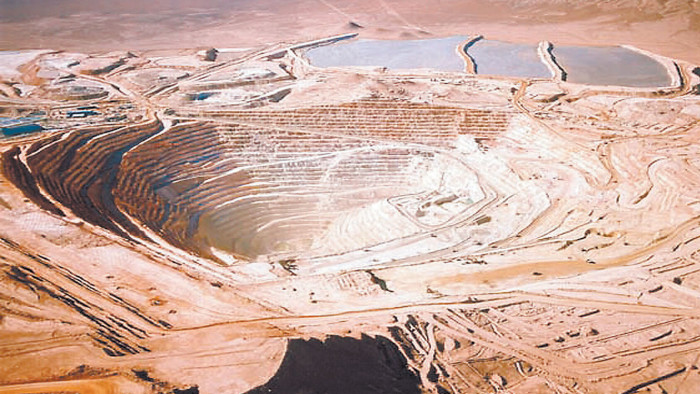
BHP Group, the world's largest miner by market value, delivered a mixed operational update on Monday: upgraded copper production guidance reflecting record-breaking performance at its flagship Escondida mine, offset by yet another cost blowout at its Jansen potash megaproject in Canada.
The divergent outcomes encapsulate BHP's strategic bet on "future-facing commodities"—copper for the energy transition and potash for global food security—while highlighting the execution risks inherent in mega-scale mining projects.
Copper Guidance Raised on Escondida Strength
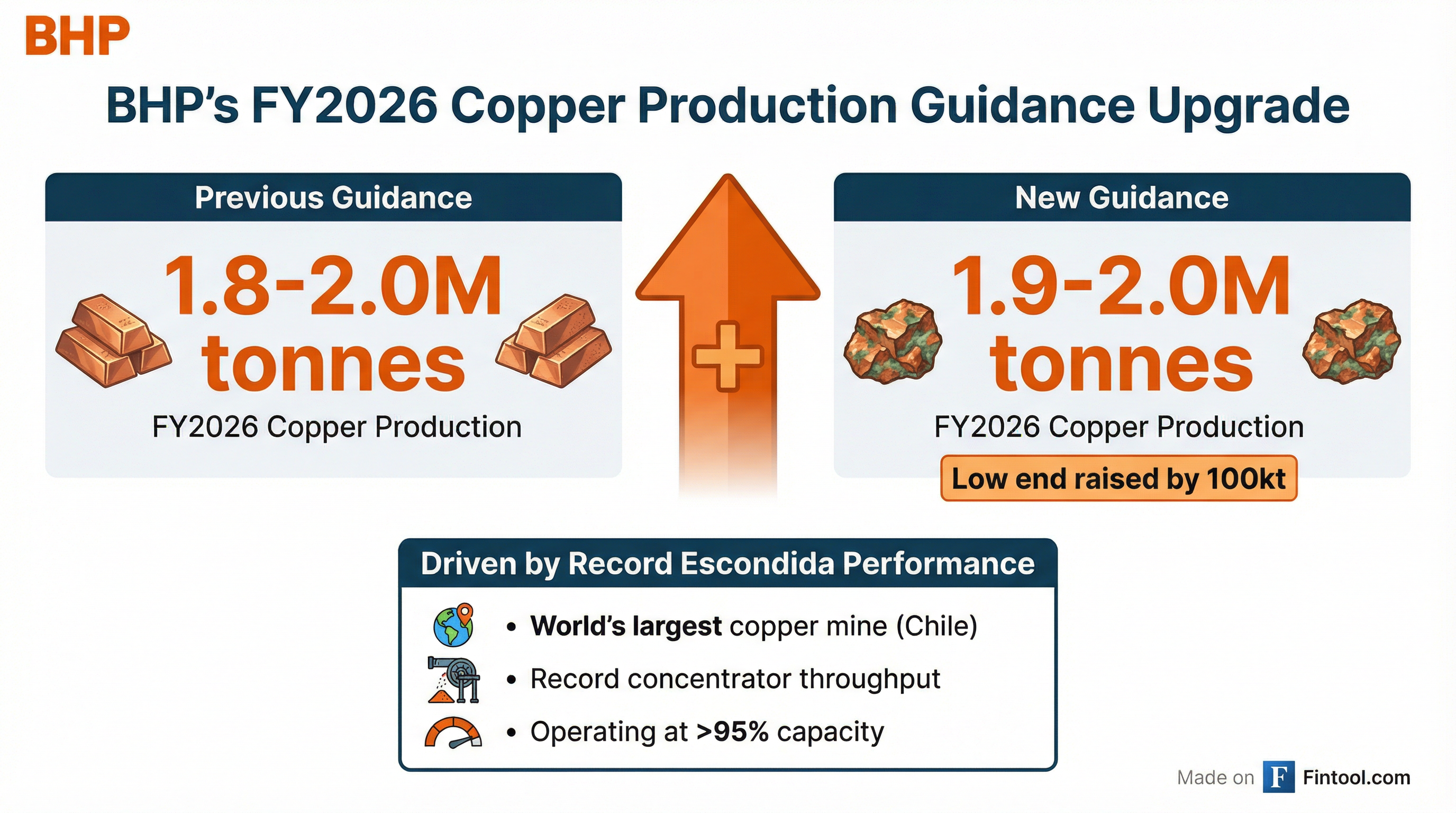
BHP now expects to produce 1.9-2.0 million metric tons of copper in fiscal year 2026 (ending June), up from a prior range of 1.8-2.0 million tons.
The upgrade is driven by exceptional performance at Escondida—the world's largest copper mine, located in Chile's Atacama Desert. CEO Mike Henry credited "record concentrator throughput" that is helping BHP capitalize on copper prices hovering near all-time highs.
The timing couldn't be better. Copper prices have surged past $13,000/mt on the London Metal Exchange—a record high driven by supply disruptions, surging AI data center demand, and the electrification megatrend. J.P. Morgan projects prices reaching $12,500/mt in Q2 2026 and averaging approximately $12,075/mt for the full year.
 Ask Fintool AI Agent
Jansen Cost Blows Out to $8.4 Billion
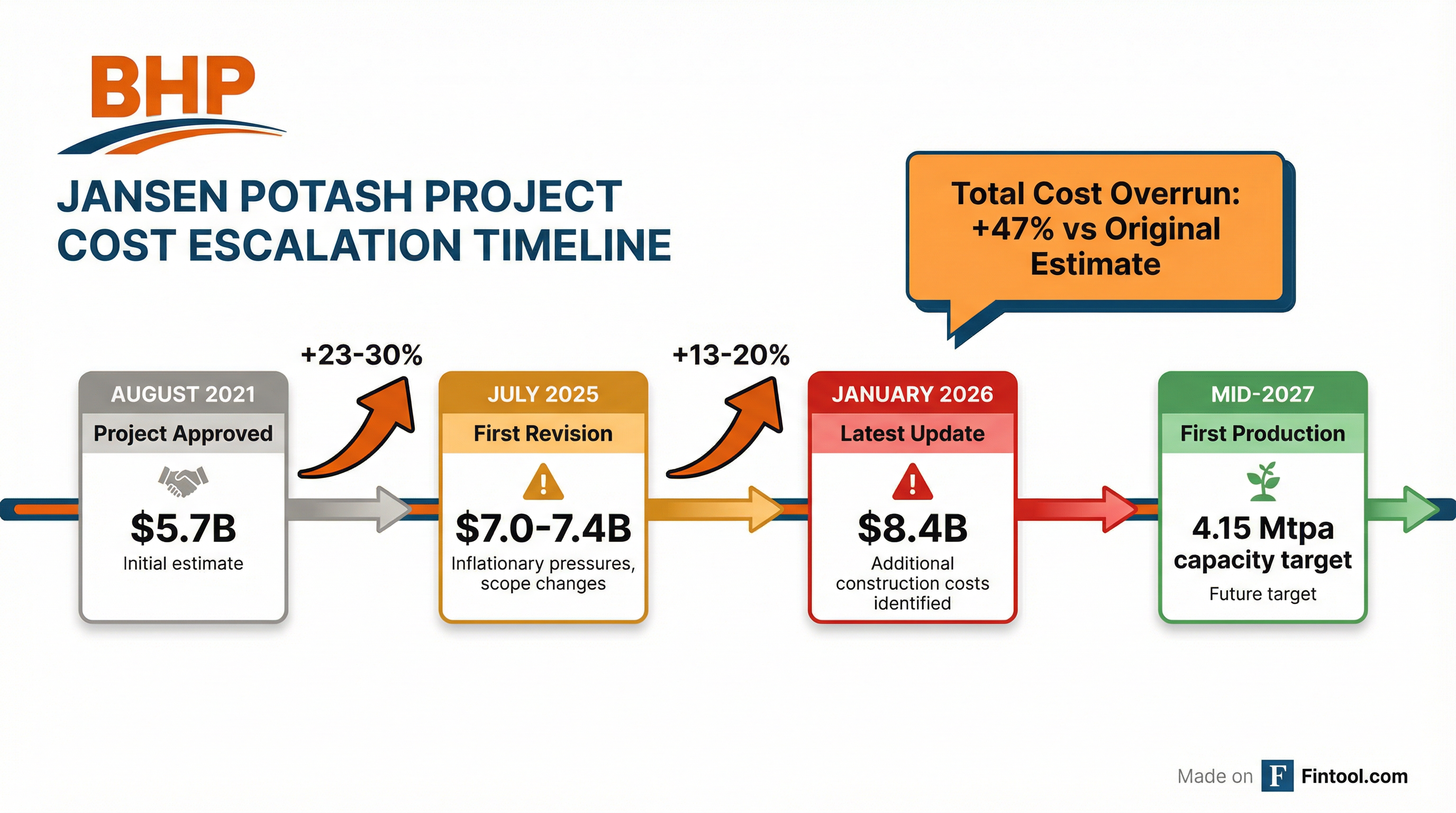
Overshadowing the copper news, BHP confirmed that its Jansen Stage 1 potash project will now cost $8.4 billion—up from a previous range of $7.0-7.4 billion flagged in July 2025, and a staggering 47% higher than the original $5.7 billion estimate when the project was approved in August 2021.
The cost increase stems from "construction hours and quantities of materials that were not included in previous execution cost estimates," BHP disclosed.
The overrun is significant but not unusual in mega-mining projects. BHP's Brandon Craig, President Americas, defended the investment: "Jansen is an important pillar in BHP's long-term growth strategy and is a long-life, low cost expandable asset that is expected to generate benefits for shareholders for decades."
The project, located in Saskatchewan, Canada, is now 75% complete with first production expected in mid-2027. BHP expects Jansen Stage 1 to produce approximately 4.15 million tonnes per annum with EBITDA margins of 63-64%—among the lowest-cost operations globally thanks to the region's high-grade deposits.
At consensus potash prices, the project carries an internal rate of return of 7.9-9.1% and an expected payback period of 11-15 years from first production—solid but not spectacular, particularly given the cost escalation.
Ask Fintool AI AgentStock Down Modestly Despite 32% YTD Rally
BHP shares on the NYSE closed at $64.86 on Friday, down 1.8% as the broader market digested Trump administration tariff threats. Despite the mixed update, the stock has rallied 31.8% since January 2025, driven by surging copper prices and renewed investor appetite for commodity exposure.
At a $165 billion market cap, BHP trades at approximately 7x trailing EBITDA—a discount to historical averages, reflecting both potash uncertainty and commodity cyclicality concerns.
Financial Snapshot
| Metric | FY 2022 | FY 2023 | FY 2024 | FY 2025 |
|---|---|---|---|---|
| Revenue ($B) | $65.1* | $53.8* | $55.7* | $51.3* |
| EBITDA ($B) | $37.3* | $25.6* | $26.8* | $23.4* |
| EBITDA Margin | 57.3%* | 47.5%* | 48.2%* | 45.7%* |
| Net Income ($B) | $30.9* | $12.9* | $7.9* | $9.0* |
| Capex ($B) | $6.1* | $7.1* | $9.3* | $9.8* |
| Net Debt ($B) | $0.7* | $11.6* | $9.7* | $13.6* |
*Values retrieved from S&P Global
Notably, capital expenditure has surged from $6.1B in FY 2022 to nearly $10B in FY 2025 as BHP invests in growth—primarily Jansen and copper expansion projects. Net debt has risen correspondingly to $13.6B, though leverage remains manageable at under 1x EBITDA.
The Bigger Picture: BHP's Commodity Bet
BHP has been reshaping its portfolio around what it calls "future-facing commodities"—copper and potash—while iron ore continues to generate more than half of earnings.
Copper benefits from structural tailwinds: the energy transition requires massive copper volumes for EVs, grid infrastructure, and data centers. S&P Global estimates demand will jump 50% to 42 million metric tons by 2040, while supply faces a potential 10-million-ton shortfall.
Potash offers defensive characteristics: global agricultural demand is steady and growing, with the market expected to expand at ~3.5% CAGR to $33.9B by 2034. Unlike volatile copper, potash prices have been remarkably stable, supported by disciplined production from major players like Nutrien, K+S, and the Canadian/Belarusian producers.
The Jansen cost blowout is frustrating but arguably manageable given BHP's balance sheet strength and the project's long-term economics. The bigger question: Can BHP execute on the subsequent Jansen stages (Stage 2 cost review expected Q4 FY2026) and expand copper production to capture the energy transition upside?
Ask Fintool AI AgentWhat to Watch
- Jansen Stage 2 Cost Update: Expected in Q4 FY2026 (April-June 2026). Another significant overrun could pressure the stock.
- Copper Prices: J.P. Morgan sees $12,500/mt in Q2; Goldman Sachs warns of potential correction to $11,000/mt by year-end as supply recovers.
- Anglo American/Teck Developments: BHP's failed bid for Anglo last year and the subsequent Anglo-Teck combination could reshape competitive dynamics in copper.
- FY2026 Results: BHP's full-year results (August 2026) will provide the definitive read on whether Escondida's record performance translates to earnings.
Related Companies: BHP · Rio Tinto · Vale · Freeport-mcmoran · Nutrien · Teck Resources