Birkenstock Stock Drops 7% at NYC Investor Day as Management Lowers Growth Targets to 13-15%
January 28, 2026 · by Fintool Agent



Birkenstock shares tumbled 6.6% during the company's first Capital Markets Day in New York City on Tuesday, as CEO Oliver Reichert told investors to expect 13-15% annual revenue growth through FY2028—a notable step down from the high-teens pace that defined the German footwear maker's first two years as a public company.
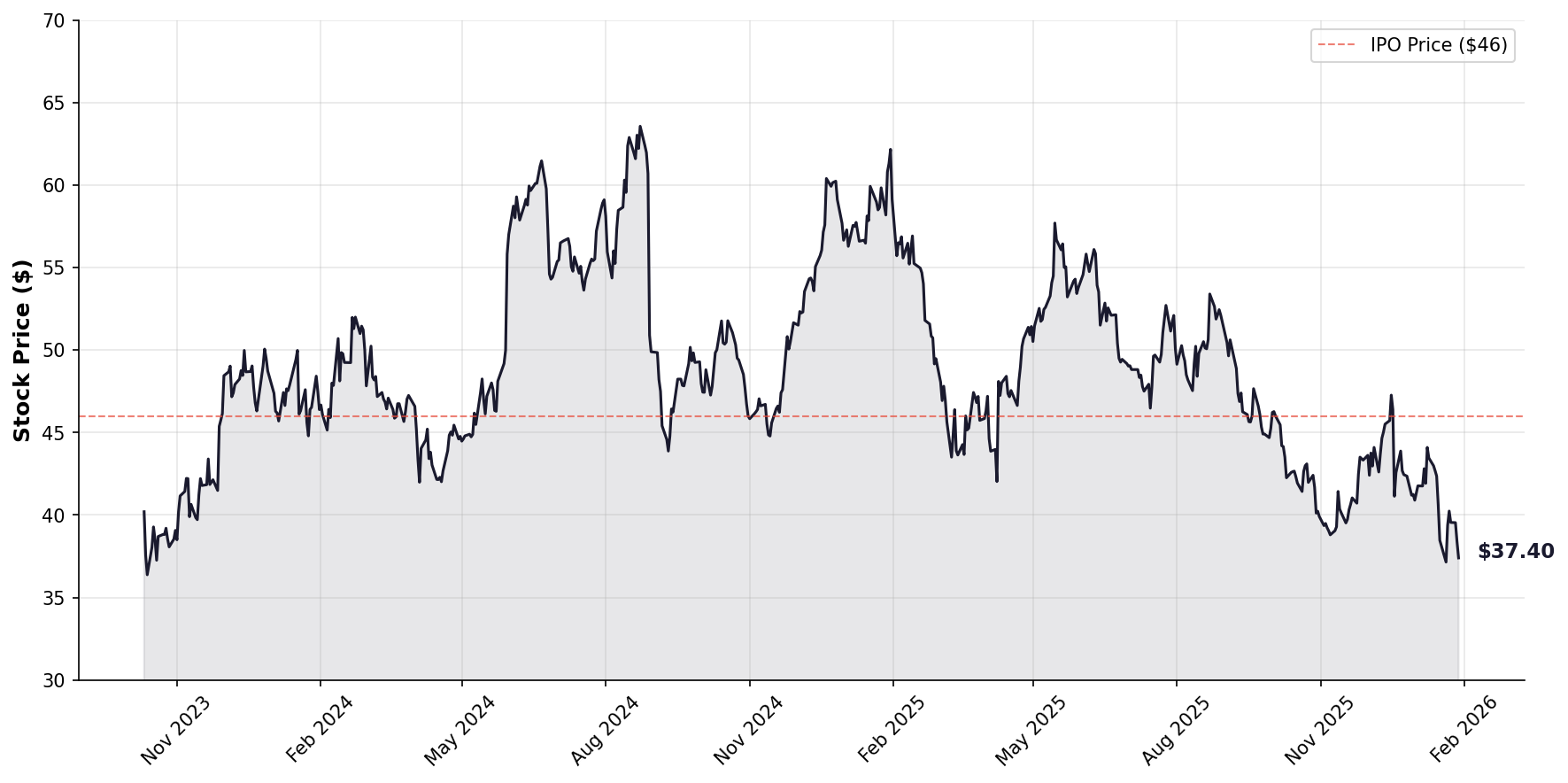
The stock opened at $40.05 and slid throughout the event, closing at $37.40—now 19% below its October 2023 IPO price of $46.
"We see unbroken demand out there," Reichert told the audience at the midtown Manhattan venue. "Could we grow faster in wholesale? Yes, we can. But what would be the result?"
The result, he argued, would be compromising Birkenstock's carefully cultivated scarcity model—the same strategy that has delivered 30%+ EBITDA margins and what management describes as "best-in-class" full-price sell-through rates approaching 98% at key retail partners.
Q1 FY2026: Strong Numbers, Uncomfortable Optics
The preliminary Q1 results released at the event showed the business remains healthy. Revenue hit €402 million, up 18% in constant currency and 11% on a reported basis—with the gap driven primarily by US dollar weakness.
| Metric | Q1 FY2026 | Q1 FY2025 | Change |
|---|---|---|---|
| Revenue (€M) | €402 | €362 | +11% reported, +18% CC |
| Adj. Gross Margin | 57.4% | 60.3% | -290 bps |
| Adj. EBITDA Margin | 26.5% | 28.2% | -170 bps |
| Adj. EPS | $0.27 | $0.18 | +50% |
CFO Ivica Krolo emphasized that the margin compression is entirely external. Excluding FX and tariff impacts, gross margin would have expanded 60 basis points and EBITDA margin would have improved 190 basis points.
"If you add back the impacts of tariffs and FX to gross margin, we are perfectly in line with a previous long-term goal of being in the 60% range," Krolo said during Q&A.
 Ask Fintool AI Agent
The 3-Year Algorithm: €1 Billion in New Revenue
Management laid out a clear financial framework for the next three years:
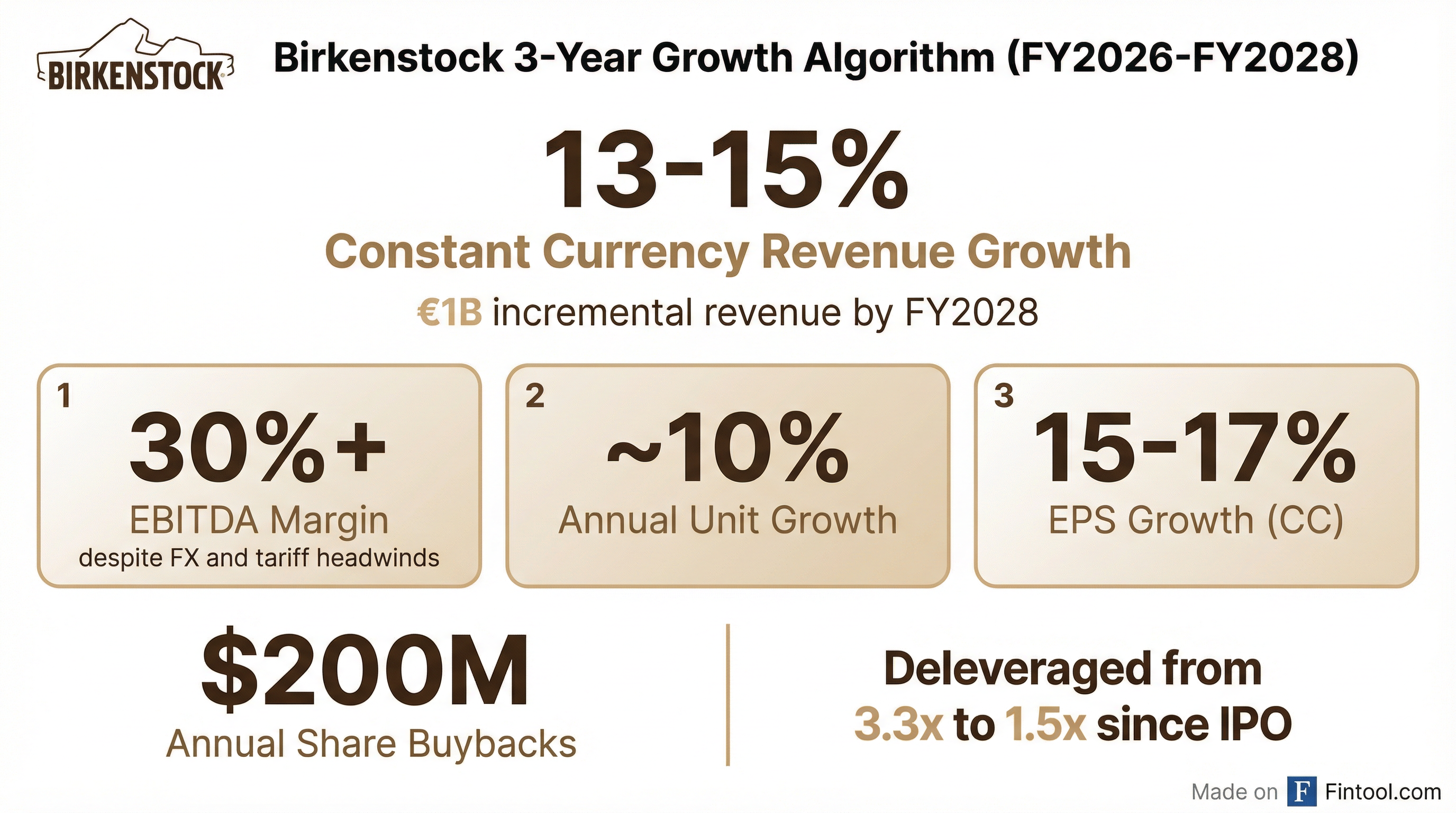
Key targets through FY2028:
- Revenue growth: 13-15% constant currency annually
- EPS growth: 15-17% constant currency (200 bps above revenue growth)
- EBITDA margin: 30%+ (assuming no additional tariffs, FX at $1.17/€)
- Unit growth: ~10% annually
- Share buybacks: $200 million per year
At the midpoint, this implies €1 billion of incremental revenue by FY2028—meaning it will take three years to add what took the brand 250 years to originally achieve.
"We are one of the absolute outliers in growth and margin perspective," Reichert said, pointing to a competitive positioning chart. "Whatever critics you may bring to the table, this is a truth."
"Steered Growth": The Channel Balancing Act
The deceleration from high-teens to mid-teens growth isn't about weakening demand—it's about channel management, according to Reichert.
B2B (wholesale) is currently outpacing DTC, driven particularly by the "emerging youth" demographic that David Kahn, President of the Americas, described as the brand's fastest-growing segment. These younger consumers—roughly ages 14 to mid-20s—prefer discovering Birkenstock in multi-brand retail environments rather than direct channels.
The math creates tension: B2B requires approximately 2.4x more pairs to generate the same revenue as DTC, given the ASP differential (€40 vs. €95). With Birkenstock already capacity-constrained, faster wholesale growth means fewer pairs available for higher-margin direct sales.
"B2B is a great business for us and not a sickness at all," Krolo insisted. "The EBITDA margin is higher, and the EBITDA margin differential between the channels is around 400-500 basis points."
Perhaps more importantly, wholesale provides 5-9 months of forward visibility through the order book, de-risking production planning.
APAC: The White Space Opportunity
The most aggressive growth target belongs to Asia-Pacific, where Birkenstock plans to double revenue over three years.
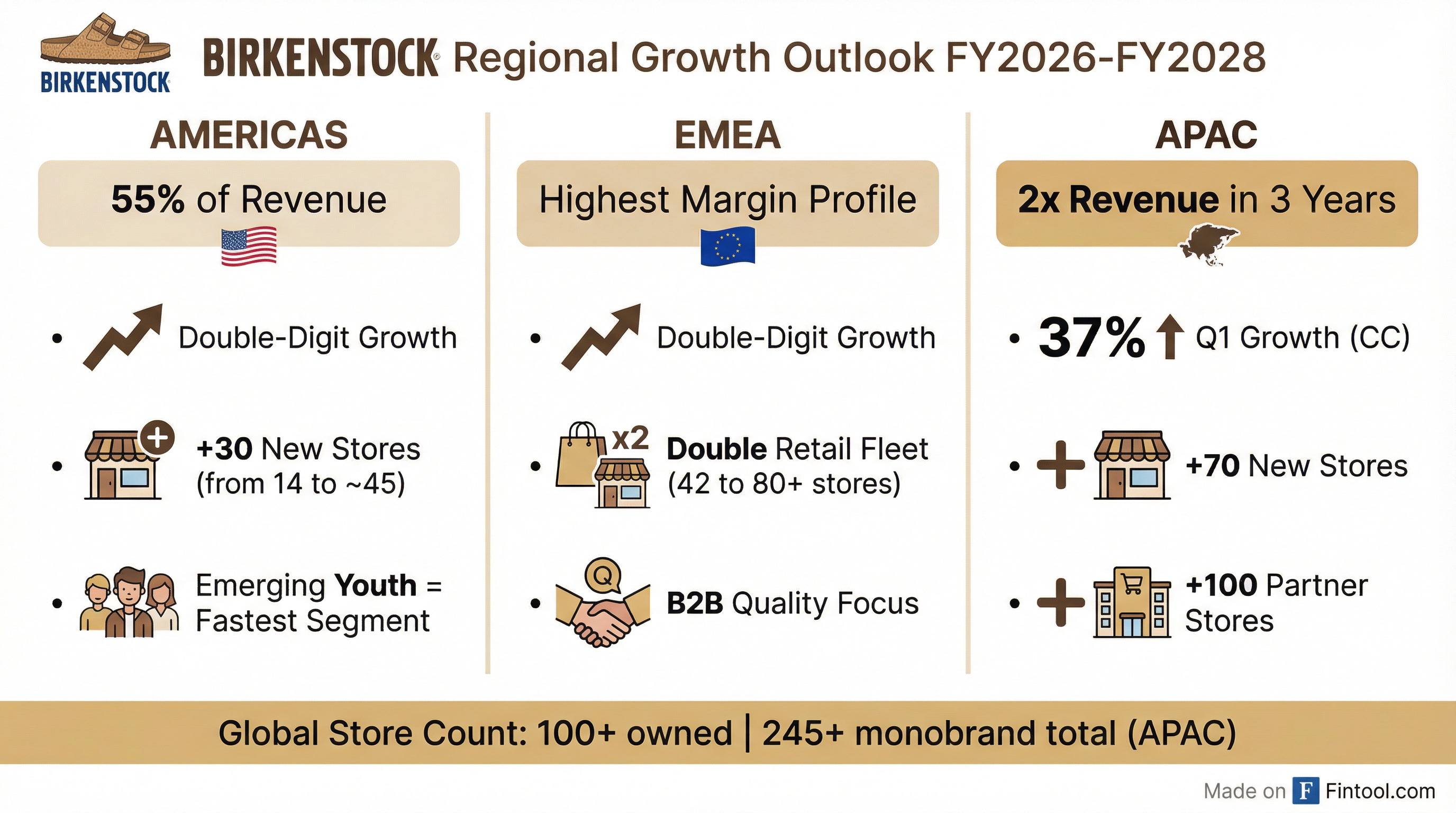
APAC already delivered 37% constant currency growth in Q1 FY2026—roughly double the pace of the Americas and EMEA.
Klaus, who leads the APAC region, outlined an ambitious retail buildout:
- 70 new company-owned stores over three years
- 100 additional partner stores
- Double-digit like-for-like growth in existing locations
The regional strategy differs fundamentally from the West. Asia is a mono-brand market where owned retail and partner stores dominate, and Birkenstock is positioning itself at premium/luxury price points. In top stores like Taikoo Li Chengdu, average transaction values reach €150-170.
"In some of our stores, we already have 30-40% of sales from 1774," Reichert noted, referring to the brand's highest-end collection.
Ask Fintool AI AgentSupply Chain: Wittichenau Factory Coming Online 2027
Supporting 10% annual unit growth requires factory expansion. Birkenstock operates seven facilities in Germany and Portugal, assembling 95% of products in-house—making it one of the most vertically integrated footwear companies in the industry.
Jakob, who oversees supply chain, detailed three expansion projects:
| Facility | Focus | Status |
|---|---|---|
| Görlitz (Germany) | Cork latex footbeds, final assembly | 1.8x FY2023 capacity by FY2027 |
| Wittichenau (Germany) | Cork latex footbeds, clogs | 78,000 sqm brownfield; operational 2027 |
| Arouca (Portugal) | Leather uppers, complex executions | Tripling production space; labor costs 50% of Germany |
The Wittichenau acquisition represents a strategic shift toward brownfield expansion rather than greenfield construction. "We're gonna be probably at half of the price of Pasewalk," Jakob said, referencing the company's last major facility.
Management is also exploring a potential expansion of the Pasewalk facility to up to 2x its current size.
Closed-Toe Now 38% of Business
One of the IPO's biggest skeptic questions—whether Birkenstock could succeed in closed-toe footwear—has been answered. The segment now represents 38% of revenue, up from 19% at IPO, and continues to outpace sandals growth.
Marcus, who leads product, highlighted the quarterly revenue profile transformation: Q1 (October-December) has grown from 15% of annual revenue in 2019 to a much more balanced share today, largely driven by closed-toe momentum.
The company is celebrating the Boston clog's 50th anniversary in 2026 and is introducing new silhouettes like the Naples Wrap, which Marcus described as "the fastest-growing silhouette" among new launches.
Investor Pushback: "What About the Stock Price?"
Jay Sole from UBS asked the question on everyone's mind: "The stock's at $37.70, and at the time of the IPO it priced at $46... What can you do to make sure the company gets credit from the market?"
Reichert's response was characteristically blunt:
"We can only deliver what we promise... Honestly, I think it's quite helpful for the operational teams to not look at the share price too often. Because if you have this kind of disconnection between your growth and the level of excellence, how you deliver quarter by quarter, and then see this reflected in the share price—this is a clear disconnect."
Since IPO, Birkenstock has delivered:
- 41% revenue growth
- 38% EBITDA growth
- 55% deleveraging (3.3x to 1.5x net leverage)
- €275 million invested in production
- $200 million in share repurchases
Yet the stock remains underwater.
Ask Fintool AI AgentWhat to Watch
February 12, 2026: Full Q1 FY2026 results and conference call
Key questions remain:
- DTC reacceleration: Can the digital business recover from what management calls a "re-platforming" transition? Online has been a soft spot amid the wholesale surge.
- Tariff evolution: Current guidance assumes no additional tariffs. Any escalation from Washington could pressure the 30%+ margin target.
- FX normalization: The EUR/USD assumption of 1.17 is already being tested (recent trading near 1.19-1.20).
- APAC execution: Doubling a region in three years while maintaining premium positioning is ambitious.
The market's verdict today was clear—investors wanted more. Whether Birkenstock's "steered growth" philosophy proves wise or overly conservative will be determined by whether the brand can sustain its remarkable full-price economics while competitors chase growth at any cost.
Related: