Boeing Lands $8.6 Billion F-15 Contract for Israel as Defense Unit Recovery Gains Momentum
December 30, 2025 · by Fintool Agent


Boeing scored an $8.6 billion contract from the Pentagon to build up to 50 F-15IA fighter jets for the Israeli Air Force—a significant win for the struggling defense giant announced hours after President Trump hosted Israeli Prime Minister Benjamin Netanyahu at Mar-a-Lago.
The contract, announced Monday in the Department of Defense's daily awards summary, covers design, integration, testing, production, and delivery of 25 new F-15IA aircraft with an option for 25 more. Work will be performed at Boeing's St. Louis facility through December 31, 2035, with initial funding of $840 million obligated at award.
Boeing shares rose 1.8% on Tuesday, trading at $221.18 at midday—their highest level in over a week.
The Deal at a Glance
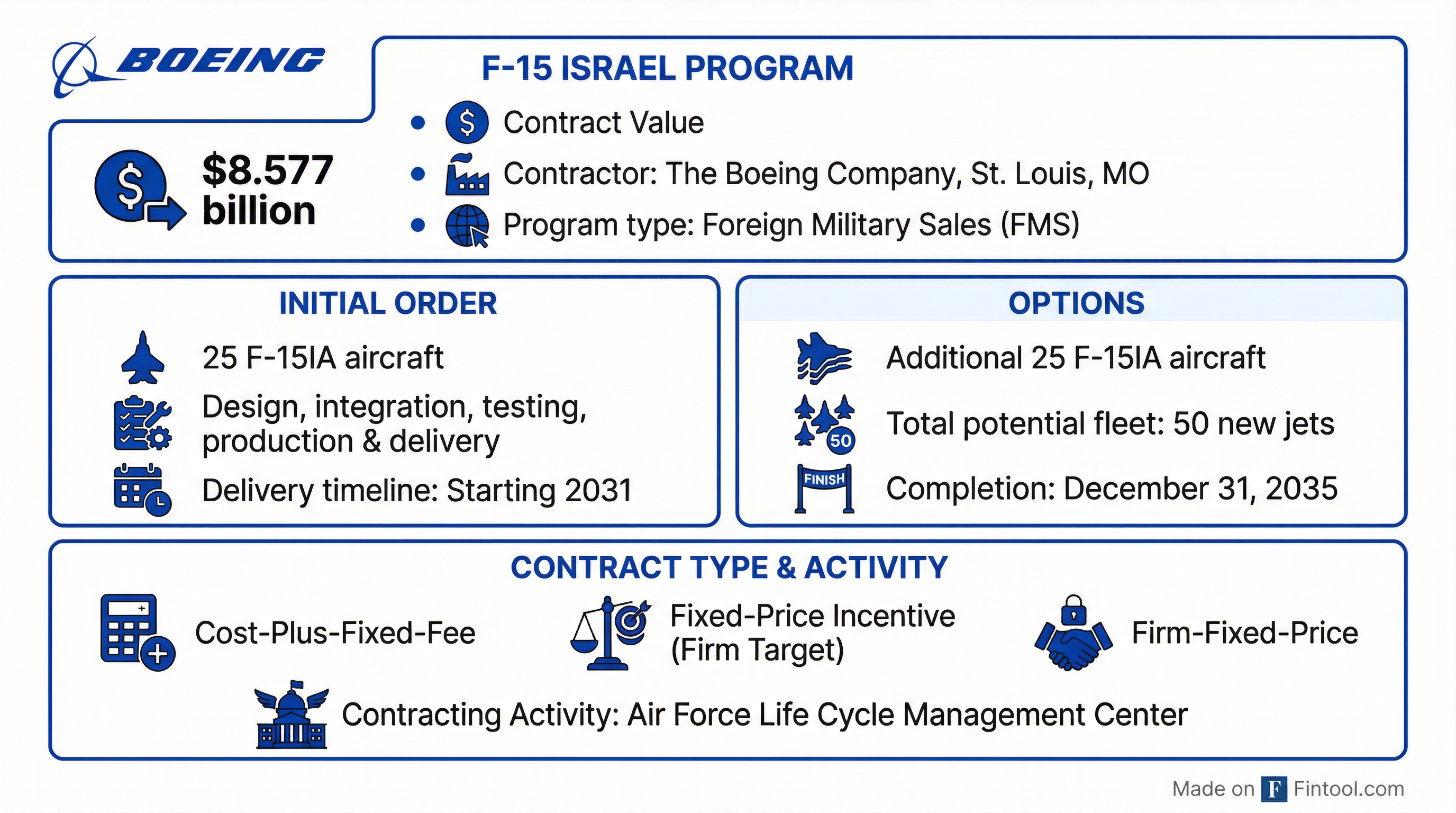
The F-15IA is the Israeli variant of Boeing's advanced F-15EX Eagle II—the latest iteration of the legendary F-15 platform that has served as the backbone of Israel's air superiority capabilities for decades. The F-15 remains Israel's most relied-upon fighter aircraft, seeing heavy use in campaigns against Iran, the Houthis in Yemen, and Hezbollah in Lebanon over the past two years.
This contract builds on Israel's existing $5.2 billion deal signed last November for an initial 25 F-15IAs. With Monday's award, the IAF's total new F-15IA order rises to 50 jets, complementing its existing fleet of 66 F-15 variants.
Deliveries of the initial batch are expected to begin in 2031, with four to six jets delivered annually.
 Ask Fintool AI Agent
Timing and Context: Trump-Netanyahu Summit
The Pentagon announcement came the same day Netanyahu visited Trump at Mar-a-Lago for talks on Gaza, Iran, and regional security. Trump pledged continued U.S. support for Israel and warned that the U.S. would back Israeli strikes on Iran if Tehran reconstitutes its nuclear program.
The meeting showcased the close U.S.-Israel defense relationship, with Trump calling Netanyahu a "hero" and stressing, "We're with you, and we'll continue to be with you."
The F-15 contract flows through the Pentagon's Foreign Military Sales (FMS) program, meaning it's funded by Israel but administered by the U.S. Air Force Life Cycle Management Center. The sole-source award reflects the unique Israeli specifications and the established F-15 supply chain at Boeing's St. Louis operations.
What It Means for Boeing's Defense Business
For Boeing, this contract couldn't come at a better time. The company's Defense, Space & Security (BDS) segment has been clawing its way back from crisis-level losses tied to fixed-price development program overruns on the KC-46A Tanker, T-7A Red Hawk, and other platforms.
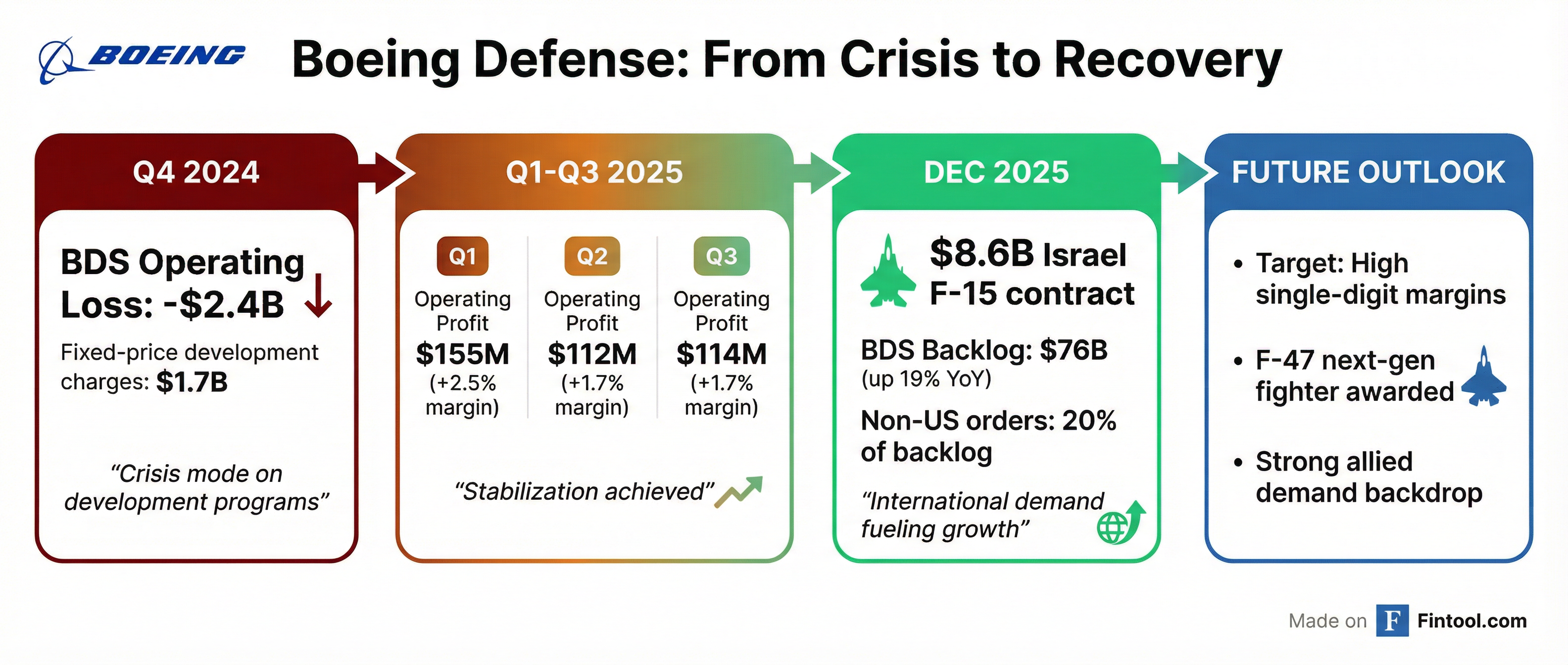
The turnaround is evident in the numbers:
| Metric | Q3 2024 | Q3 2025 | Change |
|---|---|---|---|
| BDS Revenue | $5.5B | $6.9B | +25% |
| BDS Operating Income | ($2.4B) | $114M | Swing to profit |
| BDS Operating Margin | (43.1%) | 1.7% | +44.8 ppts |
Values retrieved from S&P Global
The BDS backlog has swelled to $76.1 billion at September 30, 2025—up 19% from $64.0 billion at the end of 2024. Notably, 20% of the defense backlog now comes from non-U.S. customers, reflecting strong international demand driven by "complex and evolving security challenges and the need to modernize aging equipment and inventories."
Ask Fintool AI AgentFighter Programs: A Stabilizing Story
Boeing's fighter portfolio—comprising roughly 25% of BDS revenue—has shown improving trends after years of margin pressure. The company delivered 7 F-15 models in the first nine months of 2025, along with 12 F/A-18s.
Management has signaled that the fighter programs are "reflecting the stabilizing performance trend that began in the first quarter," with operations continuing to improve sequentially.
However, execution risk remains. An ongoing strike by approximately 3,200 IAM 837-represented workers at Boeing's St. Louis sites has disrupted F-15, F/A-18, T-7A, MQ-25, and weapons production since August 4, 2025. If prolonged, the work stoppage could materially impact financial results and delivery schedules.
The Financial Picture: Still Digging Out
Despite the defense segment's recovery, Boeing remains deeply unprofitable at the corporate level:
| Metric | FY 2022 | FY 2023 | FY 2024 |
|---|---|---|---|
| Revenue | $66.6B | $77.8B | $66.5B |
| Net Income | ($4.9B) | ($2.2B) | ($11.8B)* |
| Free Cash Flow | $4.6B* | $6.6B* | ($9.7B)* |
Values retrieved from S&P Global
The company burned through $7.6 billion of cash from Q4 2024 through Q2 2025, with cash on hand falling from $13.8 billion to $6.2 billion over that stretch. Analyst estimates project revenue recovery to $88.0 billion in FY 2025 and $96.4 billion in FY 2026, with EPS turning positive at $2.34 in FY 2026 after a projected loss of $9.62 per share in FY 2025.*
Values retrieved from S&P Global
Ask Fintool AI AgentCompetitive Landscape: F-15 vs. F-35
The F-15IA award highlights an interesting dynamic in modern fighter procurement. While Lockheed Martin's F-35 Lightning II dominates new fighter orders with its fifth-generation stealth capabilities, the F-15 platform continues to find strong demand—particularly for missions where raw speed, payload capacity, and proven reliability matter more than stealth.
The F-15 can reach speeds of Mach 2.5 and carry 29,500 pounds of weapons on external hardpoints, compared to the F-35's Mach 1.6 top speed and 18,000-pound internal payload limit.
Israel operates both platforms. Its F-35I "Adir" fleet—the first F-35s used in combat—has proven transformative for intelligence gathering and precision strikes, while the F-15 fleet provides heavy strike capacity and air superiority coverage.
What to Watch
Near-term execution: Boeing must navigate the ongoing IAM 837 strike at St. Louis, which directly affects F-15 production. Resolution of this labor dispute will be critical for maintaining delivery timelines across the fighter portfolio.
Defense budget dynamics: The FY 2026 DoD budget request stands at $848 billion, though the One Big Beautiful Bill Act appropriated an additional $156 billion for national defense priorities over the coming years. Strong bipartisan support for defense spending, combined with elevated global threat levels, should support demand.
F-47 next-generation fighter: In March 2025, Boeing was selected to design and build the Air Force's next-generation fighter aircraft. While not yet in backlog pending source selection review completion, the F-47 represents a potential multi-decade franchise.
Margin trajectory: Management targets high single-digit margins for the defense segment "in the medium to longer term." The Israel contract, structured as a hybrid cost-plus and fixed-price arrangement, should carry healthier economics than Boeing's troubled fixed-price development programs.
Ask Fintool AI AgentRelated
- Boeing – Company Profile
- Lockheed Martin – F-35 Program
- RTX Corporation – Defense Competitor