Boeing Knew About Engine Mount Flaw 15 Years Before Fatal UPS Crash, NTSB Reveals
January 14, 2026 · by Fintool Agent


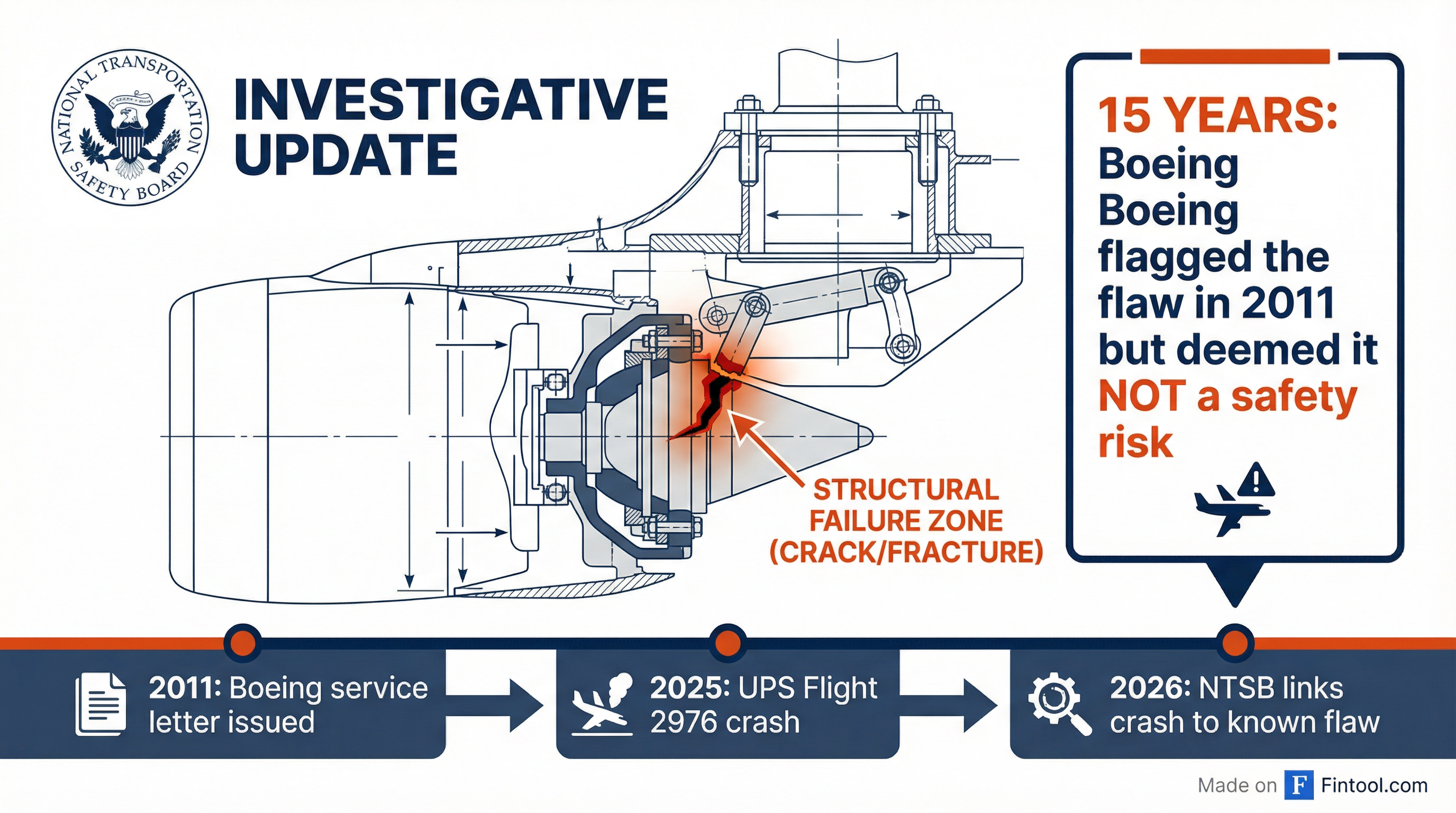
Boeing warned aircraft operators in 2011 that a critical engine mount component had failed four times on three different MD-11 jets—but the aerospace giant determined the flaw "would not result in a safety of flight condition." On Wednesday, the National Transportation Safety Board revealed that the same part is now at the center of its investigation into the November crash that killed 15 people.
The NTSB's investigative update marks another inflection point in Boeing's multi-year safety crisis, adding the legacy McDonnell Douglas MD-11 freighter fleet to the list of aircraft programs marred by quality and oversight failures.
The 2011 Service Letter
In February 2011, Boeing issued Service Letter MD-11-SL-54-104-A to operators, documenting four previous failures of the spherical bearing race—a small but critical 3-inch-wide metal housing that helps secure the MD-11's massive engines to their wings. Each failure initiated at a design recess groove on the interior surface, causing the bearing to fracture and split into two pieces.
According to the NTSB, Boeing's review of these failures concluded they did not pose a safety risk. The service letter called for visual inspections every 60 months—roughly five years—but did not mandate replacement of the affected components with a newly designed part.
"If fatigue isn't handled properly, obviously it can become a safety-of-flight issue," air safety expert Anthony Brickhouse told Reuters.
 Ask Fintool AI Agent
What the Investigation Found
Ups Flight 2976, a Boeing MD-11F cargo jet, was destroyed shortly after takeoff from Louisville Muhammad Ali International Airport on November 4, 2025. Airport surveillance footage captured the left engine and pylon separating from the wing moments after rotation, igniting a fire as the engine traversed above the fuselage before impacting the ground.
The NTSB's Wednesday update pinpointed the exact component that failed: the spherical bearing race in the pylon aft mount. Examination revealed:
- 75% of the fractured surface showed evidence of long-term fatigue cracking
- 25% showed overstress failure during the accident sequence
- The cracking originated at the same location—the design recess groove—as the failures Boeing documented in 2011
Three pilots aboard the cargo flight were killed, along with 12 people on the ground when the aircraft crashed into a petroleum recycling facility and UPS warehouse, setting off a massive blaze.
Boeing's Response
Boeing issued a brief statement Wednesday saying it "continues to support the investigation led by the NTSB" and expressed condolences to the families of the victims. The company did not address the 2011 service letter or explain why the bearing race failures were not classified as a safety-of-flight issue.
The MD-11 was designed by McDonnell Douglas, which Boeing acquired in 1997. Boeing has inherited responsibility for maintaining and supporting the aging freighter fleet, which remains popular among cargo carriers despite the model's age.
Following the crash, Boeing recommended that all MD-11s be grounded. The FAA subsequently issued an emergency airworthiness directive prohibiting further flight of MD-11 and DC-10 aircraft until inspections are completed.
Pattern of Safety Lapses
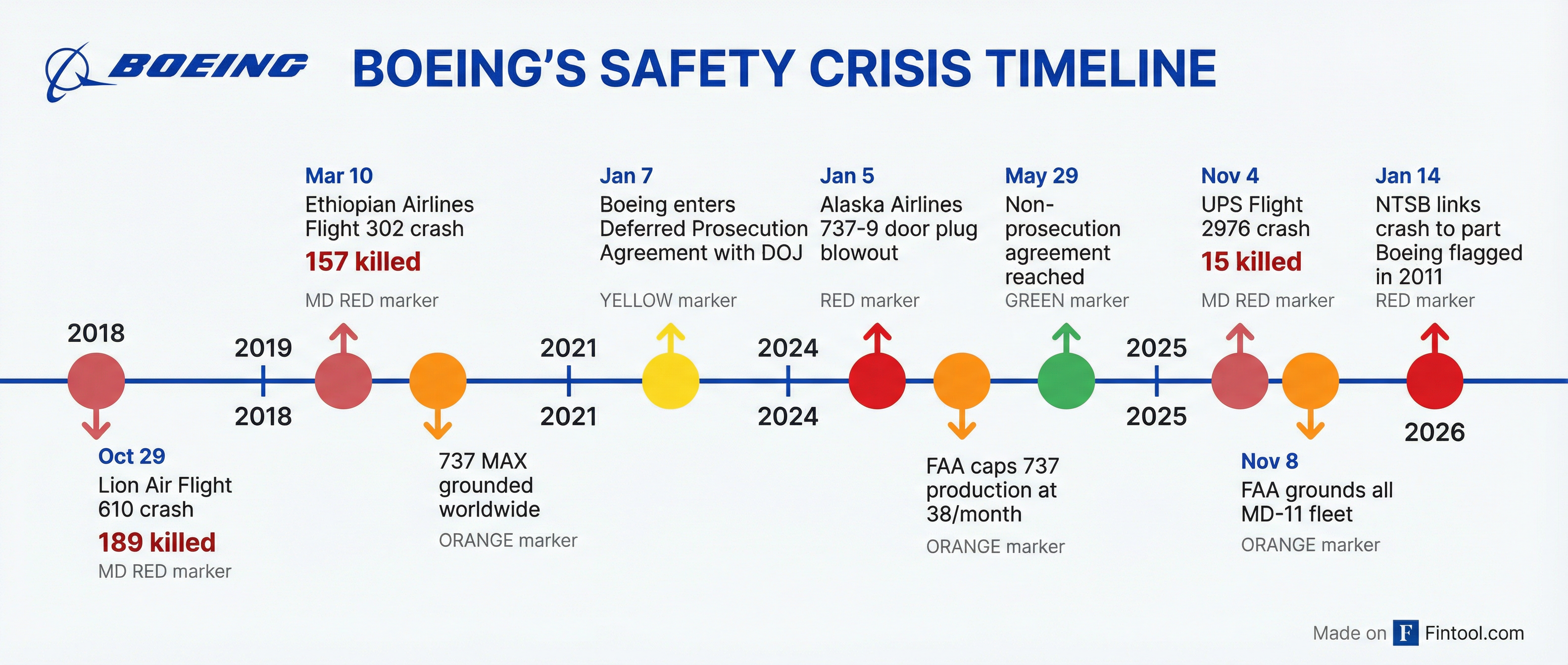
The NTSB findings add another chapter to Boeing's ongoing safety crisis:
| Event | Date | Impact |
|---|---|---|
| Lion Air Flight 610 crash | Oct 2018 | 189 killed |
| Ethiopian Airlines Flight 302 crash | Mar 2019 | 157 killed |
| 737 MAX global grounding | 2019 | Fleet grounded worldwide |
| DOJ Deferred Prosecution Agreement | Jan 2021 | Three-year oversight period |
| Alaska Airlines door plug blowout | Jan 2024 | Emergency landing, no fatalities |
| FAA caps 737 production at 38/month | 2024 | Production constraints |
| DOJ non-prosecution agreement | May 2025 | $244M fine, $455M safety investment |
| UPS Flight 2976 crash | Nov 2025 | 15 killed |
Boeing disclosed in its latest 10-Q that it "cannot reasonably estimate a range of loss" from pending lawsuits and investigations related to the 737 MAX accidents and the 2024 door plug incident.
Ask Fintool AI AgentFinancial Impact
Boeing's recent financial results reflect the cumulative toll of safety issues, production delays, and a prolonged 2024 machinist strike:
| Metric | Q4 2024 | Q1 2025 | Q2 2025 | Q3 2025 |
|---|---|---|---|---|
| Revenue ($B) | $15.2* | $19.5 | $22.7 | $23.3 |
| Net Income ($B) | -$3.9* | -$0.04 | -$0.6 | -$5.3 |
| Operating Cash Flow ($B) | -$3.5* | -$1.6 | $0.2 | $1.1 |
*Values retrieved from S&P Global
The company recorded a $4.9 billion reach-forward loss on the 777X program in Q3 2025 due to certification delays, pushing the first delivery timeline to 2027. Total debt stands at $55.7 billion.
Analysts expect Boeing to remain unprofitable through Q1 2026, with consensus EPS estimates of -$0.40 for Q4 2025 and $0.06 for Q1 2026, before a gradual recovery in the second half.*
*Values retrieved from S&P Global
Despite the November crash and ongoing investigations, Boeing shares have rallied 18.6% since November 3, 2025, closing at $242.61 on Wednesday—near their 52-week high of $247.40. The recovery reflects optimism around the October 2025 FAA approval to increase 737 production from 38 to 42 per month and progress on the machinist labor agreement.
What to Watch
The NTSB's final report on the UPS crash is expected in 18-24 months. Key questions remain:
- UPS Maintenance Practices: Investigators are reviewing how UPS incorporated Boeing's 2011 service letter recommendations and the airline's correspondence with Boeing and the FAA
- Regulatory Response: Whether the FAA will mandate replacement of the bearing race assembly across all MD-11 and DC-10 aircraft, rather than just visual inspections
- Legal Exposure: Potential wrongful death lawsuits from families of victims and Boeing's evolving liability position
- Fleet Impact: UPS operated one of the largest MD-11 fleets globally; the continued grounding has disrupted its cargo operations
Ask Fintool AI Agent