Boston Scientific Crashes 16% in Worst Day Since 1998 as EP Growth Fears Spook Investors
February 4, 2026 · by Fintool Agent


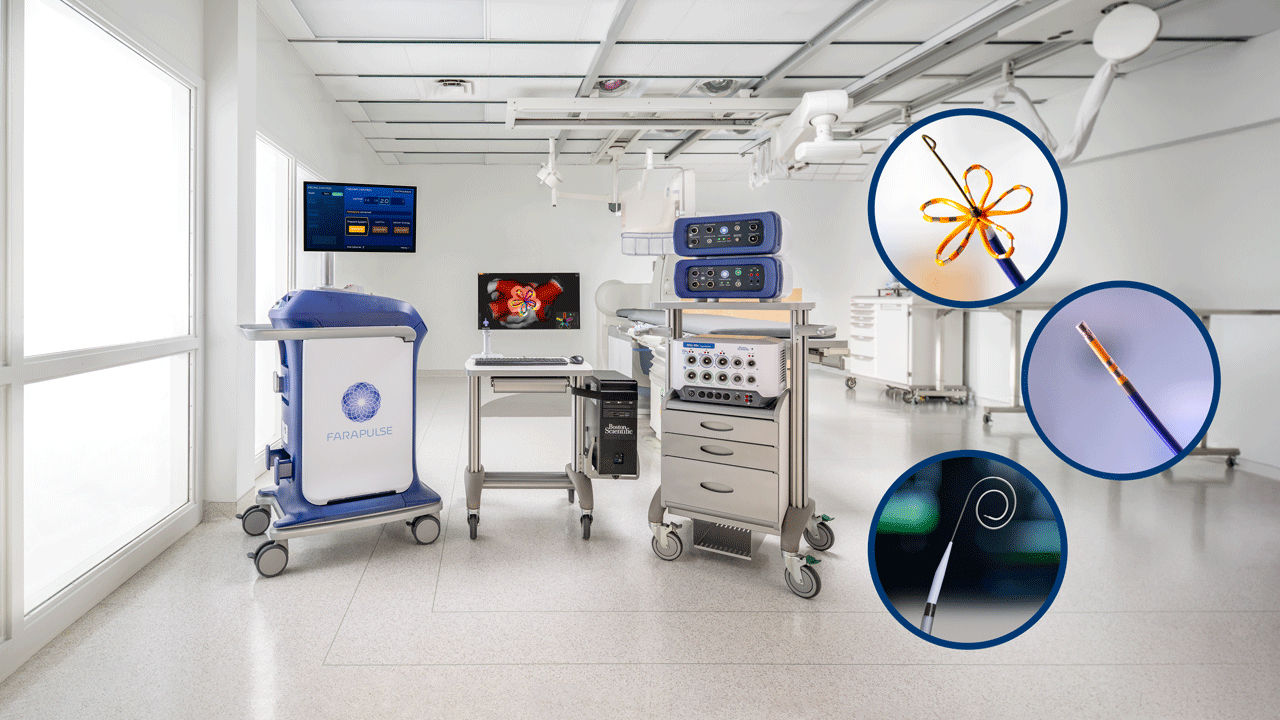
Boston Scientific shares plummeted 15.6% to $77.35 on Wednesday—the steepest single-day percentage drop in over 25 years—after its electrophysiology segment missed Wall Street expectations, sparking fears that the company's key growth engine may be decelerating faster than anticipated.
The selloff erased roughly $21 billion in market cap, taking the stock to its 52-week low of $75.00 intraday, down from a December high of $109.50. Volume exploded to 63 million shares—more than triple the daily average.
The Miss That Triggered the Rout
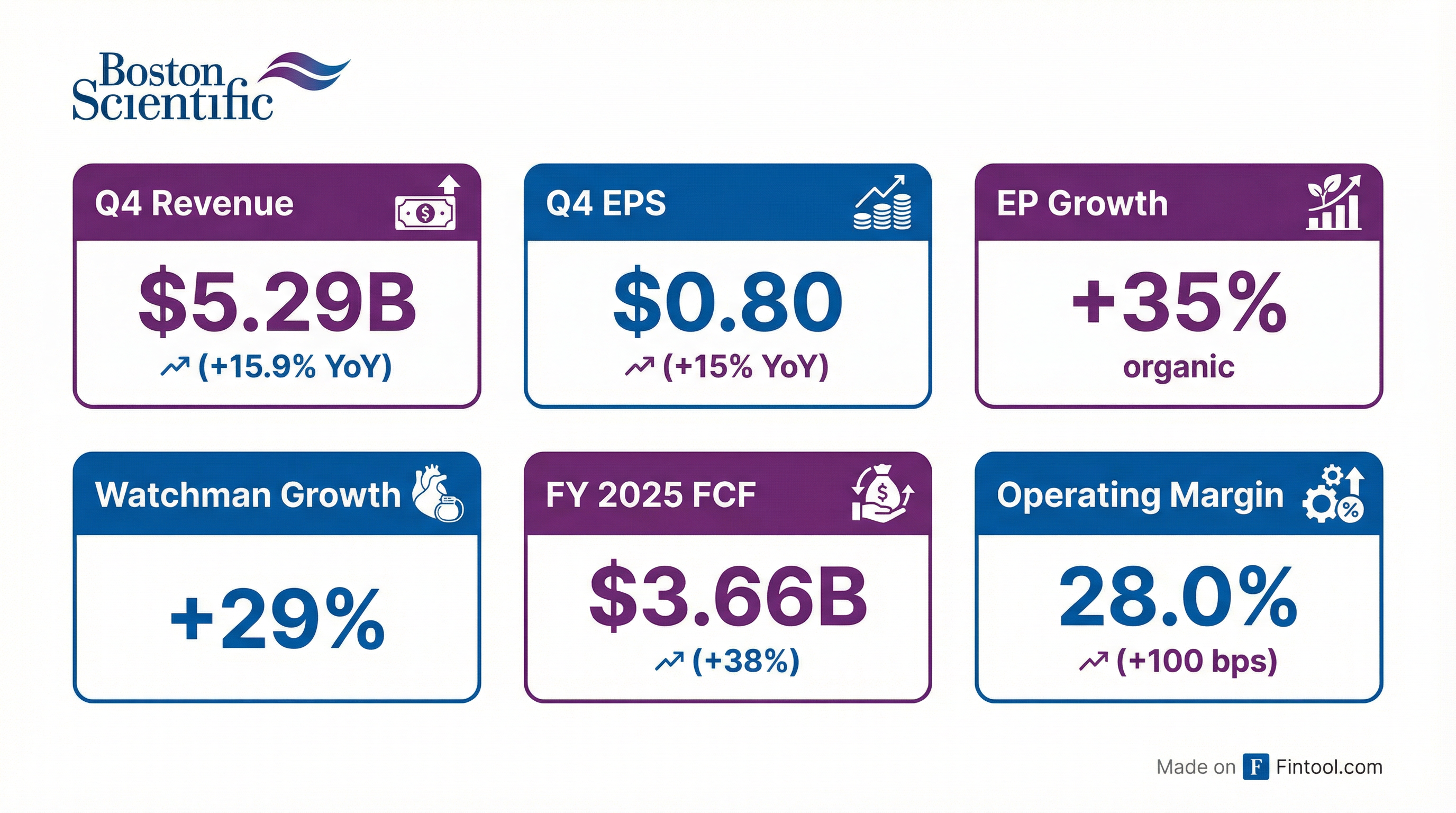
The fourth-quarter report itself was strong by most measures. Boston Scientific delivered Q4 revenue of $5.29 billion (+15.9% YoY) and adjusted EPS of $0.80, beating consensus estimates of $5.28 billion and $0.78, respectively. Full-year 2025 adjusted EPS of $3.06 grew 22%, marking the company's third consecutive year of 20%+ earnings growth.
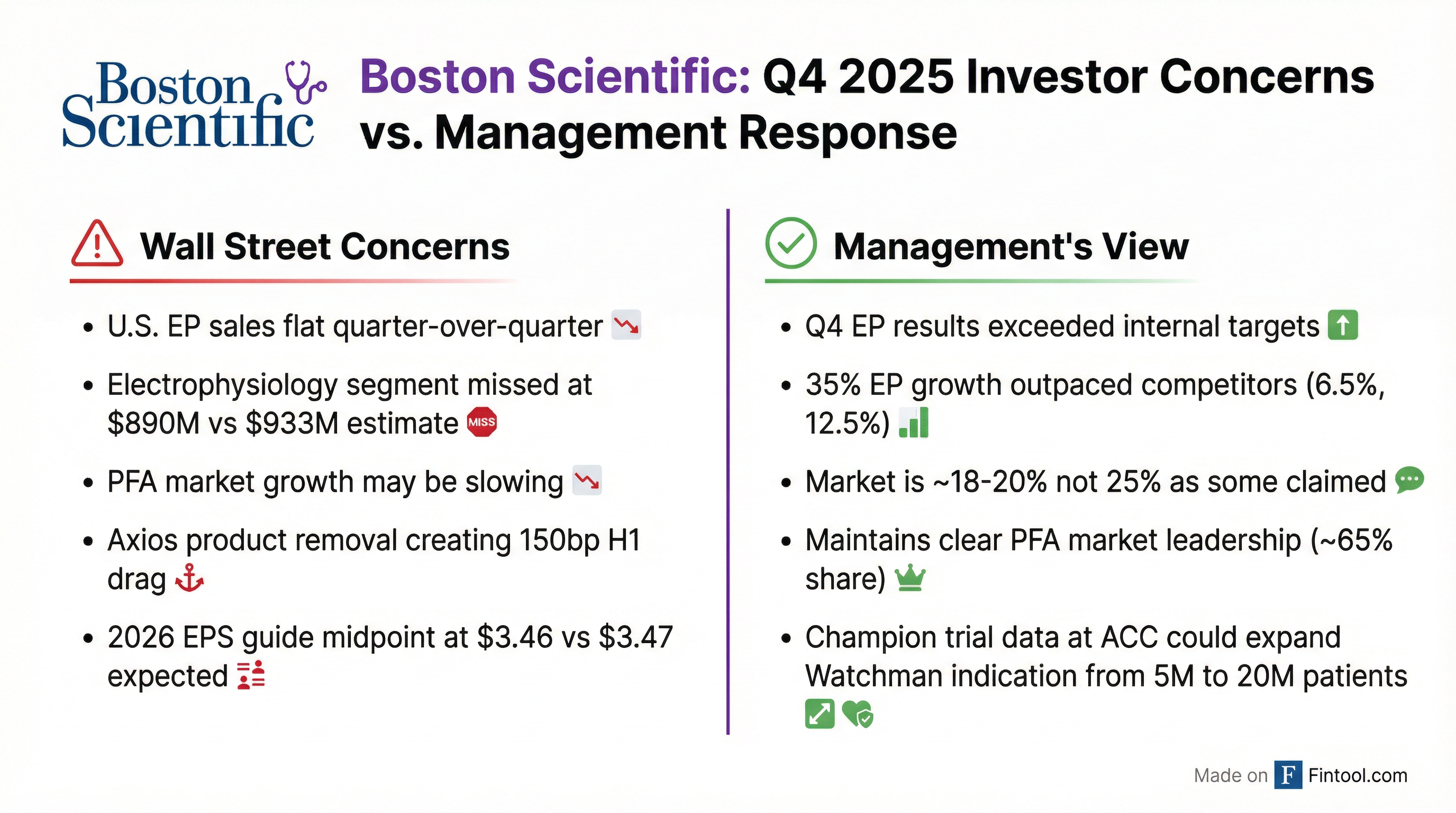
But buried in the results was a concerning data point: the electrophysiology segment—home to the company's blockbuster FARAPULSE pulsed field ablation (PFA) system—generated $890 million in Q4 sales, falling short of the Street's $933 million estimate.
The Debate: Is PFA Growth Peaking?
The heart of the investor concern lies in whether PFA—the technology that has driven Boston Scientific's outperformance—has peaked. U.S. EP sales were essentially flat sequentially, while RF ablation competitors Johnson & Johnson and Abbott reported sequential gains.
CEO Mike Mahoney pushed back forcefully on the earnings call, arguing that market expectations were inflated:
"Two of our larger competitors had results of 6.5% growth, the market leader, third-place player, 12.5%. We grew 35%, so we continue to gain share overall. To your point, we think the market in Q4 was closer to 18%-20% growth rather than what some other companies have claimed at 25%."
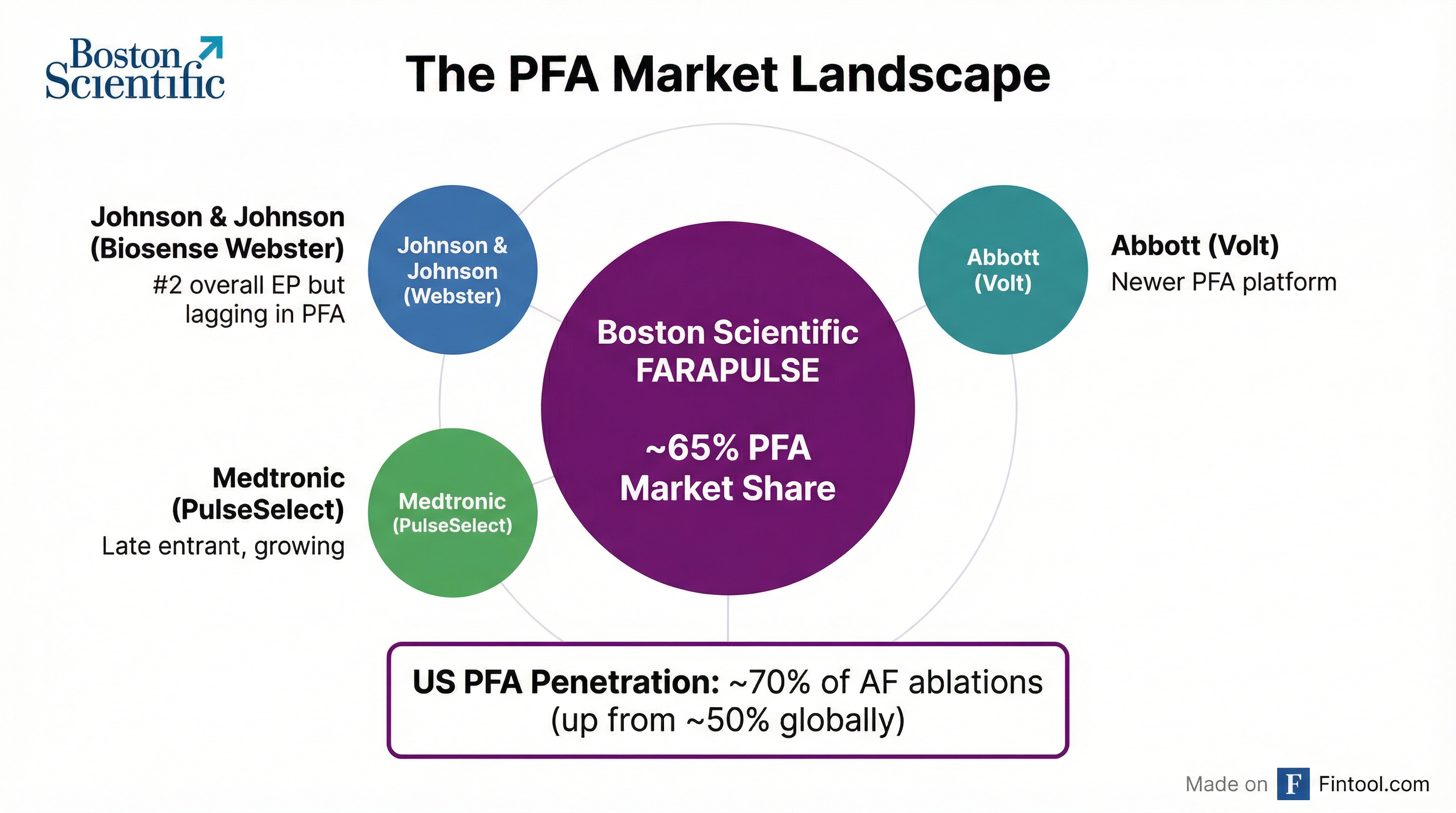
Management maintains that Q4 EP results actually exceeded internal targets and that Boston Scientific remains the clear PFA leader with approximately 65% market share.
 Ask Fintool AI Agent
Guidance: Conservative or Concerning?
The 2026 outlook added fuel to the selloff. Boston Scientific guided to:
- Organic revenue growth: 10-11% (down from 15.8% in 2025)
- Adjusted EPS: $3.43-$3.49 (midpoint $3.46 vs. $3.47 consensus)
- Operating margin expansion: 50-75 basis points
The Q1 2026 guide of 8.5-10% organic growth particularly concerned analysts, though management attributed this to tough prior-year comparisons and a ~150 basis point headwind from the Acclarent discontinuation and partial Axios product removal.
| Metric | Q4 2025 | Q3 2025 | Q4 2024 | YoY Change |
|---|---|---|---|---|
| Revenue ($B) | $5.29 | $5.07 | $4.56 | +15.9% |
| Adjusted EPS | $0.80 | $0.51 | $0.38 | +111% |
| EP Organic Growth | +35% | +37% | +63% | Decelerating |
| Watchman Growth | +29% | +29% | +33% | Stable |
| Gross Margin % | 70.7%* | 69.7%* | 67.7%* | +300 bps |
*Values retrieved from S&P Global
The Competition Is Coming
Part of the market's anxiety stems from intensifying PFA competition. While Boston Scientific pioneered the market with FARAPULSE, Medtronic launched its PulseSelect system and Abbott introduced Volt. Johnson & Johnson's Biosense Webster remains the overall EP market leader despite trailing in PFA specifically.
Mahoney acknowledged the competitive dynamics but expressed confidence: "With new entrants coming, it's not surprising that we lost some share, but the overall EP growth of 35%, I think, is quite impressive given the size of that business now."
The company projects the EP market will grow approximately 15% in 2026 and expects to outpace that growth. U.S. PFA penetration has reached roughly 70% of AF ablations, up from about 50% globally.
The Bull Case: Champion Trial Looms Large
Perhaps the most important catalyst is just weeks away. The Champion trial—a large randomized study comparing Watchman Flex versus novel oral anticoagulation—will be presented as a late-breaker at ACC on March 28, 2026.
If positive, Champion would support Watchman as a first-line therapy for stroke prevention as an alternative to blood thinners, potentially expanding the indicated patient population from approximately 5 million today to 20 million globally.
Chief Medical Officer Ken Stein noted the trial's dual primary endpoints: "One, non-inferiority for a combined endpoint stroke, systemic embolism, and death. One, for bleeding. And just as we saw with Option, I think both of those are gonna be important for the field."
The Watchman franchise itself delivered 29% growth in Q4, and the company has now treated more than 25,000 patients concomitantly with Watchman and FARAPULSE.
Ask Fintool AI AgentWhat Happens Next
Despite the brutal reaction, Boston Scientific's fundamentals remain solid:
- Free cash flow: $3.66 billion in 2025, up 38% YoY
- Long-range plan intact: Management reiterated 10%+ organic growth, 150 bps margin expansion, and double-digit EPS growth through 2028
- Penumbra acquisition: The $14.5 billion deal, announced in January, adds mechanical thrombectomy and neurovascular capabilities
The key question for investors: Is today's selloff a buying opportunity on a best-in-class med-tech compounder, or an early warning sign that the PFA hypergrowth cycle is ending?
Citi analyst Joanne Wuensch noted before the earnings: "Their worries were not misplaced," referring to investor concerns about EP segment performance.
The Champion trial presentation on March 28th will be the next major data point. Boston Scientific is hosting an investor event that evening at 5:30 PM Central Time.
Ask Fintool AI AgentRelated: