Broadridge CEO Makes Emphatic Tokenization Defense as Stock Hits 52-Week Low Despite Earnings Beat
February 9, 2026 · by Fintool Agent


Broadridge Financial Solutions CEO Tim Gokey took the stage at the UBS Global Financial Services Conference in Key Biscayne, Florida on Sunday with a clear message for investors spooked by tokenization risks: "We think this is absolutely an opportunity, not a risk for us. And I'll say that again—we think this is absolutely an opportunity."
The emphatic defense comes as Broadridge shares trade at $180.16—down 34% from their August 2025 peak of $271.91—despite the company delivering a Q2 earnings beat that topped consensus estimates by 19% and raised full-year guidance.
The Disconnect: Strong Results, Weak Stock
Broadridge reported Q2 FY2026 results on February 3 that exceeded expectations across key metrics:
| Metric | Q2 FY2026 | YoY Change | vs. Consensus |
|---|---|---|---|
| Total Revenue | $1.71B | +8% | Beat by 7.6% |
| Recurring Revenue | $1.07B | +9% | — |
| Adjusted EPS | $1.59 | +2% | Beat by $0.19 |
| Closed Sales | $57M | +24% | — |
The company also raised its full-year adjusted EPS growth guidance to 9-12% from 8-12% and reaffirmed recurring revenue growth at the higher end of 5-7%.
Yet shares fell 7% on the earnings release (February 3) and another 6% on February 6 when Broadridge announced its $170 million acquisition of CQG.
 Ask Fintool AI Agent
Gokey's Three-Part Tokenization Thesis
At the UBS conference, Gokey laid out a detailed rebuttal to concerns that blockchain-based tokenization could disintermediate Broadridge's core intermediary role between issuers and investors.
First, tokenized securities are still securities. "What the SEC has consistently talked about is that a tokenized security is still a security," Gokey said. "All of the different requirements that traditional securities have to have—we expect tokenized securities to have, including everything around governance."
Second, intermediaries aren't going away. "Where will these be purchased? We believe overwhelmingly they're going to be purchased with traditional wealth managers or the digital exchanges like the Coinbase and Krakens of the world. And all of these are our clients."
Third, direct issuance is "hugely clunky." Gokey dismissed the notion that companies like Apple or ExxonMobil would sell shares directly to investors: "That's a hugely clunky model. When you think about, at scale, is that what's really gonna happen? No, it's gonna go through intermediaries."
DLR Platform: From $100 Billion to $400 Billion Daily
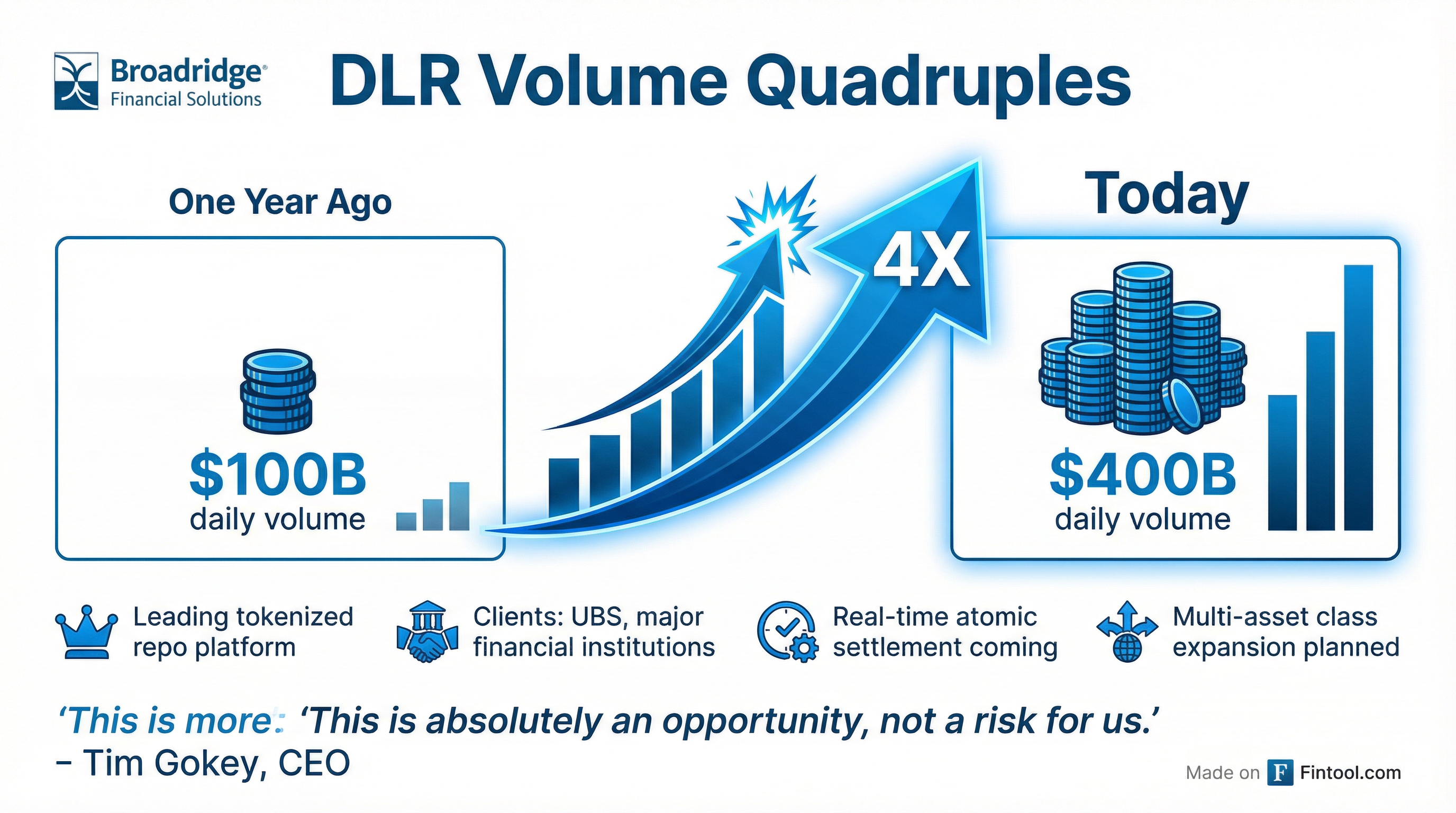
Broadridge's Digital Ledger Repo (DLR) platform—launched on a private version of the Canton network—has quadrupled its daily volumes over the past year to $400 billion.
"Since this time last year, with the market awareness, with Treasury clearing coming up, and the new administration, that's grown from $100 to $400 billion a day, a bunch of new clients signing up," Gokey said.
UBS is among the key clients using the platform. Broadridge plans to migrate DLR to the public version of Canton later this calendar year after DTCC completes its readiness work, enabling greater interoperability for bilateral repo.
Beyond repo, Broadridge has already helped Société Générale issue its first natively digital corporate bond and is in discussions with institutions about tokenizing deposits.
Ask Fintool AI AgentCQG Acquisition: $170 Million to Bolster Futures & Options
Three days before the UBS conference, Broadridge announced a $170 million agreement to acquire CQG, a Denver-based provider of futures and options execution management and algorithmic trading capabilities.
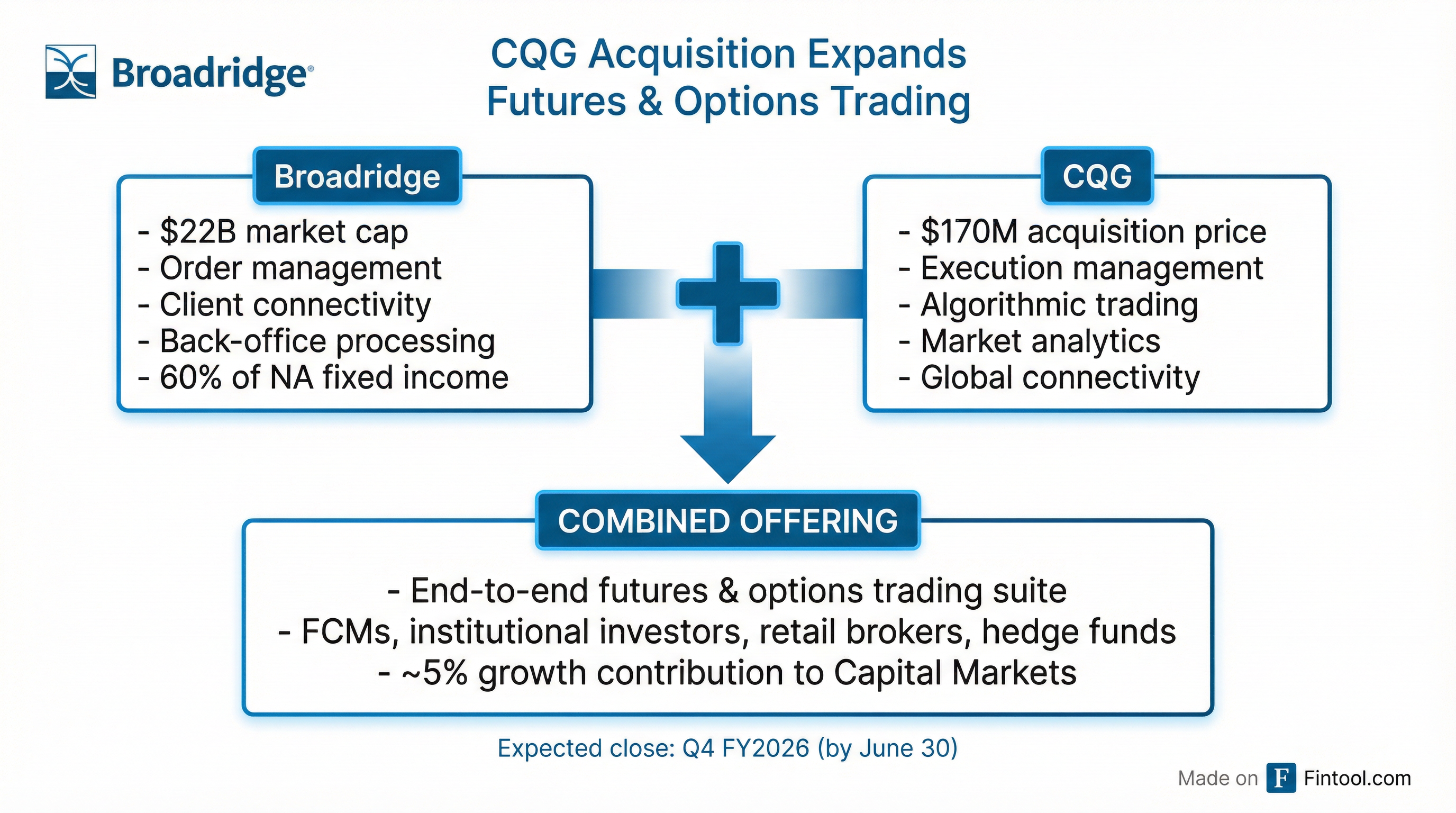
"CQG does execution management, especially in futures and options. We don't really play in the execution management space today, and we're building in futures and options," Gokey explained. "It really strengthens in both dimensions there."
The acquisition, expected to close early in Broadridge's fiscal Q4 (by June 30, 2026), is projected to contribute approximately 5 percentage points of growth to the capital markets business.
"That was about a $170 million purchase, and we think that will not necessarily this year, because it's gonna close later in the year, but you think about its addition to the capital markets business is about 5 points of growth," Gokey said.
AI: "Very Differentiated from Typical SaaS"
Gokey also addressed AI disruption concerns, arguing Broadridge is fundamentally different from software companies vulnerable to AI displacement:
"What we're doing is core market infrastructure. We're moving money, we're moving securities, we're moving votes. We're competing in operational resilience. It's a vast network, and it's really hard for one person to replace that."
The company has already seen AI-driven productivity gains:
- 20% productivity improvement in back-office operations (about 1,000 people serving 40 clients)
- AI-native custom policy engine for asset managers as an alternative to ISS and Glass Lewis
- Predictive analytics in its data and analytics business, with nearly 20 clients signed in 18 months
Goldman Sachs announced similar AI-driven operations efficiency initiatives on Friday, Gokey noted, adding that Broadridge is "already doing that."
Shareholder Engagement: The "Quiet Revolution"
Broadridge is pursuing what Gokey called a "quiet revolution" in shareholder engagement that could add 1 percentage point to governance business growth—potentially over $200 million in revenue:
Pass-through voting: Grown from 100 funds to 600 funds, with $4 trillion under management, allowing asset managers to distribute voting power to underlying shareholders.
Custom policy engine: An AI-driven alternative to ISS and Glass Lewis, launching with three Tier 1 clients this year. "Asset managers just don't like having only the choice of ISS and Glass Lewis," Gokey said.
Standing voting instructions: Beta launching with six public companies including ExxonMobil, allowing retail investors to set default voting preferences. "After Exxon announced, we literally have 100 companies coming to us saying, 'Can we get in?'"
Ask Fintool AI AgentSales Pipeline: "A Lot of Wood to Chop"
Broadridge's closed sales totaled $89 million in the first half of FY2026, trailing last year's $103 million pace but still within the company's $290-$330 million full-year guidance range.
"We have a lot of wood to chop," Gokey acknowledged, but pointed to encouraging leading indicators:
- New originations up 20% year-over-year in the first half
- Pipeline multiplier (expected closings divided by current period) "much healthier" than last year
- Seasonal pattern favors the second half
"We tend to be pre-seasonal in our sales and do a lot more in the second half than in the first half," Gokey said.
Financial Model: The Long-Term Compounding Story
Gokey reiterated Broadridge's long-term financial algorithm:
| Component | Target |
|---|---|
| Organic Recurring Revenue Growth | 5-7% |
| M&A Contribution | 1-2 points |
| Total Recurring Revenue Growth | 7-9% |
| Earnings Growth | 8-12% |
| Share Buybacks | 1 point |
| Dividend Yield | 2% |
| Total Shareholder Return | Low teens |
"Buy back 1 point of shares, pay a 2% dividend, deliver low teens to shareholders for a long time," Gokey summarized.
Valuation: 34% Discount Creates Entry Point?
At $180.16, Broadridge trades at approximately 19x FY2026 consensus EPS of $9.49—a significant discount to its historical average above 25x. The company's FY2026 estimates imply:
| Metric | FY2025A | FY2026E | FY2027E |
|---|---|---|---|
| Revenue | $6.89B | $7.34B | $7.68B |
| EPS | $8.55 | $9.49 | $10.34 |
| YoY Growth | — | +11% | +9% |
Values retrieved from S&P Global
The stock's 34% decline from its 52-week high reflects investor skepticism about long-term positioning in a tokenized world—despite strong near-term fundamentals.
What to Watch
Near-term catalysts:
- CQG acquisition closing (expected by June 2026)
- Public Canton migration for DLR platform (late calendar 2026)
- Standing voting instructions beta results with ExxonMobil and five other companies
Key risks:
- Tokenization evolution enabling issuers to bypass intermediaries
- Margin pressure from elevated growth investments
- AI-driven disruption to workflow and analytics products
Broader context: Gokey pointed to the pro-innovation regulatory agenda under SEC Chair Paul Atkins as supportive of Broadridge's positioning: "There's so much change going on in financial services right now, with a really pro-innovation regulatory agenda, with a lot of technology change."
Whether the market ultimately agrees with Gokey's tokenization thesis may determine if Broadridge's 34% discount represents an opportunity—or a warning.
Related Research: