Cameco's Grant Isaac at BMO Conference: Uranium Market 'Already at Three-Digit' Pricing as $80B AP1000 Deal Triggers Utility Scramble
February 23, 2026 · by Fintool Agent


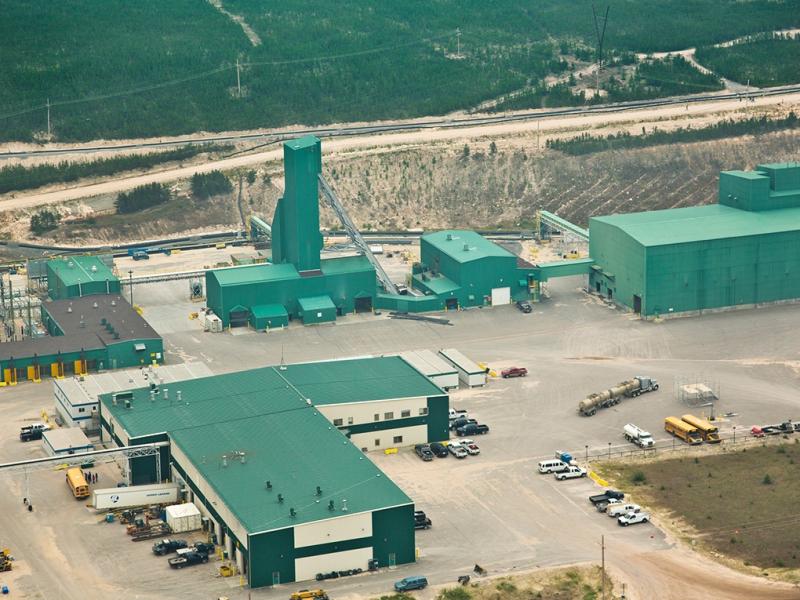
Cameco President and COO Grant Isaac delivered a pointed message at the BMO 35th Global Metals, Mining & Critical Minerals Conference in Hollywood, Florida: the uranium market has already crossed into three-digit territory—investors just aren't looking at the right benchmark.
Speaking to a packed room on Monday afternoon, Isaac opened with an unusual observation: "For the first time in 16 years, nobody asked about the spot market or the term market of uranium" during Cameco's Q4 earnings call. That silence, he suggested, belies one of the most dynamic commodity markets in a generation.
The $90 Price Is Only 30% of the Story
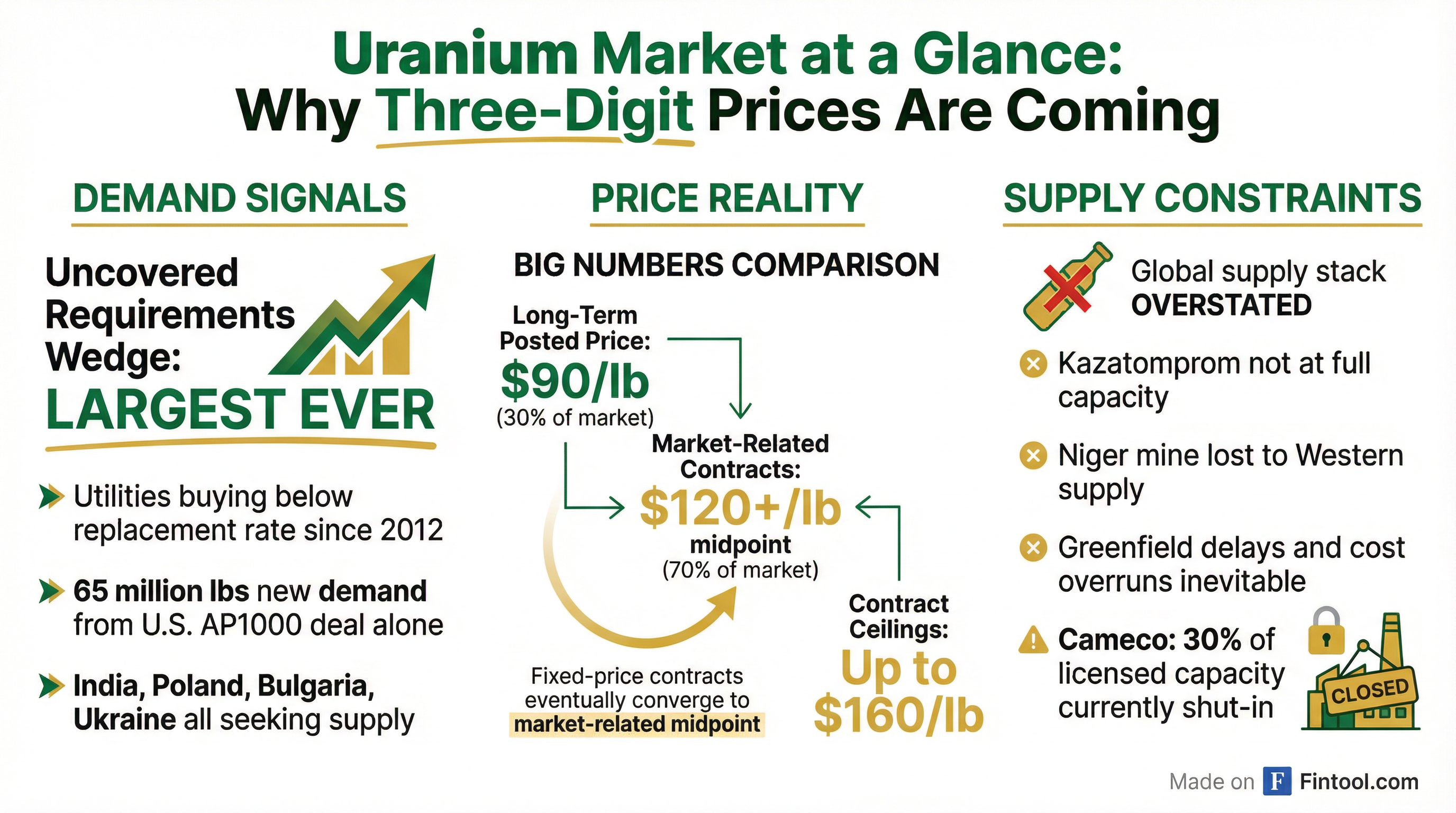
The uranium industry's posted long-term price of $90/lb captures just 30% of contracting activity. The remaining 70% of volumes contracted in 2025 were signed on market-related terms—pricing mechanisms tied to future spot or index movements rather than fixed escalators.
"If you look at market-related contracts, and you look carefully at what we disclosed in Q4, we pushed up the upper end of our price sensitivity table to $160," Isaac told the BMO audience. "Why? We are now signing contracts that are, the ceilings are going into that range."
The math is straightforward: with floors escalating into the mid-$70s and ceilings reaching $150-$160, the midpoint of market-related contracts is already approaching $120/lb. And in uranium, Isaac noted, fixed-price long-term contracts historically converge toward the midpoint of market-related deals.
 Ask Fintool AI Agent
The Uncovered Requirements Wedge: "Never Been Bigger"
Isaac's bullish thesis rests on a structural imbalance that has been building for over a decade. The "uncovered requirements wedge"—the gap between forward reactor demand and contracted supply—has never been larger.
"Utilities have been buying less than replacement rate levels of material since 2012," he explained. "At no time since 2012 have utilities collectively bought what they've consumed off old contracts, which is why the uncovered requirements curve keeps growing."
This isn't ignorance on the part of fuel buyers. As Isaac colorfully noted: "If we had all our fuel buyers in one room, not a single one of them doubts this gap. They all understand that the uranium price needs to go up. Just 100% of them believe it's somebody else's problem."
The reason? Utilities historically view uranium as the most fungible part of the fuel cycle, worrying more about scarce fabrication, enrichment, and conversion capacity. "They just expect that to continue," Isaac said. "They worry less about uranium while they're buying backwards, starting with the services and getting to uranium."
$80 Billion AP1000 Deal Creates "Contagion Effect"
That complacency began cracking late in 2025. Two events catalyzed urgency:
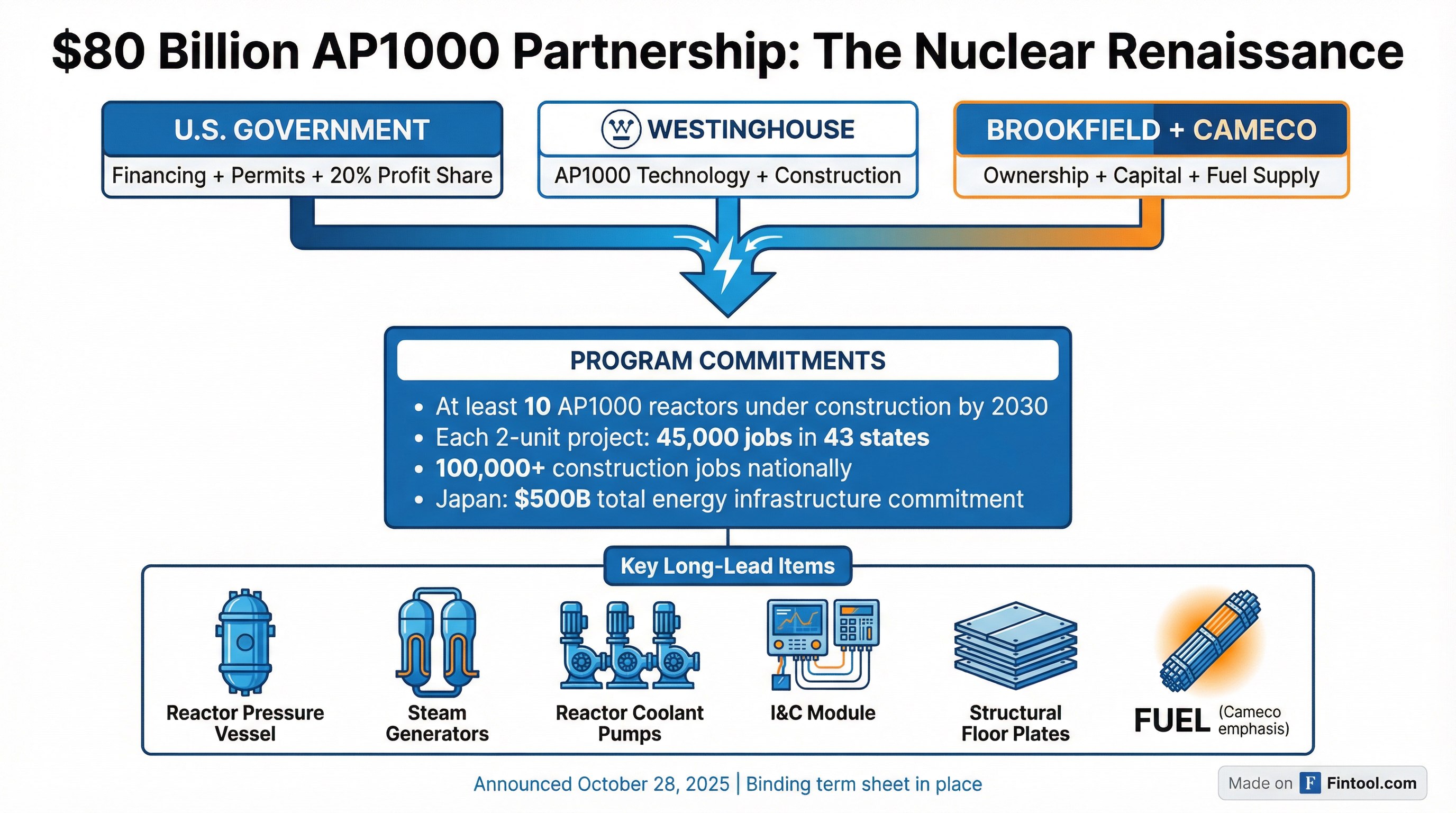
First, the October 28 announcement of an $80 billion strategic partnership between the U.S. government, Brookfield, Cameco, and Westinghouse to deploy AP1000 reactors at scale.
"That announcement alone, if you think about 10 reactors on a 10-year basis, with the initial core plus the fuel that you need, that's 65 million pounds of uranium demand nobody was thinking about," Isaac said.
Second, rumors leaked that Cameco was negotiating a major contract with India—"a lot of sovereign demand out there that's not always reflected in public RFPs that you can track."
The result was a scramble. Utilities that thought they were negotiating for the "first two" AP1000 orders suddenly found themselves wondering if they were now 11th and 12th in line—or even behind Poland, Bulgaria, and other international buyers.
"It's created an urgency to get into the supply chain sooner, which is exactly the type of contagion effect we wanted to see," Isaac said.
Ask Fintool AI AgentSupply Stack "Overstated" by Design, Disruption, and Default
While demand signals strengthen, Isaac argued the supply side is weaker than it appears. Industry supply projections assume all existing capacity runs at full utilization—but it doesn't.
"We have 30% of our licensed capacity shut in right now," Isaac noted. "Kazatomprom is not running their assets at full capacity."
Beyond voluntary curtailments, geopolitical disruptions have removed Western-accessible supply. "Look no further than Niger. Our friends at Orano had a mine taken away from them. A mine in Niger that used to provide fuel to the Western world is not doing it anymore."
And for greenfield projects in supply forecasts, Isaac was blunt: "The uranium industry hasn't figured out something any other mining industry hasn't figured out. There will be delays, and there will be cost increases."
McArthur River: Discipline Over Production Heroics
Cameco's flagship McArthur River mine—the world's second-largest uranium operation—produced 15 million pounds in 2025, with 2026 guidance of up to 17 million pounds versus historical capacity of 18 million.
When asked about accelerating production, Isaac pushed back firmly:
"This market is not yet rewarding us for taking heroic efforts to advance production. We're not at replacement rate contracting. There's a big wall of demand yet to come to the market. Why would we front run this?"
Development delays at McArthur River from late 2025—including challenges with a clay zone slowing freeze capacity installation—remain unchanged. But Cameco isn't trying to "buy back time," which Isaac described as "the most expensive thing in mining."
"The pace at which we bring production on also sends a signal to the market. And right now, the signal we prefer to send is that production is matched to the demand that's in the market, as opposed to trying to front-run it."
Conversion Market: Port Hope Leverage Grows
Beyond uranium mining, Cameco holds a commanding position in conversion—the process of transforming uranium oxide into uranium hexafluoride (UF6) for enrichment. The company's Port Hope facility in Ontario is the largest operating conversion plant in the West, owned 100% by Cameco.
Conversion pricing has reached historic levels for a structural reason: years of secondary supply (DOE inventory, Megatons to Megawatts material) came pre-converted. "As the world began to replace it, it realized that it was replacing it with fresh uranium that needed to be converted."
Of four Western conversion facilities, none are running at full capacity and one—Westinghouse's Springfield plant in the UK—remains in care and maintenance.
Isaac drew a direct parallel to uranium: "You only get one chance to price new capacity. You only get one chance, so do not squander it."
Cameco is willing to restart Springfield for "historically priced" long-term contracts—but only for 10-15 year terms, not the 3-5 years utilities have been offering. "The price is fine. We just don't see the tenor of the contracts yet being sufficient."
U.S. Brownfield Optionality: Rabbit Lake and Beyond
Cameco maintains significant idle capacity that could return without new permits or licenses. The company's U.S. mines and Canada's Rabbit Lake could together produce 7.5-8 million pounds annually.
Isaac described these as "tier two assets" that compete with greenfield projects. When capital starts flowing to greenfield development—at prices that support novel technologies and first-time operators—Cameco will offer utilities an alternative:
"You could take a chance on a greenfield project, probably in the hands of somebody who's never done it before, who's proposing a novel technology... or for that kind of price, we would bring back an already existing tier 2 asset that has a history of reliability."
The company's history validates patience. Rabbit Lake was shut in the late 1990s and restarted in the early 2000s when uranium rose from $7 to $19/lb on its way to $136. "What did we learn? We learned that we brought Rabbit Lake back too soon."
Financial Snapshot
Cameco's disciplined strategy is translating to results. Full-year 2025 revenue reached approximately CAD $3.5 billion, up 11% year-over-year. Adjusted EBITDA rose 26% to CAD $1.9 billion, while adjusted net earnings of CAD $630 million represented a 115% improvement versus 2024.
| Metric | Q1 2025 | Q2 2025 | Q3 2025 | Q4 2025 |
|---|---|---|---|---|
| Revenue ($M USD) | $549* | $643* | $441* | $876* |
| Net Income ($M USD) | $49* | $235* | $0* | $145* |
| EBITDA Margin (%) | 31.5%* | 28.8%* | 24.7%* | 21.5%* |
| Gross Margin (%) | 41.9%* | 39.2%* | 37.3%* | 30.0%* |
*Values retrieved from S&P Global
The balance sheet remains strong with approximately CAD $1.2 billion in cash and short-term investments against CAD $1 billion in total debt.
Uranium production totaled 21 million pounds (consolidated) in 2025, exceeding revised guidance. Cigar Lake performed above expectations while McArthur River delivered in line with adjusted plans following September's development reset.
Ask Fintool AI AgentThe Market Reaction
CCJ shares traded at $118.75 at Friday's close, down 2.1% on the session but up 240% from the 52-week low of $35. The stock has benefited from what Reuters described as "uranium equities surging on policies by the U.S. government designed to revive nuclear power production" even as spot prices rose a more modest 12% in 2025.
Spot uranium traded near $89/lb as of mid-February, consolidating after briefly exceeding $100 earlier in 2026. But as Isaac emphasized, the spot market isn't where price discovery is happening—it's in long-term market-related contracts where "three-digit uranium" is already the norm.
What to Watch
Near-term: Finalization of the $80 billion AP1000 definitive agreement. The binding term sheet remains in place, with long-lead item procurement for 8-10 reactors potentially announced in 2026.
Medium-term: Whether utility contracting reaches replacement rate. That inflection point would trigger both accelerated production at McArthur River and the re-pricing of Cameco's uncommitted volumes.
Long-term: The progression of market-related contract midpoints toward Cameco's $160 ceiling sensitivity. If fixed-price contracts converge to current market-related midpoints (~$120), Cameco's disciplined positioning would be vindicated—and those who front-ran with production would find themselves competing against their own oversupply.
As Isaac concluded: "We've been in these markets before, we've seen them before. This is precisely why we're disciplined, because we think there's a reckoning coming."