Citigroup Completes Russia Exit: Four-Year Saga Ends With Renaissance Capital Sale
February 18, 2026 · by Fintool Agent


Citigroup on Wednesday announced the completion of its sale of AO Citibank to Renaissance Capital, ending a nearly four-year effort to extricate itself from Russia following the Ukraine invasion. The transaction, already approved by Russian and U.S. regulators, makes Citi the last major U.S. bank to fully exit the country.
Shares rose 2.4% in morning trading as investors welcomed the closure of a lingering geopolitical overhang.
 Ask Fintool AI Agent
The Final Accounting: Capital Neutral
The financial mechanics of the exit are complex but ultimately wash out to neutral:
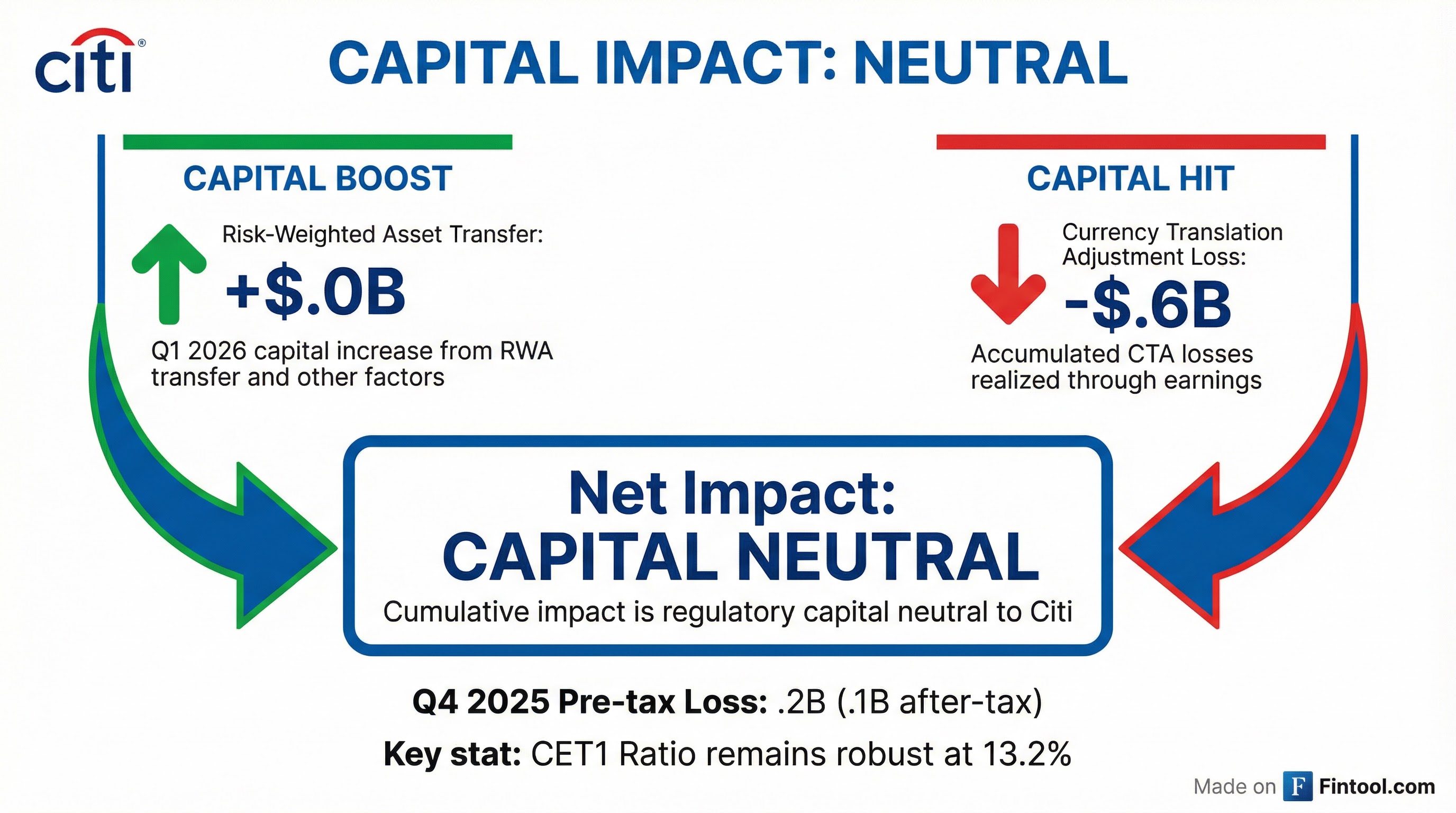
In Q1 2026, Citi's capital will rise by $4 billion from the transfer of risk-weighted assets to Renaissance Capital and other factors. This offsets the previously reported $1.6 billion currency translation adjustment (CTA) loss, making the cumulative impact capital neutral.
The $1.2 billion pre-tax loss ($1.1 billion after-tax) recognized in Q4 2025 consisted of:
| Component | Amount |
|---|---|
| Currency Translation Adjustment (CTA) | $1.6B loss |
| Derecognition of fully reserved net investment | $0.2B benefit |
| Expected sale proceeds | $0.2B benefit |
| Net Pre-tax Loss | ~$1.2B |
The CTA loss had accumulated over years as the Russian ruble depreciated against the dollar—losses that sat in Accumulated Other Comprehensive Income (AOCI) until the divestiture triggered their recognition through earnings.
A Long Road to Exit
Citi's Russia exit has been one of the most protracted among U.S. banks. The journey began in earnest in August 2022 when the bank disclosed its decision to wind down consumer, local commercial, and institutional banking businesses in Russia.
Timeline of Key Events:
| Date | Milestone |
|---|---|
| Feb 2022 | Russia invades Ukraine; Western sanctions begin |
| Aug 2022 | Citi announces wind-down of Russia operations |
| Mar 2023 | Citi ends nearly all institutional banking services |
| Q2 2025 | Consumer loan portfolio wind-down completed |
| Nov 2025 | Putin authorizes sale to Renaissance Capital |
| Dec 2025 | Board approves sale; $1.2B loss recognized |
| Feb 18, 2026 | Sale closes; full exit completed |
The bank faced persistent challenges throughout:
Sanctions Complexity: Western sanctions and Russian counter-measures created a labyrinth of restrictions on capital movements and operations.
Trapped Capital: As of September 2025, Citi had approximately $9 billion in third-party exposure tied to Russia—largely corporate dividends that Russian authorities would not allow to be remitted. Approximately 82% of these exposures were dividends Citi held as custodian for clients.
Limited Buyer Pool: Finding an eligible, willing buyer in a sanctioned market proved extraordinarily difficult. Renaissance Capital, a Moscow-based investment bank that rose to prominence helping companies list in London and Moscow, emerged as the only viable option.
Ask Fintool AI AgentHow Citi Compares to Peers
Citigroup's exit took considerably longer than some Wall Street peers, reflecting its larger Russian footprint:
| Bank | Exit Status | Timeline | Details |
|---|---|---|---|
| Goldman Sachs | Completed (Apr 2025) | 3 years | Sold to Balchug Capital with Putin authorization |
| JPMorgan | Winding Down | Ongoing | Ended most services; limited operations remain |
| Citigroup | Completed (Feb 2026) | ~3.5 years | Sold to Renaissance Capital |
| Raiffeisen (Austria) | Still Operating | — | Largest Western lender remaining; exit blocked Oct 2025 |
| UniCredit (Italy) | Still Operating | — | Among Russia's top 20 banks by assets |
Goldman Sachs and JPMorgan announced their intention to exit Russia in March 2022, just days after the invasion began. But those banks had far smaller Russian operations—Goldman had about 80 employees and $700 million in exposure, while JPMorgan wasn't even in its top 20 markets.
Citi, by contrast, operated a full consumer banking franchise, extensive institutional services, and held billions in custody assets—all of which required careful unwinding under intense regulatory scrutiny.
Part of a Broader Transformation
The Russia exit is one piece of CEO Jane Fraser's comprehensive transformation strategy to simplify Citi's global footprint and improve returns.
Remaining Divestitures:
- Poland: The last international consumer market to be sold, expected to close in 2026
- Banamex IPO: Mexico's Banamex being prepared for a potential IPO, with timing dependent on market conditions
The transformation is showing results. Full-year 2025 net income reached $14.3 billion, up 13% from 2024, on revenues of $85.2 billion.
| Metric | FY 2025 | FY 2024 | FY 2023 |
|---|---|---|---|
| Revenues | $25.4B | $27.0B | $23.6B |
| Net Income | $14.3B | $12.7B | $9.2B |
| Return on Equity | 6.8% | 6.2% | 4.6% |
"We are not graded on effort," Fraser wrote to staff in January. "We are judged on our results. And I expect to see the last vestiges of old, bad habits fall away, and a more disciplined, more confident, winning Citi emerge in 2026."
Ask Fintool AI AgentWhat to Watch
With Russia in the rearview mirror, attention shifts to:
Banamex Execution: "We are focused on the next step in the exit process, and we're actively looking at selling some additional smaller stakes as we lead up to an IPO," Fraser said on the Q4 earnings call.
ROE Trajectory: Citi's return on tangible common equity was 5.1% in Q4 2025 (7.7% excluding Russia), still far short of its 10-11% target.
Regulatory Progress: The Fed recently terminated consent orders that had demanded Citi improve its risk controls—a positive development for the transformation story.
Headcount Rationalization: Citi continues to streamline operations; Fraser has warned that "automation, AI, and further process simplification" will reshape how work gets done.
The Bottom Line
Citigroup's Russia exit closes one of the messiest chapters in the bank's recent history. The $1.2 billion loss is painful but manageable for a firm generating $14 billion in annual net income. More importantly, it removes a persistent overhang that has complicated Citi's transformation narrative.
The market appears to agree—Citi's 66% stock gain over 2025 suggests investors believe the transformation is working, even as one-time charges temporarily dent earnings.
With Russia behind it, Citi emerges as a more focused institution better positioned to compete with peers in its core businesses: services, markets, banking, wealth, and U.S. personal banking.
Related Companies: