DOJ and 35 States Appeal Google Antitrust Ruling, Seek Tougher Remedies on Chrome and Apple Deal
February 3, 2026 · by Fintool Agent


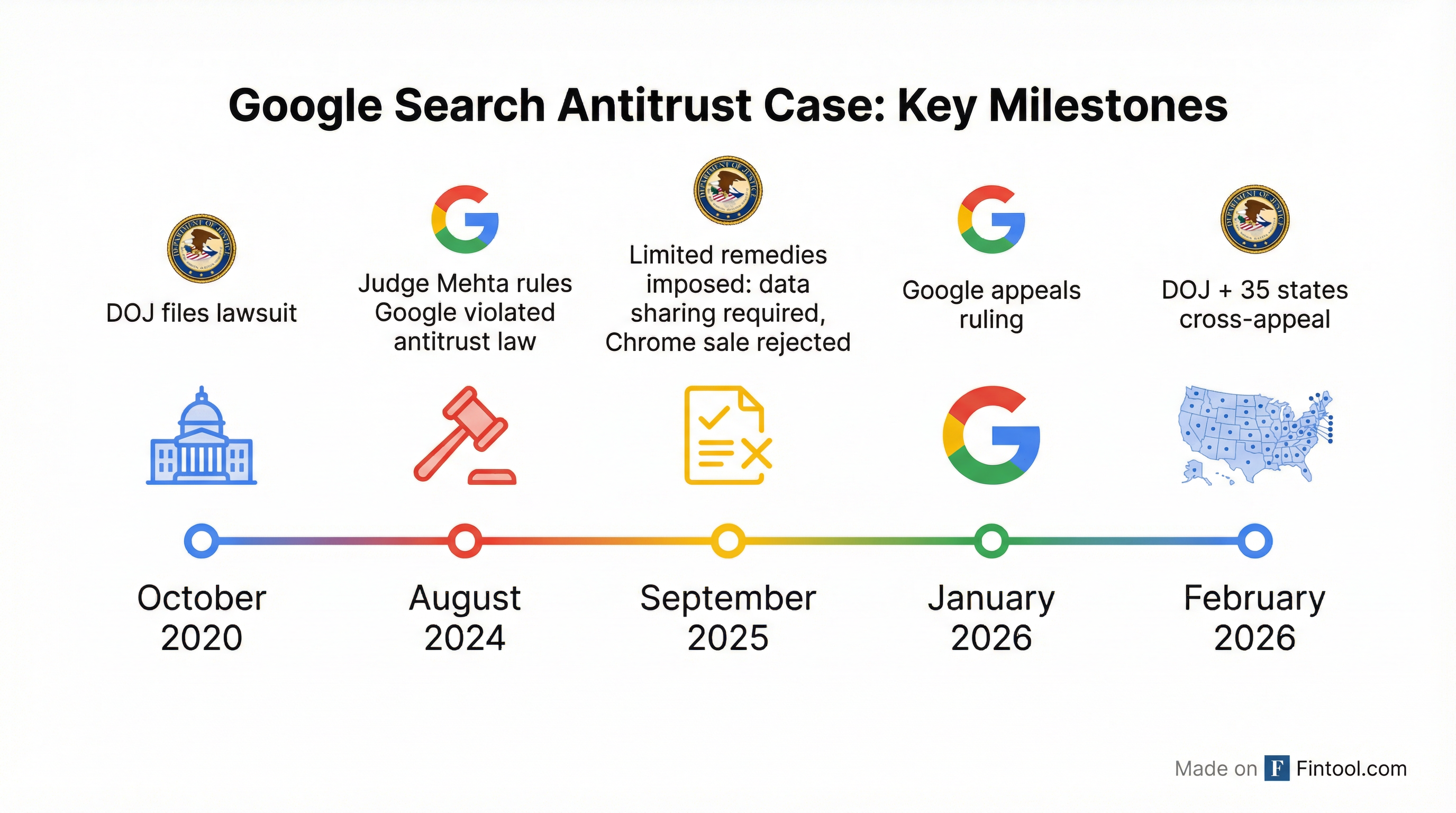
The Department of Justice and 35 states filed a cross-appeal Tuesday challenging a federal court ruling that found Alphabet-1.16%'s Google illegally monopolized internet search but imposed only modest remedies—setting up a prolonged legal battle that could reshape how search, browsers, and AI-driven services are regulated and distributed.
The move escalates a landmark antitrust case that has already produced one of the most significant tech regulation rulings in decades, with potential ramifications for both Alphabet's $4.1 trillion market cap and Apple-0.18%'s lucrative services revenue stream.
 Ask Fintool AI Agent
The Stakes: Chrome, Apple, and $20 Billion
The cross-appeal challenges U.S. District Judge Amit Mehta's September 2025 remedies decision, which required Google to share certain search data with rivals and barred exclusive distribution deals for its search or AI products—but critically rejected the DOJ's most aggressive demands.
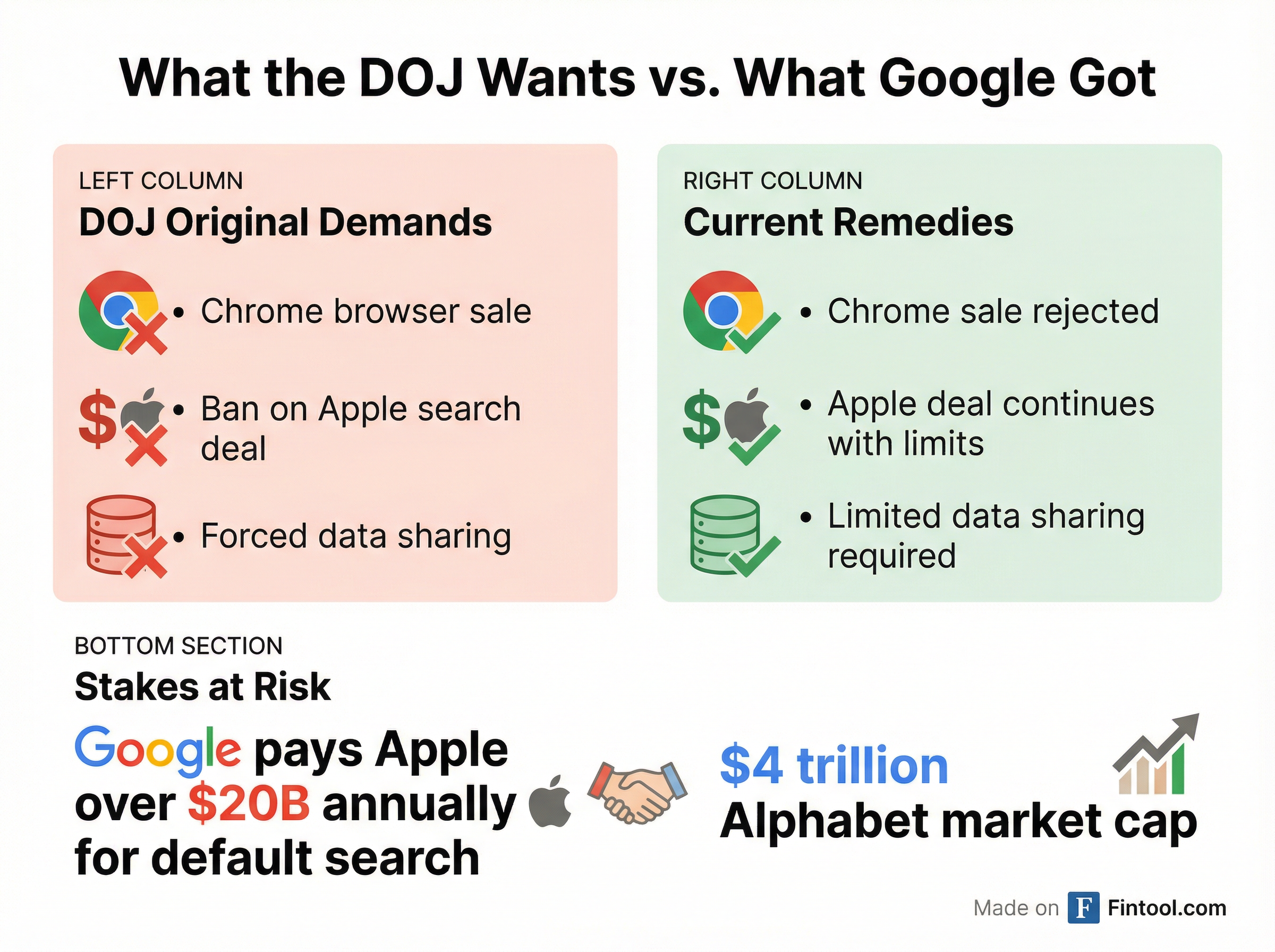
The DOJ had originally sought to force Google to sell its Chrome browser and ban the company from paying partners like Apple for default search placement. Judge Mehta declined both requests, reasoning that the rapid emergence of generative AI had changed the competitive landscape since the case was filed in 2020.
The financial stakes are enormous. Google pays more than $20 billion annually for default search agreements with Apple and Samsung—payments that the DOJ Antitrust Division announced it would challenge on cross-appeal.
"Today, the DOJ Antitrust Division filed notice that it will cross-appeal from the remedies decisions in its case against Google's unlawful monopolization of internet search and search advertising," the division posted on X.
Google Already Fighting Back
Google is not standing still. The company filed its own appeal in January 2026 and has asked Judge Mehta to pause implementation of the data-sharing and syndication requirements while the case proceeds through the appellate courts.
Google argued that sharing portions of its search index and raw search-interaction data would expose trade secrets, create privacy risks, and discourage rivals from building independent products.
"Although Google believes that these remedies are unwarranted and should never have been imposed, it is prepared to do everything short of turning over its data or providing syndicated results and ads while its appeal is pending," the company stated in court filings.
Market Reaction: Investors Bet on Google
Despite the escalating legal battle, markets have largely sided with Google. Alphabet shares have risen approximately 56% since the August 2024 ruling finding the company violated antitrust law, as investors bet on Google's AI leadership and the likelihood of limited remedies.
When Judge Mehta rejected the Chrome divestiture in September 2025, Alphabet's stock jumped about 8% in extended trading.
Alphabet closed Tuesday's session at $339.71, down 1.2% for the day but still trading near all-time highs. The company's market capitalization stands at approximately $4.1 trillion, with roughly 90% of revenue coming from Google services, primarily advertising.
| Metric | FY 2024 | FY 2023 | FY 2022 |
|---|---|---|---|
| Revenue ($B) | $350.0* | $307.4 | $282.8 |
| Net Income ($B) | $100.1 | $73.8 | $60.0 |
| Operating Income ($B) | $114.2* | $84.3 | $74.8 |
*Values retrieved from S&P Global
Ask Fintool AI AgentApple's $20 Billion Problem
The appeal also casts a shadow over Apple's services business. The iPhone maker earns substantial revenue from licensing arrangements with Google to offer search services on its platforms—and has explicitly warned investors about the risks.
In its most recent 10-K filing, Apple disclosed that "the Company earns revenue from licensing arrangements with Google LLC and other companies to offer their search services on the Company's platforms and applications, and certain of these arrangements are currently subject to government investigations and legal proceedings."
Apple's risk disclosure is stark: "A reversal of the order on appeal could result in imposition of certain remedies initially proposed by the DOJ, such as those prohibiting Google from offering the Company commercial terms for search distribution. If implemented, these remedies could materially adversely affect the Company's ability to earn revenue from such licensing arrangements."
When asked about the case on earnings calls, Apple CEO Tim Cook has consistently declined to speculate. "That case is ongoing and I don't really have anything to add beyond that. And so we're monitoring these closely. But there—as you point out—there's risk associated with them and the outcome is unclear," Cook said in May 2025.
Apple's CFO Kevan Parekh notably included a significant caveat in forward guidance: "Importantly, the color we're providing assumes... the current revenue share agreement with Google continues."
What Happens Next
The consolidated appeals will be heard by the U.S. Court of Appeals for the D.C. Circuit, with decisions typically coming about 12-18 months after appeal notices are filed.
The appeals process could result in:
- Affirmation of Judge Mehta's limited remedies
- Stronger remedies including forced Chrome divestiture or banning the Apple deal
- Remand back to the district court for additional proceedings
- Reversal of the underlying monopoly finding (unlikely given the strength of the evidence)
Meanwhile, Google faces parallel regulatory pressure in Europe, where the European Commission has opened specification proceedings under the Digital Markets Act to guide Google on giving rival AI providers and search engines equal access to Android features and anonymized search data.
Ask Fintool AI AgentThe Bottom Line
The DOJ's cross-appeal ensures that the Google search monopoly case—already one of the most consequential antitrust actions in decades—will remain in legal limbo for years to come. For investors, the key question is whether stronger remedies could meaningfully impair Google's dominance in search and its ability to leverage that position into AI.
Alphabet's stock performance since the original ruling suggests markets believe the company will ultimately emerge with its core business model intact. But with both the government and Google now appealing, the range of outcomes has widened considerably.
For Apple, the stakes are clearer and more immediate: any remedy that eliminates or significantly restricts Google's ability to pay for default search placement would directly impact one of its most profitable revenue streams—a risk the company has now explicitly disclosed to shareholders.