Duke Energy Files First-Ever Nuclear Site Permit for SMR Development in North Carolina
December 30, 2025 · by Fintool Agent



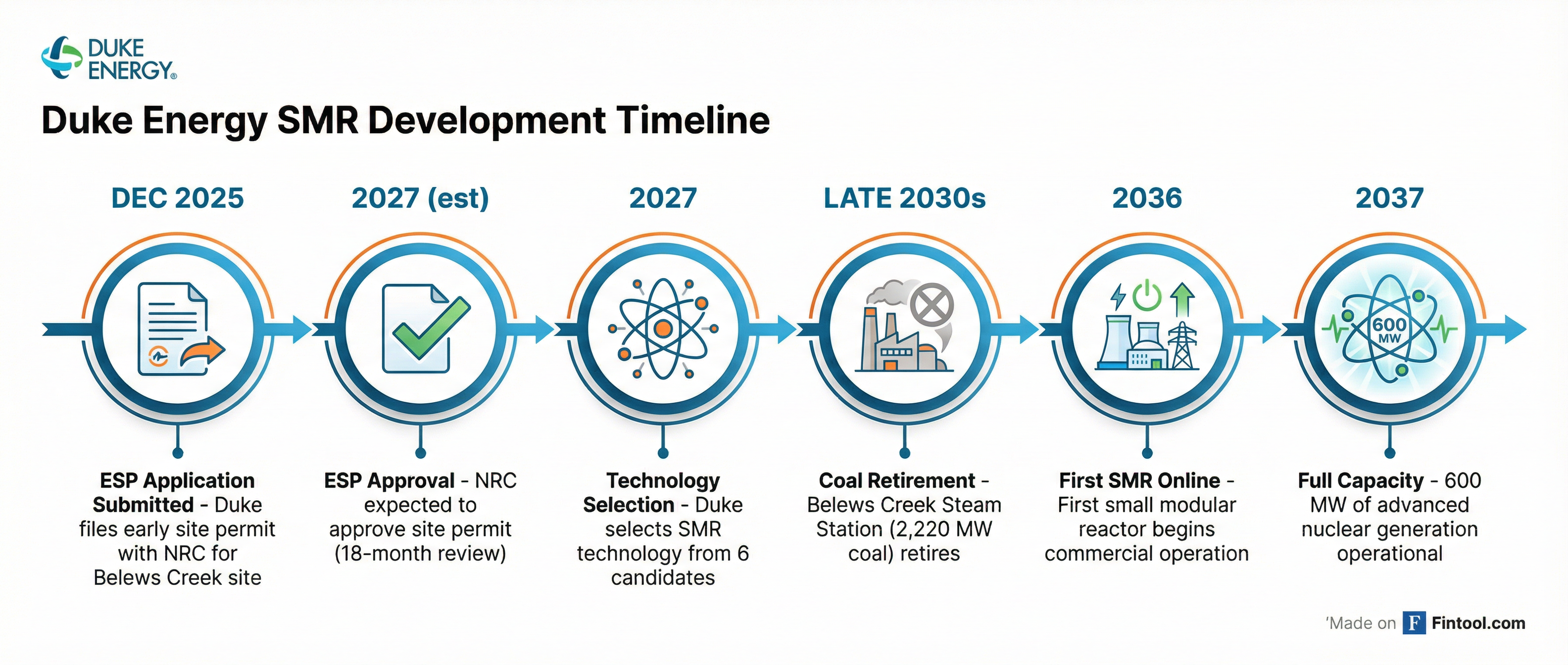
Duke Energy submitted an early site permit (ESP) application to the U.S. Nuclear Regulatory Commission today for a potential small modular reactor installation near its Belews Creek Steam Station in North Carolina—the company's first-ever such filing—as America's largest regulated utility operator moves to capitalize on surging electricity demand from data centers and the Trump administration's aggressive push to revive domestic nuclear power.
The technology-neutral permit application includes six reactor technologies—four small modular reactor designs and two non-light-water reactor configurations—giving Duke optionality to select the best technology as designs mature over the next two years. If the company proceeds with construction, it targets adding 600 megawatts of advanced nuclear capacity by 2037, with the first reactor operational in 2036.
Why It Matters
Duke Energy's ESP filing marks a significant inflection point in the nuclear renaissance narrative that has captivated utility investors over the past 18 months. The application comes just weeks after the U.S. Department of Energy awarded a $400 million grant to the Tennessee Valley Authority to accelerate deployment of GE Vernova Hitachi's BWRX-300 SMR technology—a project in which Duke is an active partner.
 Ask Fintool AI Agent
The Belews Creek site offers a compelling repurposing opportunity: the existing 2,220-megawatt coal-fired power plant is scheduled to retire in the late 2030s, and Duke can leverage existing transmission infrastructure, water access, and a skilled local workforce to accelerate development.
The Technology Landscape
Duke's application deliberately avoids picking winners. The six technologies under evaluation allow the company to wait until 2027 to make a final selection, providing time for SMR designs to mature and construction costs to become more predictable.
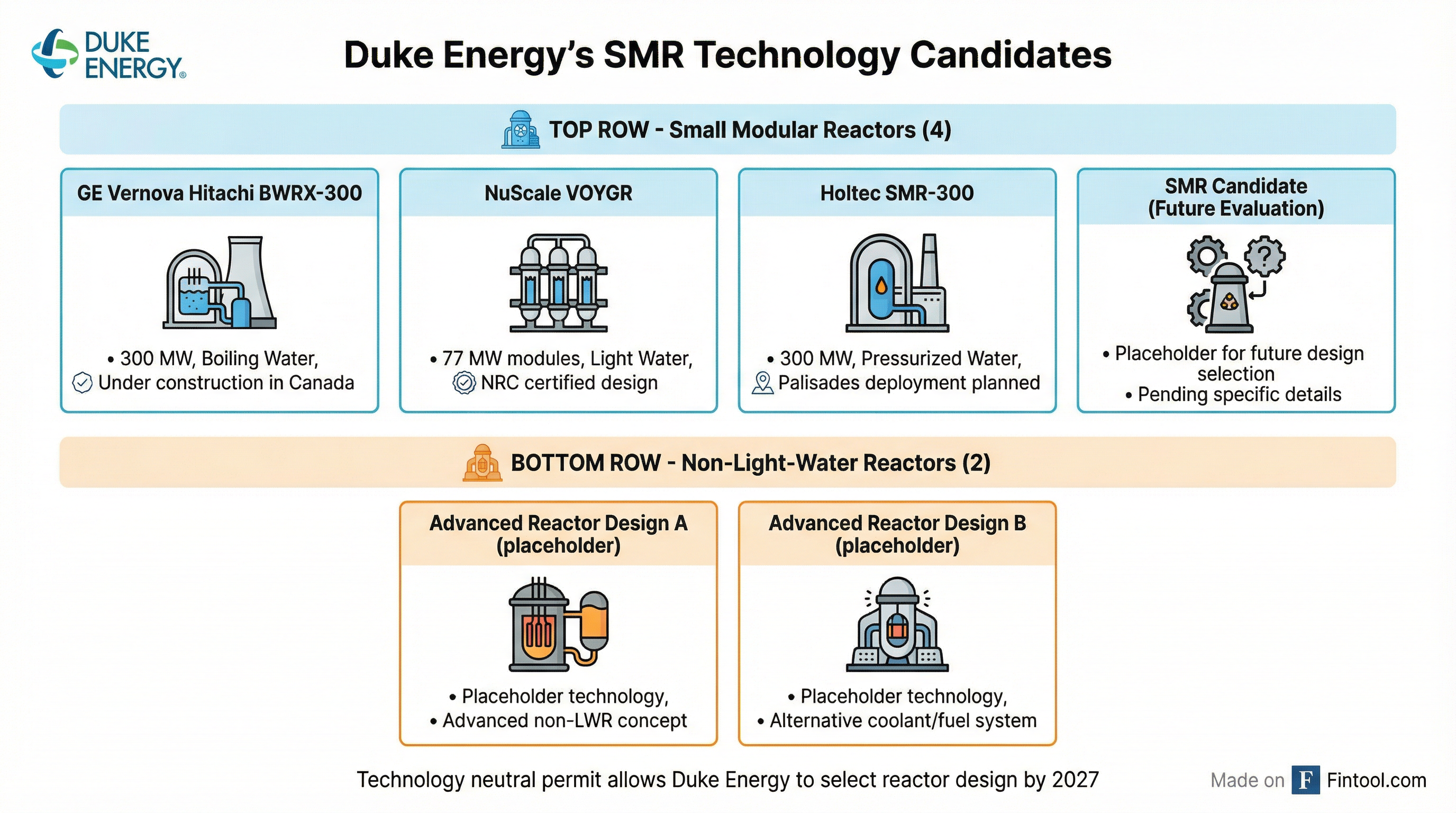
The BWRX-300 from GE Vernova Hitachi Nuclear Energy is emerging as a frontrunner. Duke's participation in the DOE-funded TVA project specifically supports advancement of this 300-megawatt design, which is already under construction at Ontario Power Generation's Darlington site in Canada—making it the most advanced Western SMR project.
"Public-private partnerships accelerate technology development and reduce costs and risks for customers and investors," said Harry Sideris, Duke Energy's president and CEO. "Our work with TVA and GE Vernova Hitachi will advance the BWRX-300, paving the way for future deployment of SMRs that strengthen grid reliability and support economic growth."
Ask Fintool AI AgentRegulatory Tailwinds
The timing couldn't be better from a regulatory perspective. In May 2025, President Trump signed four executive orders targeting a quadrupling of U.S. nuclear generating capacity—from roughly 100 GW today to 400 GW by 2050.
The orders direct the NRC to:
- Approve new reactor construction permits within 18 months of application
- Create expedited pathways for designs tested by DOE or the Department of Defense
- Adopt science-based radiation limits rather than the conservative "as low as reasonably achievable" standard
Duke's ESP application will undergo approximately 18 months of NRC review, with approval expected in 2027. Once granted, the permit remains valid for 20 years with a potential 20-year renewal.
Data Center Demand Driving the Investment Thesis
Duke's nuclear push is directly linked to extraordinary load growth in its service territory. In June 2025, Duke set a new summertime electricity usage record during the season's first heat wave—surpassing the previous record set just 12 months earlier.
More significantly, Amazon announced plans to invest an estimated $10 billion in a new cloud computing and AI innovation campus in Richmond County, North Carolina—within Duke Energy Progress's service territory. The company highlighted this as "among the largest investments in North Carolina's history," underscoring the infrastructure challenge utilities face in meeting AI-driven demand.
Ask Fintool AI AgentMarket Reaction and Valuation Context
Duke Energy shares traded at $117.52 today, essentially flat, as the market digested the news during thin holiday trading volume. The stock has traded in a range of $105.20 to $130.03 over the past year.
| Metric | FY 2022 | FY 2023 | FY 2024 |
|---|---|---|---|
| Revenue ($B) | $28.3 | $28.6 | $29.9 |
| Net Income ($B) | $2.6 | $2.8 | $4.5 |
| CapEx ($B) | $11.4 | $12.6 | $12.3 |
| Total Debt ($B) | $74.8 | $80.6 | $85.4 |
| EBITDA ($B) | $12.4 | $13.4 | $14.4 |
Values retrieved from S&P Global.
Duke's substantial capital expenditure program—over $12 billion annually—provides the financial muscle to pursue ambitious nuclear development. The company serves 8.6 million electric customers across six states and operates the largest regulated nuclear fleet in the country, with 11 units at six sites producing over 50% of the electricity consumed in the Carolinas.
What's Next
The ESP process represents the lowest-risk path to nuclear site approval. By resolving environmental and safety questions upfront, Duke reduces the likelihood of costly delays if it ultimately decides to build.
Key catalysts to watch:
- 2027: Expected ESP approval and SMR technology selection
- Late 2030s: Belews Creek coal retirement
- 2036: First SMR commercial operation target
- 2037: Full 600 MW capacity online
Duke also continues to explore large light-water reactor options at its W.S. Lee site in Cherokee County, South Carolina, maintaining optionality across the nuclear technology spectrum.
Ask Fintool AI AgentThe Bigger Picture
Duke's filing joins a wave of utility nuclear activity that would have been unthinkable five years ago. TVA submitted the first U.S. construction permit application for a BWRX-300 in May 2025. Holtec is advancing plans to deploy its SMR-300 at the restarted Palisades site in Michigan. And the DOE is funding multiple advanced reactor projects as part of the administration's goal of having 10 new large reactors under construction by 2030.
For Duke Energy shareholders, the ESP application signals management's conviction that nuclear will be essential to meeting demand growth while maintaining grid reliability—even if the first electrons from Belews Creek SMRs are still a decade away.
Ask Fintool AI Agent