eBay Acquires Depop for $1.2 Billion, Etsy Stock Surges 18% on Exit
February 18, 2026 · by Fintool Agent


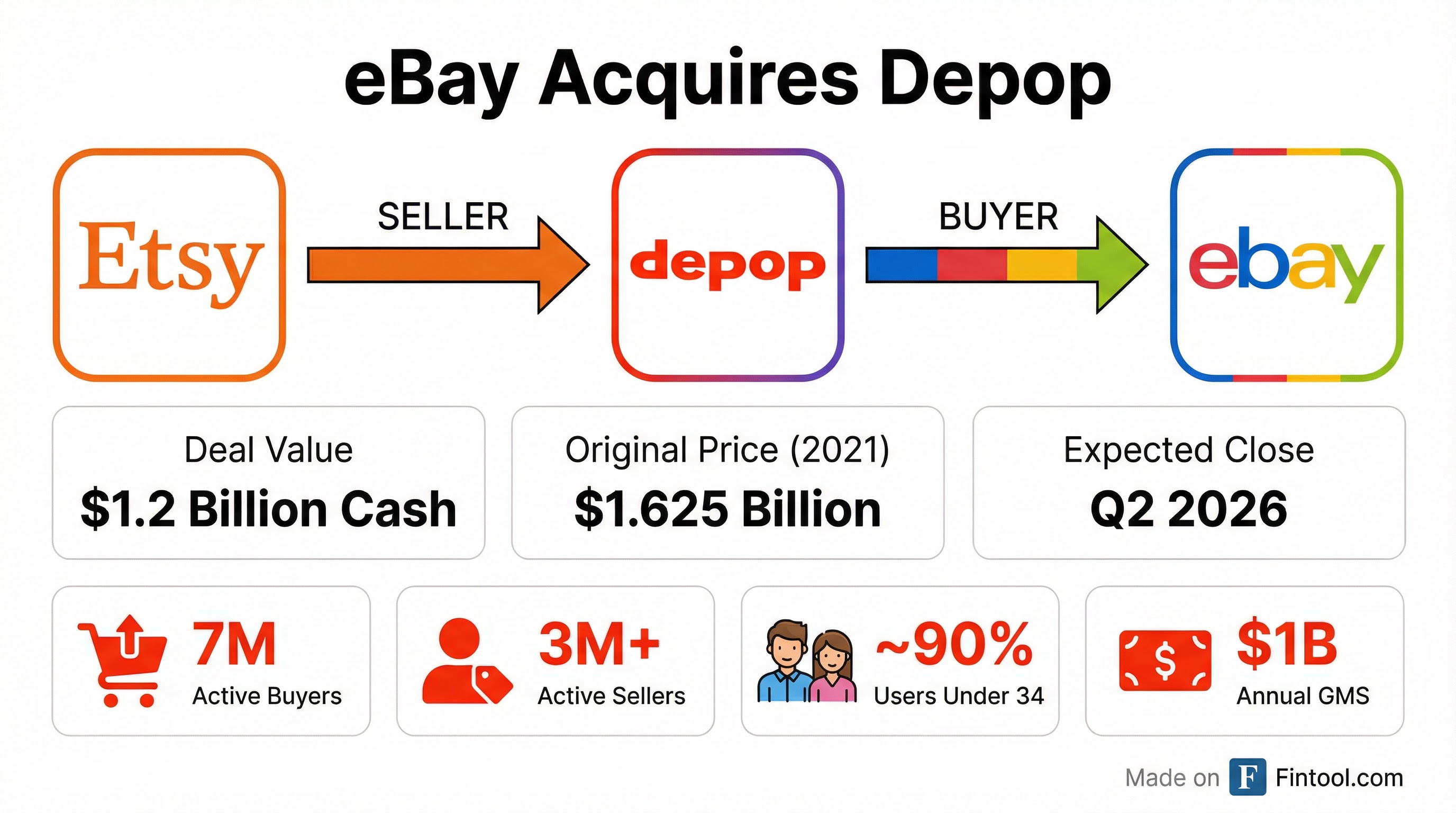
Ebay is acquiring secondhand fashion marketplace Depop from Etsy for $1.2 billion in cash—roughly $400 million less than Etsy paid for the app in 2021—in a deal that accelerates eBay's push into Gen Z recommerce while giving Etsy a clean exit from an underperforming asset.
Etsy shares jumped approximately 18% on the news, with investors cheering both the cash infusion and strategic clarity.
The transaction, unanimously approved by both boards, is expected to close in Q2 2026 pending regulatory approval.
 Ask Fintool AI Agent
The Deal at a Glance
| Metric | Value |
|---|---|
| Purchase Price | $1.2 billion (all cash) |
| Original Acquisition (2021) | $1.625 billion |
| Implied Loss for Etsy | $425 million |
| Expected Close | Q2 2026 |
| Depop Annual GMS | $1 billion |
| Depop Active Buyers | 7 million |
| Depop Active Sellers | 3+ million |
Why eBay Wants Depop
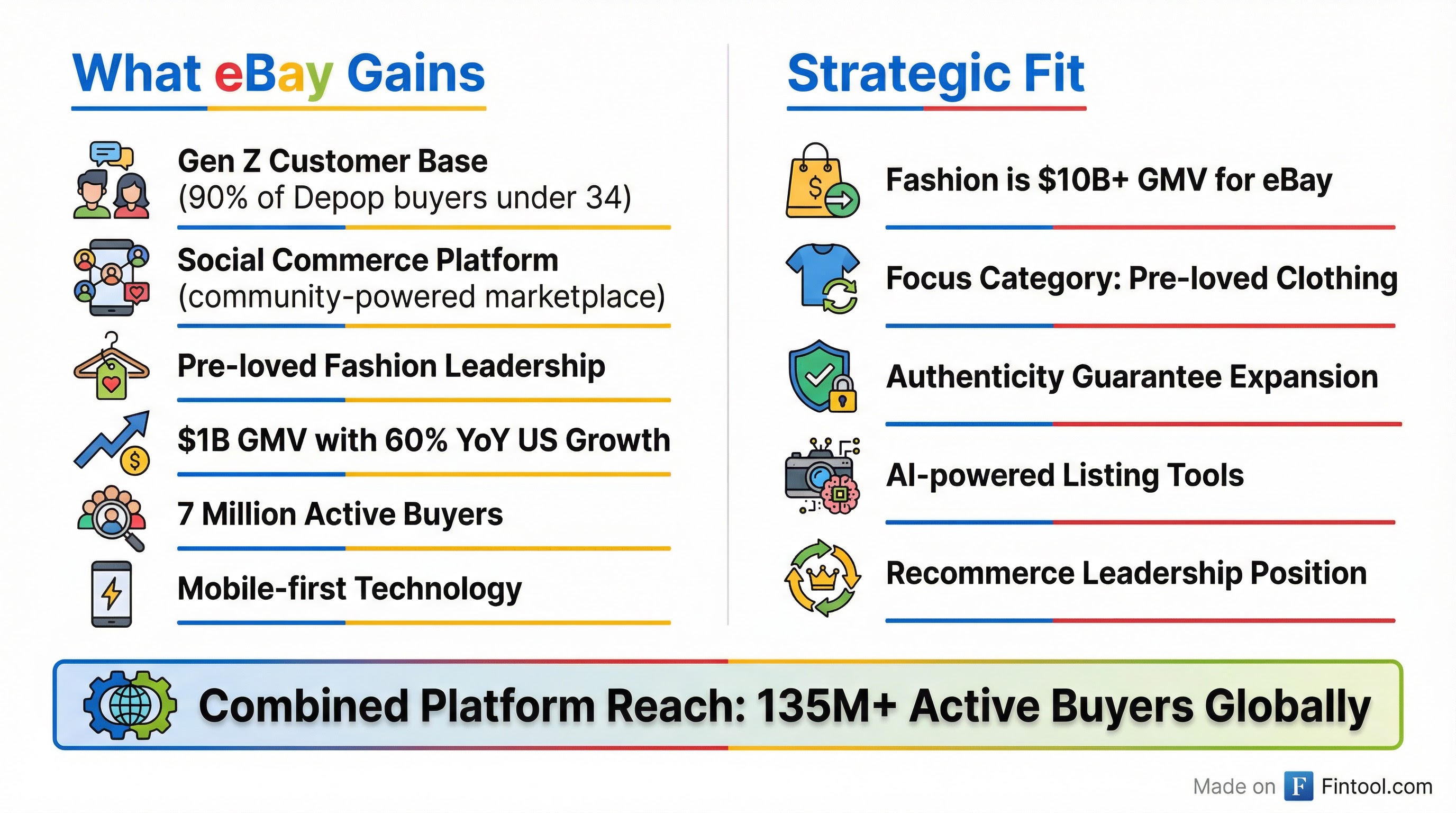
The strategic logic is straightforward: eBay needs younger customers, and Depop has them.
Nearly 90% of Depop's 7 million active buyers are under 34, making it one of the most concentrated Gen Z marketplaces in e-commerce. The platform generated approximately $1 billion in gross merchandise sales in 2025, including nearly 60% year-over-year growth in the U.S.
"A key C2C driver, fashion represents more than $10 billion in annual gross merchandise volume for eBay and delivered 10% year-over-year GMV growth in the U.S. in 2025," said Jamie Iannone, CEO of eBay. "This acquisition presents an opportunity to advance one of our newest and fastest-growing Focus Categories with a marketplace that complements our existing presence, and enables us to reach a younger demographic across the expanding recommerce landscape."
The deal fits squarely into eBay's Focus Category strategy, which has driven accelerating growth across collectibles, motors, and fashion. In Q4 2025, eBay reported total revenue of $3.0 billion (+15% YoY) and GMV of $21.2 billion (+10% YoY), with non-GAAP EPS of $1.41.
Ask Fintool AI AgentWhy Etsy Is Selling
For Etsy, the sale represents a strategic retreat from what was once billed as a transformative acquisition.
When Etsy bought Depop in June 2021, the deal was announced at the peak of pandemic-era e-commerce enthusiasm. Tech valuations were soaring, and secondhand fashion apps were riding a cultural wave. Etsy paid $1.625 billion—a significant premium at the time.
The integration proved difficult. Depop's mobile-first, social commerce model—built around community and discovery—never fully meshed with Etsy's search-driven marketplace for handmade and vintage goods. While Depop continued to grow, it remained a drag on Etsy's margins and demanded management attention away from the core platform.
Selling at a ~$425 million loss is painful, but the cash provides optionality. Etsy ends Q3 2025 with approximately $1.25 billion in cash and equivalents; adding $1.2 billion in proceeds significantly strengthens the balance sheet for buybacks, debt reduction, or core marketplace reinvestment.
eBay's Recommerce Momentum
The acquisition comes as eBay leans heavily into its positioning as the original recommerce platform. In Q4 2025, the company:
- Expanded eBay Live streaming shopping to Germany and Australia
- Expanded Authenticity Guarantee in Germany to cover apparel, shoes, accessories, and jewelry
- Released a next-generation AI-powered "Magical Listing" tool for sellers
- Announced a multi-year partnership with Condé Nast as official Pre-Loved Partner across Vogue, GQ, and Vanity Fair
Management has emphasized that AI is core to the platform's evolution. "We have built significant momentum across our strategic priorities, delivering meaningful growth and reinforcing our leadership in recommerce," said CEO Jamie Iannone. "As we continue to harness AI to elevate the customer experience worldwide, eBay is in the strongest position it has been in years."
Depop will retain its brand, platform, and culture post-acquisition—a structure that should help preserve what makes the marketplace distinctive.
Ask Fintool AI AgentFinancial Context
eBay's Recent Performance
| Metric | Q4 2025 | Q4 2024 | Change |
|---|---|---|---|
| Revenue | $2,965M | $2,579M | +15% |
| GMV | $21,237M | $19,320M | +10% |
| Non-GAAP EPS | $1.41 | $1.25 | +13% |
| Operating Margin (Non-GAAP) | 26.1% | 27.0% | -90 bps |
| Active Buyers | 135M | 134M | +1% |
eBay also announced a 7% dividend increase to $0.31 per share and authorized an additional $2.0 billion in share repurchases.
Etsy's Position
Etsy's core marketplace has faced its own challenges. Revenue growth has been modest, and the company has been under pressure to demonstrate a clearer path to profitability improvement. The Depop sale simplifies the story—Etsy becomes a purer play on its namesake marketplace for handmade and vintage goods.
| Metric | Q3 2025 | Q2 2025 | Q1 2025 |
|---|---|---|---|
| Revenue | $678M | $673M | $651M* |
| Net Income | $75.5M | $28.8M | -$52.1M* |
| Cash & Equivalents | $1,249M | $1,183M | $649M* |
*Values retrieved from S&P Global
What to Watch
Integration execution: Depop's mobile-first, social commerce DNA is different from eBay's traditional marketplace model. Preserving what makes Depop work while extracting synergies will be the key operational challenge.
Gen Z acquisition metrics: The primary strategic rationale is customer demographics. Watch for disclosures on cross-platform user acquisition and retention rates.
Fashion GMV growth: eBay has highlighted fashion as a $10B+ Focus Category. Depop should meaningfully accelerate this segment—management guidance on combined fashion GMV will be critical.
Regulatory timeline: The deal requires standard antitrust review. Given both companies operate consumer marketplaces, regulators may take a close look at market concentration in secondhand fashion.