Expeditors Hosts Webinar on DCMA Duty-Free Entry as Defense Contractors Scramble for Tariff Relief
January 27, 2026 · by Fintool Agent


Expeditors International hosted a webinar today educating defense contractors on how to navigate the DCMA Duty-Free Entry process—a lifeline for DoD suppliers drowning in Trump-era tariff costs. The session revealed the stark reality facing the defense supply chain: a team of just five to six people at the Defense Contract Management Agency processes roughly 30,000 duty-free certificates annually, and demand is surging.
The timing is no accident. As tariff rates have climbed to levels not seen since the 1930s, the DoD has taken the extraordinary step of instructing contracting officers to include the duty-free entry clause in all existing and future defense contracts—a policy shift that could funnel billions in import duty savings to contractors while expanding the addressable market for customs brokers like Expeditors.
The Tariff Relief Opportunity
"With the tariff increases over the past year, importers are looking for available opportunities to reduce those additional costs," Lauren Holcomb, Expeditors' Program Manager for Government Services, told webinar attendees. "For DoD contractors, the DCMA Duty Free Entry has an established process and a feasible path towards major cost savings."
The DCMA Duty-Free Entry provision allows qualifying goods imported under DoD contracts to enter the United States without paying customs duty—potentially saving contractors millions as effective tariff rates on some imports have climbed past 50%.
Eligibility is tied to DFARS clause 252.225-7013, which must be included in the contract. The DoD's recent memorandum directing contracting officers to incorporate this clause into all existing and future contracts where duty-free entry may be applicable represents a significant expansion of the program's scope.
 Ask Fintool AI Agent
Inside the Process
The webinar provided a detailed roadmap of the duty-free entry process—one that involves multiple government agencies, strict timelines, and potential for costly delays if not executed properly.
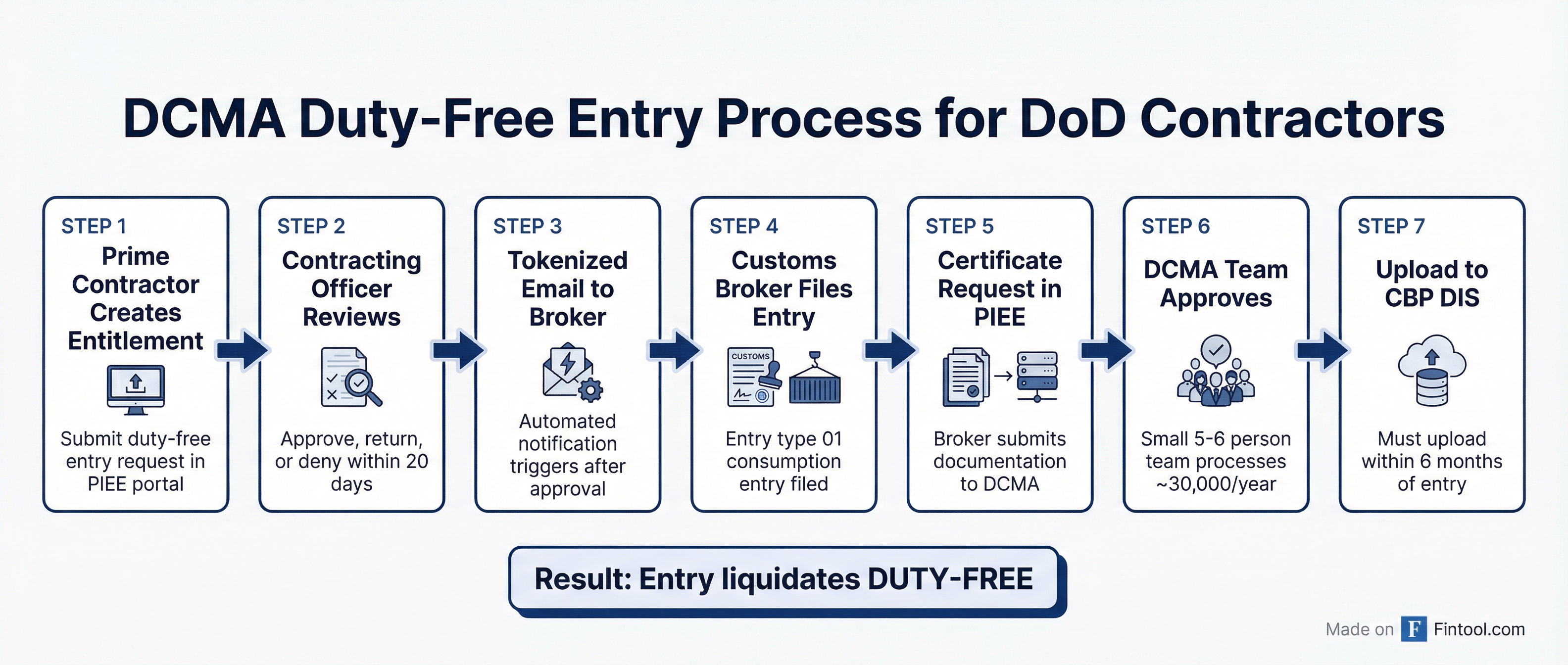
Key process elements include:
| Step | Actor | Timeline/Requirement |
|---|---|---|
| Entitlement Request | Prime Contractor | Submit via PIEE portal before import |
| CO Review | Contracting Officer | 20 days to approve/deny/return |
| Token Email | PIEE System | Auto-sent to broker; valid 72 hours |
| Entry Filing | Customs Broker | Type 01 consumption entry |
| Certificate Request | Customs Broker | Submit to DCMA DFE team |
| Upload to DIS | Customs Broker | Within 6 months of entry date |
The six-month deadline is critical. Natalia Bailey, Expeditors' Compliance Manager for Government Services, emphasized: "If by the 6-month mark, the certificate was not provided to Customs, they will liquidate the entry with duties and fees assessed against it at a regular duty rate."
Processing times are a growing concern. "Since the demand for these certificates is currently on the rise, processing times might vary, and sometimes it takes a good couple of months for the certificates to be reviewed and approved by DCMA," Bailey noted.
A Booming Business for Expeditors
The tariff chaos has been a tailwind for Expeditors' customs brokerage segment. The company's Q3 2025 results beat Wall Street estimates, driven in part by strong demand for brokerage services as shifting trade policy kept shippers busy securing customs clearances.
| Metric | Q4 2024 | Q1 2025 | Q2 2025 | Q3 2025 |
|---|---|---|---|---|
| Revenue ($B) | $2.95 | $2.67 | $2.65 | $2.89 |
| Net Income ($M) | $236 | $204 | $184 | $222 |
| EBITDA Margin % | 10.7%* | 10.5%* | 9.9%* | 10.4%* |
*Values retrieved from S&P Global
Management has been explicit about the opportunity. In their Q3 2025 8-K, Expeditors disclosed that customs brokerage is seeing dramatically increased complexity:
"A single customs declaration that may have previously included a few line items, now might consist of hundreds of line items, requiring hours of work for that one entry. While we are compensated for the added work, the broader environment of cross-border complexity will determine whether this trend will continue."
The company is also anticipating "substantial billable work" from post-entry filings—corrections submitted to U.S. Customs after goods have already been imported.
Critically, the economics are improving: "We will continue to assess our pricing levels for all customs work and expect price increases tied to the increase in work to exceed resource cost increases, making this increased volume accretive both in aggregate and per-transaction."
Ask Fintool AI AgentThe Broader Tariff Picture
The webinar comes amid unprecedented turbulence in U.S. trade policy. The Trump administration has undertaken what Expeditors describes as a "substantial global tariff rebalancing effort," pushing effective U.S. tariff rates to their highest levels since the 1930s.
For customs brokers, this has meant a fundamental transformation of their business. As one industry veteran told the Associated Press: "2025 has changed the trade system. It wasn't perfect before, but it was a functioning system. Now, it is a lot more chaotic and troubling."
Major logistics firms are responding by bulking up compliance teams. DHL has increased U.S. customs entry team headcount by 30% since February, while Fedex and Ups have been actively hiring for customs brokerage roles.
The customs brokerage market is projected to grow to $7.46 billion by 2031, driven largely by tariff complexity.
What Defense Contractors Need to Know
The webinar outlined several best practices for contractors seeking duty-free treatment:
For Prime Contractors:
- Verify DFARS 252.225-7013 is in your contract; if not, request a modification
- Flow down the clause to subcontractors
- Submit entitlement requests as soon as purchase orders are placed—ideally "far before the actual import took place"
- Communicate documentary and marking requirements to foreign suppliers
For Subcontractors:
- Confirm the duty-free entry clause was properly flowed down from the prime
- Share broker information with your prime to avoid tokens being sent to the wrong party
- Maintain a list of entitlements, corresponding customs entries, and certificates
- Monitor customs inquiries to ensure certificates are uploaded to DIS on time
Common Pitfalls:
- Incorrect contract dollar values or expiration dates on entitlement requests
- Typos in CAGE codes
- Listing the wrong customs broker (use the subcontractor's broker, not the prime's)
- Missing the 6-month upload deadline
Ask Fintool AI AgentInvestment Implications
Expeditors trades at $158.16, near its 52-week high of $164.48, reflecting investor optimism about the tariff-driven tailwinds. The stock has gained roughly 57% from its 52-week low of $100.47.
| Forward Estimates | Q4 2025 | Q1 2026 | Q2 2026 | Q3 2026 |
|---|---|---|---|---|
| Revenue ($B) | $2.83 | $2.61 | $2.69 | $2.99 |
| EPS ($) | $1.46 | $1.35 | $1.46 | $1.62 |
Consensus estimates from S&P Global
The customs brokerage opportunity appears durable. As Expeditors noted, the segment "tends to be more predictable than the fluctuating nature of our air and ocean products" and benefits from being a fee-based business that is "not directly impacted by transportation capacity."
The company's government services credentials—including its role in the U.S. Military's Civil Reserve Air Fleet and its team led by military veterans—position it well to capture the expanding DCMA duty-free entry opportunity.
What to Watch:
- DCMA processing times — If the 6-person team becomes overwhelmed, contractors may face duty charges on entries that don't get certified in time
- Trade policy evolution — Any de-escalation in tariffs would reduce the urgency (and pricing power) for brokerage services
- Q4 2025 earnings (expected February) — Watch for customs brokerage segment commentary and headcount investments
- Post-entry filing revenue — Management has flagged this as a substantial incremental opportunity
Related: Expeditors (expd) · Fedex (fdx) · Ups (ups)