FedEx Fires First Shot in $130 Billion Tariff Refund Battle
February 23, 2026 · by Fintool Agent


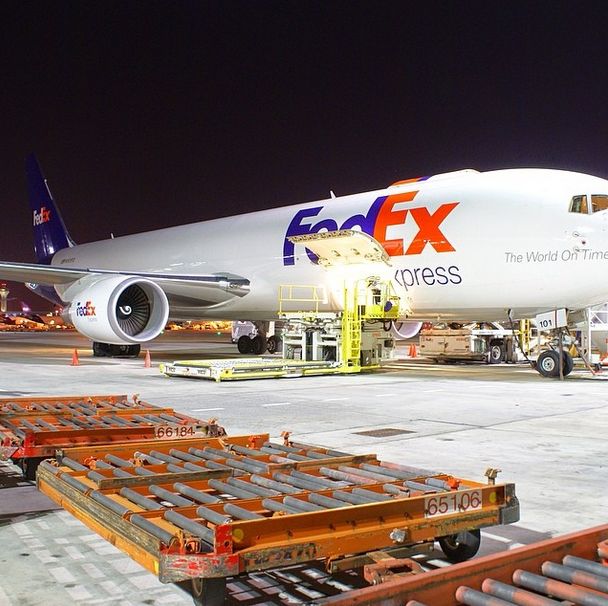
Fedex became the first major American company to sue for tariff refunds after the Supreme Court's landmark ruling, filing a lawsuit Monday seeking a "full refund" of all duties paid under the now-illegal International Emergency Economic Powers Act tariffs.
The suit, filed in the U.S. Court of International Trade, opens what could become the largest tariff refund battle in U.S. history, with an estimated $130-175 billion in duties potentially owed back to importers.
The Lawsuit
FedEx filed its 11-page complaint against U.S. Customs and Border Protection, CBP Commissioner Rodney Scott, and the U.S. government on Monday—just three days after the Supreme Court's 6-3 ruling struck down the IEEPA tariffs as unconstitutional.
"Plaintiffs seek for themselves a full refund from Defendants of all IEEPA duties Plaintiffs have paid to the United States," the complaint states.
The company did not disclose the exact amount it has paid in IEEPA tariffs. However, in September 2025, FedEx warned investors that tariffs would take a $1 billion bite out of fiscal 2026 earnings—with most of that stemming from reduced shipments on the highly profitable China-U.S. lane.
On a note posted to its website, FedEx stated: "While the Supreme Court did not address the issue of refunds, FedEx has taken necessary action to protect the company's rights as an importer of record to seek duty refunds from U.S. Customs and Border Protection."
 Ask Fintool AI Agent
The Supreme Court Ruling
The Supreme Court's February 20 decision in Learning Resources, Inc. v. Trump was unambiguous: the president cannot unilaterally impose tariffs under IEEPA.
Chief Justice John Roberts wrote for the 6-3 majority:
"The president asserts the extraordinary power to unilaterally impose tariffs of unlimited amount, duration, and scope. In light of the breadth, history, and constitutional context of that asserted authority, he must identify clear congressional authorization to exercise it."
The ruling invalidated tariffs imposed since February 2025 on imports from China, Canada, Mexico, and most other U.S. trading partners—tariffs that had generated more than $130 billion in revenue for the U.S. Treasury.
Critically, the majority opinion was silent on refunds. That omission left Justice Brett Kavanaugh warning in his dissent that the refund process would be "a mess"—and left the question to lower courts to resolve.
FedEx's Financial Exposure
The tariff uncertainty has weighed on FedEx's results throughout fiscal 2026.
| Metric | Q3 2025 | Q4 2025 | Q1 2026 | Q2 2026 |
|---|---|---|---|---|
| Revenue ($B) | $22.2 | $22.2 | $22.2 | $23.5 |
| Net Income ($M) | $909 | $1,648 | $824 | $956 |
FedEx Chief Customer Officer Brie Carere described the tariff period as "very stressful" for customers, particularly small exporters, on the company's September earnings call.
FedEx shares closed Monday at $383.71, down 1.23%, giving the company a market capitalization of approximately $91 billion. The stock has roughly doubled from its 52-week low of $194.30.*
The Broader Refund Landscape
FedEx's suit is not the first tariff challenge—but it is the first major lawsuit filed after the Supreme Court's ruling.
Costco made headlines in December 2025 when it became one of the first prominent companies to sue the Trump administration, seeking to preserve its right to refunds should the Supreme Court rule against IEEPA tariffs. Other early filers included Revlon and Kawasaki.
Those preemptive suits have now been consolidated as AGS Company Automotive Solutions v. U.S. Customs and Border Protection, with more than 1,000 claimants.
The Justice Department and litigants have asked the Court of International Trade to establish a steering committee to coordinate the flood of refund cases—a common step in complex trade disputes.
Ask Fintool AI AgentThe Refund Question
Despite the Supreme Court ruling, the path to refunds remains uncertain.
President Trump himself lamented the ruling's silence on refunds at a press conference Friday: "They take months and months to write an opinion and they don't even discuss that point... I guess it has to get litigated for the next two years."
Key refund hurdles include:
- Liquidation status: Entries that have already been liquidated (finalized by CBP) may require administrative protests or court action to recover
- Processing capacity: CBP's systems would need to process potentially millions of refund transactions
- Treasury impact: A refund of $130+ billion would significantly impact the federal budget
- Statutory deadlines: Various time limits apply depending on entry status and protest filings
The Court of International Trade has, however, affirmed that importers have two years to appeal for prospective IEEPA tariff refunds on liquidated entries—longer than the 180-day window for standard administrative protests.
What's Next
The administration responded to Friday's ruling by immediately imposing new tariffs under different statutory authority—Section 122 of the Trade Act of 1974—though these alternative tariffs face their own legal limitations.
For FedEx and other importers, the litigation will now shift to the mechanics of recovery. The company's move signals that major corporations are not waiting for a government-directed refund process that may never come.
"This Court has jurisdiction and authority to order remedial relief and refunds of IEEPA duties paid by importers," FedEx wrote in its complaint, citing the Supreme Court's acknowledgment that the Court of International Trade has "exclusive jurisdiction" over such claims.
With the first major post-ruling lawsuit now filed, the dam may be about to break.
Ask Fintool AI AgentRelated
*Values with asterisk retrieved from S&P Global