FMC Corporation Explores Full Sale After $1.7B Quarterly Loss Wipes Out Goodwill
February 5, 2026 · by Fintool Agent


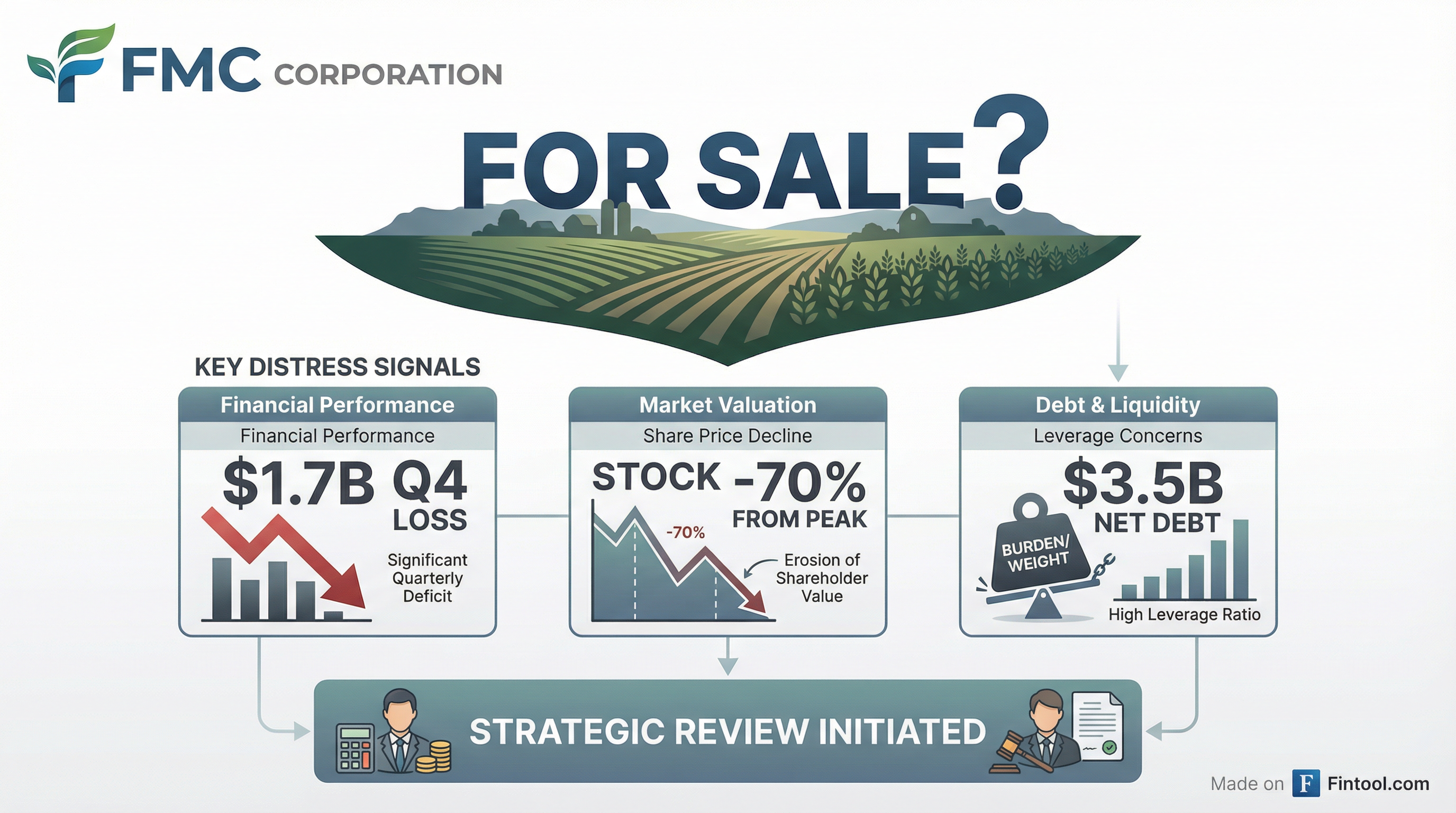
FMC Corporation is exploring a full sale of the company, sending shares down 20% after the agricultural sciences company reported a $1.72 billion quarterly loss and wiped out its entire $1.36 billion goodwill balance.
The Philadelphia-based crop protection company's board has authorized "the exploration of strategic options, including but not limited to, the sale of the company" to unlock shareholder value, CEO Pierre Brondeau said on the earnings call. The company has hired financial and legal advisors, though Brondeau emphasized the review is "at a preliminary stage" with no assurance of a transaction.
FMC shares plunged to $13.58 in trading Wednesday—down 70% from their 52-week high of $44.78—as investors digested both the strategic review news and a brutal set of quarterly numbers. The stock touched an intraday low of $12.48.
 Ask Fintool AI Agent
The Numbers Are Ugly
FMC's Q4 2025 results revealed the depth of the company's challenges:
| Metric | Q4 2025 | Q4 2024 | YoY Change |
|---|---|---|---|
| Revenue | $1.08B | $1.22B | -12% |
| Net Income | -$1.72B | -$16M | NM |
| Adjusted EBITDA | $280M | $339M | -17% |
| Adjusted EPS | $1.20 | $1.79 | -33% |
For full-year 2025, FMC posted a staggering $2.24 billion net loss—down from $341 million in profit the prior year—on revenue of $3.47 billion, an 18% decline.
The Q4 loss was driven primarily by a non-cash goodwill impairment of $1.36 billion "triggered by the decline in our stock price," according to the 8-K filing. The company also recorded $200 million in restructuring charges related to "Project Foundation," its comprehensive cost optimization program.
Why Sell Now?
The strategic review comes as FMC grapples with multiple headwinds:
Generic Competition: FMC's flagship insecticide Rynaxypyr (chlorantraniliprole) lost patent protection at year-end 2025, and "a large number of generic CTPR offerings" have launched in the U.S. and Brazil. Distributors have been reluctant to stock FMC's branded product until they understand "the quality, availability, and grower response" to generics.
Core Portfolio Weakness: Brondeau admitted he underestimated the competitive pressure on FMC's legacy portfolio outside of Rynaxypyr. "If you look at the performance of the company, we pretty much performed as expected in every aspect except the core portfolio outside of Rynaxypyr," he said on the call. That portfolio represents $2.2 billion in sales—and nearly $1 billion comes from high-cost facilities that aren't competitive against generics.
Balance Sheet Strain: Net debt stands at $3.5 billion with leverage at 4.1x trailing EBITDA. The company recently renegotiated its revolving credit facility to allow 6x leverage through Q3 2026.
The Dual-Track Strategy
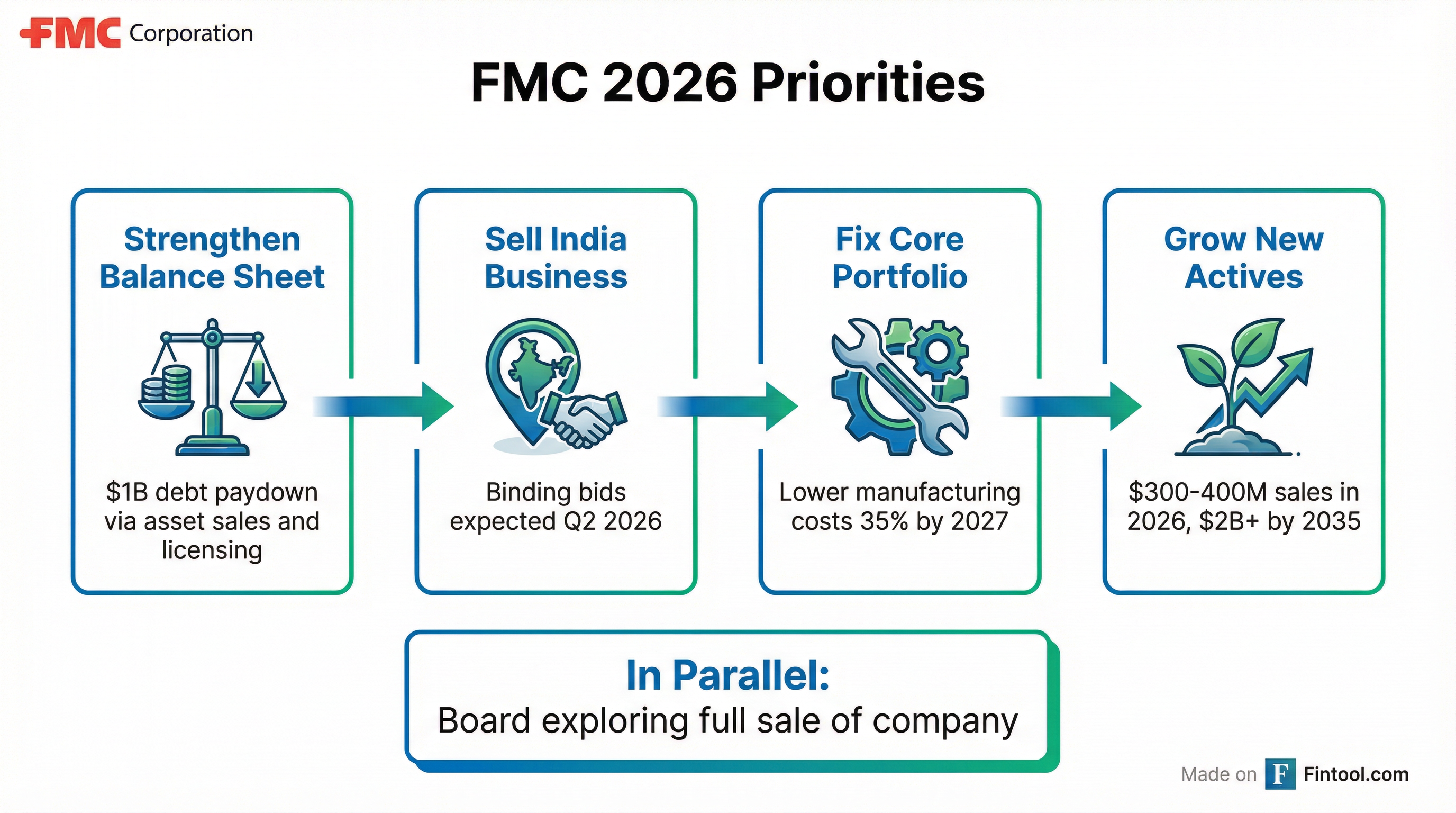
FMC is pursuing two parallel paths. The base operating plan focuses on four priorities for 2026:
- Strengthen the balance sheet by paying down $1 billion in debt through asset sales and licensing agreements
- Sell India commercial business (binding bids expected in Q2)
- Improve competitiveness of the legacy core portfolio by cutting manufacturing costs 35% by 2027
- Grow new active ingredients to $300-$400 million in sales (up from $200 million in 2025)
In parallel, the board is pursuing a full sale. Asked whether this is the right time to sell—given the company is arguably at the bottom of its cycle—Brondeau was direct:
"We also believe it is important to always look at a double path. A parallel path would allow benefit for shareholders and potentially thinking about doing more things with the portfolio of the company that we can do alone. When you take money to restructure a company like we are doing, it is money you don't spend in accelerating the growth of your new active ingredients."
The CEO suggested a new owner with deeper pockets could accelerate development of FMC's promising R&D pipeline—including four new active ingredients expected to generate $2 billion in annual sales by 2035.
Ask Fintool AI AgentBleak 2026 Guidance
The near-term outlook isn't encouraging:
| Metric | 2026 Guidance | vs. 2025 |
|---|---|---|
| Revenue (ex-India) | $3.60-$3.80B | -5% |
| Adjusted EBITDA | $670-$730M | -17% |
| Adjusted EPS | $1.63-$1.89 | -41% |
| Free Cash Flow | -$65M to +$65M | Break-even |
Q1 2026 will be particularly weak—management expects adjusted EBITDA of just $45-$55 million, down 58% year-over-year, with an EBITDA margin around 7%. Nearly all of the $20 million tariff headwind hits Q1, along with unfavorable manufacturing cost timing.
Who Might Buy FMC?
At a market cap now under $1.7 billion—down from over $5 billion two years ago—FMC presents an interesting takeover target. Potential acquirers could include:
Strategic Buyers:
- Corteva ($51B market cap) – The pure-play ag leader could absorb FMC's portfolio and accelerate its own crop protection offerings
- Basf – German chemicals giant with agricultural solutions division
- Syngenta (ChemChina-owned) – Seeking Western technology and distribution
Private Equity: FMC's new active ingredient pipeline and restructuring opportunity could appeal to PE firms with agrochemical experience.
The key asset is FMC's R&D pipeline. Four new molecules—fluindapyr, Isoflex, Dodhylex (first new mode of action herbicide in 30+ years), and Rimisoxafen (first dual mode of action herbicide ever)—could generate over $2 billion in annual sales by 2035. A well-capitalized acquirer could accelerate commercialization.
Ask Fintool AI AgentWhat to Watch
Q2 2026: Binding bids expected for India commercial business (carrying value written down to $450 million).
H1 2026: Refinancing of $500 million bonds maturing in October.
Strategic Process: No timeline given, but Brondeau noted advisors are now onboard. Any deal would likely need antitrust review given FMC's market positions in certain crop protection categories.
The clock is ticking. FMC's covenant leverage of 4.6x leaves limited headroom against the 6x limit, and the company needs to manage working capital carefully given the seasonality of Q1 EBITDA. A sale—or significant asset sales—may be the only path to shore up the balance sheet while preserving the value of a genuinely differentiated R&D pipeline.
Related: FMC Corporation | Corteva, Inc. | Nutrien LTD.