FTC Slaps GM with 20-Year Consent Order After OnStar Data Scandal
January 15, 2026 · by Fintool Agent



The Federal Trade Commission finalized a sweeping 20-year consent order against General Motors on January 14, banning the automaker from sharing driver geolocation and behavior data with consumer reporting agencies for five years after regulators determined GM secretly harvested and sold intimate driving details from millions of vehicles—sometimes as frequently as every three seconds.
GM has already accrued $300 million in Q3 2025 for investigations and litigation related to its former OnStar Smart Driver program. The case marks the FTC's first enforcement action targeting connected vehicle data practices—and a warning shot across the bow of an auto industry increasingly reliant on data monetization.
How Your Car Became a Surveillance Device
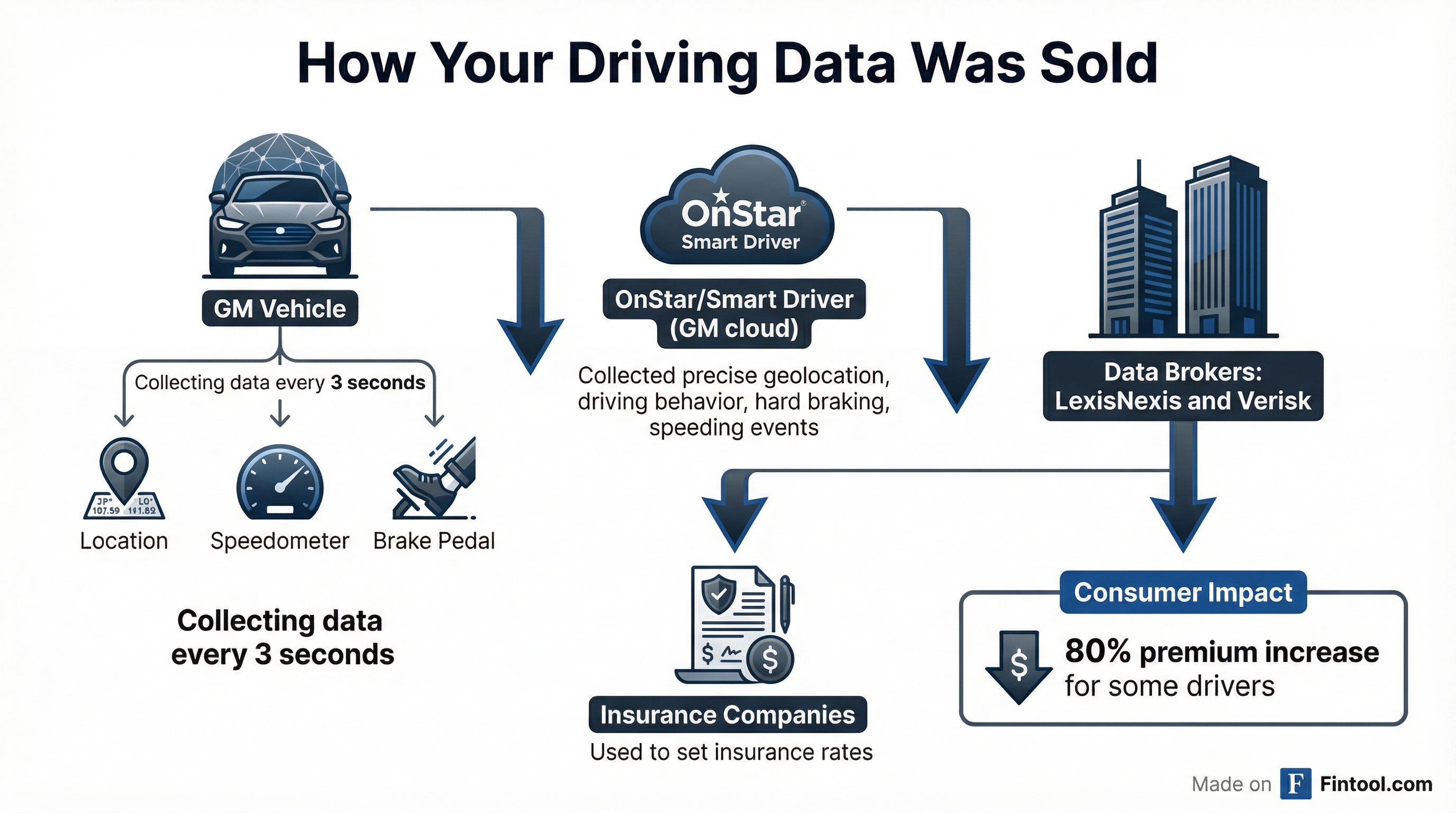
The scheme worked like this: GM's OnStar Smart Driver feature, pitched as a free add-on to encourage safer driving, quietly collected precise location data, hard braking events, speeding incidents, and other driving behaviors. This information was transmitted to GM as often as every three seconds, then sold to data brokers LexisNexis (owned by Relx) and Verisk Analytics.
Those brokers then supplied the data to insurance companies, which used it to adjust premiums—often without drivers knowing their own vehicles were rating their performance behind the wheel.
The human cost became starkly real for consumers like Temeika Clay, whose car insurance premium jumped 80% after GM shared 603 entries of her driving data from her Chevy Camaro. "Never did I imagine it would be spying on us," she told WBSTV.
 Ask Fintool AI Agent
What the Order Requires
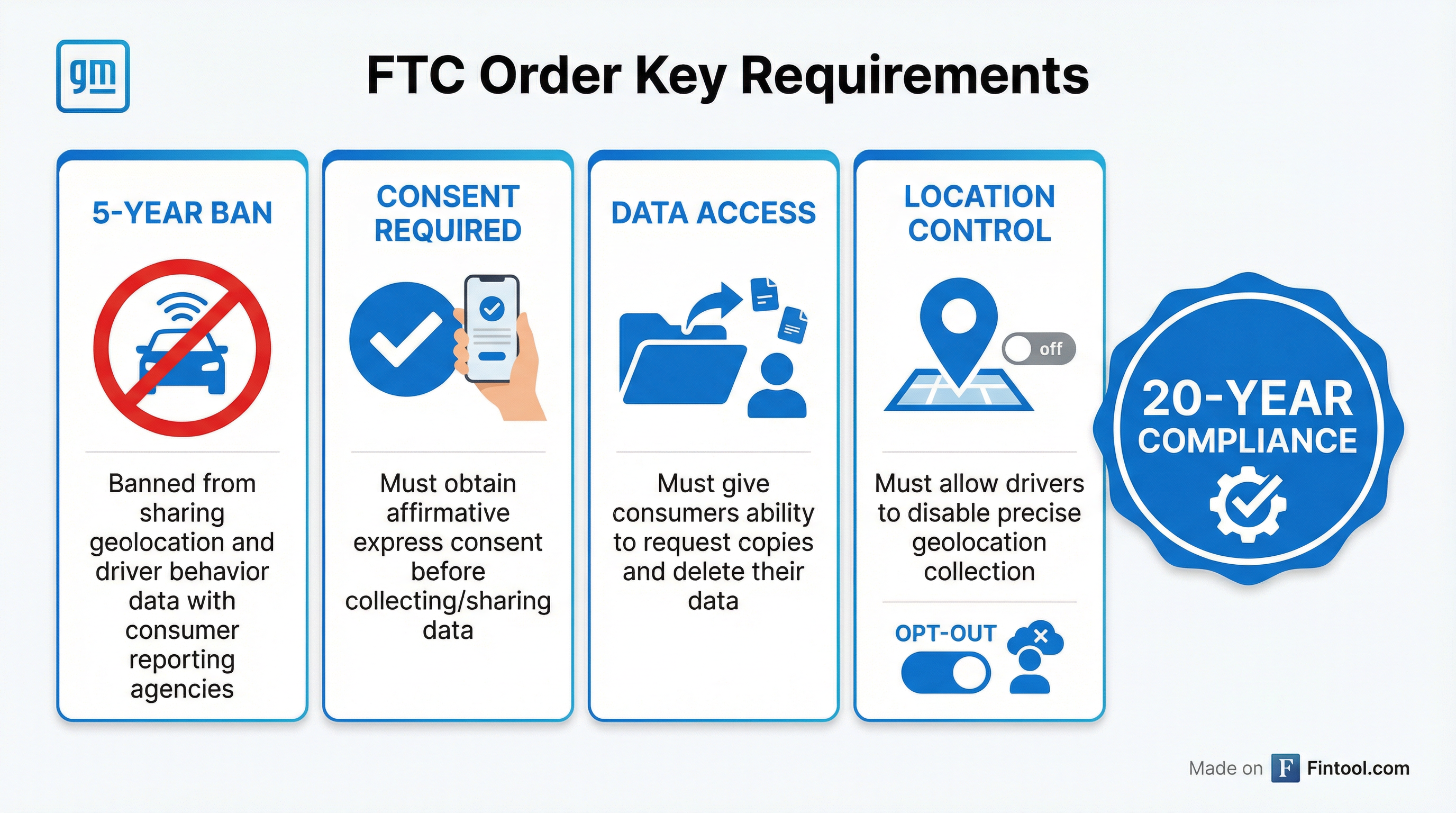
The FTC's final order imposes extensive restrictions on GM's handling of connected vehicle data:
| Requirement | Duration | Details |
|---|---|---|
| Data sharing ban | 5 years | Prohibited from disclosing geolocation and driver behavior data to consumer reporting agencies |
| Consent mandate | 20 years | Must obtain affirmative express consent before collecting, using, or sharing connected vehicle data |
| Data access | 20 years | Must provide consumers ability to request copies of their data and seek deletion |
| Location control | 20 years | Must allow drivers to disable precise geolocation collection |
| Opt-out mechanism | 20 years | Must provide clear opt-out for data collection with limited exceptions |
Former FTC Chair Lina Khan characterized the conduct as an "egregious betrayal of consumers' trust," noting that GM monitored and sold driving data "sometimes as often as every three seconds."
Timeline of the Scandal
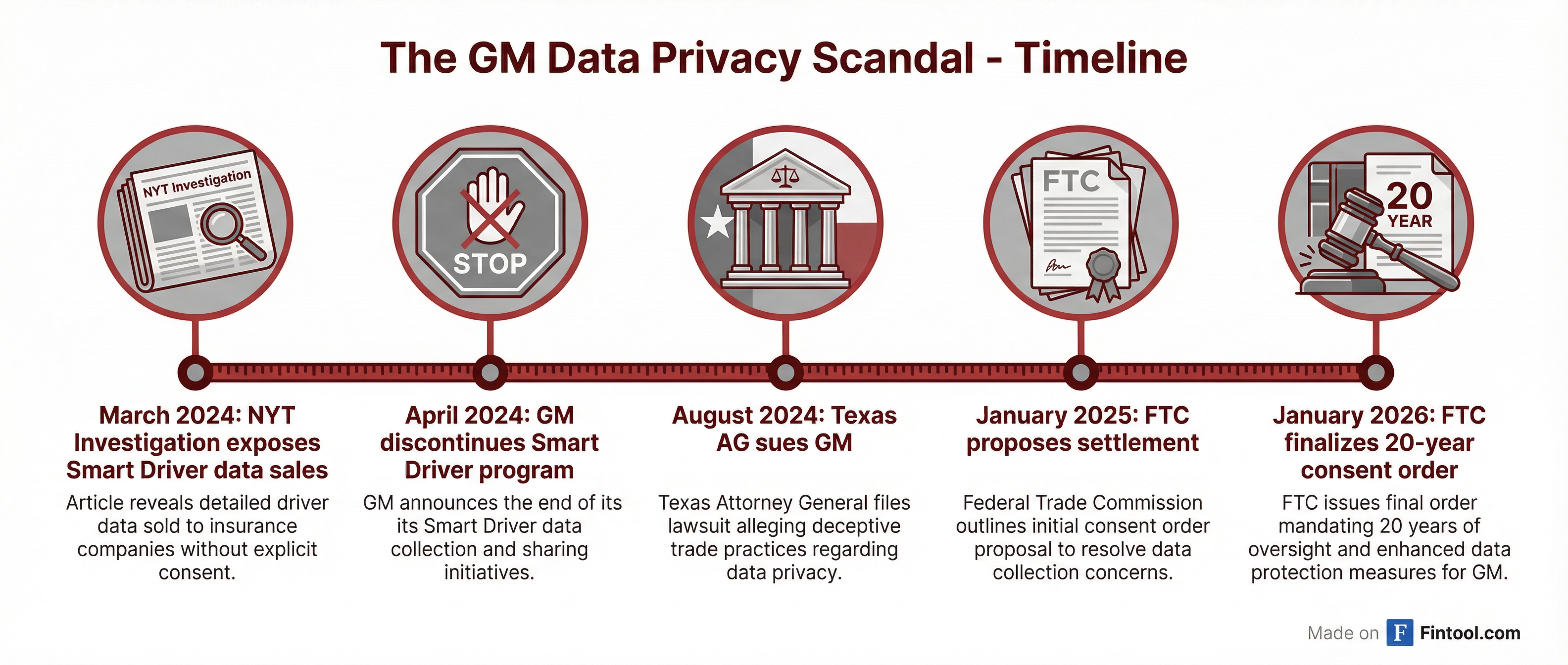
The scandal unfolded over nearly two years:
- March 2024: New York Times investigation reveals GM and OnStar were collecting and selling driver data to brokers
- April 2024: GM discontinues Smart Driver program across all brands, citing "customer feedback," and severs relationships with LexisNexis and Verisk
- August 2024: Texas Attorney General Ken Paxton sues GM, alleging the company installed technology on 14 million vehicles to siphon and sell user data
- January 2025: FTC proposes settlement with GM in final days of Biden administration
- Q3 2025: GM accrues $300 million for Smart Driver investigations and litigation
- January 14, 2026: FTC finalizes 20-year consent order
Financial Impact for GM
GM's Smart Driver-related charges have been substantial, though they pale in comparison to the automaker's broader EV-related writedowns:
| Metric | Q4 2024 | Q1 2025 | Q2 2025 | Q3 2025 |
|---|---|---|---|---|
| Revenue | $43.6B* | $39.9B | $42.9B | $44.3B |
| Net Income | -$3.0B* | $2.8B* | $1.9B | $1.3B |
| OnStar Smart Driver Charges | — | — | — | $300M |
*Values retrieved from S&P Global
The company disclosed in its Q3 2025 10-Q that beyond the $300 million accrual, "at this stage, we are not able to estimate any reasonably possible or probable material loss or range of loss that may result from these actions beyond this accrual." Multi-district litigation remains pending in the Northern District of Georgia.
GM's stock fell 2.1% on January 14 when the order was finalized, closing at $81.23. Shares traded at $81.35 on January 15, essentially flat.
Ask Fintool AI AgentIndustry-Wide Implications
GM isn't alone. Texas Attorney General Ken Paxton has expanded his investigation to Ford, Toyota, Hyundai, and Fiat Chrysler (Stellantis), demanding each explain their data collection, sharing, and selling practices under oath.
Ford has been quick to differentiate itself, stating it "does not sell any connected vehicle data to data brokers" and that exploratory partnerships with LexisNexis and Verisk "ended without launching any products." The company said it stopped supporting usage-based insurance programs last year and previously required a "double opt-in experience" for any data sharing.
Toyota faces more scrutiny. Texas regulators have demanded details about Connected Analytic Services LLC, an affiliate of Toyota Insurance Management Solutions that acknowledges using "telematics data from Toyota vehicles equipped with data communication modules" to "refine insurance pricing options."
The Texas AG has also sued Allstate and its data subsidiary Arity for allegedly using covertly obtained driving data to raise insurance rates on Texas consumers.
What to Watch
The FTC order sets a precedent that will ripple through the automotive industry as vehicles become increasingly connected. Key questions going forward:
-
State enforcement: Will other state attorneys general follow Texas in pursuing automakers and data brokers?
-
Class action outcomes: The multi-district litigation in Georgia remains pending. Settlement outcomes could establish templates for future cases.
-
Insurance industry exposure: Data brokers and insurers who purchased the data may face their own regulatory scrutiny.
-
Revenue model implications: Automakers have been counting on data monetization as a growth driver. How will they pivot?
GM said it "remains committed to protecting customer privacy, maintaining trust, and ensuring customers have a clear understanding of our practices." The company has consolidated its U.S. privacy notices into a single document and argues the FTC order "largely codifies changes GM says it has already made."
But with 20 years of compliance ahead and litigation still pending, the true cost of GM's "egregious betrayal" remains to be tallied.
Ask Fintool AI AgentRelated: