Huntington Closes $7.4B Cadence Merger, Becomes 16th-Largest U.S. Bank
February 2, 2026 · by Fintool Agent


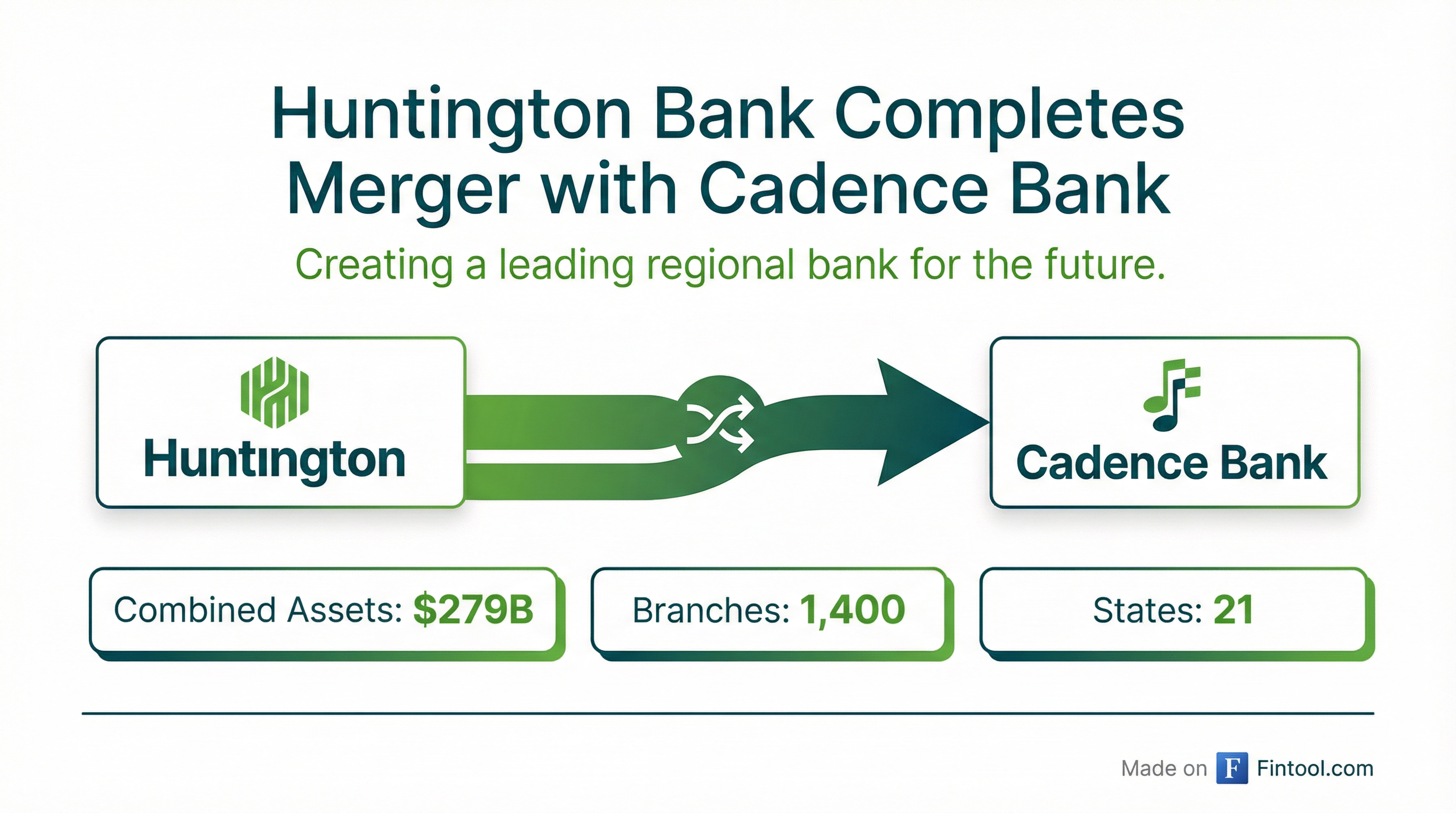
Huntington Bancshares (HBAN) completed its all-stock acquisition of Cadence Bank on Saturday, creating a $279 billion regional banking giant with dominant market positions in Texas and the Deep South.
The deal, announced in October 2025 and closed in just under four months, marks another milestone in the accelerating consolidation of U.S. regional banks. It follows Fifth Third's completion of its $10.9B Comerica acquisition by just one day, signaling that the Trump administration's lighter regulatory touch is enabling faster deal timelines.
The Deal Terms
Under the merger agreement, Cadence shareholders received 2.475 shares of Huntington common stock for each Cadence share, representing approximately 462 million newly issued Huntington shares. The exchange ratio valued Cadence at roughly $7.4 billion based on Huntington's recent trading levels.
| Metric | Combined Company |
|---|---|
| Total Assets | $279 billion |
| Total Deposits | $221 billion |
| Total Loans | $187 billion |
| Branch Network | 1,400 branches |
| Geographic Reach | 21 states |
The transaction makes Huntington the 16th-largest bank in the United States and delivers immediate scale in high-growth markets. Huntington is now the #1 bank in Mississippi and #8 largest in Texas by deposit market share.
 Ask Fintool AI Agent
Strategic Rationale: Expansion into Faster-Growing Markets
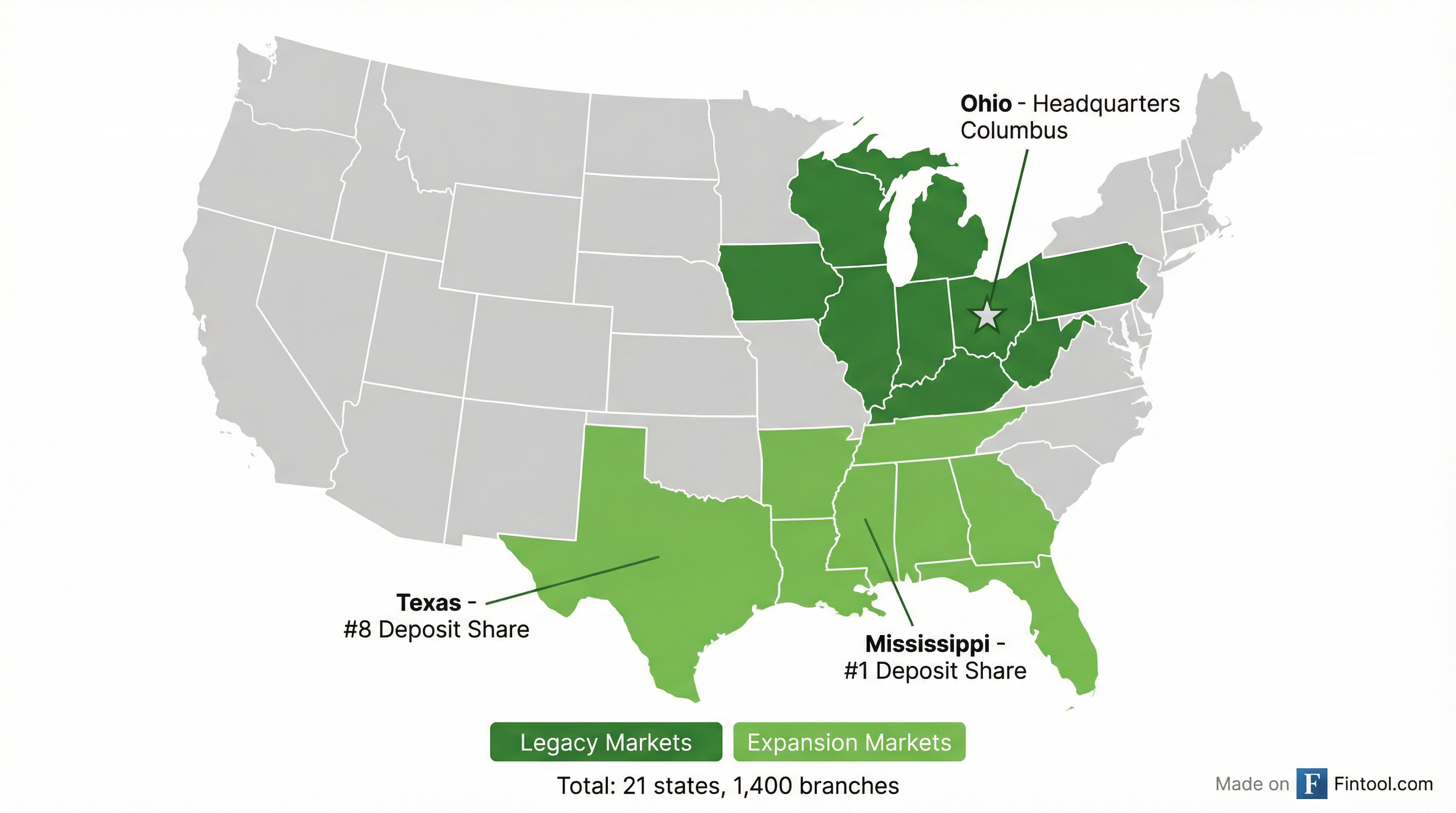
Huntington, founded in 1866 and headquartered in Columbus, Ohio, has historically been a Midwest-focused regional bank. The Cadence acquisition fundamentally reshapes its geographic profile, adding 390 branches across Texas and the Southern U.S. to its network.
On Huntington's January 22 earnings call, CEO Steve Steinour emphasized the strategic importance of the expansion:
"This partnership marks a significant milestone for Huntington and will serve as a springboard for growth across a number of high-growth markets across Texas and the South."
The markets Huntington is entering through Cadence are projected to grow roughly 30% faster than the national average, according to management's investor presentation. Texas, in particular, has been one of the most attractive banking markets in the country, driven by population migration, corporate relocations, and energy sector strength.
Huntington has committed to no branch closures in Cadence's network and plans to invest to grow the footprint over time. Customer accounts will migrate to Huntington systems mid-2026.
The "Partnership" Approach to M&A
Huntington has intentionally framed the Cadence transaction—and its earlier acquisition of Veritex in October 2025—as "partnerships" rather than traditional acquisitions. On the Q4 earnings call, President of Consumer & Regional Banking Brent Standridge explained the differentiated approach:
"One of the things that partnership has allowed us to do is to really move with greater speed and rigor on some of the key decisions. As it relates to board decisions, management decisions, all of our colleague decisions, organizational structure decisions, all of those have been decided and communicated. That creates a high level of certainty for the colleagues."
For Cadence, Huntington undertook a 22-city tour immediately after the October announcement to meet with Cadence colleagues and learn about their customers and markets. All key personnel and organizational decisions were completed before closing.
This collaborative approach contrasts with hostile or heavily contested deals and appears designed to minimize talent attrition and customer disruption—historically the biggest risks in bank M&A.
Ask Fintool AI AgentFinancial Impact and 2026 Outlook
Huntington delivered strong standalone results in Q4 2025, with adjusted EPS of $0.37, up 9% year-over-year, and 290 basis points of positive operating leverage for the full year. The company's guidance for 2026 incorporates the Cadence contribution:
| 2026 Guidance | Huntington Standalone | Cadence Contribution |
|---|---|---|
| NII Growth | 10-13% | $1.85-1.9B (inc. PAA) |
| Fee Revenue Growth | 13-16% | $300M |
| Expense Growth | 10-11% | $1.1B |
| Operating Leverage | 150-200 bps | - |
| Net Charge-offs | 25-35 bps | No change |
Cost synergies from Cadence are expected to begin immediately and reach full run rate in Q4 2026. Revenue synergies—from deploying Huntington's broader product platform to Cadence customers—are expected to contribute in the back half of 2026 and accelerate into 2027.
CFO Zach Wasserman confirmed that Huntington remains on track for $2 pro forma EPS in 2027, the target set when the Cadence deal was announced.
Board Changes and Leadership
Three former Cadence directors join Huntington's board, expanding it to 15 members:
- James D. "Dan" Rollins III – Former Cadence CEO, joins as non-executive Vice Chairman with a $10 million closing payment plus annual fees of $6M/$5M/$4M over three years
- Virginia Hepner – Retired Wachovia/Wells Fargo executive with 25 years of banking experience
- Alice Rodriguez – Retired JPMorgan Chase executive with 35 years of banking experience
Rollins had served as Cadence CEO since 2012 and Chairman since 2014. His retention as Vice Chairman signals Huntington's commitment to preserving Cadence's relationships and institutional knowledge.
The Regional Bank Consolidation Wave
The Huntington-Cadence closing, just one day after Fifth Third-Comerica, underscores the rapid pace of regional bank consolidation. The drivers are well-established:
- Scale economics – Technology investments, regulatory compliance, and competitive pricing require greater scale to absorb fixed costs
- Deposit competition – Higher-for-longer rates have intensified the fight for deposits, favoring banks with diversified funding sources
- Growth markets – Midwest banks like Huntington and Fifth Third are seeking exposure to faster-growing Sun Belt markets
- Regulatory clarity – The Trump administration's approach to bank M&A has reduced deal uncertainty and shortened approval timelines
With Cadence now absorbed, Huntington has signaled it remains open to future M&A—but only on strategic terms.
"We're not going to do an MOE. We're not going to go to auctions. They have to be strategic in nature where they're adding value and revenue growth for us," CEO Steinour said on the Q4 call.
Ask Fintool AI AgentWhat to Watch
- Mid-2026 systems migration – The full integration of Cadence customer accounts will be a key execution milestone
- Revenue synergy disclosures – Huntington plans to provide detailed revenue synergy guidance "later this quarter"
- Texas market share gains – Huntington's ability to compete against larger players like JPMorgan, Bank of America, and Texas-native banks will test the thesis
- Credit quality – Net charge-offs guided at 25-35 bps, but integration distractions can sometimes lead to credit slippage