Intel Bets on Startup Its CEO Invested In: $350M SambaNova Partnership Raises Conflict Questions
February 24, 2026 · by Fintool Agent


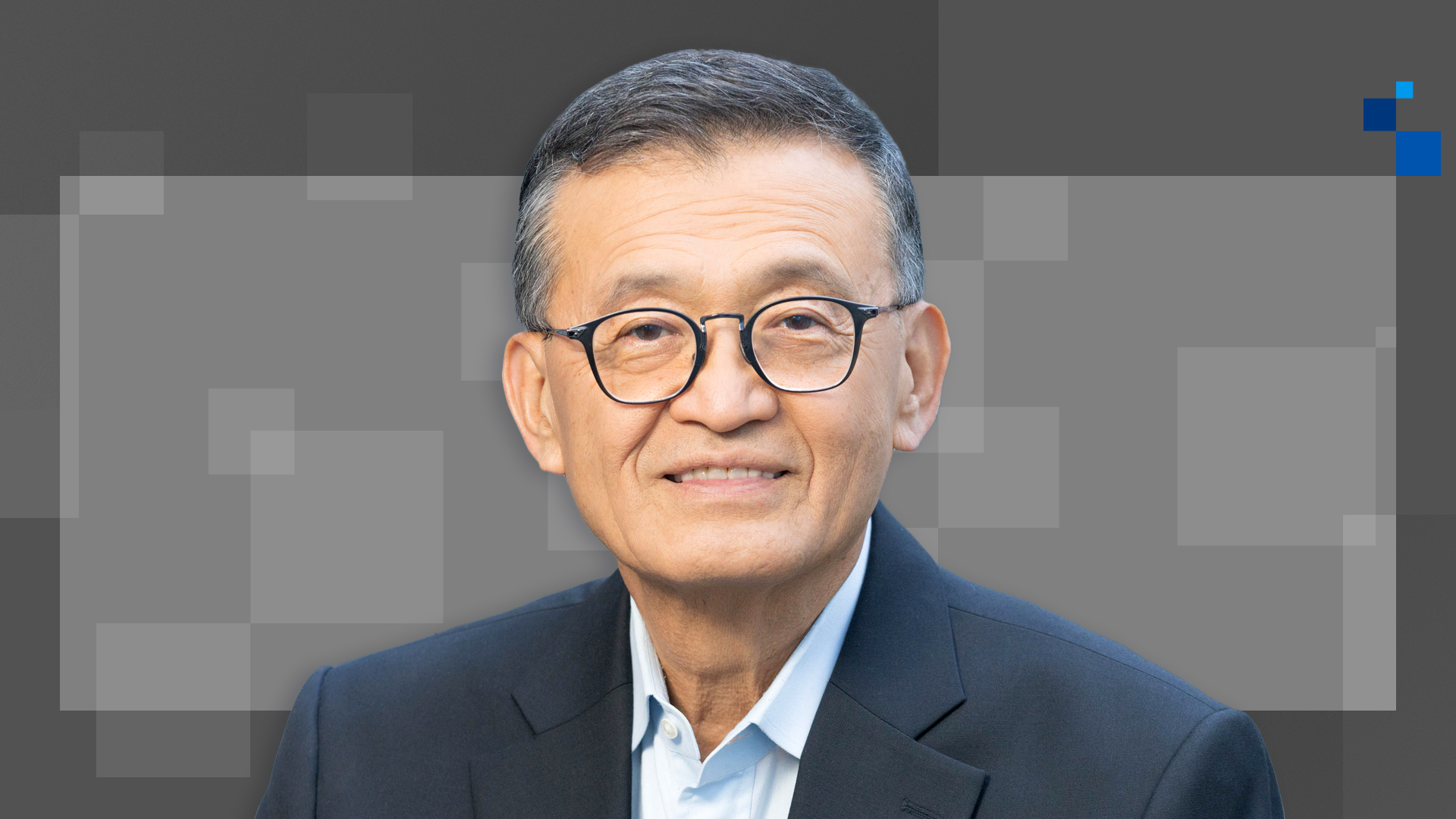
Intel announced a multi-year strategic partnership with AI chip startup SambaNova Systems on Tuesday, months after acquisition talks at a $1.6 billion valuation reportedly collapsed. The deal puts CEO Lip-Bu Tan's dual roles as Intel chief and SambaNova chairman under fresh scrutiny—even as Intel fights to regain relevance in the AI chip market dominated by Nvidia.
Intel shares rose 5.3% to $45.93 on the news, continuing a 75% rally over the past year fueled by U.S. government support and a strategic investment from Nvidia itself.
The Deal Structure
Under the partnership, Intel and SambaNova will collaborate on delivering AI inference solutions built around Intel Xeon processors. Intel Capital is participating in SambaNova's $350 million Series E financing round, led by Vista Equity Partners and Cambium Capital, with additional backing from Battery Ventures and T. Rowe Price.
The collaboration spans three key areas:
- Infrastructure integration: SambaNova systems will incorporate Intel Xeon CPUs and Intel GPUs
- Joint sales and marketing: Intel's enterprise, cloud, and partner channels will help drive SambaNova adoption
- Cloud-scale AI inference: The companies aim to deliver high-performance, cost-efficient inference for AI-native companies and governments
SambaNova has now raised $1.4 billion in total funding. The startup unveiled its new SN50 AI chip alongside the partnership announcement, claiming it delivers 5X faster performance than competitive chips and 3X lower total cost of ownership than GPUs—direct shots at Nvidia's Blackwell systems. SoftBank will be the first customer to deploy SN50 in its next-generation AI data centers in Japan.
 Ask Fintool AI Agent
The Conflict Question
The partnership raises uncomfortable governance questions. Tan has been SambaNova's chairman since 2017—six years before becoming Intel's CEO in March 2025. His venture capital firm, Walden International, was among SambaNova's earliest investors alongside Google's venture arm.
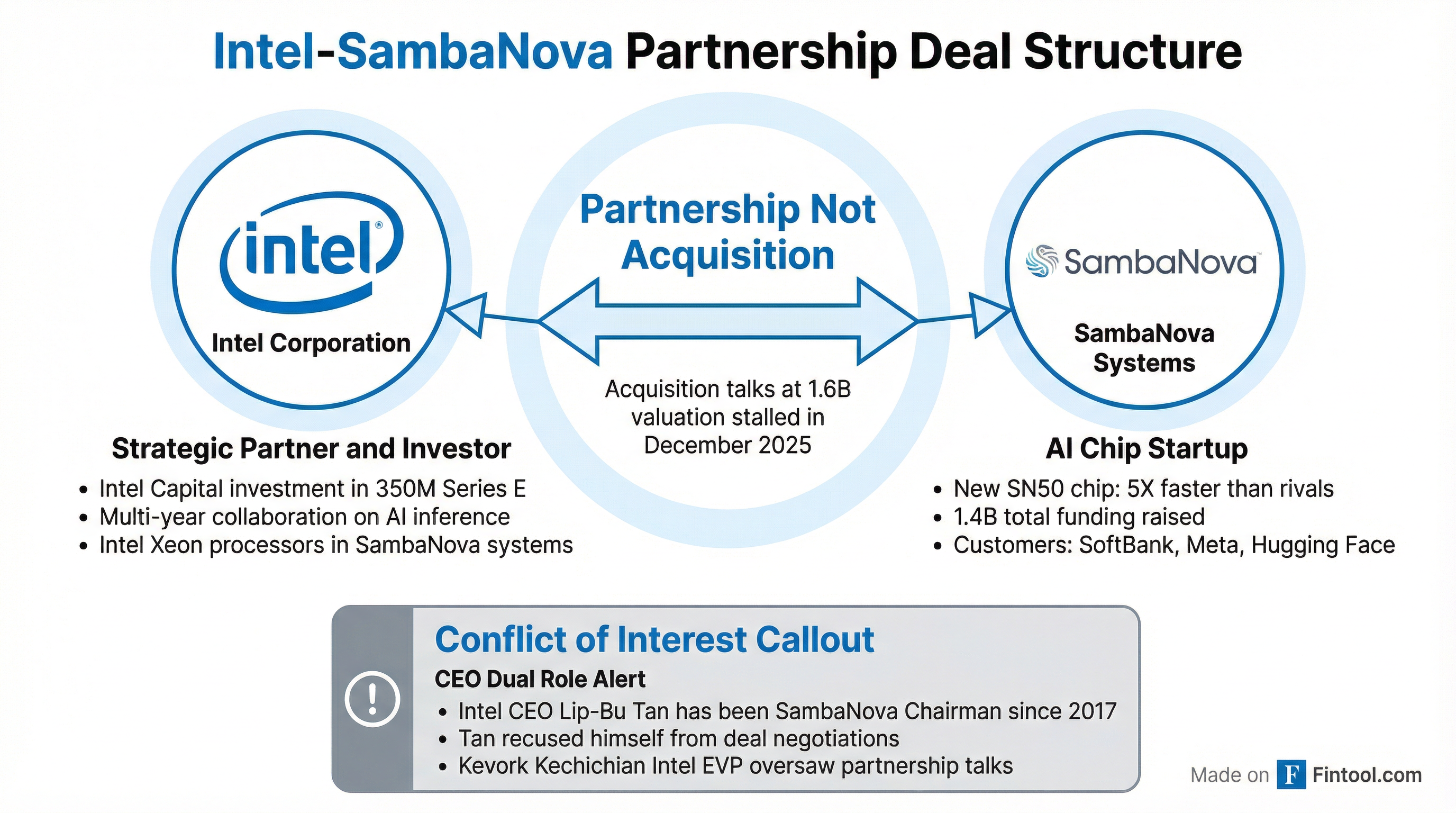
"Some former Intel executives have expressed surprise that the company's directors did not seek to limit Mr. Tan from profiting from Intel acquisitions or other deals in the sector," The New York Times reported. Intel said Tan recused himself from discussions about the collaboration, with talks overseen by Kevork Kechichian, the executive vice president who joined Intel in September to lead its data center group.
"We have well-established governance procedures to ensure decisions are made in Intel's best interests," an Intel spokesperson said.
The conflict issue isn't new for Tan. Last year, he pitched Intel's board on acquiring Rivos—another AI chip startup where he serves as chairman—but the board rejected the proposal, citing conflicts and a lack of AI strategy to justify the deal. Meta ultimately acquired Rivos for around $4 billion in September 2025.
Intel's AI Chip Struggle
The partnership underscores just how far Intel has fallen behind in the AI chip race. While Nvidia's GPU systems dominate generative AI workloads, Intel's revenue has declined for four consecutive years. In Q4 2025, Intel posted revenue of $13.7 billion and a net loss of $591 million.
| Metric | Q1 2025 | Q2 2025 | Q3 2025 | Q4 2025 |
|---|---|---|---|---|
| Revenue ($B) | $12.7 | $12.9 | $13.7 | $13.7 |
| Net Income ($M) | -$821 | -$2,918 | $4,063 | -$591 |
| Gross Margin (%) | 37.8% | 33.7% | 38.2% | 37.3% |
Intel's 10-K filing bluntly acknowledges the competitive challenge: "Organizations sought scalable, secure and energy-efficient solutions to manage rising complexity and performance needs, prioritizing GPU systems offered by certain of our competitors to handle compute-heavy generative AI workloads, often at the expense of CPU investment."
Ask Fintool AI AgentThe Strategic Logic
Despite the optics, the partnership makes strategic sense for both companies. Intel needs AI chip wins to regain credibility; SambaNova needs manufacturing scale and enterprise distribution.
On Intel's January earnings call, Tan outlined a "heterogeneous" AI strategy combining CPUs with GPUs, ASICs, and accelerators. "The deployment of AI is only amplifying the importance of x86, from orchestration and control planes to inference edge workloads and agentic AI," he said.
The CEO revealed Intel is developing its own inference-optimized GPUs—Crescent Island on the Xe3P architecture—and next-generation Jaguar Shores chips. But those remain years away from high-volume production. In the meantime, partnerships like SambaNova can help Intel participate in AI infrastructure buildouts.
"For customers with AI workloads well-suited to SambaNova's approach, the combination of Intel CPUs and SambaNova's AI platform can provide a compelling rack-level inference option as Intel's GPU-based solutions come online," Intel said in its announcement.
SambaNova CEO Rodrigo Liang said the decision to remain independent came down to momentum: "It was very quickly obvious to all of us that that was the best path for the company." The startup counts Meta, Hugging Face, and major AI labs as customers.
What to Watch
The partnership won't move the needle for Intel's financials immediately, but several factors bear monitoring:
-
SN50 customer traction: If SambaNova's performance claims hold up and SoftBank's deployment goes well, it could validate the Intel-SambaNova platform for enterprise AI inference
-
Governance scrutiny: With Tan holding chairman roles at multiple portfolio companies, expect continued attention on how Intel manages related-party transactions
-
Intel's internal GPU progress: The company's Crescent Island and Jaguar Shores chips remain the longer-term AI plays; delays or disappointments could renew pressure on the stock
-
Nvidia's response: The AI chip leader already partnered with Intel to build custom Xeon processors with NVLink technology—a sign that even Nvidia sees value in Intel's x86 ecosystem
For now, Intel is placing a bet that the AI inference market will be large enough for multiple winners—and that helping competitors like SambaNova succeed is better than ceding the market entirely to Nvidia.
Ask Fintool AI AgentRelated: