Affirm Wins Exclusive BNPL Rights to QuickBooks' $2 Trillion Invoice Platform
February 02, 2026 · by Fintool Agent


Affirm Holdings ($62, +2.8%) secured a major distribution win Monday with a multi-year exclusive deal to become the sole buy now, pay later provider embedded in Intuit's QuickBooks Payments platform—opening the door to more than $2 trillion in annual invoice volume across millions of small and mid-market businesses.
The partnership marks Affirm's largest push into B2B payments and extends a string of exclusive deals that have reshaped its distribution footprint over the past year.
The Deal Structure
Under the agreement, Affirm becomes the exclusive pay-over-time solution built directly into QuickBooks Payments. The integration requires no additional setup from merchants—businesses using QuickBooks to invoice customers will simply see Affirm as a payment option in the coming months.
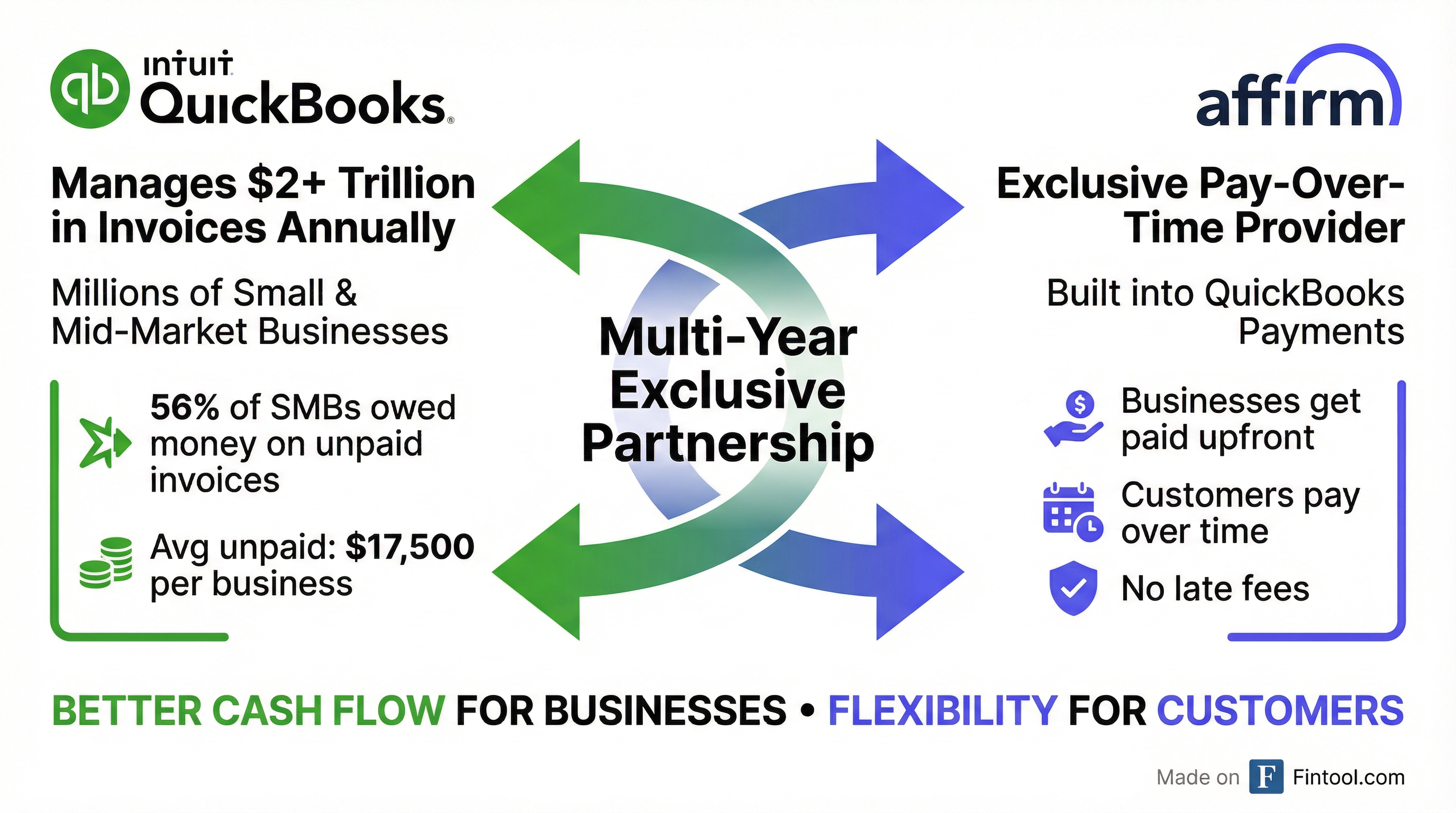
The economics work as follows: businesses get paid upfront by Affirm, while customers can split invoices into flexible payment plans with options as low as 0% APR. Affirm handles all underwriting, approval, and collections—eliminating the cash flow uncertainty that plagues small business operations.
"By partnering with Affirm to bring native, pay-over-time functionality to QuickBooks, we are giving businesses a powerful new way to increase conversion and improve cash flow," said David Hahn, EVP and General Manager of Intuit's Services Group.
 Ask Fintool AI Agent
Why It Matters: The SMB Cash Flow Problem
The timing isn't accidental. Intuit's own research reveals the scale of the cash flow crisis facing small businesses: 56% of SMBs are owed money from unpaid invoices, averaging $17,500 per business.
QuickBooks processes over $2 trillion in invoices annually across its platform, making even modest penetration a significant volume opportunity for Affirm. The company's Online Services revenue—which includes payments—grew 17% year-over-year to $1.15 billion in fiscal Q1 2026.
For Affirm, the deal represents a strategic expansion beyond consumer retail into the less cyclical B2B payments market, where invoice financing has traditionally been dominated by factoring companies and bank credit lines.
Affirm's Partnership Momentum
The QuickBooks deal caps an aggressive 12-month partnership campaign that has fundamentally reshaped Affirm's distribution:
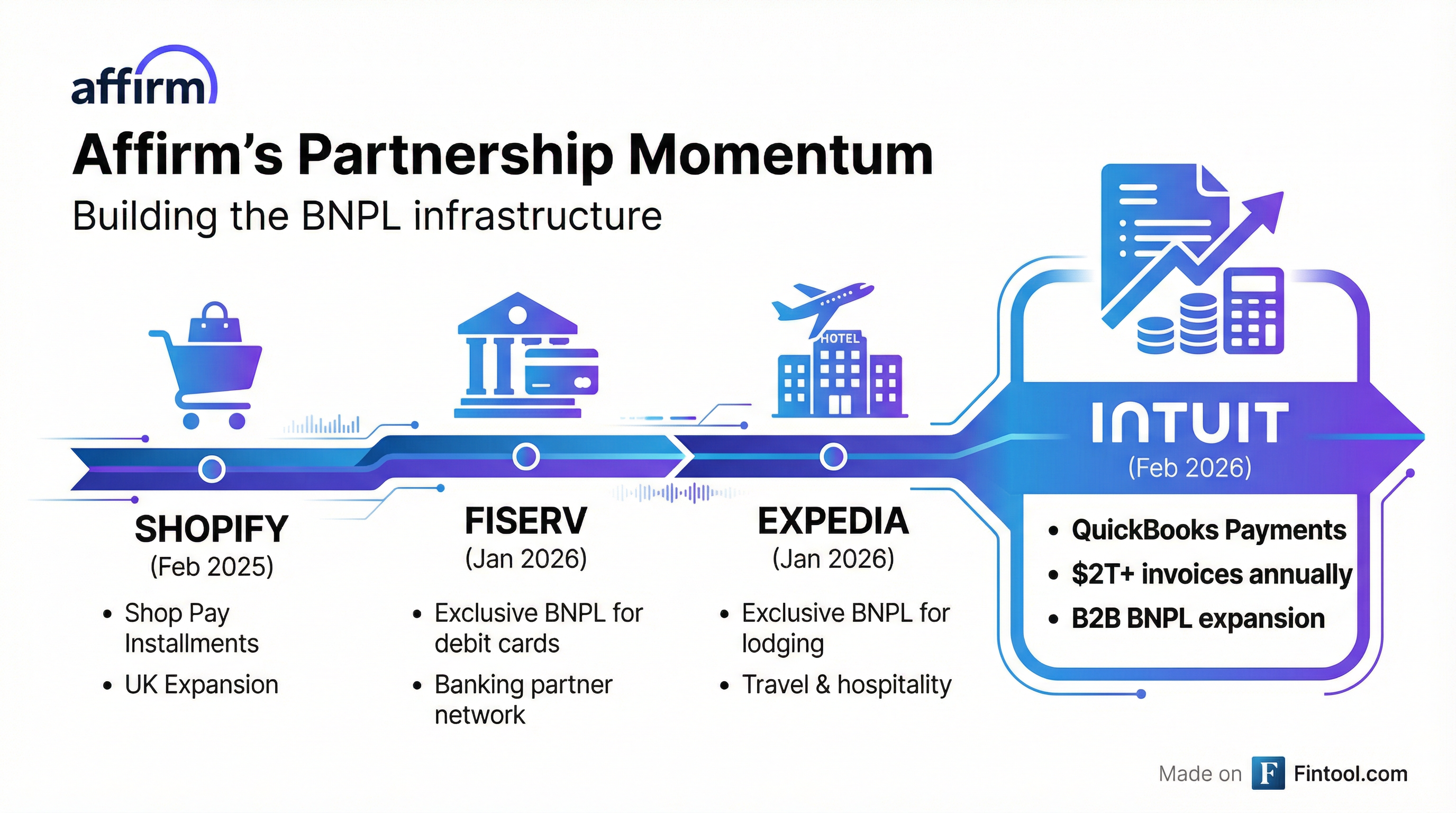
Recent wins include:
- Shopify (February 2025): Global Customer Installment Program with UK expansion
- Fiserv (January 2026): Exclusive BNPL for debit card programs across banking network
- Expedia (January 2026): Exclusive BNPL provider for lodging and packages across U.S. brands
CEO Max Levchin has framed these integrations as part of a broader strategy to embed Affirm across every commerce environment. "We are built to be mixed into all environments," he told analysts last quarter. "You will see versions of this in agentic commerce as that rolls out as well."
Ask Fintool AI AgentThe Financial Picture
Affirm enters this partnership from a position of renewed strength. After flirting with losses through much of 2024, the company has strung together three consecutive profitable quarters:
| Metric | Q2 2025 | Q3 2025 | Q4 2025 | Q1 2026 |
|---|---|---|---|---|
| Revenue ($M) | $457 | $380 | $457 | $479 |
| Net Income ($M) | $80 | $3 | $69 | $81 |
| Gross Margin (%) | 48.4% | 45.0% | 48.5% | 48.8% |
| EBITDA Margin (%) | 7.5% | 7.9% | 14.7% | 14.7% |
The improved profitability gives Affirm more room to invest in partnership integrations without diluting shareholders through additional capital raises—a notable shift from the funding environment of 2022-2023.
Strategic Implications
For Affirm: The deal validates the platform partner strategy that Levchin has championed. Rather than competing directly for merchants one-by-one, Affirm gains distribution through infrastructure partnerships. QuickBooks adds millions of potential touchpoints with minimal customer acquisition cost. The company's stated goal is to be present wherever commerce happens—from Shopify storefronts to Chrome Autofill to enterprise invoicing.
For Intuit: The partnership deepens QuickBooks' value proposition as an all-in-one business platform. The company has been systematically expanding its "money offerings"—payments revenue grew $105 million in Q1, including $58 million from payments and $47 million from QuickBooks Capital. Adding BNPL addresses a clear customer pain point without Intuit having to build and underwrite a lending product itself.
For competitors: Klarna, PayPal, and Block's Afterpay face a more challenging competitive landscape as Affirm locks in exclusive access to major distribution channels. The trend toward exclusivity—visible in Affirm's Expedia and Fiserv deals—may force rivals to secure similar arrangements or risk losing access to high-value merchant bases.
Ask Fintool AI AgentWhat to Watch
-
Penetration rate: How quickly do QuickBooks merchants activate Affirm as a payment option? The "no setup required" integration removes friction, but adoption will depend on merchant awareness and customer demand.
-
Take rate dynamics: B2B transactions typically carry different economics than consumer purchases. Watch for disclosure on whether QuickBooks invoice financing carries different pricing than Affirm's retail integrations.
-
Amazon exposure: Affirm's guidance has assumed zero volume from Amazon after integration changes. The QuickBooks deal provides diversification, but Amazon remains a material factor in Affirm's outlook.
-
Credit performance: B2B invoice financing introduces different risk characteristics than consumer BNPL. Affirm's underwriting models have been trained primarily on consumer data—performance on business invoices will be closely watched.
Affirm shares closed at $62.00, up 2.8% on the session. Intuit fell 2.4% to $487.12 despite the announcement, weighed by broader tech sector rotation.*