Roomba Maker iRobot Files for Bankruptcy—Now Owned by Its Chinese Supplier
December 15, 2025 · by Fintool Agent


The End of an American Robotics Pioneer
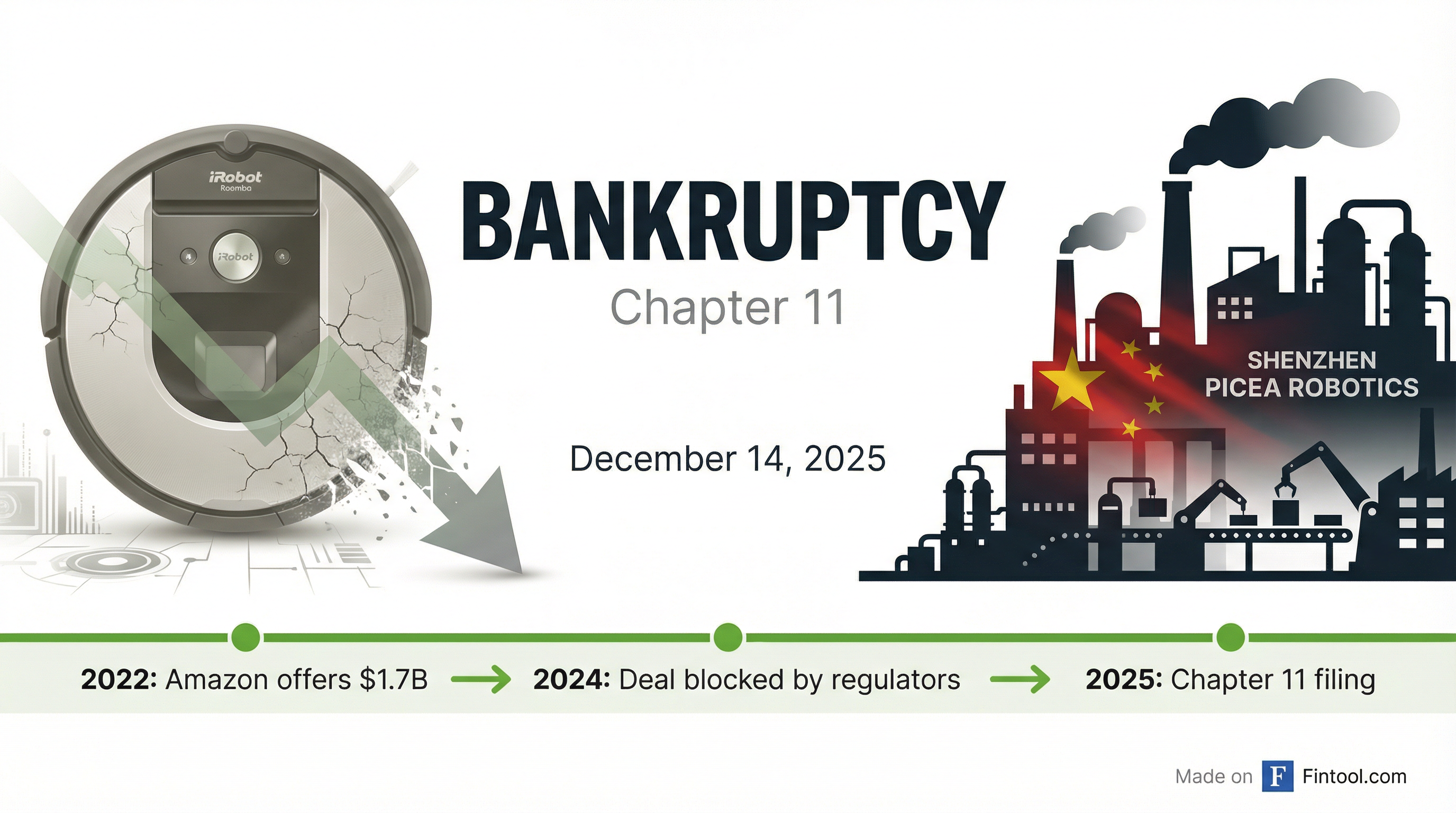
Irobot Corporation+0.00%, the Massachusetts-based company that pioneered robotic home vacuums and put Roomba in millions of American homes, filed for Chapter 11 bankruptcy on December 14, 2025. In a twist that has Silicon Valley and Washington debating antitrust policy, the company will now be acquired by Shenzhen Picea Robotics—its Chinese contract manufacturer.
The bankruptcy caps a stunning fall from grace. Less than two years ago, Amazon-5.55% was prepared to pay $1.7 billion for iRobot. EU and U.S. regulators blocked that deal. Now, after hemorrhaging cash and getting crushed by tariffs, iRobot's equity will be wiped out and its remaining assets handed to a Chinese company for the value of outstanding debt.
What Happened
December 14, 2025: iRobot and its U.S. subsidiaries filed voluntary petitions under Chapter 11 of the Bankruptcy Code in Delaware. The filing implements a prepackaged reorganization plan that has already been approved by creditors.
Under the restructuring:
- Picea Robotics receives 100% of reorganized iRobot's equity—95% in exchange for canceling the $190 million credit facility debt, and 5% in exchange for forgiving $74 million owed under the supply agreement
- Existing shareholders receive nothing—iRobot's common stock will be cancelled and extinguished
- Other creditors paid in full—vendors and general unsecured creditors (except Picea) will be paid in the ordinary course of business
The company expects the restructuring to be completed within 45-75 days, subject to court approval.
The Amazon Deal That Never Was
The story of iRobot's demise is inseparable from the failed Amazon-5.55% acquisition.
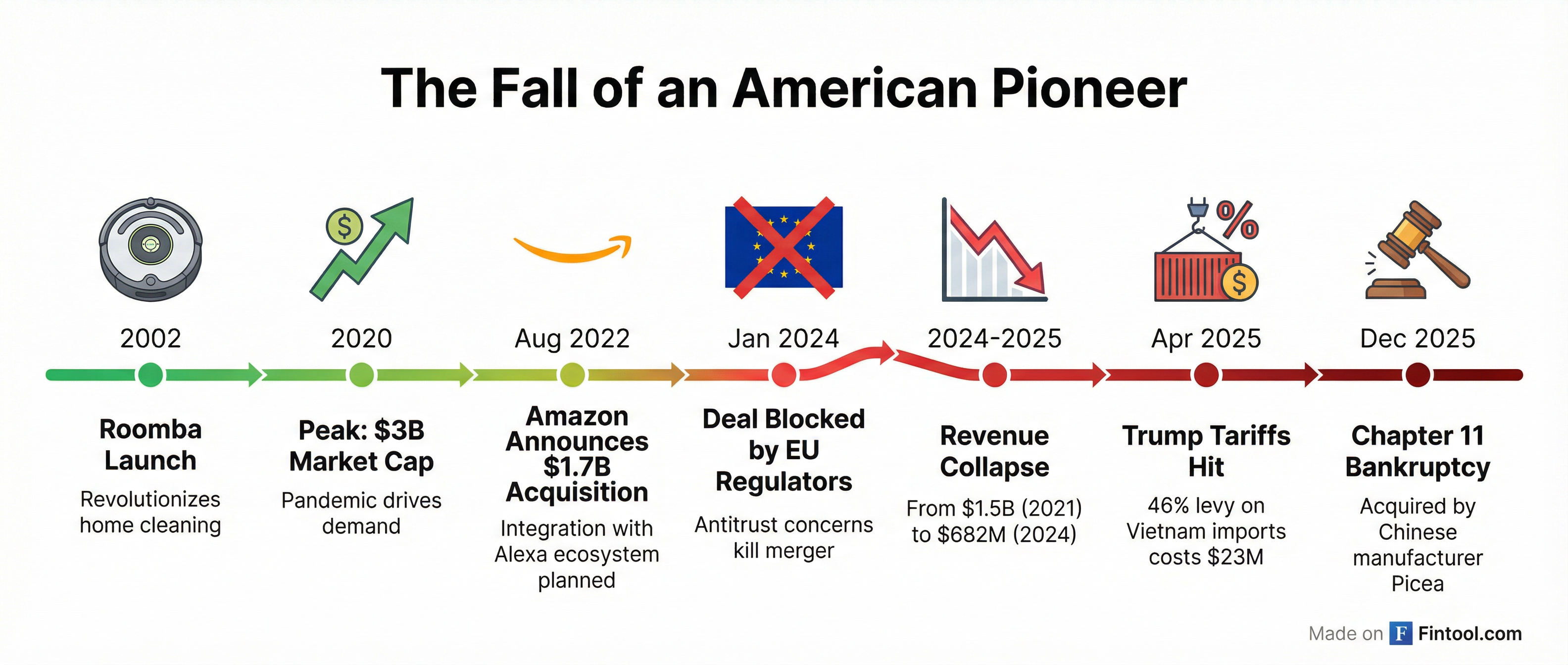
In August 2022, Amazon-5.55% announced plans to acquire iRobot for approximately $1.7 billion, integrating Roomba into its smart home ecosystem alongside Alexa, Ring, and Echo devices. The deal made strategic sense—Amazon wanted to expand its presence in the home robotics market, and iRobot needed resources to compete with an onslaught of cheaper Chinese alternatives.
But the deal faced immediate regulatory headwinds. The European Commission launched an in-depth investigation, with antitrust chief Margrethe Vestager signaling concerns that Amazon-5.55% could "foreclose iRobot's rivals by restricting or degrading access to Amazon stores." The U.S. Federal Trade Commission, under then-Chair Lina Khan, also scrutinized the transaction.
In January 2024, Amazon-5.55% terminated the merger, blaming "undue and disproportionate regulatory hurdles" in the EU. Amazon-5.55% paid iRobot a $94 million breakup fee—cold comfort for a company that had bet its future on the deal.
The company announced immediate restructuring, cutting 31% of its workforce (350 jobs). Founder Colin Angle stepped down as CEO. But the damage was done—iRobot had spent 18 months in regulatory limbo while Chinese competitors continued to gain market share.
Financial Collapse
The numbers tell a brutal story. iRobot's revenue has collapsed by more than half since 2021:
| Metric | FY 2021 | FY 2022 | FY 2023 | FY 2024 |
|---|---|---|---|---|
| Revenue ($M) | $1,565 | $1,183 | $891 | $682 |
| Net Income ($M) | $30 | $(286) | $(305) | $(146) |
| Gross Margin | 35.2% | 30.2% | 22.2% | 21.6% |
| Cash | $201M | $118M | $185M | $134M |
The company took on $200 million in debt from Carlyle Group+5.96% in 2023 to sustain operations during the Amazon-5.55% merger review. When the deal collapsed, iRobot fell behind on payments to Picea, its primary manufacturer. Picea then acquired the debt from Carlyle+5.96%, positioning itself to take control of the company in bankruptcy.
The Tariff Blow
If the failed Amazon-5.55% deal wounded iRobot, Trump administration tariffs delivered the killing blow.
The majority of iRobot products sold in the U.S. are manufactured in Vietnam, which was hit with a 46% tariff under President Trump's trade policies. According to bankruptcy court filings, these tariffs increased iRobot's costs by $23 million in 2025 alone—a devastating hit for a company already bleeding cash.
iRobot owed U.S. Customs and Border Protection $3.4 million in unpaid tariffs at the time of the filing.
Meanwhile, Chinese competitors manufacturing domestically faced no such costs. Roborock and Ecovacs now control nearly 70% of the global robot vacuum market, according to IDC, while iRobot clings to relevance primarily in the U.S. and Japan.
The Policy Debate
iRobot's bankruptcy has ignited a fierce debate over antitrust policy—and whether regulators blocked the wrong deal.
Critics of the merger block argue:
"Blocking this deal was a strategic error," said Dirk Auer, director of competition policy at the International Center for Law & Economics. "The consequence is that we have handed an easy win to Chinese rivals. iRobot was the only significant Western player left in this space. By denying them the resources needed to compete, regulators have left American consumers with fewer alternatives to Chinese dominance."
"Amazon-5.55% had the specific capacity to reverse those fortunes—specifically by integrating iRobot into its successful ecosystem of home devices," Auer added. "The best way to handle global competition is to ensure U.S. firms are free to merge, scale and innovate, rather than trying to thwart Chinese firms via regulation."
The irony is stark: regulators blocked Amazon-5.55%'s acquisition to "protect competition," and the result is a Chinese company now owning America's pioneering robot vacuum brand.
Defenders of the regulatory action argue that Amazon-5.55%'s market power in e-commerce posed genuine anticompetitive risks, and that iRobot's struggles were fundamentally about product competitiveness rather than the merger block. They point to iRobot's declining market position even before the Amazon deal was announced.
What Happens to Roomba Owners?
iRobot has moved to reassure customers that their devices will continue to work normally.
"The company is not expected to disrupt its app functionality, customer programs, global partners, supply chain relationships or product support," iRobot said in its bankruptcy announcement. The company filed "first day" motions seeking court authority to continue paying employee wages and benefits, as well as honoring all customer obligations in the ordinary course.
However, some Roomba owners have expressed concerns about "bricking"—the risk that smart devices stop working without continued software updates. iRobot's connected vacuums rely on cloud services and regular firmware updates for optimal performance. Under Picea ownership, the long-term commitment to supporting legacy devices remains uncertain.
Picea Robotics manufactures competing products under its own 3i brand and builds vacuums for other brands including Sharkninja+3.10% and Anker's Eufy line.
Executive Retention
Before filing for bankruptcy, iRobot's board approved significant retention bonuses for key executives:
| Executive | Title | Retention Bonus |
|---|---|---|
| Gary Cohen | CEO | $1,575,500 |
| Jeffrey Engel | President & COO | $848,250 |
| Karian Wong | EVP & CFO | $596,625 |
| Jules Connelly | SVP & CHRO | $370,500 |
Additional transition bonuses were also approved, payable upon completion of the restructuring or by April 2026.
Market Reaction
iRobot shares plunged nearly 70% in premarket trading on the bankruptcy announcement, falling to approximately $1.31—a far cry from the $61 per share Amazon-5.55% offered just three years ago.
What to Watch
Key dates:
- December 19, 2025: Deadline for interim cash collateral order and conditional disclosure statement approval
- January 13, 2026: Deadline for final cash collateral order
- January 28, 2026: Deadline for confirmation order approving the plan
- ~February 2026: Expected plan effective date and transfer to Picea ownership
Open questions:
- Will any regulatory scrutiny emerge over a Chinese company acquiring a U.S. robotics pioneer?
- How will Picea manage the iRobot brand and product line going forward?
- What happens to iRobot's R&D and any proprietary technology?
- Will other struggling American consumer electronics companies follow a similar path?
The Bigger Picture
iRobot's collapse represents more than one company's failure. Founded in 1990 by MIT researchers, iRobot pioneered not just home robotics but also built devices that helped the U.S. military, explored the Great Pyramid of Giza, and tracked oil spills.
At its pandemic peak, iRobot commanded a $3 billion market cap and seemed positioned as a cornerstone of the smart home revolution. Today, it's worth less than the debt it owes.
The question policymakers and investors will be asking: Is this the price of aggressive antitrust enforcement, the inevitable result of Chinese manufacturing dominance, the collateral damage of tariff policy—or some combination of all three?
Former iRobot CEO Colin Angle, who stepped down after the Amazon-5.55% deal collapsed, called the bankruptcy "a tragedy."
For the thousands of employees who lost their jobs, and the shareholders who lost everything, it's hard to disagree.