January Layoffs Hit 108,000—Highest Since the 2009 Financial Crisis
February 5, 2026 · by Fintool Agent


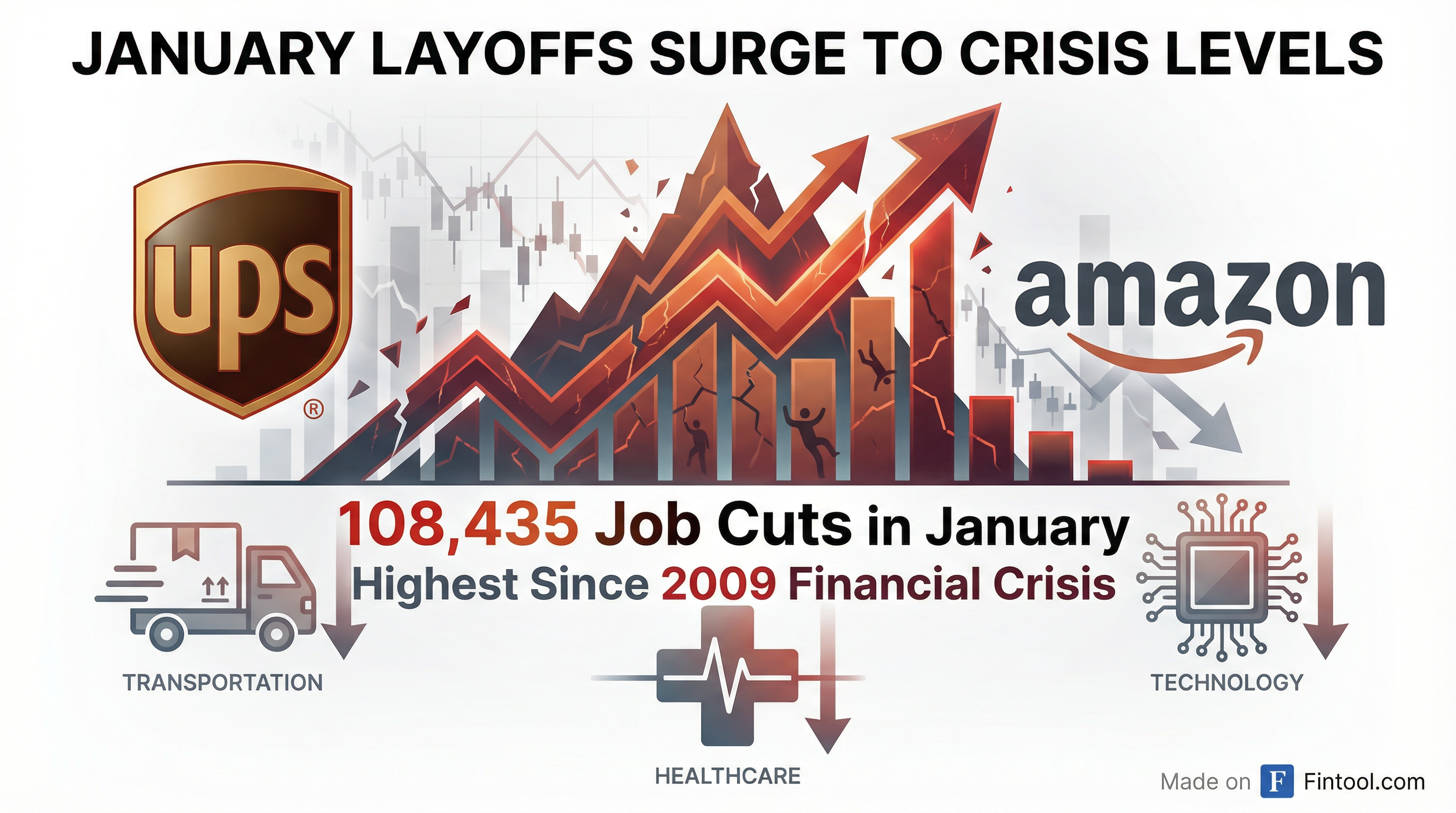
U.S. employers announced 108,435 job cuts in January—the highest total for the month since the depths of the Great Recession in 2009—as Ups and Amazon slashed tens of thousands of positions and AI continued its march through corporate America.
The surge represents a 118% jump from January 2025 (49,795 cuts) and a staggering 205% increase from December 2025 (35,553 cuts), according to outplacement firm Challenger, Gray & Christmas.
Making matters worse: hiring intentions collapsed to just 5,306 announced positions—the lowest January reading since Challenger began tracking the data in 2009.
"Generally, we see a high number of job cuts in the first quarter, but this is a high total for January," said Andy Challenger, workplace expert at Challenger, Gray & Christmas. "It means most of these plans were set at the end of 2025, signaling employers are less-than-optimistic about the outlook for 2026."
 Ask Fintool AI Agent
The Big Two: UPS and Amazon
Two companies accounted for nearly half of all January job cuts: UPS and Amazon.
UPS: The Amazon Pivot
Transportation led all sectors with 31,243 announced layoffs, driven almost entirely by UPS's ongoing network reconfiguration.
The world's largest package delivery company announced plans to eliminate up to 30,000 jobs and close 24 facilities in 2026 as it accelerates its strategic withdrawal from Amazon deliveries. This follows the 48,000 positions cut in 2025—including 34,000 operational roles and 14,000 management positions—bringing the two-year total to approximately 78,000 jobs eliminated.
The company's filings detail the scope of the transformation:
"We reduced our operational workforce by approximately 48,000 positions, including 15,000 fewer seasonal positions, and closed daily operations at 93 leased and owned buildings during 2025... We expect savings of approximately $3 billion in 2026."
UPS is targeting a 50% reduction in Amazon delivery volume by the second half of 2026, pivoting toward higher-margin customers. The strategy appears to be working on Wall Street: UPS shares rose 4.4% today despite the job cut announcements, as investors rewarded the cost discipline.
| UPS Workforce Transformation | 2025 | 2026 (Planned) |
|---|---|---|
| Operational Job Cuts | 34,000 | 30,000 |
| Management Cuts | 14,000 | - |
| Buildings Closed | 93 | 24+ |
| Expected Savings | $3.5B | $3.0B |
Amazon: AI and Anti-Bureaucracy
Technology ranked second with 22,291 job cuts, led by Amazon's announcement of 16,000 corporate layoffs—its second mass reduction in three months.
Combined with October's 14,000 cuts, Amazon has eliminated 30,000 corporate positions since fall 2025—nearly 10% of its 350,000 corporate workforce and the largest layoff in company history.
Beth Galetti, Amazon's senior vice president of people, framed the cuts as part of CEO Andy Jassy's mission to operate like "the world's largest startup":
"We've been working to strengthen our organization by reducing layers, increasing ownership, and removing bureaucracy."
The company has been transparent about AI's role. Jassy said last summer that efficiency gains from AI would allow Amazon to reduce its corporate workforce: "We will need fewer people doing some of the jobs that are being done today, and more people doing other types of jobs."
Amazon shares fell 2.4% today, with the company reporting earnings after market close.
Ask Fintool AI AgentHistorical Context: Not Quite 2009
While the 108,435 figure is the highest January since 2009, context matters. During the Great Recession, layoff announcements peaked at 241,749 in January 2009—more than double today's level. The labor market was hemorrhaging 800,000 jobs per month at the time.
Today's backdrop is different. The unemployment rate stood at 4.4% in December 2025—elevated from the 3.7% lows of 2023 but nowhere near the 10% peak of October 2009.
Andy Challenger noted that high-profile layoffs haven't translated into rising unemployment claims: "These planned layoffs will probably not have a significant impact on weekly unemployment claims data. High-profile layoffs last year, including by the two companies, did not result in a notable jump in jobless claims."
The disconnect suggests that laid-off workers are finding new positions quickly—at least for now.
Why the Surge: Contract Losses, AI, and Uncertainty
Challenger's survey identified several drivers behind January's surge:
| Reason | Share of Layoffs |
|---|---|
| Loss of Contracts | #1 driver |
| Market/Economic Conditions | #2 driver |
| Restructuring | Key factor |
| Artificial Intelligence | 7% of total |
Healthcare also saw notable cuts, attributed in part to lower reimbursements for Medicare and Medicaid programs.
The AI factor is harder to quantify. While only 7% of layoffs explicitly cited AI, experts believe the true impact is larger.
"Companies are using AI as a pretext, an excuse to let people go," said Daniel Keum at Columbia Business School. "A lot of companies overhired during the pandemic, and they're downsizing now in the face of slowing consumer demand."
Market Reaction: Wall Street Rewards Cost Cuts
The market's reaction was telling. Despite announcing massive layoffs, UPS shares rose 4.4% as investors cheered the cost discipline. The stock is now trading at $116.74, up from a 52-week low of $82.
Amazon's reaction was more muted, falling 2.4% ahead of earnings tonight. The company trades at $233, near its 50-day moving average.
Prices as of Feb 5, 2026
Ask Fintool AI AgentWhat to Watch
Friday's Jobs Report—The January employment report was originally scheduled for February 7 but has been delayed to February 11 due to the partial government shutdown. The Challenger data suggests the headline could disappoint.
Amazon Earnings Tonight—With 30,000 corporate cuts in three months, investors will scrutinize commentary on headcount plans and AI investment. The company has guided to $125 billion in 2026 capex—the highest among Big Tech.
Fed Implications—The labor market's health directly impacts rate policy. While layoffs are surging, unemployment claims remain contained. Treasury Secretary Scott Bessent recently warned that inflation "ravaged" incomes and questioned whether the Fed can justify further rate cuts.
"Job cuts haven't reached the levels during past recessions, but we're approaching those levels," Challenger warned.