Micron Commits $24 Billion to Singapore Expansion as AI Memory Crisis Intensifies
January 27, 2026 · by Fintool Agent


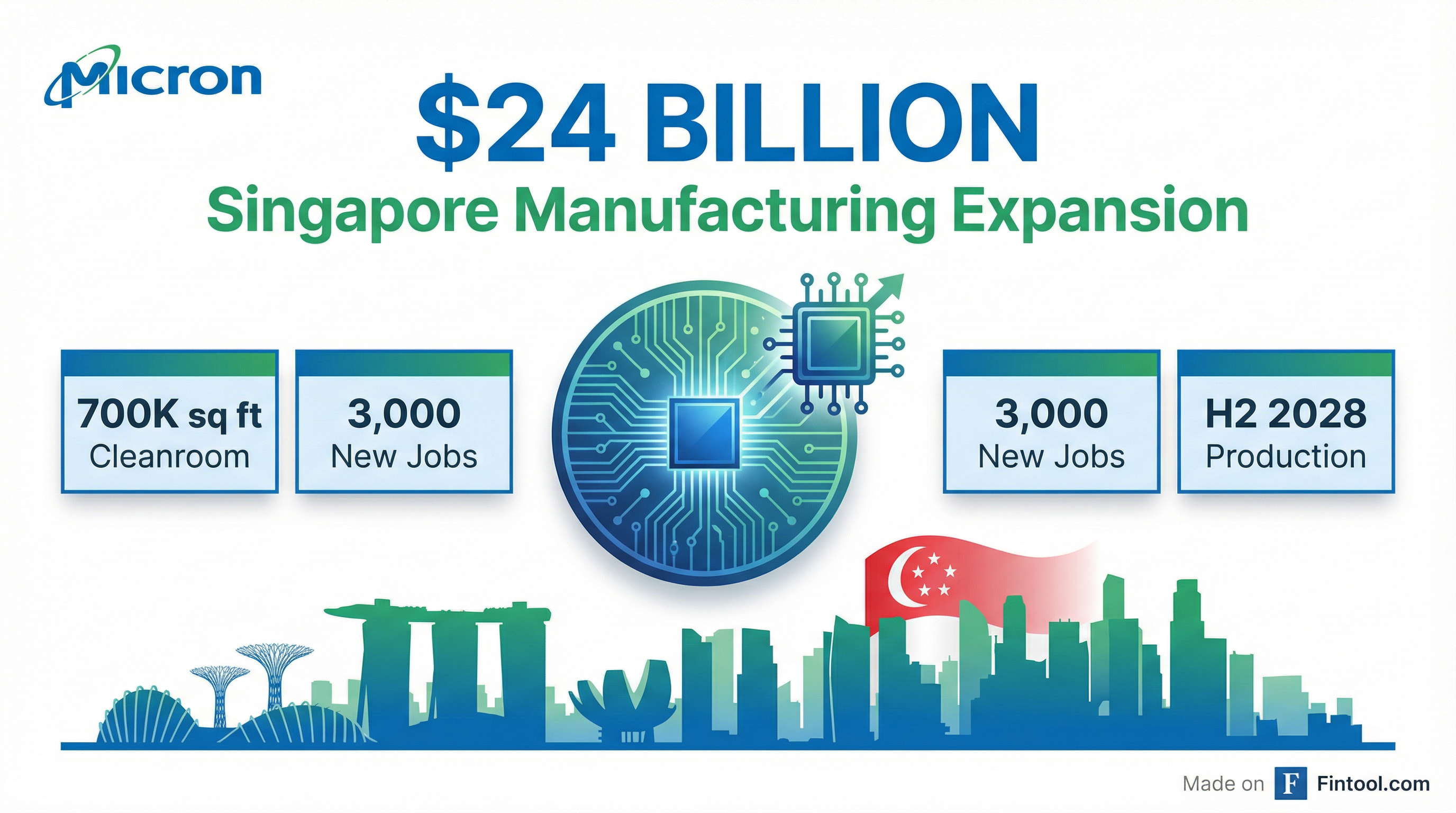
Micron Technology is making the largest single investment in its history, committing $24 billion over 10 years to build a new NAND flash memory factory in Singapore as the semiconductor industry scrambles to address an unprecedented AI-driven shortage that analysts expect to persist through at least late 2027.
The announcement, made at a groundbreaking ceremony attended by Singapore's Deputy Prime Minister Gan Kim Yong, marks a pivotal moment in the global race to expand memory capacity. With data centers now consuming an estimated 70% of global memory production, legacy customers from automotive to consumer electronics are facing supply allocations reminiscent of the COVID-era chip crunch.
"Micron's leadership in advanced memory and storage is enabling the AI-driven transformation reshaping the global economy," said Manish Bhatia, EVP of Global Operations at Micron. "This investment underscores Micron's long-term commitment to Singapore as an important hub in our global manufacturing network."
 Ask Fintool AI Agent
The Numbers Behind the Bet
The Singapore expansion will add 700,000 square feet of cleanroom space—the equivalent of roughly 12 football fields—making it Singapore's first double-story wafer manufacturing facility. Combined with Micron's previously announced $7 billion HBM advanced packaging facility at the same complex, the company's total Singapore investment now approaches $31 billion.
| Metric | Details |
|---|---|
| Total Investment | $24 billion over 10 years |
| Cleanroom Space | 700,000 sq ft |
| New Jobs | 1,600 (NAND fab) + 1,400 (HBM facility) = 3,000 total |
| Production Start | H2 2028 |
| Technology | Advanced NAND for AI and data-centric applications |
Singapore will produce 98% of Micron's flash memory output once the facility reaches full capacity, cementing the city-state's position as a critical node in the global semiconductor supply chain.
Why Now: The Memory Supercycle
The investment comes as the memory industry experiences what Bank of America calls a "supercycle similar to the boom of the 1990s." The firm forecasts global DRAM revenue to surge 51% and NAND by 45% in 2026, with Micron named as a "Top Pick" among beneficiaries.
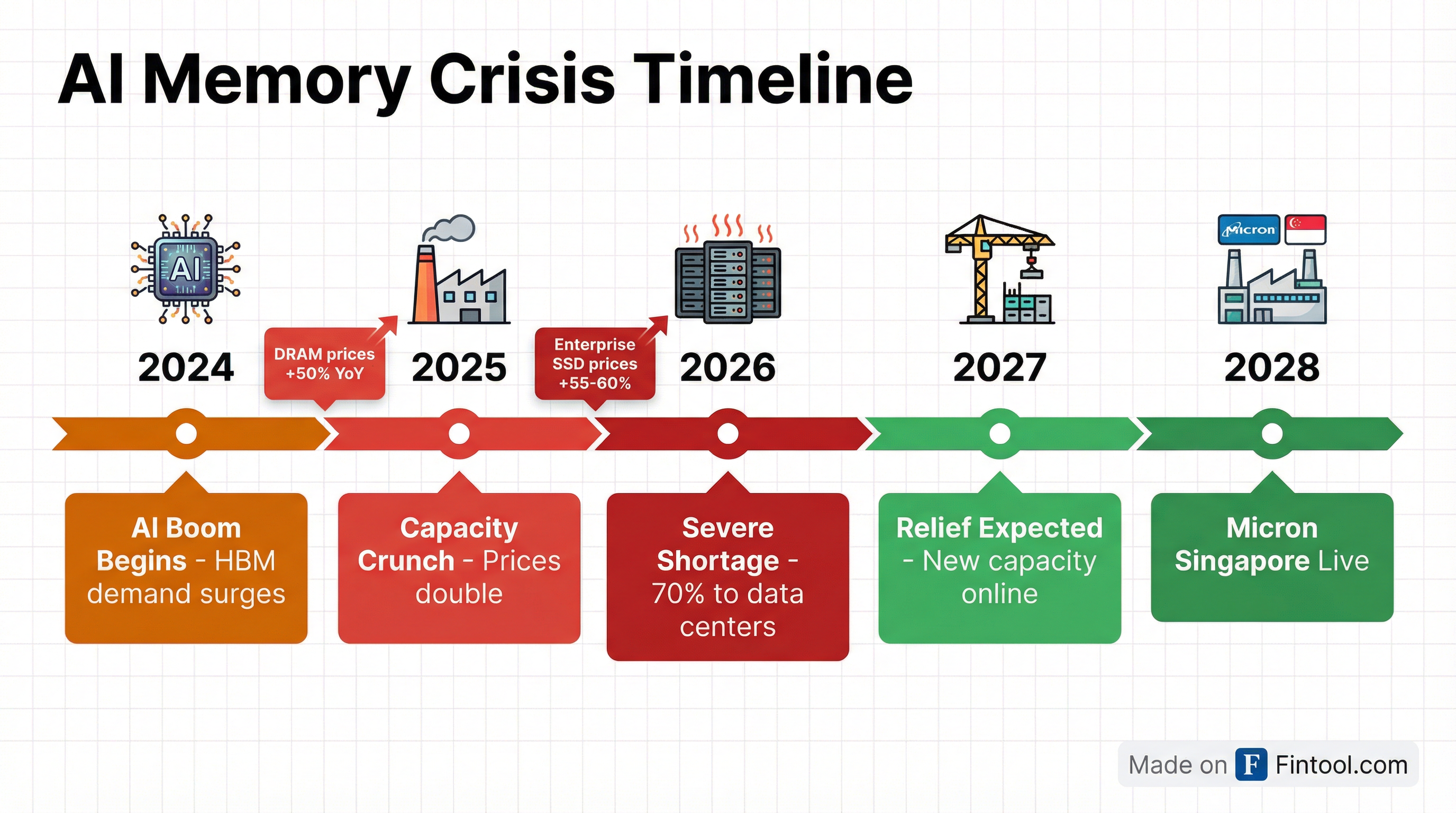
The shortage has become so acute that Silicon Motion's CEO recently described the situation as one "we're facing [that has] never happened before: HDD, DRAM, HBM, NAND... all in severe shortage in 2026."
The core problem is structural: every wafer allocated to produce high-bandwidth memory (HBM) for AI accelerators—which commands far higher margins—is a wafer denied to the LPDDR5X module in a smartphone or the SSD in a consumer laptop. This zero-sum reallocation has created cascading shortages across the technology ecosystem.
Ask Fintool AI AgentMicron's Financial Momentum
The company enters this expansion phase from a position of strength. Micron just reported record Q1 FY2026 results, with revenue hitting $13.6 billion—a 70% year-over-year increase—and net income reaching $5.2 billion. Gross margins expanded to a record 56%, up nearly 20 percentage points from a year ago.
| Metric | Q2 2025 | Q3 2025 | Q4 2025 | Q1 2026 |
|---|---|---|---|---|
| Revenue ($B) | $8.05 | $9.30 | $11.32 | $13.64 |
| Net Income ($B) | $1.58 | $1.89 | $3.20 | $5.24 |
| Gross Margin % | 36.8% | 37.7% | 44.7% | 56.0% |
| Operating Cash Flow ($B) | $3.94 | $4.61 | $5.73 | $8.41 |
*Values retrieved from S&P Global.
Management has been emphatic about the demand-supply imbalance. On the Q1 earnings call, Chief Business Officer Sumit Sadana stated: "The aggregate demand for both DRAM and NAND is substantially higher than the ability to supply to it, not just from a Micron perspective, but even at an aggregate industry level. All segments are short in terms of what they need from us versus what we are able to supply."
Competitive Positioning
Micron's move parallels aggressive capacity expansion by its Korean rivals. SK Hynix announced a $13 billion new plant earlier this month, while Samsung is building a new production line at its Pyeongtaek facility—though mass production won't begin until 2028.
| Company | Market Share (Q3 2025) | Recent Capacity Investment |
|---|---|---|
| Samsung | 40% DRAM, 33% NAND | New Pyeongtaek line (2028) |
| SK Hynix | 30% DRAM, 20% NAND | $13B new plant announced |
| Micron | 25% DRAM, 13% NAND | $24B Singapore expansion |
The industry dynamics favor memory producers with aggressive expansion plans. TrendForce expects enterprise SSD contract prices to rise 55-60% as demand outpaces supply, while IDC forecasts DRAM and NAND supply growth will remain below historical norms at just 16% and 17% year-over-year, respectively.
Ask Fintool AI AgentMarket Reaction and Outlook
Micron shares rose 1.4% on Tuesday to close at $410.24, extending the stock's remarkable run. The company's market capitalization now exceeds $450 billion, reflecting investor confidence in the memory supercycle thesis.
Analysts project continued growth, with consensus revenue estimates of $18.8 billion for Q2 FY2026 and over $22 billion by Q4 FY2026. Consensus EPS estimates climb from $8.25 in Q2 to over $10 by year-end.*
*Values retrieved from S&P Global.
However, the investment timeline highlights a key risk: the new Singapore capacity won't come online until H2 2028—well after the current shortage is expected to ease. This suggests Micron is betting on sustained structural demand growth rather than a short-term cyclical spike.
What to Watch
Near-term catalysts:
- Q2 FY2026 earnings (expected March 2026) for updated HBM demand signals
- Progress on Micron's potential $1.8 billion Powerchip fab acquisition in Taiwan
- Samsung and SK Hynix capacity expansion timelines
Key risks:
- Potential memory price correction after 2026 as new capacity comes online
- Geopolitical tensions affecting semiconductor supply chains
- HBM margin compression as competition intensifies
For Singapore, the investment reinforces its strategic importance in the global chip ecosystem. As Economic Development Board Managing Director Jermaine Loy noted: "Micron's latest expansion will strengthen our semiconductor ecosystem and further anchor Singapore as a critical node in the global semiconductor supply chain."
Related: