Former TSMC Chairman Bets $7.8 Million on Micron at All-Time Highs
January 16, 2026 · by Fintool Agent


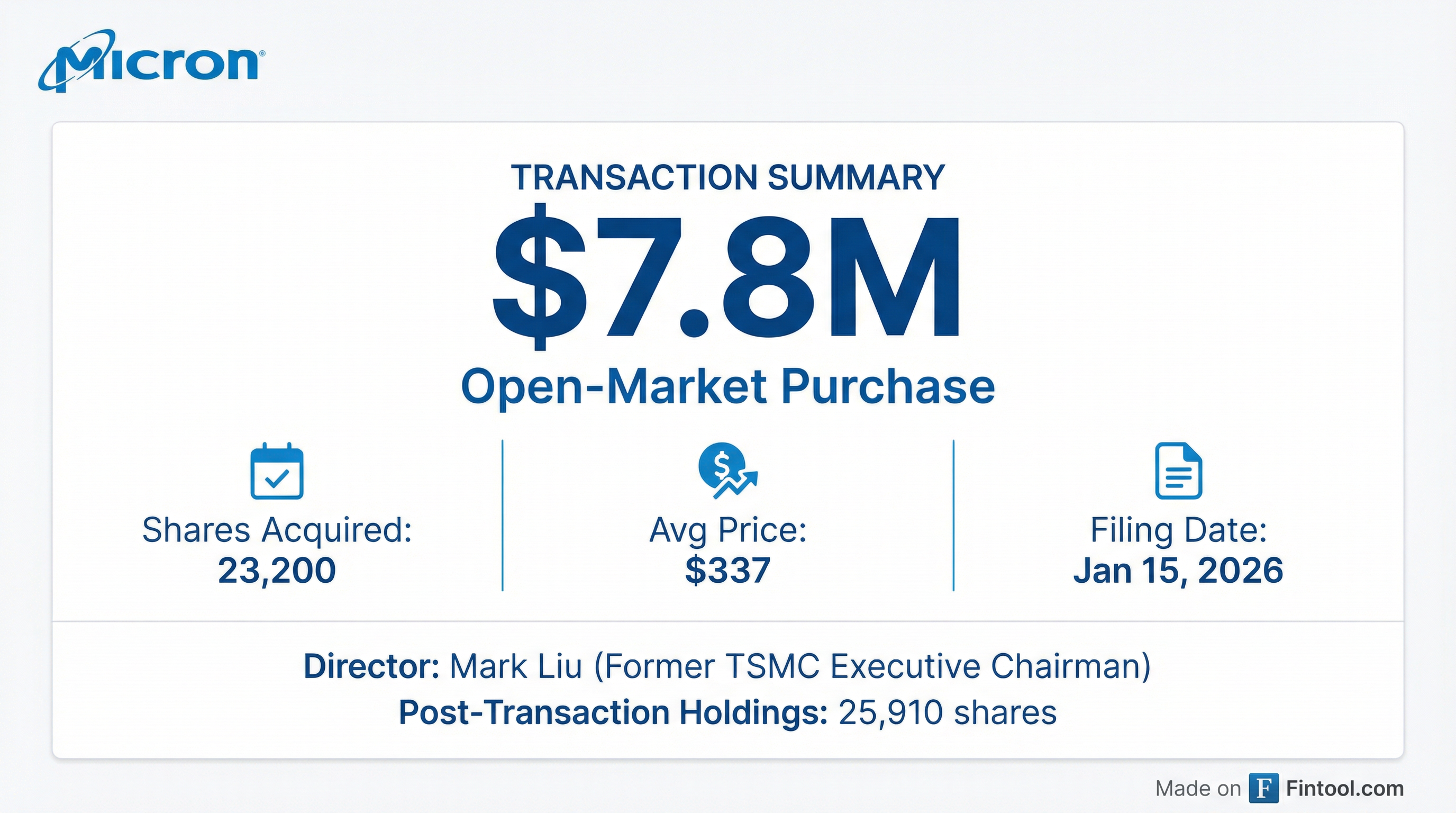
Mark Liu knows semiconductor supply chains better than almost anyone alive. The former Taiwan Semiconductor Manufacturing Company (TSMC) executive chairman just put $7.8 million of his own money into Micron Technology+3.08%—and he did it at record-high prices.
The open-market purchases, disclosed in an SEC Form 4 filing on January 15, mark one of the largest director buys in the semiconductor industry this year. Liu acquired 23,200 shares across three transactions on January 13-14 at prices between $336.63 and $337.50—just below Micron's+3.08% all-time high of $351.23 hit on January 13.
This isn't a director buying the dip. This is a semiconductor legend buying at the top and signaling he expects the stock to go higher.
Why Mark Liu's Conviction Matters
Liu spent over three decades at TSMC, the world's largest contract chipmaker and the manufacturer of virtually every advanced AI chip—including Nvidia's+7.87% GPUs that require Micron's high-bandwidth memory (HBM).
During his tenure as TSMC executive chairman (2018-2024) and president/co-CEO (2013-2018), Liu oversaw the company's rise to a $1 trillion market cap and its expansion into the most advanced semiconductor manufacturing processes in the world. He understands the intricate relationship between logic chips and memory better than most—and he's seeing something in Micron that convinced him to write an eight-figure check.
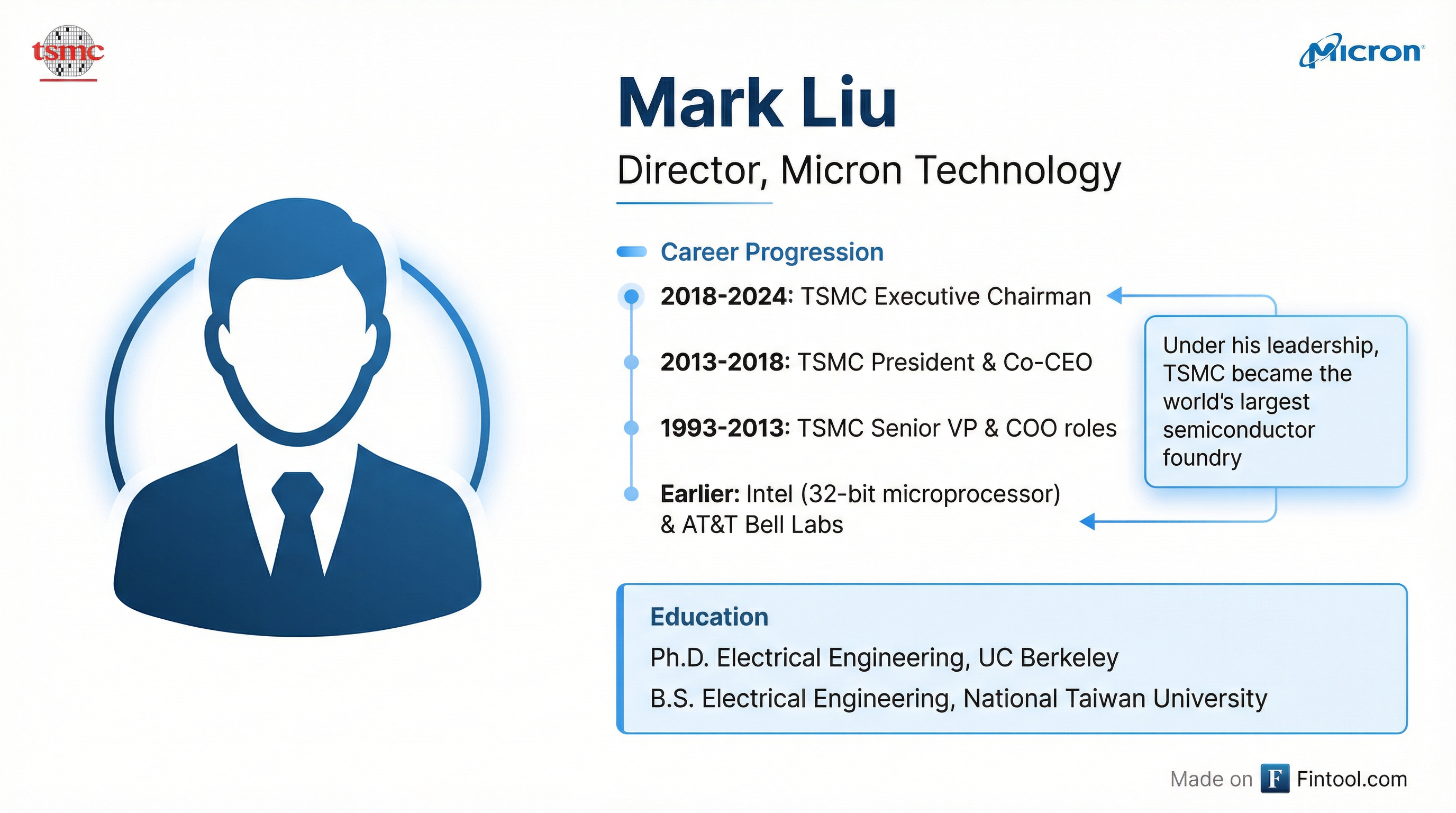
Liu joined Micron's board in March 2025 alongside Christie Simons, a former Deloitte senior partner who led the firm's Global Semiconductor Center of Excellence. CEO Sanjay Mehrotra praised Liu's "deep technical expertise and business acumen," noting his experience would "help guide Micron as we scale our business to address the growing opportunities unleashed by AI."
 Ask Fintool AI Agent
The HBM Supercycle Is Real
Liu's purchase comes at a pivotal moment for Micron. The company's Q1 FY2026 earnings—reported December 17—demolished expectations with record revenue of $13.6 billion, up 57% year-over-year and beating consensus by $761 million.
The driver: insatiable demand for high-bandwidth memory (HBM), the specialized chips that power AI accelerators from NVIDIA, Amd+8.28%, and Google. Micron's entire 2026 HBM supply is already sold out, with both volume and pricing locked in through customer agreements.
"We are more than sold out," said Sumit Sadana, Micron's Chief Business Officer, on the earnings call. "We have a significant amount of unmet demand in our models."
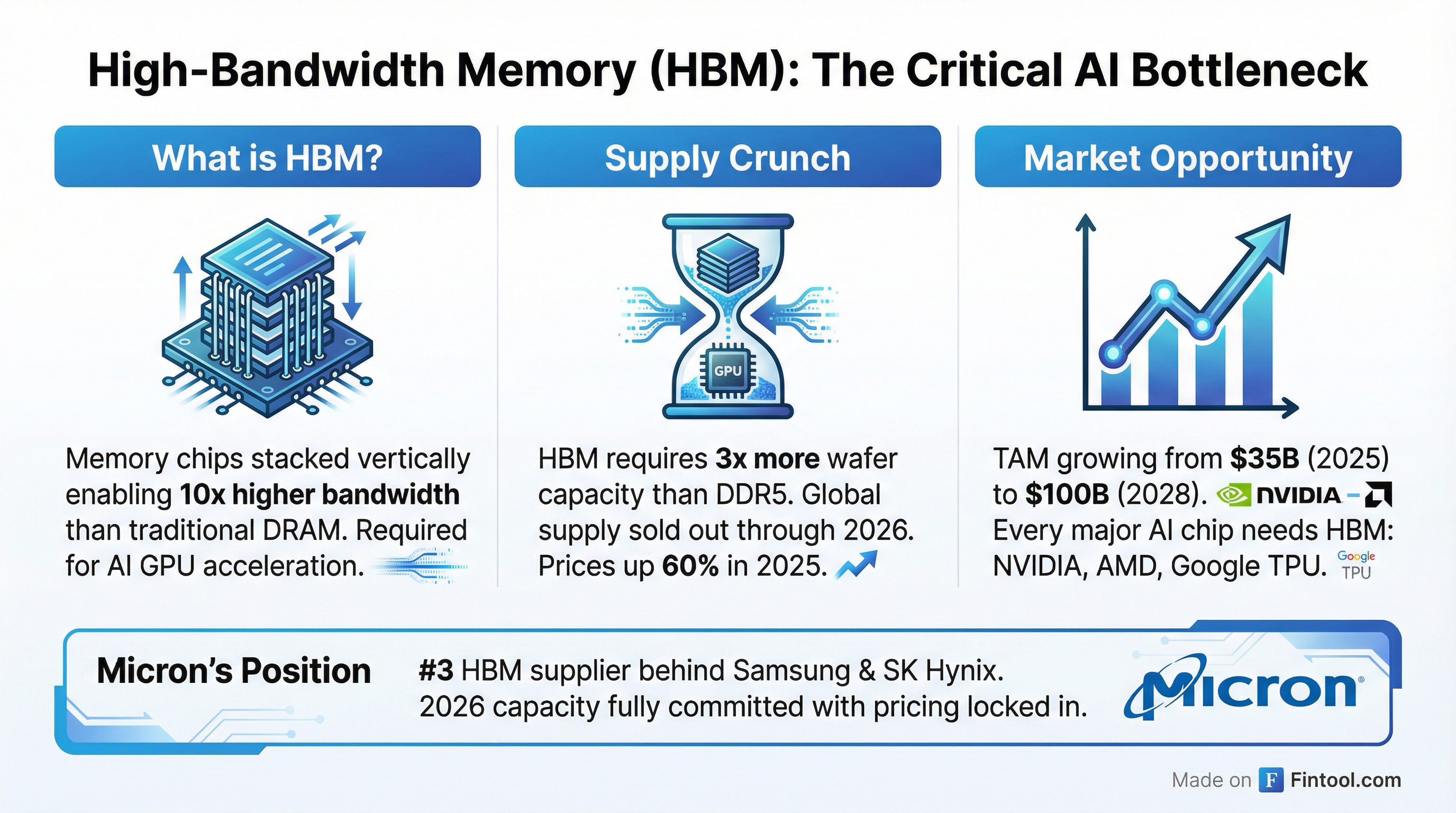
Management painted a picture of supply constraints extending well beyond 2026. The demand from data center customers has stepped up "very significantly and pervasively," creating shortages not just in HBM but across all DRAM and NAND product lines.
| Metric | Q2 2025 | Q3 2025 | Q4 2025 | Q1 2026 |
|---|---|---|---|---|
| Revenue (B) | $8.1 | $9.3 | $11.3 | $13.6 |
| Gross Margin | 36.8% | 37.7% | 44.7% | 56.0% |
| Net Income (B) | $1.6 | $1.9 | $3.2 | $5.2 |
Net income has more than tripled in four quarters. Gross margins expanded from 37% to 56%. This is not a typical memory cycle—it's a structural shift driven by AI infrastructure buildout.
Ask Fintool AI AgentStock Performance and Timing
Liu's purchase timing is notable. Micron+3.08% shares have rallied 18% since year-end, climbing from $285 on December 31 to hit an intraday all-time high of $351.23 on January 13—the same day Liu began buying.
The stock has since pulled back slightly, closing at $336.63 on January 15. But Liu wasn't deterred by the elevated valuation—suggesting he sees significant upside ahead. At 37 analysts covering the stock, the consensus Buy rating and $339 average price target are already being front-run by the market.
Analysts remain bullish. 100% of recent ratings have been target price increases, with high-end estimates implying more than 30% upside from current levels. The consensus revenue forecast for FY2026 calls for roughly 100% year-over-year growth, though that may prove conservative given the supply-demand imbalance.
| Period | Revenue Estimate | EPS Estimate |
|---|---|---|
| Q1 2026 (Actual) | $13.6B (beat $12.9B est.)* | $4.78 (beat $3.96 est.)* |
| Q2 2026 | $18.8B* | $8.06* |
| Q3 2026 | $20.7B* | $9.21* |
| Q4 2026 | $22.3B* | $9.99* |
*Values retrieved from S&P Global
Ask Fintool AI AgentWhat Liu Sees That Others Might Miss
Mark Liu's unique vantage point as former TSMC chairman gives him insight the typical investor lacks. He understands:
1. The HBM-Logic Interplay: Every NVIDIA H100, H200, and Blackwell GPU needs HBM memory. Liu knows exactly how many AI chips TSMC is fabbing—and therefore how much HBM the market needs.
2. Capacity Constraints: Building advanced memory fabs takes years. Liu watched TSMC struggle with capacity constraints firsthand and knows how difficult—and expensive—it is to add semiconductor production.
3. Customer Commitments: The hyperscalers (Amazon, Microsoft, Google, Meta) have locked in multi-year AI infrastructure plans. Liu likely has visibility into these roadmaps.
4. Pricing Power: When supply can't meet demand, prices rise. Micron's HBM pricing is already locked in at elevated levels through 2026, providing revenue visibility the memory industry has rarely enjoyed.
"We believe it's possible based on our ability to deploy bits to premium products in which we're best positioned," CFO Mark Murphy said about margin expansion potential. "We believe that our cost performance is such that it will help us sustain or expand these margins."
What to Watch
February guidance: Micron's Q2 FY2026 guidance calls for approximately $18.8 billion in revenue—implying 38% sequential growth. Any upward revision would validate the demand thesis.
HBM4 ramp: Management expects HBM4 yields to ramp faster than HBM3E, with production beginning in early calendar 2026 and shipments in Q2. Execution here is critical.
Competitive dynamics: Samsung and SK Hynix are also ramping HBM production. Watch for any signs of supply catching up with demand—though management sees the shortage persisting into 2027 or beyond.
Cash generation: Micron generated record free cash flow in Q1 and is now in a net cash position after paying down $2.7 billion in debt. Capital allocation decisions could drive shareholder value.
Related Companies: Micron Technology+3.08% | TSMC+5.48% | Nvidia+7.87% | Amd+8.28% | Samsung Electronics+0.00%