MSCI CEO Henry Fernandez Buys $3.56M in Stock After Sector Selloff—His Largest 2026 Purchase
February 18, 2026 · by Fintool Agent


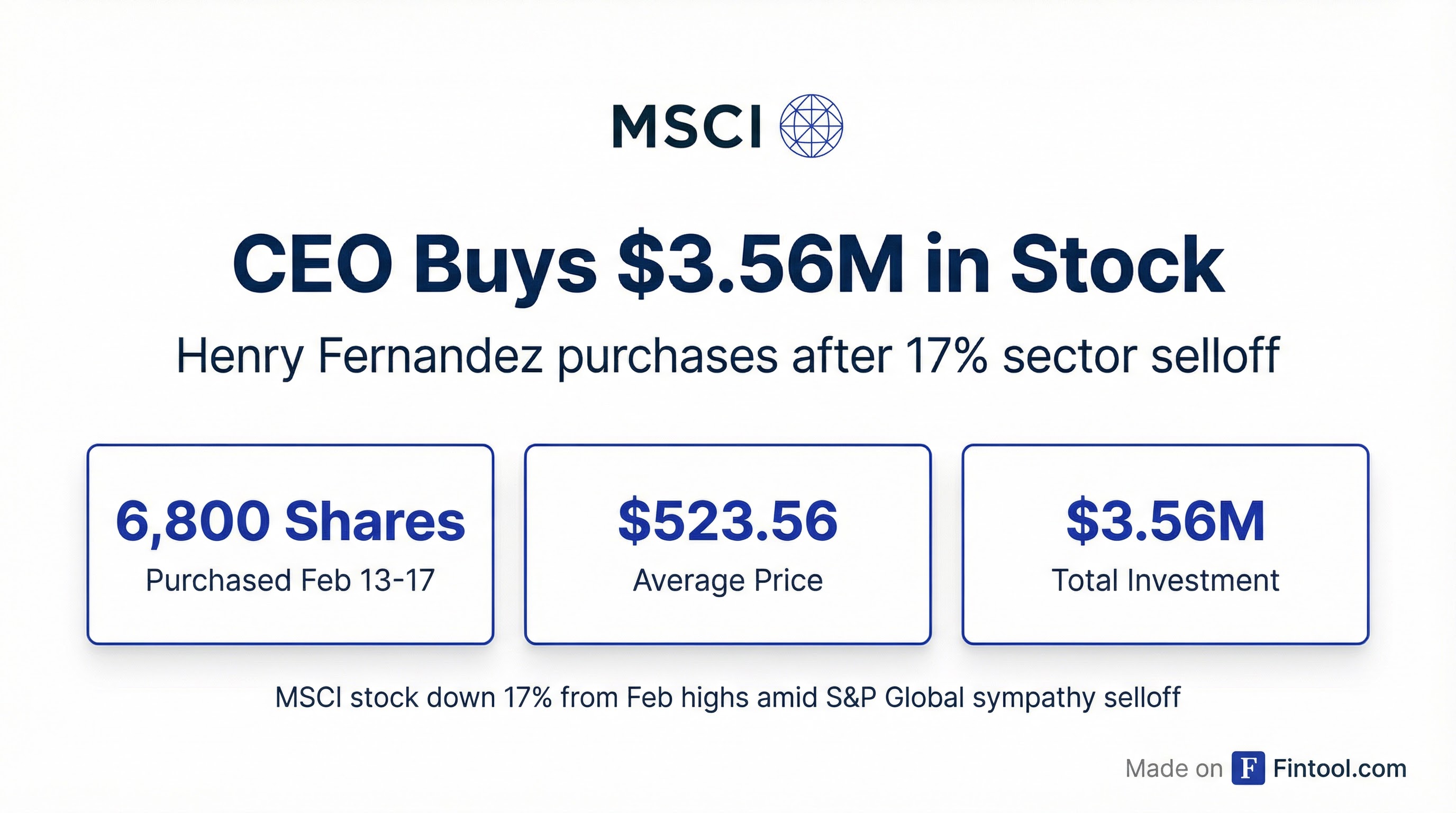
Msci Inc. Chairman and CEO Henry Fernandez just deployed $3.56 million of his personal capital into MSCI stock—his largest purchase in 2026 and at the lowest prices he's bought in over a year. The Form 4 filings, disclosed late Monday, show Fernandez acquired 6,800 shares across four transactions on February 13 and 17.
The market noticed. MSCI shares jumped 4.6% Tuesday to $545.25, their best single-day gain since November.
 Ask Fintool AI Agent
The Purchase Details
Fernandez, who founded MSCI and has led it as CEO for 26 years, made his largest buy on February 13—6,000 shares at an average price of $524.18, totaling $3.15 million. He followed up on February 17 with three smaller purchases totaling 800 shares at roughly $519 each.
| Date | Shares | Price | Value |
|---|---|---|---|
| Feb 13 | 6,000 | $524.18 | $3,145,080 |
| Feb 17 | 240 | $517.32 | $124,157 |
| Feb 17 | 360 | $519.45 | $187,002 |
| Feb 17 | 200 | $520.00 | $104,000 |
| Total | 6,800 | $523.56 avg | $3,560,239 |
Following these transactions, Fernandez directly owns 1,493,847 shares—worth approximately $814 million at today's price—plus an additional 691,090 shares held indirectly through family trusts.
What Triggered the Buying Opportunity
MSCI's stock had cratered 17% in just eight trading days, from $625 on February 2 to $515 on February 10—not because of anything MSCI did wrong, but because peer S&P Global missed 2026 guidance and sparked sector-wide panic.
S&P Global's February 9 earnings call projected 2026 EPS of $19.40-$19.65, missing the $19.96 consensus estimate and triggering an 18% crash in SPGI shares. MSCI, Moody's, and FactSet all got dragged down in the sympathy selling.
| Stock | Feb 2 Price | Feb 10 Price | Decline |
|---|---|---|---|
| SPGI | $527.66 | $401.08 | -24% |
| MSCI | $624.75 | $515.66 | -17% |
| MCO | - | - | -11% |
| FDS | - | - | -7% |
But here's the disconnect: MSCI's fundamentals looked nothing like S&P Global's concerns. MSCI had just reported strong Q4 results on January 28, with index subscription run rate growth accelerating to 9.4% and record ETF inflows of $67 billion for the quarter.
The company also announced it was extending its critical ETF licensing partnership with Blackrock through 2035—a decade-long commitment that secures a substantial portion of MSCI's asset-based fee revenue.
A Pattern of Conviction
This isn't Fernandez buying a token amount for optics. Over the past 12 months, he has accumulated approximately $20 million in MSCI stock through open-market purchases:
| Date | Shares | Approximate Value |
|---|---|---|
| Feb 2025 | 5,300 | $3.0M |
| Jul 2025 | 12,400 | $6.7M |
| Dec 2025 | 12,500 | $6.7M |
| Feb 2026 | 6,800 | $3.6M |
| Total | 37,000 | ~$20M |
What's notable: Fernandez's February 2026 purchases came at the lowest prices in his entire 12-month buying history. His prior purchases averaged $550+; this time he bought at $523. When a founder-CEO with a $814 million stake adds $3.6 million at 52-week lows, it's worth paying attention.
Ask Fintool AI AgentMSCI's Fundamentals: Different Than SPGI
The market may have lumped MSCI in with S&P Global, but the businesses have important differences:
MSCI FY 2025 Results:
| Metric | FY 2025 | FY 2024 | Change |
|---|---|---|---|
| Revenue | $3.13B | $2.86B | +10% |
| EBITDA Margin | 58.2% | 57.7% | +50 bps |
| Diluted EPS | $15.69 | $14.05 | +12% |
| Index Retention | 95.9% | 94.7% | +120 bps |
MSCI's business is structurally different from S&P Global in one critical way: approximately 75% of MSCI's revenue is recurring subscription-based, providing visibility and stability that pure transaction-driven businesses lack.
The company maintained its long-term guidance for low double-digit revenue growth (excluding asset-based fees), high single-digit to low double-digit expense growth, and low to mid-teens EBITDA growth—powered by operating leverage.
Management also announced a $3 billion share repurchase authorization and raised the quarterly dividend to $2.05 from $1.80—a 14% increase—signaling confidence beyond just the CEO's personal buying.
What the Market Might Be Missing
Investors who sold MSCI alongside S&P Global may have overlooked several key differentiators:
1. The BlackRock Partnership: ETFs linked to MSCI indexes captured $204 billion in inflows during 2025—the company's ecosystem is expanding, not contracting. The 2035 extension with BlackRock removes overhang risk from the stock's largest single relationship.
2. Private Capital Expansion: MSCI's private capital solutions segment saw recurring sales jump 86% year-over-year in Q4, driven by the Total Plan offering and transparency data products.
3. AI Upside vs. Downside: While S&P Global faces questions about AI disrupting its data products, MSCI's index licensing business is harder to disrupt—you can't AI your way into being the benchmark for trillions in passive assets.
4. Premium Valuation Justified: At today's price, MSCI trades at roughly 35x forward earnings versus S&P Global's ~22x. But MSCI's higher recurring revenue mix, stronger growth trajectory, and secular tailwinds from passive investing may justify the premium.
Ask Fintool AI AgentWhat to Watch
Q1 2026 Results: MSCI's next earnings (expected late April) will reveal whether the subscription momentum continued and how asset-based fees tracked amid market volatility.
Baer Pettit Transition: President Baer Pettit formally retired March 1, with Alvise Munari and Jorge Mina taking expanded roles. Execution under new leadership will be closely watched.
ETF Flows: MSCI's asset-based fee revenue is driven by AUM in linked products. Continued strong inflows would validate the BlackRock extension's strategic importance.
Valuation Re-Rating: At $545, MSCI is still down 13% from its February 2 peak of $625 and 10% below its 52-week high of $626. If the sympathy selling proves overdone, there's room for multiple expansion.
The Bottom Line
Henry Fernandez has been MSCI's CEO since 1998. He knows this business better than anyone on Wall Street. When he deploys $3.6 million of personal capital at the lowest prices he's paid in a year—right after the stock got dragged down by a peer's problems—it's a signal worth heeding.
The stock's 4.6% pop today suggests the market is starting to agree.
Related