MSCI Backs Off Crypto Exclusion: Strategy Surges 6% as $113B in Bitcoin Treasury Stocks Preserved
January 06, 2026 · by Fintool Agent



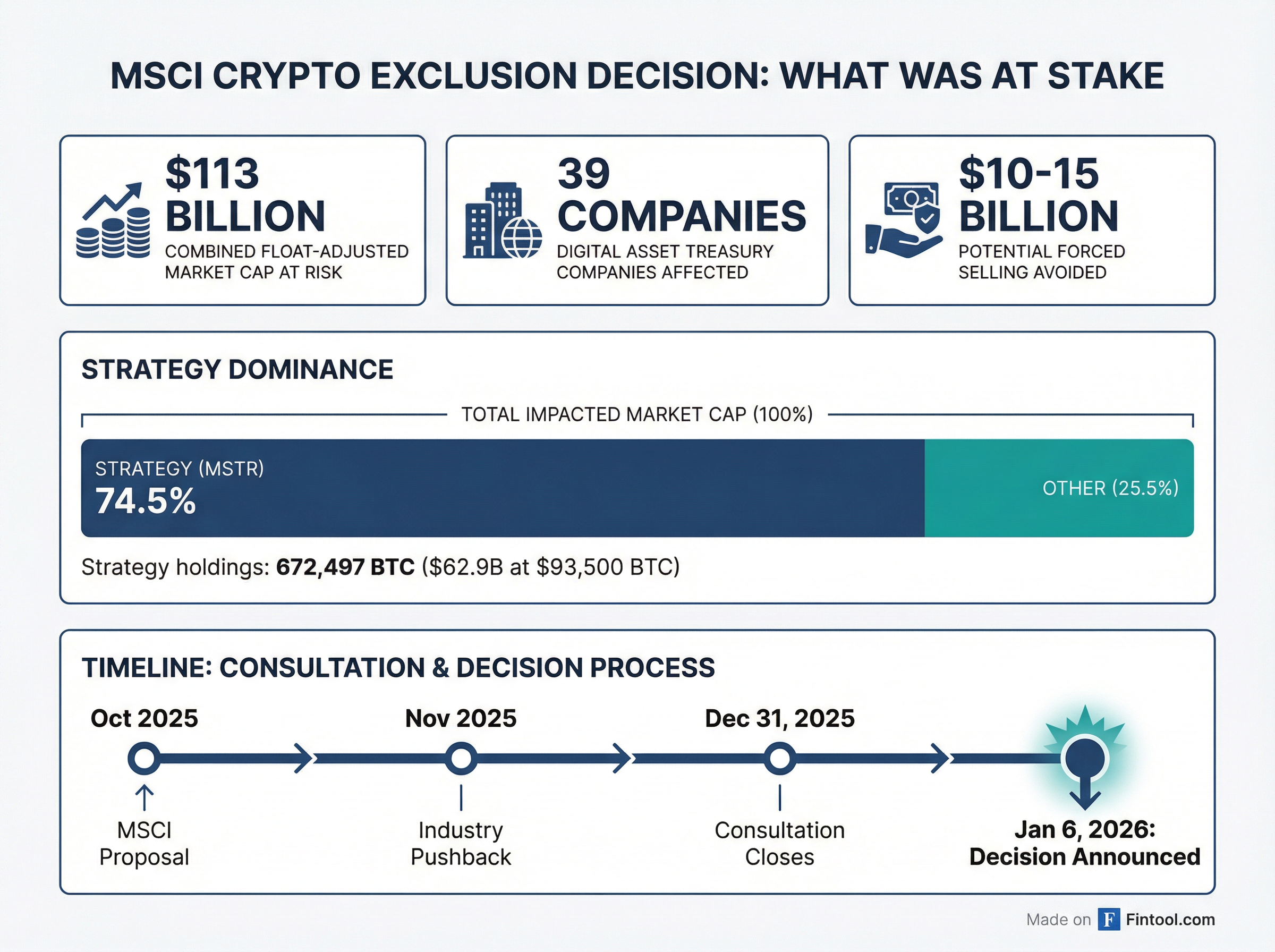
Strategy+26.11% surged 6% in after-hours trading Tuesday after Msci-1.43%, the world's largest index provider, reversed course on a proposal that would have ejected Bitcoin treasury companies from its flagship global indexes—averting what analysts estimated could have triggered $10 billion to $15 billion in forced liquidations.
The decision ends months of uncertainty that had weighed heavily on Strategy and 38 other companies whose digital asset holdings exceed 50% of total assets. Together, these firms represent approximately $113 billion in float-adjusted market capitalization, with Strategy accounting for 74.5% of the total—making this one of the most consequential index methodology decisions in recent memory.
The Decision
MSCI announced Tuesday that it "decided not to implement the proposal to exclude digital asset treasury companies from the MSCI Global Investable Market Indexes as part of the February 2026 Index Review."
"Distinguishing between investment companies and other companies that hold non-operating assets, such as digital assets, as part of their core operations rather than for investment purposes requires further research and consultation with market participants," MSCI stated.
The index provider confirmed that companies currently included in MSCI indexes will remain, provided they continue to meet all other index requirements. However, MSCI noted it will not implement increases to the Number of Shares, Foreign Inclusion Factor, or Domestic Inclusion Factor for these securities, and will defer any additions or size-segment migrations.
Market Reaction
Strategy shares closed the regular session at $157.97, down 4.1% on the day, before surging to $165.29 in after-hours trading—a 6% jump that erased the day's losses and then some. The stock has fallen sharply from its 52-week high of $457.22, pressured by a combination of Bitcoin's pullback from all-time highs and uncertainty around the MSCI proposal.
Other digital asset treasury companies also rallied. Bitmine Immersion (BMNR) gained 3.5% after hours, while Sharplink (SBET) and Twenty One Capital (XXI) saw modest bumps.
Bitcoin itself added roughly 1% on the news, trading around $93,500—continuing a rally that has pushed the cryptocurrency above $94,000 in the first week of 2026.
 Ask Fintool AI Agent
What Was at Stake
Had MSCI proceeded with the exclusion, the consequences would have been severe. JPMorgan analysts estimated that Strategy alone could have faced up to $2.8 billion in outflows from MSCI-linked funds, escalating to $8.8 billion if competitors like FTSE Russell adopted similar policies.
| Metric | Value |
|---|---|
| Companies Affected | 39 |
| Combined Float-Adjusted Market Cap | $113 billion |
| Potential Forced Selling (Est.) | $10-15 billion |
| Strategy's Share of Impact | 74.5% |
| Current Index Constituents at Risk | 18 |
| Non-Constituents Blocked from Future Inclusion | 21 |
The preliminary list of affected companies included 18 current MSCI index constituents representing $98 billion in market cap facing immediate removal, plus 21 non-constituents worth $15 billion that would have been permanently blocked from future inclusion.
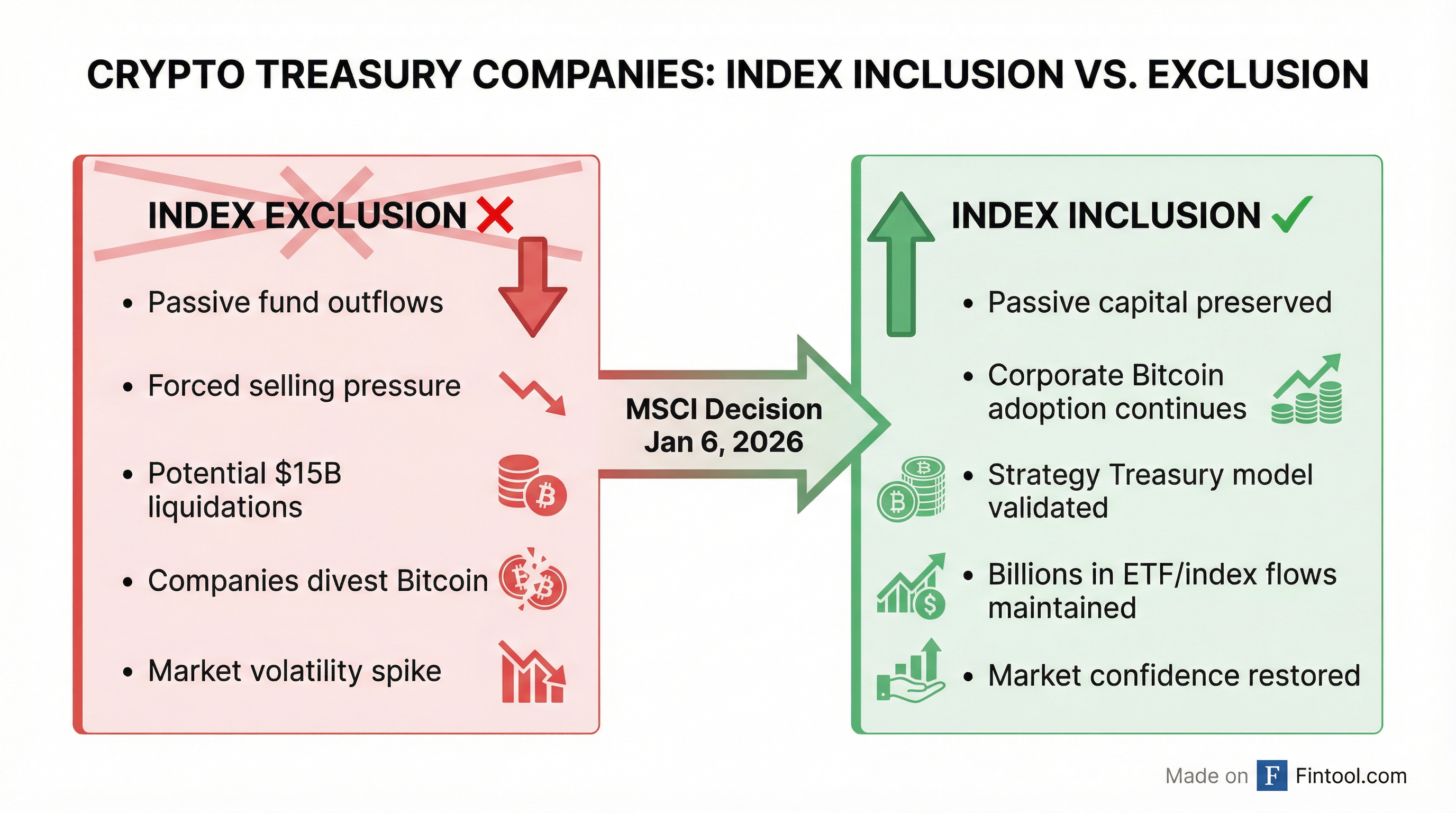
Beyond the direct outflows, companies facing exclusion might have liquidated Bitcoin holdings to dip below the 50% threshold—a scenario that could have triggered broader market selloffs and heightened volatility across the cryptocurrency ecosystem.
Strategy's Position
Strategy remains the world's largest corporate Bitcoin holder by a wide margin. As of December 28, 2025, the company holds 672,497 BTC at an aggregate purchase price of $50.44 billion, representing an average cost of $74,997 per Bitcoin.
At current Bitcoin prices around $93,500, Strategy's Bitcoin holdings are worth approximately $62.9 billion—comfortably above its current market capitalization of roughly $45 billion. This premium-to-NAV dynamic has been central to Strategy's capital markets strategy, allowing it to raise billions through equity issuances to fund additional Bitcoin purchases.
In December, Strategy established a $1.44 billion USD reserve to support dividend payments on its preferred stock and interest on its outstanding indebtedness—a move designed to insulate the company from short-term Bitcoin volatility. The reserve has since grown to $2.19 billion.
"Establishing a USD Reserve to complement our BTC Reserve marks the next step in our evolution, and we believe it will better position us to navigate short-term market volatility while delivering on our vision of being the world's leading issuer of Digital Credit," said Michael Saylor, Founder and Executive Chairman.
| Strategy Holdings | Value |
|---|---|
| Total Bitcoin | 672,497 BTC |
| Aggregate Purchase Price | $50.44 billion |
| Average Cost Per BTC | $74,997 |
| Current Value (at $93,500/BTC) | $62.9 billion |
| USD Reserve | $2.19 billion |
Ask Fintool AI AgentThe Industry Pushback
The MSCI reversal followed an unprecedented lobbying effort from the Bitcoin treasury community. Bitcoin for Corporations (BFC), a coalition promoting corporate Bitcoin adoption, mobilized over 1,500 signatures on a petition opposing the exclusion, delivering it to MSCI on December 30. Eight of the 39 affected companies are BFC members.
"We had a very constructive conversation," said George Mekhail, BFC's executive director, after discussions with MSCI's head of research. "I think they were very much still in a listening and learning posture. I think a lot of this just really has to do with a lack of education and understanding of Bitcoin itself, as well as these Bitcoin treasury companies and the significance of their operating businesses."
Strategy itself urged MSCI to reject the proposal, stating "the wiser course is for MSCI to remain neutral and let the markets decide the course of DATs."
Additional opposition came from Strive Asset Management and prominent investor Bill Miller, among others. No major institutional investors publicly supported the exclusion proposal.
What's Next
While MSCI has shelved immediate exclusion plans, the index provider signaled it "intends to open a broader consultation on the treatment of non-operating companies generally."
This leaves the door open for future changes. MSCI acknowledged investor concerns that some digital asset treasury companies "exhibit characteristics similar to investment funds, which are typically not eligible for inclusion in MSCI indexes." The key question—whether holding Bitcoin as a treasury reserve constitutes an operating business or an investment fund—remains unresolved.
For now, the decision removes a significant overhang on Strategy and its peers, potentially reopening the door to passive capital inflows that had been frozen pending the review. With Bitcoin showing renewed strength in early 2026 and the MSCI threat neutralized, the path forward for corporate Bitcoin adoption appears clearer—though future regulatory and index methodology challenges are likely.
Ask Fintool AI Agent