Judge Clears Musk vs. OpenAI for Jury Trial, Setting March Showdown Over $500 Billion AI Empire
January 8, 2026 · by Fintool Agent


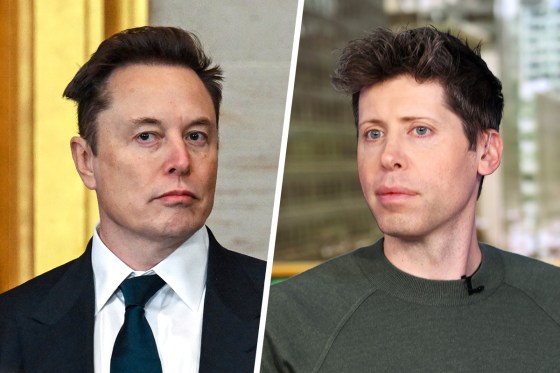
"This case is going to trial."
With those six words, U.S. District Judge Yvonne Gonzalez Rogers set the stage for what could become the most consequential legal battle in AI history. On Wednesday, the judge rejected OpenAI's motion to dismiss Elon Musk's lawsuit alleging the ChatGPT maker betrayed its founding nonprofit mission—clearing the way for a jury trial scheduled to begin March 30, 2026, in Oakland, California.
The ruling comes just months after OpenAI completed a complex restructuring that valued the company at $500 billion, transforming it from a nonprofit research lab into a public benefit corporation with Microsoft as its largest investor.
"I think there's plenty of evidence," Judge Gonzalez Rogers said, referring to Musk's claims. "It's circumstantial, but that's how these things work."
The Allegations: A Founding Agreement Betrayed?
At the heart of Musk's lawsuit is a fundamental question: Did OpenAI's leadership make binding commitments to maintain its nonprofit structure when Musk helped found the organization and contributed approximately $38 million—roughly 60% of its early funding?
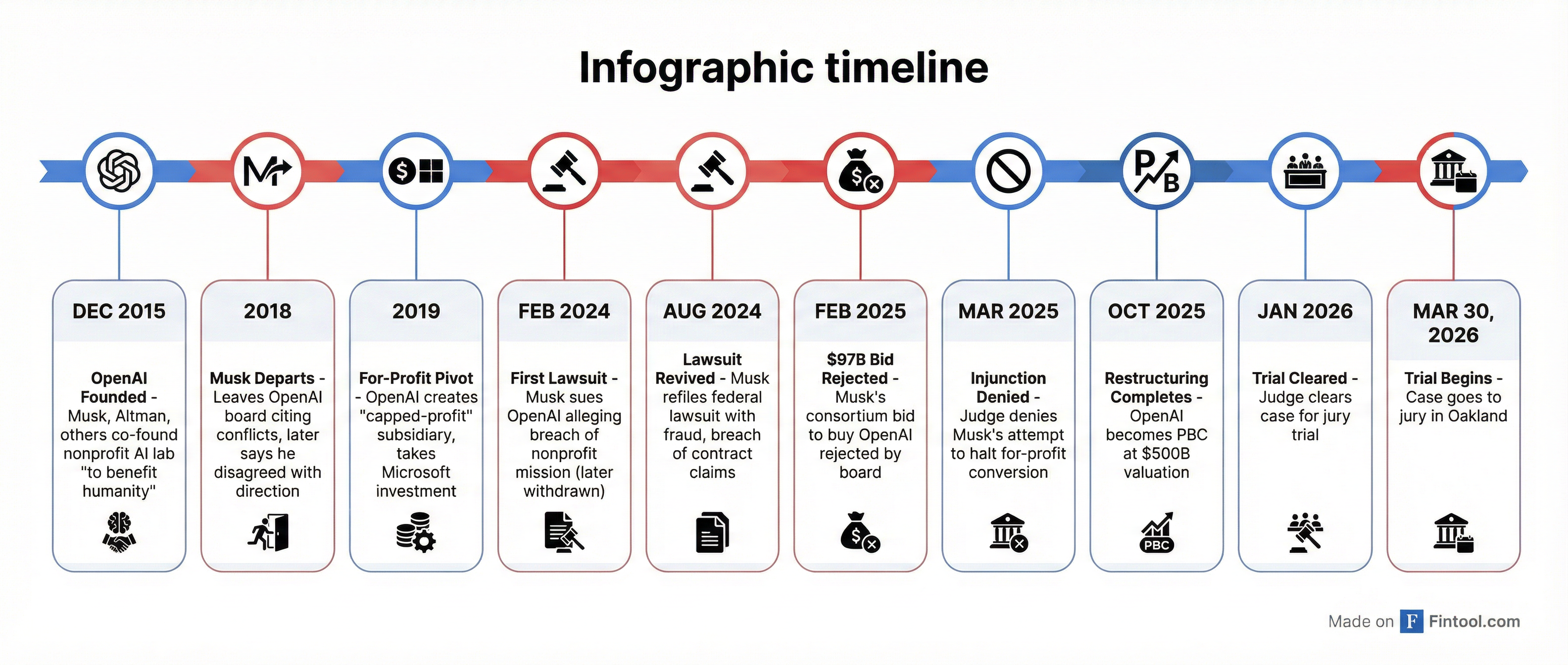
Musk claims that OpenAI co-founders Sam Altman and Greg Brockman fraudulently induced him to help establish and fund the organization in 2015 under the premise that it would remain a nonprofit dedicated to developing AI "for the benefit of humanity." Instead, he alleges, they plotted a for-profit switch to enrich themselves through multibillion-dollar deals with Microsoft.
OpenAI, Altman, and Brockman have denied the claims, characterizing Musk as "a frustrated commercial competitor seeking to slow down a mission-driven market leader." After the hearing, an OpenAI spokesperson said: "Mr. Musk's lawsuit continues to be baseless and a part of his ongoing pattern of harassment, and we look forward to demonstrating this at trial."
 Ask Fintool AI Agent
The Restructuring That Changed Everything
The lawsuit targets OpenAI's transformation from a nonprofit AI safety research lab into one of the world's most valuable private companies. The restructuring, completed in October 2025, created a public benefit corporation valued at $500 billion and fundamentally altered Microsoft's relationship with the company.
Under the new agreement, Microsoft holds approximately 27% of OpenAI on an as-converted diluted basis—a stake worth roughly $135 billion. The deal extends Microsoft's exclusive API access and IP rights through 2032, while giving OpenAI freedom to partner with other cloud providers and pursue an IPO.
Key terms of the October 2025 restructuring:
| Element | Previous Structure | New Structure |
|---|---|---|
| Corporate Form | Capped-profit controlled by nonprofit | Public benefit corporation |
| Valuation | $100B (2024) | $500B |
| Microsoft Stake | 32.5% (pre-dilution) | 27% ($135B) |
| Microsoft IP Rights | Until AGI declaration | Extended through 2032, includes post-AGI |
| Compute Provider | Microsoft right of first refusal | OpenAI can use any provider |
| Azure Commitment | — | $250B incremental services |
The nonprofit will be renamed the OpenAI Foundation and will hold roughly 26% of the for-profit entity—making it "one of the best-funded non-profits ever," according to OpenAI.
Microsoft in the Crosshairs
While the trial will focus primarily on OpenAI, Microsoft is also named as a defendant—and the judge signaled that the tech giant may not escape easily. Microsoft lawyers urged Gonzalez Rogers to dismiss the claims against their client, arguing there was no evidence the company "aided and abetted" OpenAI's alleged misconduct.
The judge has yet to rule on Microsoft's dismissal motion, but allowed the case to proceed to trial. For Microsoft, the stakes extend beyond legal liability—the trial could expose details of its negotiations with OpenAI and force executives to testify about one of the most important partnerships in the company's history.
Microsoft's OpenAI investment has been transformative. The company's $13 billion in funding commitments has turned into a stake worth approximately $135 billion—a nearly 10x return on paper. The partnership has powered Microsoft's AI strategy across Azure, Microsoft 365, and Windows.
| Metric | Q4 2024 | Q1 2025 | Q2 2025 | Q3 2025 | Q1 2026 |
|---|---|---|---|---|---|
| Revenue ($B) | — | — | — | — | $65.6* |
| Cloud Revenue ($B) | — | — | — | — | $40.9* |
| Market Cap | $3.0T | $3.3T | $3.5T | $3.8T | $4.1T* |
*Values retrieved from S&P Global
Ask Fintool AI AgentWhat the Trial Will Decide
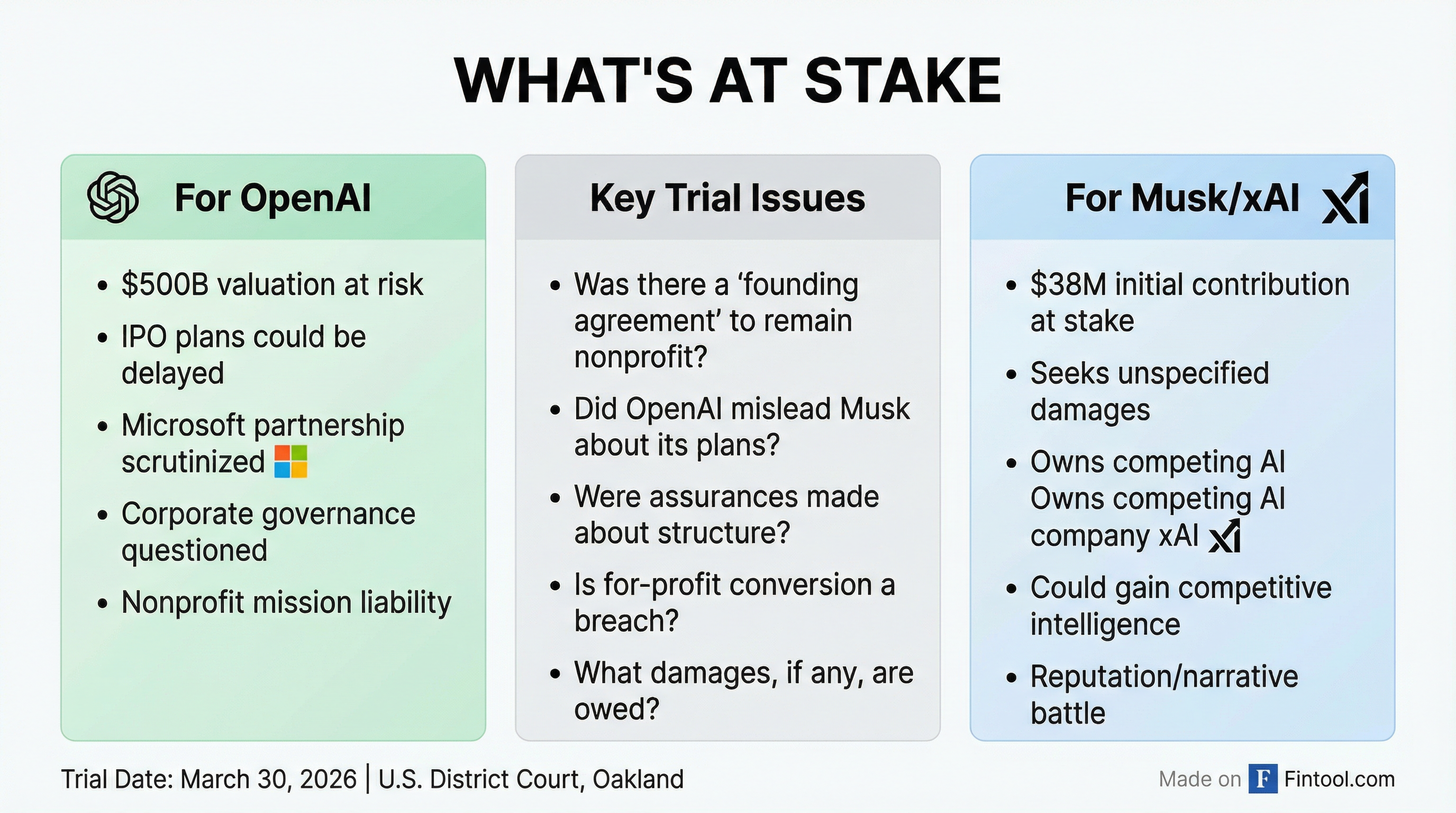
Judge Gonzalez Rogers indicated that several key factual questions will be put before the jury:
1. Did a "Founding Agreement" Exist?
Musk's complaint refers to a 2015 understanding that OpenAI would remain a nonprofit. OpenAI has denied any such formal agreement ever existed, arguing that discussions about structure were preliminary and non-binding.
2. Were Assurances Made?
The judge said there was "plenty of evidence" suggesting OpenAI's leaders made assurances that its original nonprofit structure would be maintained. Whether those assurances were legally binding is for the jury to decide.
3. Was Musk Misled?
OpenAI has argued that Musk knew about for-profit discussions as early as 2018 and was himself an advocate for such a structure. Documents released in prior proceedings suggest Musk may have proposed merging OpenAI with Tesla.
4. What Damages Are Owed?
If the jury finds in Musk's favor, it will need to determine what remedy is appropriate. Musk seeks unspecified "ill-gotten gains," which could theoretically encompass a share of OpenAI's enormous valuation.
The Competitive Context: Musk's xAI Empire
Adding complexity to the case is Musk's role as founder and owner of xAI, a direct OpenAI competitor that closed a $20 billion funding round just days ago at a valuation exceeding $230 billion. xAI's Grok chatbot competes directly with ChatGPT, and Musk has been vocal about his desire to build AI systems that offer an alternative to what he views as OpenAI's censored approach.
OpenAI and its defenders have argued that Musk's lawsuit is fundamentally a competitive tactic—an attempt to slow down a market leader while his own company catches up. "Seeing the remarkable technological advances OpenAI has achieved, Musk now wants that success for himself," OpenAI said in earlier court filings.
The trial could provide Musk with access to internal OpenAI documents and communications during discovery, potentially yielding competitive intelligence about the company's technology, strategy, and relationships with Microsoft and other partners.
What's at Stake: A $500 Billion Question
For OpenAI, the trial introduces significant uncertainty at a pivotal moment. The company is reportedly preparing for a potential IPO as early as late 2026, and any adverse ruling could complicate that process.
The nonprofit structure that Musk seeks to enforce is the same structure that other critics—including California and Delaware attorneys general—scrutinized during the restructuring process. While regulators ultimately approved the deal, a jury finding that OpenAI violated its founding commitments could have broad implications for how AI companies structure themselves and for the nonprofit-to-for-profit transition model that has become common in Silicon Valley.
For investors in OpenAI's ecosystem—including Microsoft, Nvidia, and Oracle—the trial represents a governance risk that could affect valuations. Microsoft's 8-K filing specifically notes that its OpenAI investment "may result in early termination or renegotiation of the arrangement" if circumstances change.
Ask Fintool AI AgentThe Road to March 30
With the trial date now set, both sides will spend the next several months preparing their cases. Key events to watch:
January-February 2026: Final pre-trial motions and discovery disputes. The judge indicated she will issue a written order addressing OpenAI's dismissed motion and any remaining claims.
March 2026: Final trial preparations. Both sides will submit witness lists and exhibit lists. Settlement discussions may intensify as trial approaches.
March 30, 2026: Trial begins in U.S. District Court, Oakland, California. The proceedings could last several weeks given the complexity of the issues.
The outcome will likely be appealed regardless of which side prevails, potentially extending the legal saga for years. But the trial itself—with testimony from key figures including potentially Altman, Musk, and Microsoft executives—will provide unprecedented insight into the founding and evolution of one of the most important companies in AI history.
The Bottom Line
Judge Gonzalez Rogers' ruling transforms what OpenAI dismissed as a "frivolous" lawsuit into a genuine legal threat. While the company maintains its restructuring was proper and that no founding agreement was ever breached, a jury will now have the opportunity to examine the evidence and decide whether OpenAI's leaders kept their promises to a co-founder who helped bring the organization to life.
For the AI industry, the trial will be a referendum on a fundamental question: Can a company founded with a mission to benefit humanity transform itself into a $500 billion for-profit enterprise—and if so, what obligations, if any, does it owe to those who funded that original mission?
The answer begins March 30.