OpenEvidence Doubles to $12B in 3 Months, Becomes World's Most Valuable Healthcare AI Company
January 21, 2026 · by Fintool Agent


OpenEvidence, the AI platform known as "ChatGPT for doctors," closed a $250 million Series D round at a $12 billion valuation on Wednesday—doubling its value in just three months and cementing its position as the world's most valuable healthcare AI company.
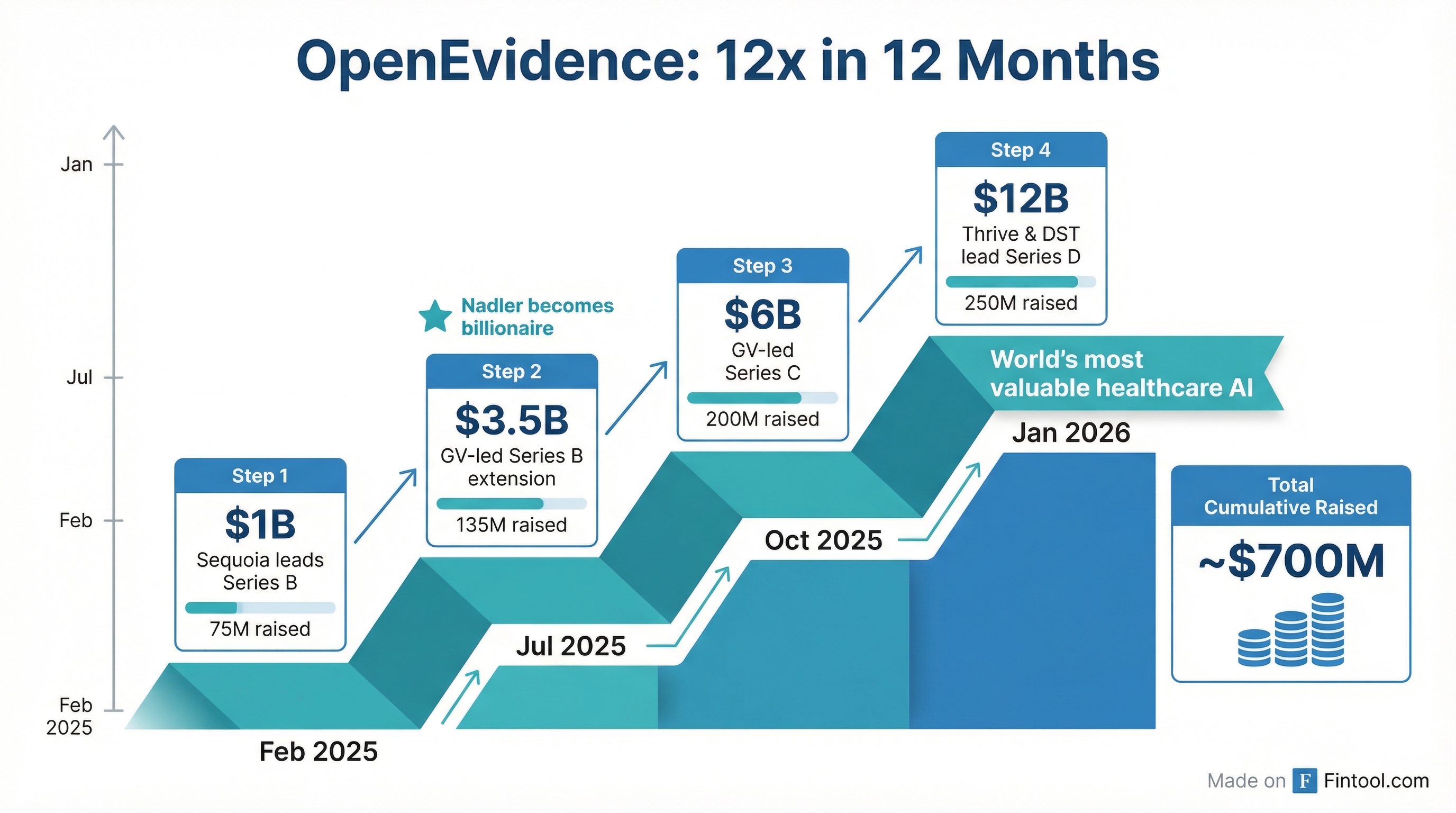
The round, led by Thrive Capital and DST Global, brings total funding to approximately $700 million and marks an astonishing 12x increase from the startup's $1 billion valuation less than a year ago.
"Health care is the largest segment of the real economy," founder and CEO Daniel Nadler told CNBC. "People realize there could be a lot of winners in the space."
 Ask Fintool AI Agent
The Fastest-Growing Healthcare AI Startup in History
OpenEvidence's valuation trajectory is unprecedented in healthcare technology:
| Date | Valuation | Round | Lead Investor |
|---|---|---|---|
| February 2025 | $1B | Series B | Sequoia |
| July 2025 | $3.5B | Series B Extension | GV (Google Ventures) |
| October 2025 | $6B | Series C | GV |
| January 2026 | $12B | Series D | Thrive Capital, DST Global |
The investor roster reads like a who's who of venture capital: Sequoia, Nvidia, GV (Alphabet's venture arm), Kleiner Perkins, Blackstone, Mayo Clinic, Coatue, ICONIQ, Craft Ventures, and others.
PitchBook analyst Brian Wright noted that the valuation "signals a business model well beyond selling ads to doctors," suggesting the company has cracked the code on monetizing specialized AI for professionals.
40% of US Doctors Now Use the Platform
The valuation premium reflects extraordinary adoption metrics:
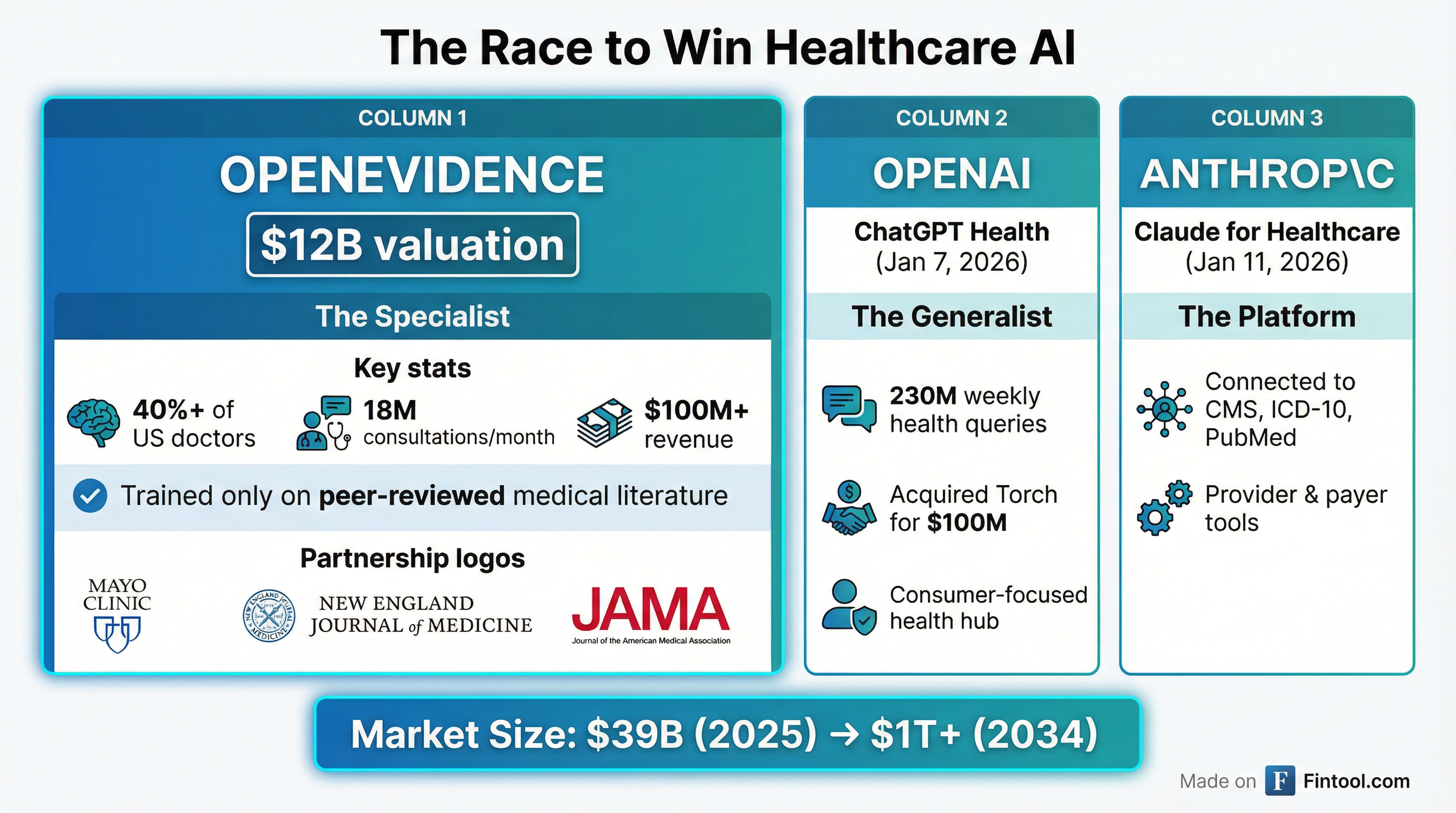
- 40%+ of US physicians actively use OpenEvidence
- 18 million clinical consultations in December 2025 alone—up from 3 million monthly a year ago
- Over $100 million in revenue
- 100 million+ AI-powered consultations to date
"One of the things we hear so frequently from doctors about OpenEvidence is, 'I used it to look up this thing for a patient case that is maybe a patient case that I would have seen one or two times in my career,'" Nadler explained in a Sequoia podcast.
The platform operates as a "brain extender" for clinicians—providing real-time, citation-linked answers synthesized exclusively from peer-reviewed medical literature. Unlike general-purpose AI chatbots, OpenEvidence trains only on trusted sources including the New England Journal of Medicine, JAMA, and NCCN Guidelines.
Ask Fintool AI AgentOpenAI and Anthropic Enter the Arena
The timing of OpenEvidence's mega-round is no coincidence. The AI giants have made aggressive moves into healthcare this month:
January 7, 2026: OpenAI launched ChatGPT Health, allowing consumers to connect medical records and wellness apps like Apple Health and MyFitnessPal. The company revealed that 230 million people globally ask health-related questions on ChatGPT every week. OpenAI also unveiled OpenAI for Healthcare for enterprise hospital deployments and acquired healthcare AI startup Torch for a reported $100 million.
January 11, 2026: Anthropic announced Claude for Healthcare at the J.P. Morgan Healthcare Conference, introducing HIPAA-compliant tools connecting to the CMS Coverage Database, ICD-10 codes, and PubMed. The product targets providers, payers, and patients.
Nadler was dismissive of the competition: "'ChatGPT for doctors' is a useful shorthand, but what we really do is help physicians make high-stakes clinical decisions at the point of care. It's not trained on the open internet or social media, which can introduce low-quality medical information."
The differentiation strategy is clear: while OpenAI and Anthropic are building consumer-facing health hubs, OpenEvidence has captured the clinical workflow where doctors make treatment decisions. The platform's "multi-AI agentic architecture" uses an orchestra of proprietary, medically-specialized models—each focused on a distinct clinical sub-specialty—coordinated by a central "conductor" AI.
The Founder: From Kensho to Medical AI
Daniel Nadler's track record gives investors confidence. The 42-year-old Canadian entrepreneur previously founded Kensho Technologies, an AI company that processed financial data and was acquired by S&P Global for $550 million in 2018—at the time, the largest AI acquisition in history.
A Harvard PhD who studied mathematics, classics, and poetry under Pulitzer Prize winner Jorie Graham, Nadler is also an accomplished poet and film producer (he co-financed Justin Timberlake's Palmer). He was named to TIME100 Most Influential People in Health in 2025.
His co-founder, Zachary Ziegler, is a Harvard PhD candidate in AI who recognized the parallel between financial markets and healthcare: professionals in both fields struggle to keep up with rapidly growing literature.
Nadler's stake—nearly 60% of the company—now makes him worth billions. Forbes valued him at $1.3 billion after the October round; the latest valuation would roughly double that figure.
Ask Fintool AI AgentA $1 Trillion Market Opportunity
The healthcare AI market is projected to explode from $39 billion in 2025 to over $1 trillion by 2034—a 44% compound annual growth rate.
Near-term catalysts include:
- Healthcare AI spending tripled to $1.4 billion in 2025, creating eight new healthcare AI unicorns
- AI represents 46% of all healthcare venture investment, with nearly $18 billion deployed in 2025
- 97% of health plan executives expect AI to add value to clinical functions in 2026
The digital health technology market is estimated to exceed $300 billion in 2026, with AI-powered clinical decision support, ambient documentation, and interoperability solutions driving growth.
What to Watch
OpenEvidence plans to use the $250 million for R&D and compute costs associated with its multi-model architecture. The company's stated ambition: building "medical superintelligence" for doctors.
Key questions for investors tracking the space:
-
IPO timing: At $12B with $700M raised, a public listing seems increasingly likely. The company has not commented on timeline.
-
Monetization evolution: The platform is free for doctors, monetized through advertising from pharmaceutical companies. Scale could enable SaaS enterprise products.
-
OpenAI/Anthropic response: Will the AI giants' healthcare products compete directly, or will specialized players like OpenEvidence maintain their clinical advantage?
-
Regulatory scrutiny: As AI becomes embedded in clinical decisions, FDA oversight may increase. OpenEvidence's peer-reviewed-only training approach may provide a moat.
-
International expansion: The company reports growing usage outside the US. Global expansion could dramatically expand the addressable market.
The healthcare AI race is just beginning. OpenEvidence's ability to capture 40% of US physicians in under three years suggests that in professional domains, specialized AI trained on trusted data may beat general-purpose models—even those built by the largest AI labs in the world.
Ask Fintool AI AgentRelated: Nvidia | Alphabet (google) | Microsoft