Oracle's OpenAI Hangover: Worst Quarter Since the Dot-Com Bust
December 26, 2025 · by Fintool Agent


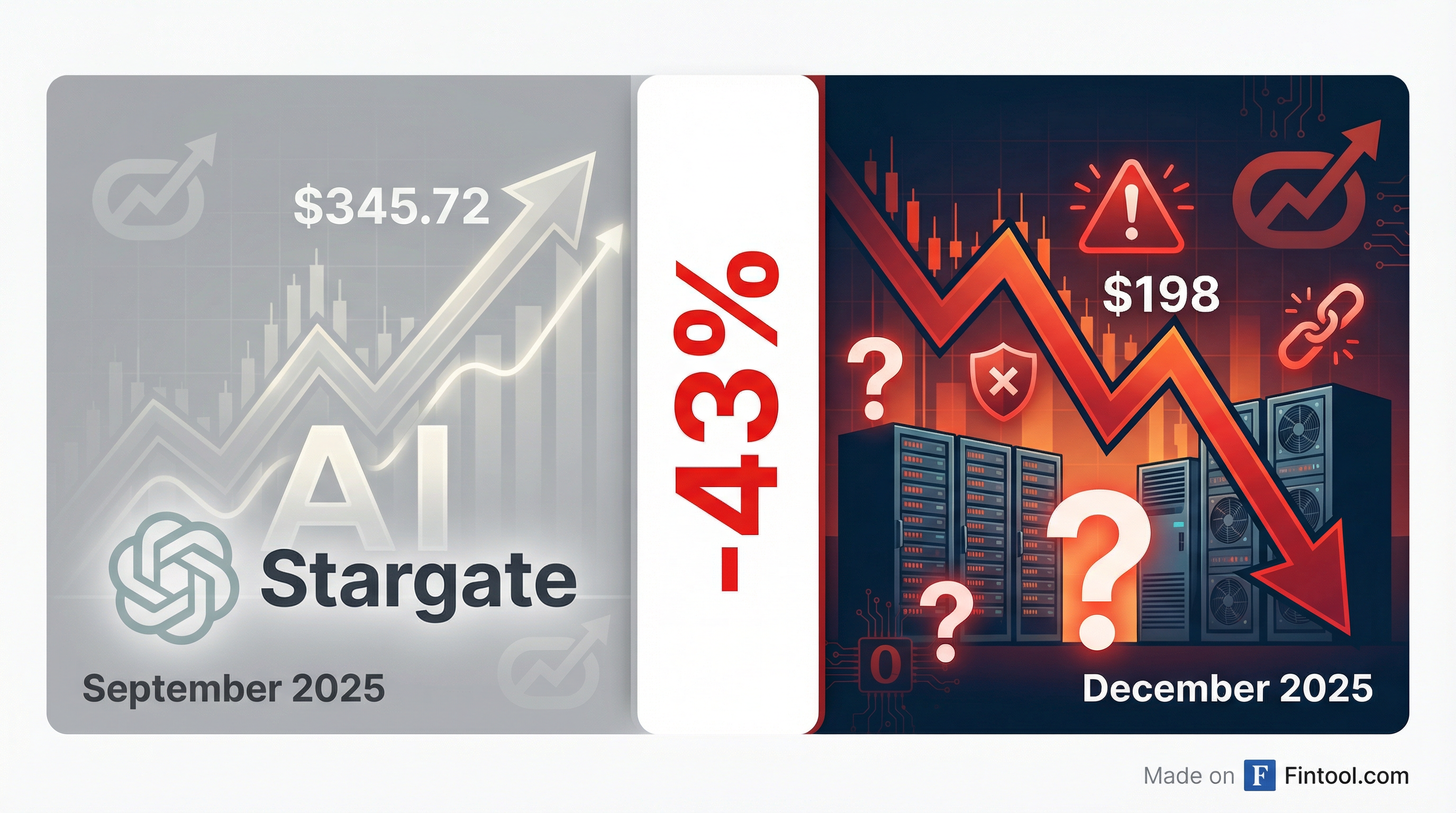
Oracle+4.62% shares have plummeted 31% this quarter, putting the stock on track for its steepest decline since the dot-com collapse of 2001—and the company's newly appointed co-CEOs are barely three months into their tenure.
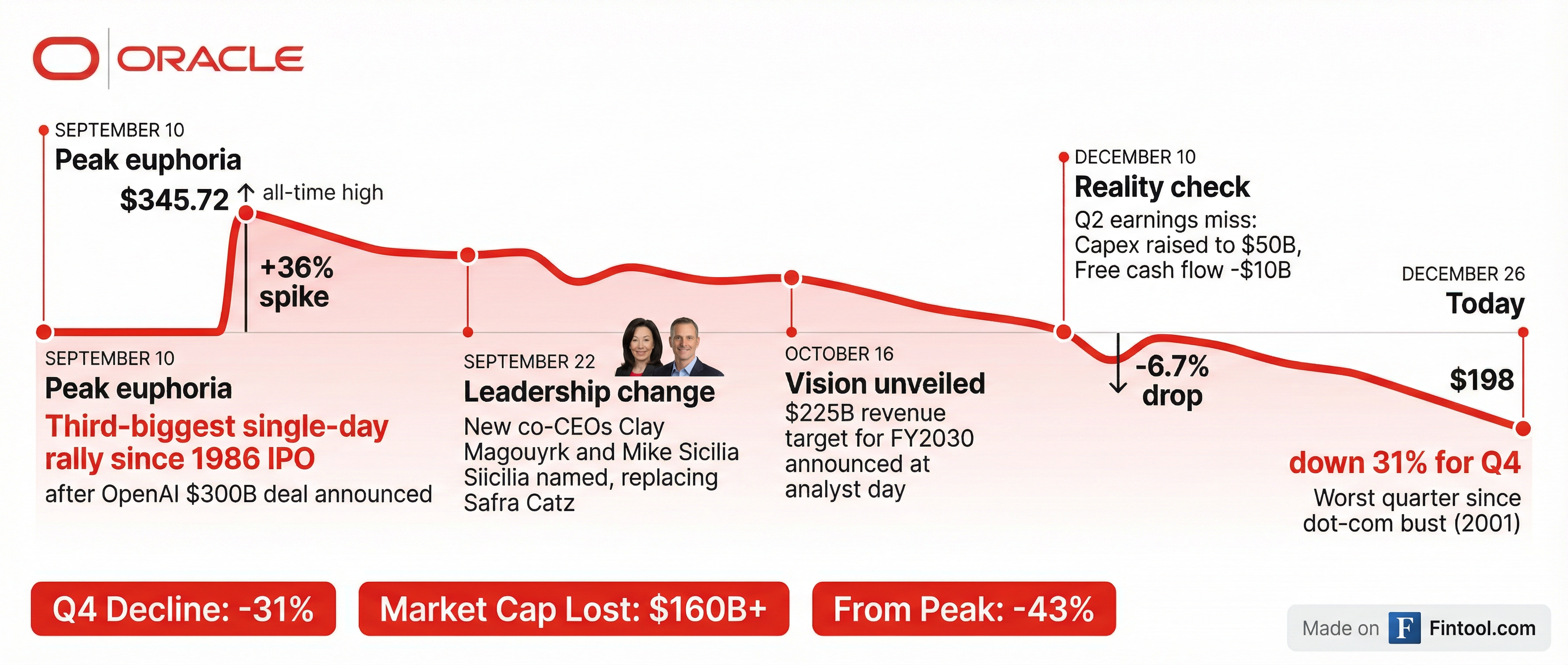
What began as Silicon Valley's biggest cloud deal ever has become a cautionary tale about the perils of AI infrastructure bets. Oracle's $300 billion OpenAI partnership, announced to great fanfare in September, initially sent shares rocketing 36%—the third-largest single-day rally in the company's history since its 1986 IPO. By the close of that day, the stock hit an intraday record of $345.72.
Three months later, the stock trades around $198—a 43% decline from peak to trough that has erased more than $160 billion in market value.
The Numbers That Spooked Wall Street
The December 10 earnings call was supposed to be a victory lap. Instead, it became the catalyst for another leg down.
| Metric | Q2 2026 | Q2 2025 | Change |
|---|---|---|---|
| Revenue | $16.1B | $14.1B | +14% |
| Cloud Infrastructure Revenue | $4.1B | $2.5B | +66% |
| Free Cash Flow | -$10.0B* | -$1.1B* | -818% |
| Capital Expenditure | $12.0B* | $4.0B* | +200% |
| Total Debt | $131.7B* | $99.5B* | +32% |
*Values retrieved from S&P Global
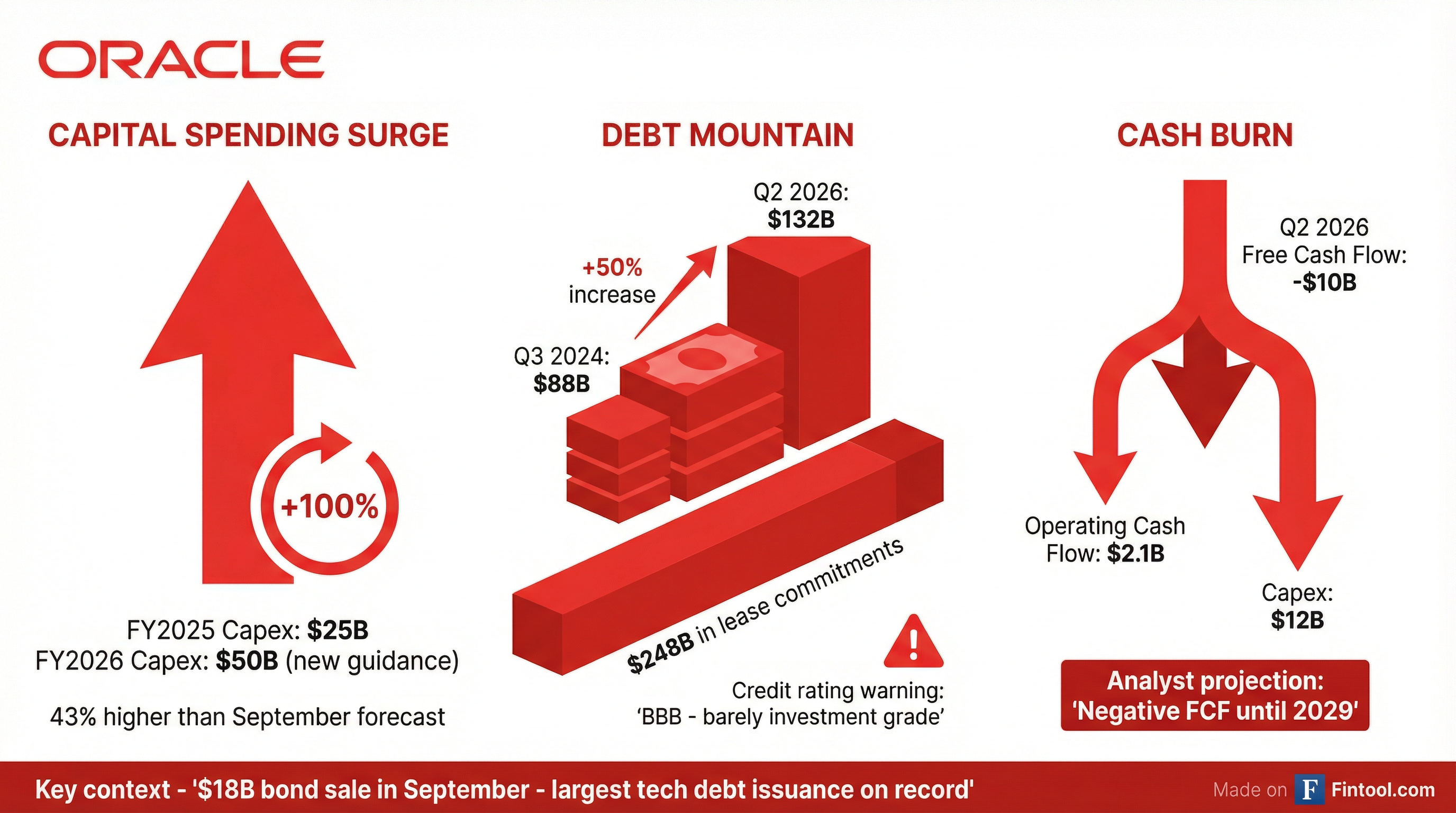
Newly appointed CFO Doug Kehring delivered the figure that changed everything: $50 billion in planned capital expenditures for fiscal 2026—43% higher than the $35 billion Oracle had guided to in September, and double the $25 billion spent in fiscal 2025.
The free cash flow picture was equally jarring. Oracle burned $10 billion in the quarter, far worse than the $6 billion outflow analysts had expected.
 Ask Fintool AI Agent
The OpenAI Concentration Problem
At the heart of investor anxiety lies a single name: OpenAI.
The ChatGPT maker accounts for at least $300 billion of Oracle's $523 billion remaining performance obligations (RPO)—meaning roughly 58% of Oracle's entire contracted backlog depends on one customer that is itself burning cash at an extraordinary rate.
"Will the demand be there from OpenAI?" asked Eric Lynch, managing director at Suncoast Equity Management. "Four or five years is a long time. That's just not within our investment discipline."
The concerns extend beyond OpenAI's ability to pay. Competition from Google's-2.53% Gemini models and Anthropic's Claude has intensified, prompting OpenAI CEO Sam Altman to declare a "code red" internally as the company fights to maintain its lead in the AI race.
The Debt Problem
Oracle's AI ambitions require mountains of capital, and the company has been borrowing aggressively to fund them.
In September, Oracle raised $18 billion in a jumbo bond sale—one of the largest debt issuances in tech industry history. Total debt has ballooned to $132 billion from $88 billion two years ago, and the company has committed to $248 billion in lease obligations to boost cloud capacity.
The cost of insuring Oracle's debt against default has surged to its highest level in at least five years. With a BBB credit rating—just a few notches above junk status—investors are questioning whether Oracle can maintain investment-grade status through this expansion.
"Considering Oracle is already barely hanging on to an investment grade rating, we would be concerned about Oracle's ability to live up to these obligations without restructuring its OpenAI contract," wrote analysts at D.A. Davidson in a December 12 note.
Ask Fintool AI AgentManagement's Defense
On the earnings call, co-CEO Clay Magouyrk pushed back against the most bearish assumptions.
The key points from management:
-
Less capital than feared: Oracle expects to need "substantially less" than the $100 billion some analysts had modeled for the buildout
-
Flexible financing models: Customers can bring their own chips, and vendors may rent rather than sell capacity, reducing Oracle's upfront capital requirements
-
Rapid redeployment: If any customer can't pay, Oracle claims it can redirect infrastructure to other customers "in hours" with more than 700 AI customers on the platform
-
Diversifying backlog: Q2 brought $68 billion in new RPO from Meta-1.31%, Nvidia+7.87%, and other customers
"We're committed to maintaining our investment-grade debt rating," Kehring emphasized on the call.
The Bull Case: Don't Bet Against Larry
Despite the carnage, some investors remain resolute.
"You would have gone bankrupt 40 times betting against Larry over the last 50 years," said Zachary Lountzis, vice president at Lountzis Asset Management, which held $25 million in Oracle shares as of September 30. "He sees the future."
Lountzis's firm bought Oracle shares in 2020 below $60 and has held through the volatility, even adding roughly 30,000 shares in Q1 2025. "We didn't feel the economics of the business changed with all the largely positive news that came out," he said. "What we've seen from $340 down to $180 is actually a very healthy correction."
The consensus analyst price target of $291 implies 47% upside from current levels—a striking gap between Wall Street ratings and market sentiment.*
*Values retrieved from S&P Global
Oracle also caught a break last week when TikTok agreed to sell part of its U.S. business to an Oracle-led consortium, providing some diversification away from OpenAI dependency.
Ask Fintool AI AgentThe Long Road Ahead
The fundamental tension is temporal: Oracle's AI infrastructure investments won't generate returns for years.
At October's analyst day, management outlined a vision for $225 billion in revenue by fiscal 2030—up from $57 billion in fiscal 2025. But that growth comes at the expense of profitability. FactSet analysts project gross margins will fall from 77% in fiscal 2021 to approximately 49% by 2030, with cumulative negative free cash flow of $34 billion over the next five years before turning positive in 2029.
For new co-CEOs Magouyrk and Sicilia—promoted in September to replace the veteran Safra Catz—it's a trial by fire. They inherit both the biggest opportunity and the biggest risk Oracle has faced in decades.
What to Watch
Near-term catalysts:
- Q3 2026 earnings (March 2026): Will capex continue to escalate?
- OpenAI funding developments: Any struggles in the AI startup's fundraising could ripple through to Oracle
- Credit rating reviews: A downgrade to junk status would significantly raise borrowing costs
Structural questions:
- Can Oracle diversify its customer base fast enough to reduce OpenAI concentration?
- Will alternative financing models (customer-owned chips, vendor rentals) materialize at scale?
- How quickly can cloud infrastructure margins reach the targeted 30-40% range?
The Oracle story in 2025 is a microcosm of the broader AI infrastructure moment: enormous opportunity colliding with enormous capital requirements, and a market that has grown increasingly skeptical about when—or whether—the investment will pay off.
Ask Fintool AI AgentRelated: