Berkshire's PacifiCorp Sells $1.9B in Washington Assets as Wildfire Liabilities Mount
February 17, 2026 · by Fintool Agent


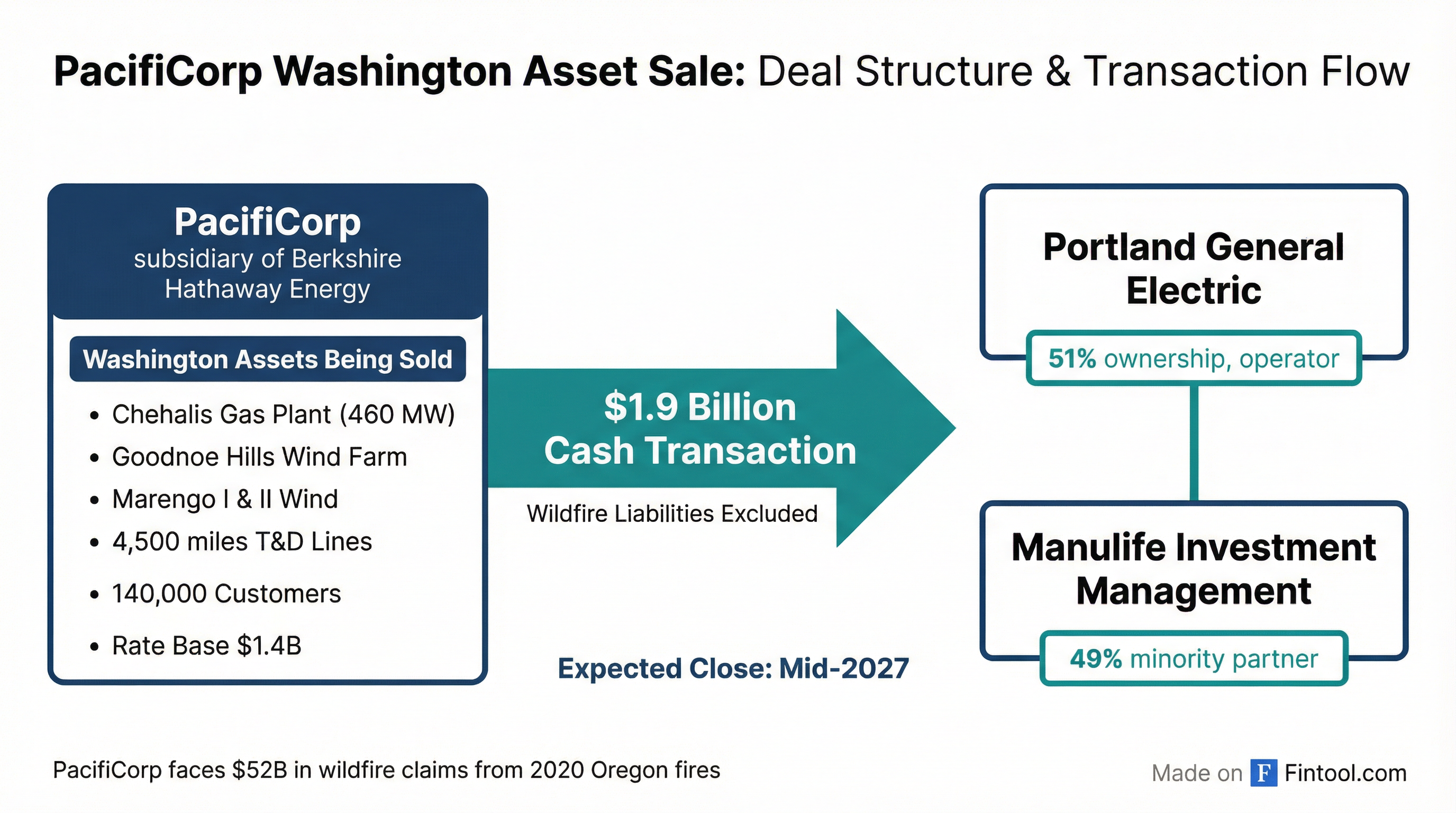
Pacificorp, the Berkshire Hathaway-owned utility facing up to $52 billion in wildfire damage claims, is selling its Washington state operations to Portland General Electric for $1.9 billion—a rare major asset sale for the Omaha conglomerate that underscores the financial strain from Oregon wildfire litigation.
The transaction, announced Tuesday, marks the first significant divestiture under Greg Abel's leadership since he succeeded Warren Buffett as Berkshire's chief executive on January 1, 2026. PacifiCorp cited "diverging policies" among the six western states it serves and "extraordinary pressure" on its financial stability, liquidity, and credit ratings.
The Deal Structure
Pge is partnering with Manulife Investment Management, which will take a 49% stake in the Washington utility business, with PGE owning 51% and operating the combined entity. The transaction includes:
- Chehalis natural gas plant (460 MW combined-cycle turbine)
- Goodnoe Hills, Marengo I & II wind farms (approximately 540 MW combined)
- 4,500 miles of transmission and distribution lines
- 140,000 customers across 2,700 square miles in central and southeastern Washington
- Rate base of $1.4 billion (implying a 1.36x rate base multiple)
"This transaction represents a key step in our strategy," said Maria Pope, PGE's President and CEO. "Portland General Electric brings a track record of effective operational performance, including strong plant availability, first quartile safety, commitment to wildfire and other risk mitigation."
Critically, the deal excludes liabilities associated with wildfires outside of Washington, meaning PGE will not inherit PacifiCorp's massive Oregon wildfire exposure.
 Ask Fintool AI Agent
The Wildfire Crisis
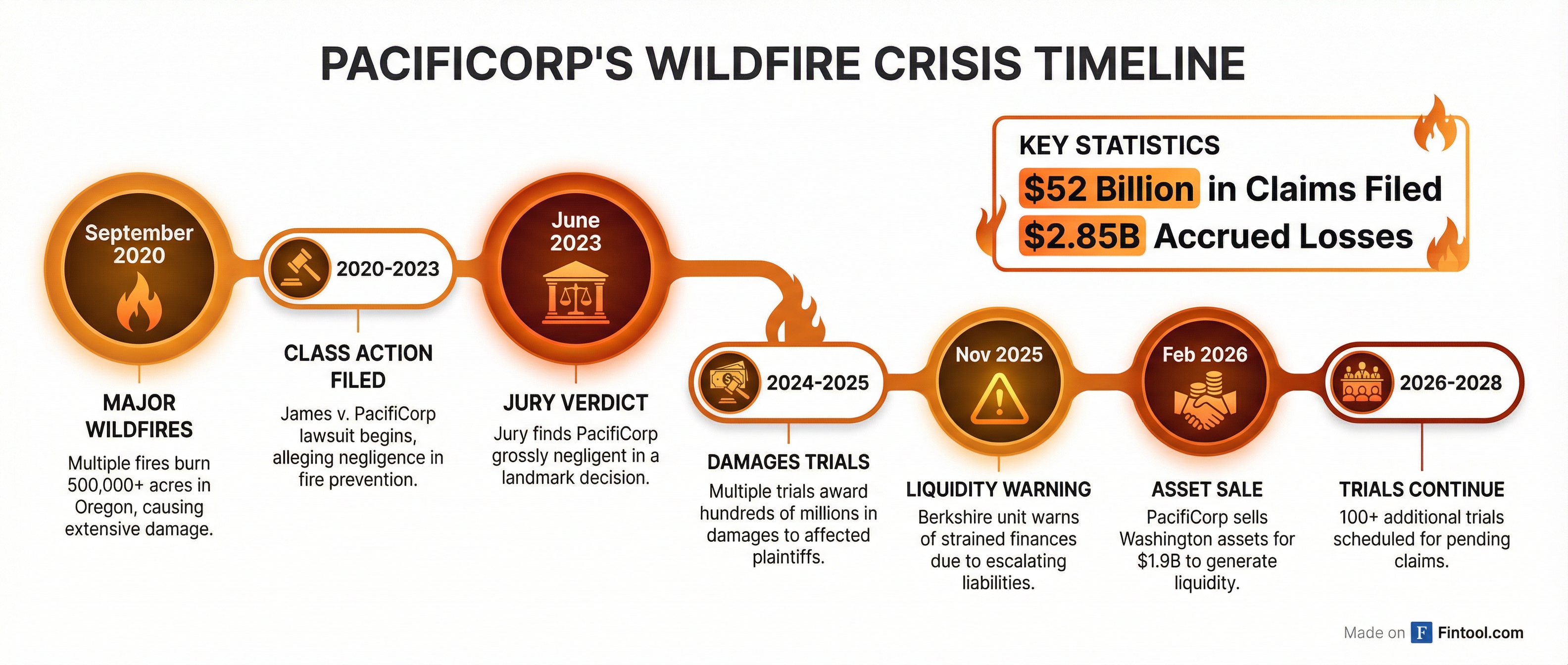
PacifiCorp's financial distress stems from the September 2020 wildfires that burned over 500,000 acres across Oregon and Northern California. The fires destroyed over 2,000 structures, injured multiple individuals, and caused several fatalities. Third-party reports and government investigations concluded that PacifiCorp's power lines contributed to multiple fire ignitions.
The damages exposure is staggering:
| Metric | Amount |
|---|---|
| Claims Filed | $55 billion (excluding punitive damages) |
| James Case Claims | $52 billion |
| U.S. Government Claim | $900+ million |
| Cumulative Losses Accrued | $2.85 billion |
| Unpaid Liabilities | $1.45 billion |
| Insurance Recoveries | $530 million (no further expected) |
Under Oregon law, economic and property damages can be doubled if a defendant is found to have acted with gross negligence, recklessness, willfulness, or malice. A June 2023 jury found PacifiCorp's conduct met all four standards.
The litigation schedule is equally daunting. A July 2025 case management order proposes scheduling dozens of trials in 2026 and over 100 more in 2027 and 2028, involving approximately 2,000 plaintiffs. PacifiCorp has appealed key verdicts to the Oregon Court of Appeals, but stays have been denied.
Why Now?
PacifiCorp's November 2025 filing warned of "strained liquidity" from the wildfire trials—a remarkable disclosure for a Berkshire subsidiary. The company has been scrambling for capital:
- Sought to sell its share of a 300-mile power line to a related company
- Faced credit rating downgrades
- Experienced restricted access to capital markets
"It is reasonably possible PacifiCorp will incur significant additional losses beyond the amounts currently accrued," Berkshire disclosed in its Q3 2025 10-Q, noting it "is currently unable to reasonably estimate the range of possible additional losses."
The $1.9 billion cash infusion provides critical liquidity as PacifiCorp navigates trials that could extend through 2028.
Ask Fintool AI AgentPGE's Opportunity
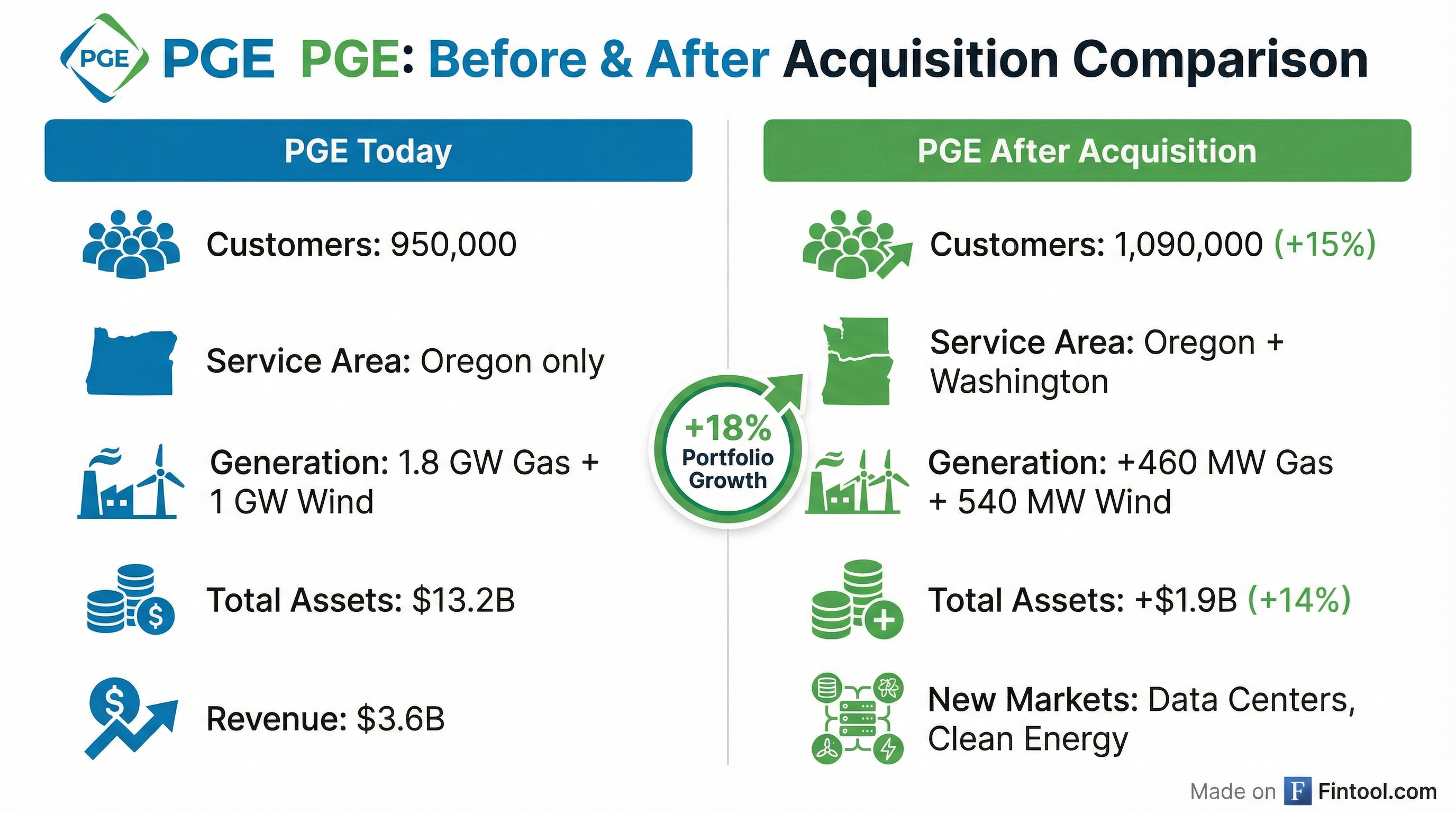
For Portland General Electric, the acquisition represents a transformational expansion:
| Metric | Before | After | Change |
|---|---|---|---|
| Customers | 950,000 | 1,090,000 | +15% |
| Service Territory | Oregon only | Oregon + Washington | 2 states |
| Generation Portfolio | 2.8 GW | +1 GW | +36% |
| Total Assets | $13.2B | +$1.9B | +14% |
PGE guided for EPS accretion in the first full year and reaffirmed its 5%-7% long-term earnings and dividend growth rate. CFO Joe Trpik noted that the acquired Washington rate base of $1.4 billion comes with an allowed ROE of 9.5%.
"We anticipate meaningful customer upside," Pope said. "The increased scale will deliver benefits from shared corporate functions, enhanced purchasing power, and efficient financing for system investments."
PGE Financial Snapshot
| Metric | FY 2023 | FY 2024 | FY 2025 |
|---|---|---|---|
| Revenue ($M) | $2,923 | $3,440 | $3,576 |
| Net Income ($M) | $228 | $313 | $306 |
| Total Assets ($B) | $11.2 | $12.5 | $13.2 |
| Cash from Operations ($M) | $420 | $778 | $1,118 |
The company's operating cash flow has nearly tripled over three years, providing firepower for the acquisition.
Financing Structure
PGE secured $1.9 billion in bridge commitments from Barclays and JP Morgan. The permanent financing plan includes:
- $600 million equity contribution from Manulife
- $700 million secured debt at the Washington utility
- $600 million raised at PGE's proposed holding company
PGE also refreshed its at-the-market equity program, upsizing it to $500 million to support the "diverse and robust" capital expenditure plan.
Regulatory Path
The transaction requires approvals from:
- Washington Utilities and Transportation Commission (net benefit standard, ~11 months)
- Oregon Public Utility Commission (no-harm standard, ~11 months)
- FERC (federal regulatory approval)
Both companies expect closing approximately 12 months after regulatory filings are submitted, targeting mid-2027. Break fees of $35 million are structured for certain failure scenarios.
What to Watch
For Berkshire investors: This sale signals that even Berkshire's vaunted "never sell" philosophy has limits when facing existential litigation risk. PacifiCorp's Oregon wildfire trials could deliver verdict shocks that affect Berkshire Hathaway Energy's earnings for years.
For PGE shareholders: The deal provides regulatory diversification into Washington and meaningful scale. Analysts pressed management on whether this "enhances" the 5%-7% EPS growth guidance—CFO Trpik confirmed the acquisition provides "upward pressure" on earnings growth.
For the utility sector: PacifiCorp's distress sale highlights the industry's growing wildfire liability crisis. Oregon lacks legislation limiting utility wildfire exposure, and this deal demonstrates the capital markets consequences for utilities operating without such protections.
Ask Fintool AI Agent